

The word “adaptogen” is everywhere right now, from trendy coffee alternatives to high-end supplement stacks, yet most people using these products couldn’t explain what actually qualifies something as an adaptogen. That gap between marketing and science is real. Non-toxic plant-derived substances that help the body resist stress and return to balance have been used in traditional medicine for centuries, but the modern wellness industry has stretched the term so far that it’s lost much of its meaning. This guide cuts through the noise and gives you the actual science, the real examples, and a practical framework for using adaptogens wisely.
Table of Contents
- What is an adaptogen? Core definition and history
- How adaptogens work: Science behind stress resilience
- Popular adaptogens and their researched benefits
- Are adaptogens safe and effective? Limitations and cautions
- Bringing adaptogens into your wellness routine
- Discover trusted adaptogen support with NutriBliss
- Frequently asked questions
Key Takeaways
| Point | Details |
|---|---|
| Clear adaptogen definition | Not all stress-supporting herbs are adaptogens—true adaptogens must meet strict scientific criteria. |
| Science and limitations | Adaptogens hold promise but human studies are still limited, so use with realistic expectations. |
| Practical safety tips | Check with your healthcare provider before adding adaptogens, especially if you have medical conditions. |
| Whole-person wellness | Adaptogens can complement but never replace sleep, nutrition, or stress-management basics. |
What is an adaptogen? Core definition and history
The term “adaptogen” was coined in 1947 by Soviet pharmacologist Nikolai Lazarev, who was searching for substances that could help soldiers and workers perform under extreme stress. His student Israel Brekhman later formalized the concept through research on Siberian ginseng. The idea wasn’t new in practice, though. Ayurvedic and Traditional Chinese Medicine had been using plants like ashwagandha and ginseng for thousands of years for exactly this purpose.
What separates a true adaptogen from a general herbal supplement comes down to three specific criteria. According to the adaptogen basics framework, a substance must be non-toxic at normal doses, support the body’s ability to cope with stress nonspecifically, and help normalize physiological functions regardless of the health condition present. All three criteria must be met.
“To qualify as an adaptogen, a substance must be non-toxic at normal doses, support the body’s ability to cope with stress nonspecifically, and help normalize physiological functions irrespective of the pathologic state.” — Merck Manuals
Here’s where the confusion starts. Many herbs marketed as adaptogens are simply calming, energizing, or anti-inflammatory. That doesn’t make them adaptogens. A true adaptogen works bidirectionally, meaning it can calm an overactive stress response or stimulate an underactive one, depending on what your body needs. Understanding adaptogens and stress resilience at this level helps you filter out the hype.
What adaptogens are NOT:
- General stimulants like caffeine
- Sedatives or sleep aids on their own
- Cure-alls for chronic disease
- Interchangeable with any calming herb
How adaptogens work: Science behind stress resilience
Your body handles stress through the HPA axis, which stands for the hypothalamic-pituitary-adrenal axis. When you encounter a stressor, this system triggers the release of cortisol, your primary stress hormone. Short bursts of cortisol are healthy and necessary. Chronic elevation is where the damage happens, affecting sleep, immunity, metabolism, and mood.
Adaptogens interact with the HPA axis to regulate cortisol levels, activate adaptive stress response pathways like PI3K/Akt, and influence molecular targets such as Hsp70, CREB, and neuropeptides. That sounds complex, but the practical effect is straightforward: your stress response becomes more efficient and less reactive over time.
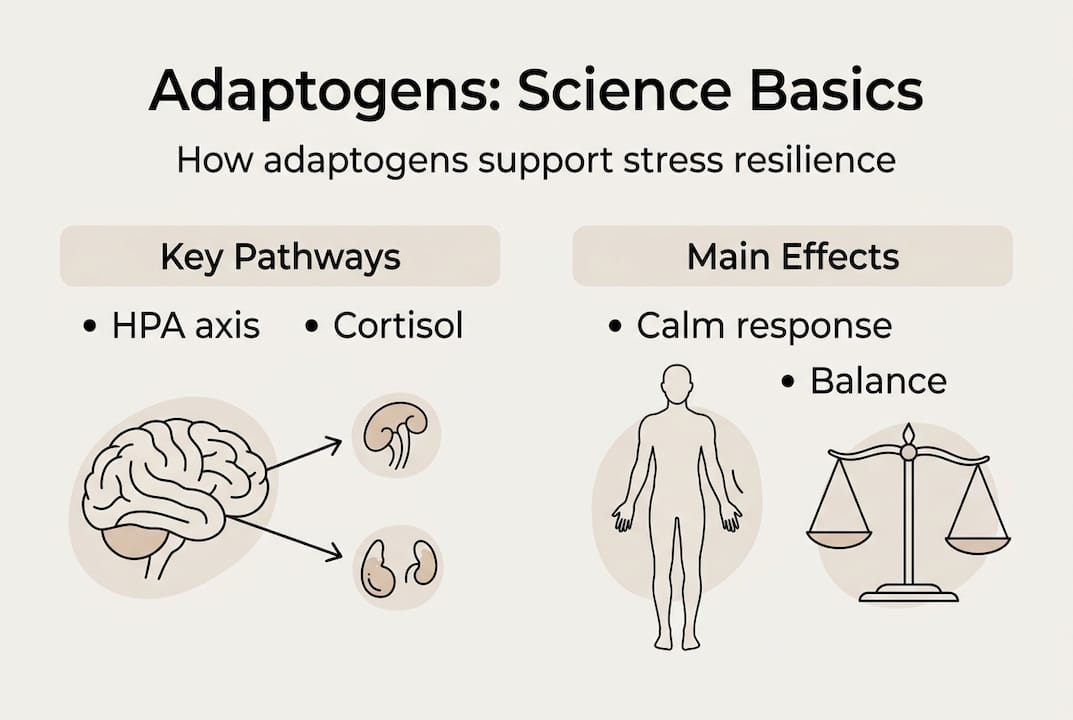
One of the most useful concepts here is the idea of eustress versus distress. Eustress is the beneficial, growth-promoting kind of stress, like what you experience during exercise. Adaptogens act as mild eustressors, triggering beneficial adaptive responses similar to exercise and extending your resistance to stress-induced fatigue without pushing you into exhaustion.
Adaptogens vs. other stress solutions
| Approach | Mechanism | Duration of effect | Side effect risk |
|---|---|---|---|
| Adaptogens | HPA axis modulation | Long-term with consistent use | Low at normal doses |
| Prescription anxiolytics | GABA receptor activity | Short-term, fast-acting | Moderate to high |
| Caffeine | Adenosine receptor blocking | Short-term | Moderate (dependency) |
| Meditation | Nervous system regulation | Long-term with practice | None |
| Exercise | Cortisol regulation, endorphins | Long-term | Very low |
Pro Tip: Adaptogens work best when used consistently over weeks, not as a one-time fix. Think of them like exercise for your stress response system. Pairing them with science-backed wellness strategies amplifies the results.
Popular adaptogens and their researched benefits
Not all adaptogens are created equal, and the research behind each one varies significantly. Common adaptogens include ashwagandha, Panax ginseng, American ginseng, rhodiola, eleuthero, reishi, schisandra, and holy basil (also called tulsi). Each has a distinct profile of benefits and a different body of evidence supporting it.
| Adaptogen | Key researched benefits | Typical use |
|---|---|---|
| Ashwagandha | Cortisol reduction, sleep quality, anxiety relief | Daily capsule or powder |
| Panax ginseng | Cognitive performance, energy, immune support | Morning supplement |
| Rhodiola rosea | Mental fatigue, endurance, mood | Pre-work or pre-exercise |
| Eleuthero | Stamina, immune function, recovery | Athletic performance |
| Reishi mushroom | Immune modulation, sleep, stress | Evening tea or capsule |
| Schisandra | Liver support, mental clarity, endurance | Daily tonic |
| Holy basil (tulsi) | Anxiety, blood sugar balance, inflammation | Tea or capsule |
Ashwagandha is currently the most studied adaptogen for stress and anxiety, with multiple randomized controlled trials showing meaningful reductions in cortisol and perceived stress. If you want a deeper look, the ashwagandha gummies benefits guide covers the research in detail. Rhodiola has strong evidence for mental fatigue and is popular among people with demanding cognitive workloads.

Rhodiola and eleuthero are particularly well-studied for athletic and physical performance contexts. For a broader view of how plants fit into a performance-focused lifestyle, the herbal supplements and fitness resource is worth exploring. Reishi and schisandra have solid traditional use but less robust clinical trial data compared to ashwagandha or rhodiola.
A few important caveats:
- Individual responses vary significantly based on genetics, gut microbiome, and baseline stress levels
- Most studies use standardized extracts, not raw powders, so product form matters
- Evidence strength differs widely across adaptogens, so don’t treat them as a uniform category
- Understanding herbal supplement uses broadly helps you contextualize where adaptogens fit
Are adaptogens safe and effective? Limitations and cautions
Here’s the honest picture: the science is promising but not complete. Clinical trials are often small, low-quality, and highly variable in methodology. Human evidence is limited compared to preclinical (animal and cell) studies, and supplements remain largely unregulated, which creates real risks around dose accuracy and ingredient quality.
That doesn’t mean adaptogens are ineffective. It means you should approach them with informed expectations rather than miracle-cure thinking. The evidence for ashwagandha and rhodiola in particular is strong enough to justify use in healthy adults managing everyday stress. But the broader category needs more rigorous research.
“Clinical trials are often small, low-quality, with high heterogeneity; human evidence is limited compared to preclinical; supplements are unregulated, risking variability in dose and quality.” — Frontiers in Pharmacology
Who should avoid adaptogens or consult a doctor first:
- Pregnant or breastfeeding individuals (safety data is insufficient)
- People with autoimmune conditions like lupus or rheumatoid arthritis
- Those with thyroid disorders, since some adaptogens affect thyroid hormone levels
- Anyone taking blood thinners, antidepressants, or immunosuppressants
- People with a history of hormone-sensitive conditions
Rare but real risks include liver toxicity with certain products, particularly when combined with other supplements or medications. This is rare, but it reinforces why product quality and transparency matter. Always check for third-party testing certifications on any supplement you buy.
Pro Tip: Before adding any adaptogen to your stack, review your current supplements for potential interactions. A well-structured supplement schedule for wellness and guidance on safe supplement combinations can help you avoid overlap and maximize benefit. When in doubt, check with a healthcare provider who understands integrative medicine.
For a balanced overview of adaptogen safety advice, the Merck Manuals resource is one of the most reliable non-commercial references available.
Bringing adaptogens into your wellness routine
Knowing the science is one thing. Putting it into practice is another. The key is starting intentionally rather than just adding a new supplement to an already chaotic routine. Experts consistently caution against over-reliance on supplements when lifestyle fundamentals aren’t in place. Adaptogens support a healthy system; they don’t fix an unhealthy one.
A stepwise approach to adding adaptogens:
- Audit your current stress load and identify your primary concern (fatigue, anxiety, sleep, focus)
- Choose one adaptogen with evidence matching your goal, starting with ashwagandha or rhodiola
- Use a standardized extract at the clinically studied dose for at least 4 to 6 weeks before evaluating
- Track your response using a simple daily journal: energy, mood, sleep quality, and stress perception
- Adjust based on results, and only add a second adaptogen after establishing a clear baseline
- Keep your lifestyle fundamentals strong: 7 to 9 hours of sleep, regular movement, whole food nutrition, and stress management practices
- Consult a healthcare provider if you have any underlying conditions or take prescription medications
Pro Tip: The most common mistake people make with adaptogens is expecting fast results. These are not stimulants. The benefits build gradually over weeks of consistent use. A structured daily wellness guide can help you build the habits that make adaptogens most effective.
Balance is the real goal. Adaptogens are one tool in a larger toolkit that includes sleep, nutrition, movement, and mental health practices. Used in that context, they can genuinely move the needle on how you handle stress.
Discover trusted adaptogen support with NutriBliss
If you’ve made it this far, you now have a clearer picture of what adaptogens actually are, how they work, and how to use them responsibly. The next step is finding products that match the quality standards the science demands.
At NutriBliss, we take the guesswork out of supplement selection by focusing on transparency, research-backed formulations, and quality you can verify. We believe in the science behind superfoods and apply that same standard to every adaptogen product we carry. Whether you’re new to adaptogens or looking to refine your current stack, you can explore adaptogen supplements across our full catalog and find options that align with your specific wellness goals. Quality matters more than convenience when it comes to what you put in your body.
Frequently asked questions
What makes a supplement an adaptogen?
A supplement qualifies as an adaptogen only if it meets three criteria: it must be non-toxic at normal doses, help the body resist stress non-specifically, and normalize physiological function regardless of the condition present. Most herbs marketed as adaptogens don’t fully meet all three.
Are adaptogens safe for everyone?
No. People who are pregnant, have thyroid or autoimmune disorders, or take medications like blood thinners or antidepressants face specific risks with adaptogens and should consult a doctor before use. Rare cases of liver toxicity have also been reported.
Can adaptogens replace stress management techniques like sleep or exercise?
No. Adaptogens may support your stress resilience, but they cannot substitute for sleep, balanced nutrition, or regular movement. Experts prioritize lifestyle over supplements as the foundation of any stress management plan.
How do adaptogens actually work in the body?
Adaptogens interact with the HPA axis to help regulate cortisol and activate adaptive stress response pathways. Over time, this makes your body’s stress response more efficient and less prone to chronic activation.