

Yes, in some adults, especially when you pair it with regular exercise and stick with it for at least 12 weeks. A 2024 meta-analysis of 21 randomized controlled trials found that whey protein combined with exercise lowered LDL cholesterol by an average of 5.38 mg/dL, with total cholesterol dropping even further. The effect isn’t universal, and it isn’t dramatic on its own.
- LDL drops with exercise added. Whey plus training reduced LDL by roughly 5.38 mg/dL and total cholesterol by 8.58 mg/dL in pooled trial data.
- Triglycerides respond to duration, not speed. Studies running 12 weeks or longer showed modest triglyceride reductions; shorter trials rarely showed much of anything.
- HDL barely moves. Across most pooled analyses, whey’s effect on “good” cholesterol is inconsistent at best.
The catch: your age, starting weight, dose, and whether you exercise all shape whether you’ll see any of this. A 25 year old lifting weights three times a week and a sedentary 65 year old taking the same scoop of powder are not going to get the same result.
Key Takeaways
Whey protein lowers LDL and total cholesterol modestly, but mainly in people who exercise regularly and use it for 12 weeks or longer.
| Point | Details |
|---|---|
| Exercise is the multiplier | LDL reductions of 5.38 mg/dL only showed up clearly when whey was paired with regular training. |
| Duration matters more than speed | Triglyceride benefits appeared after 12 weeks or more; shorter trials showed little effect. |
| Dose signals point above 40g | Subgroup data suggests daily intake above 35 to 40 grams is linked to stronger LDL and total cholesterol drops. |
| Not everyone responds equally | Overweight adults and people under 50 show the clearest benefits; evidence is weaker for older adults. |
| Nutribliss supports the full routine | Nutribliss offers protein and recovery-focused supplements meant to complement, not replace, exercise and clinical guidance. |
Table of Contents
- Whey Protein Lower Cholesterol: What the Clinical Trials Actually Show
- How Whey Protein Might Affect Cholesterol Levels
- Who Sees the Biggest Cholesterol Benefit From Whey?
- How to Use Whey Protein for Cholesterol Support
- Whey Protein vs. Plant Protein for Lowering Cholesterol
- Safety, Side Effects, and When to Talk to a Doctor
- Sources
Whey Protein Lower Cholesterol: What the Clinical Trials Actually Show
The most rigorous data point comes from a 2024 systematic review pooling 21 randomized controlled trials on whey protein and cardiometabolic markers. When researchers isolated trials that combined whey with an exercise program, LDL fell by a mean difference of −5.38 mg/dL (95% CI: −8.87 to −1.88). Total cholesterol dropped even more in that same subgroup, by about 8.58 mg/dL.
The headline number: Whey plus exercise lowered LDL by 5.38 mg/dL on average across 21 trials, a modest but real reduction, not a substitute for statins or a strict diet overhaul.
Triglycerides told a similar story, but the trigger there was time, not exercise. Interventions lasting 12 weeks or more showed triglyceride reductions of roughly 6.61 mg/dL. Shorter studies, in the 4 to 8 week range, generally didn’t move the needle much at all. That’s a pattern worth remembering: whey’s cardiometabolic benefits show up slowly, and researchers who cut their trials short tend to report null results.
HDL cholesterol is the outlier. Across most pooled data, whey’s impact on HDL is small, inconsistent, or absent altogether. One separate meta-analysis of 20 studies found triglyceride and HDL improvements but no significant change in total cholesterol or LDL overall, then noted that subgroups taking more than 40 grams a day did see LDL and total cholesterol reductions. That dose-dependent signal shows up again and again in the literature, even when the topline pooled result looks unimpressive.
| Lipid Marker | Direction/Magnitude | Typical Confidence Interval |
|---|---|---|
| LDL cholesterol | Down ~5.38 mg/dL (with exercise) | 95% CI: −8.87 to −1.88 |
| Total cholesterol | Down ~8.58 mg/dL (whey + exercise) | Reported as statistically significant |
| Triglycerides | Down ~6.61 mg/dL (≥12 weeks) | Reported as statistically significant |
| HDL cholesterol | Little to no consistent change | Wide, often non-significant intervals |

A separate 12-week trial of whey isolate in overweight and obese adults backs this up: total cholesterol and LDL each fell by about 7% compared to baseline, an effect size consistent with the pooled meta-analytic data even though it came from a single randomized trial.
None of this evidence is bulletproof. A few limitations show up across nearly every trial in this space:
- Sample sizes tend to run small, often under 100 participants per arm.
- Control groups vary widely, some use casein, others use maltodextrin or no supplement at all, making direct comparisons messy.
- Diet isn’t always controlled for, so a participant quietly cutting fast food during the trial can skew results in whey’s favor.
- Heterogeneity between studies is high enough that researchers flag it as a limiting factor in nearly every systematic review on the topic.
How Whey Protein Might Affect Cholesterol Levels
Nobody fully understands the mechanism, but a handful of plausible pathways show up consistently in the research.
- Hepatic cholesterol synthesis. Some evidence suggests whey peptides may modestly influence how the liver regulates cholesterol production, though this pathway is less established than the others.
- Bioactive peptides affecting bile acid excretion. Certain whey-derived peptides appear to interact with bile acid metabolism, which could increase cholesterol excretion rather than reabsorption.
- Improved insulin sensitivity. Whey’s amino acid profile, particularly its leucine content, appears to support better insulin signaling, which indirectly improves how the body handles triglycerides.
- Changes in LDL particle size and quality. This is the most interesting finding in the whole body of research: one trial found LDL fell by 7% without any change in ApoB, the protein marker tied to LDL particle number.
Exercise seems to amplify all of this. Resistance training increases muscle protein synthesis and improves how muscle tissue clears glucose and fat from the bloodstream. Layer whey’s amino acids on top of that, and you get a bigger metabolic response than either intervention produces alone, which is likely why nearly every meaningful lipid improvement in the 2024 meta-analysis showed up specifically in the whey-plus-exercise subgroup.
Pro Tip: A drop in LDL without a corresponding drop in ApoB isn’t a red flag; it can actually mean your body is producing larger, more buoyant LDL particles instead of the small, dense kind associated with arterial plaque. Particle quality matters as much as the raw LDL number on your lab report.
Who Sees the Biggest Cholesterol Benefit From Whey?
The evidence points to a fairly specific group of people who benefit most, and a much larger group where the science is thin or absent.
People most likely to see results:
- Overweight or obese adults, where baseline lipid abnormalities give more room for improvement
- Adults under age 50, where subgroup data shows the clearest effect sizes
- Anyone combining whey with a consistent resistance or aerobic exercise program
- People sticking with it for 12 weeks or longer, not just a few weeks
People where the evidence is weak or missing:
- Adults 50 and older, where broad LDL improvements haven’t held up as consistently in pooled data
- Anyone relying on whey alone, with no exercise and no dietary substitution, to manage advanced dyslipidemia
- Short-term users testing it for under 12 weeks, since most of the measurable benefit takes time to appear
Context matters just as much as demographics. If you’re already on a statin, whey isn’t going to replace it, and a 5 mg/dL LDL reduction that looks meaningful in a population-level study can feel almost invisible on an individual lab report. Anyone managing existing heart disease or taking lipid medication should treat whey as a supporting habit, not a treatment plan, and loop in a clinician before making changes.
How to Use Whey Protein for Cholesterol Support
If you want to give whey protein a fair shot at improving your lipid numbers, the details of how you use it matter more than which brand you buy.
Dose and duration: Trial data shows the clearest signals at doses above 35 to 40 grams a day, sustained for at least 12 weeks. Lower doses or shorter windows tend to produce weaker or null results, though study designs vary enough that this isn’t an exact threshold.
Timing: Some trials use whey as a preload before meals, essentially drinking it 15 to 30 minutes before eating, to blunt post-meal glucose and lipid spikes. Others use it post-workout for muscle recovery. Both approaches show benefits in different studies; neither is clearly superior for cholesterol specifically. Our guide to whey timing and dosage breaks down both strategies in more depth.
What to replace, not just add: The biggest overlooked detail in most of this research is substitution. Using whey to replace higher-saturated-fat animal protein, like swapping a fatty cut of beef for a shake, appears to matter more than simply adding whey calories on top of an unchanged diet.
Monitoring checklist:
- Get baseline lipid panel before starting
- Recheck cholesterol and triglycerides around the 12-week mark
- Track body weight and exercise consistency alongside lab values
- Adjust expectations if you’re not also training regularly
Pro Tip: Pairing whey with resistance training two to three times a week appears to be the single biggest lever in the research for turning a modest supplement into a meaningful metabolic habit. For more on why that pairing works, see our breakdown of whey’s role in a fitness routine.
Whey Protein vs. Plant Protein for Lowering Cholesterol
Soy and other plant proteins have their own, separately documented track record for cholesterol, and the mechanism differs from whey’s.
| Comparison Point | Whey Protein | Soy/Plant Protein |
|---|---|---|
| Effect on LDL-C | Down ~5.38 mg/dL with exercise | Down ~3 to 4%, roughly 4-5 mg/dL |
| Dose associated with effect | >35-40 g/day, ≥12 weeks | ~25 g/day |
| Population most likely to benefit | Overweight/obese, under 50, exercisers | General adult population, especially those replacing animal protein |
| Evidence strength | Meta-analysis of 21 RCTs | Meta-analysis of 46 trials |
| Practical considerations | May cause GI upset in lactose-intolerant users; better taste for many | Lower allergen risk; some find taste or texture less appealing |
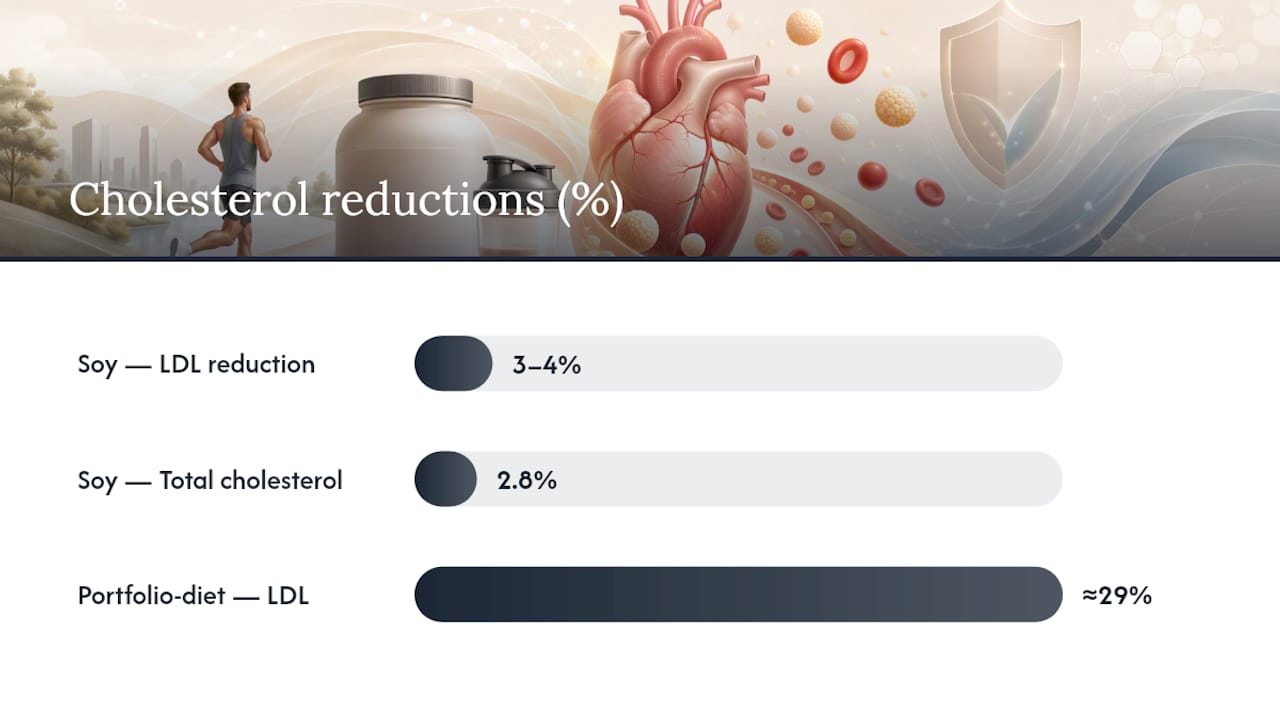
A meta-analysis of 46 trials found soy protein at a median dose near 25 grams a day lowered LDL by about 3 to 4% and total cholesterol by roughly 2.8%. Much of that benefit likely comes from substitution: swapping soy for saturated-fat-heavy animal protein reduces overall saturated fat intake, which independently lowers LDL. Combine soy with other cholesterol-fighting foods like viscous fiber, plant sterols, and nuts, and the additive effect can approach 29% LDL reduction in controlled portfolio-diet trials, a scale whey alone doesn’t come close to matching.
So which one should you actually reach for? If your goal is muscle building or recovery alongside a modest lipid benefit, whey’s exercise synergy makes it the more practical pick. If cholesterol is your primary concern and you’re not training regularly, plant protein paired with a broader dietary shift, the kind described in our plant-based protein powder guide, may deliver more consistent results. Readers curious about swapping red meat for plant-based alternatives can find practical substitutions in this guide to alternative protein foods.
Safety, Side Effects, and When to Talk to a Doctor
Whey protein is generally well tolerated, but it isn’t risk-free for everyone.
- Common side effects: bloating, gas, and stomach cramps, especially in people with lactose intolerance who choose whey concentrate over isolate
- Allergy risk: milk protein allergy is a real concern, distinct from lactose intolerance, and can trigger more serious reactions
- Kidney concerns: people with preexisting, severe kidney disease should be cautious with high protein intake generally, since damaged kidneys have a harder time clearing protein metabolic byproducts
- Drug interactions: direct interactions between whey and lipid-lowering medications are unlikely, but clinicians managing patients with reduced kidney function should factor in total daily protein load
Stop and check with a clinician if you notice new, unexplained symptoms, have a known kidney condition, or are pregnant or planning to become pregnant. For a deeper rundown, our guide to whey protein side effects covers dosing thresholds and who should be more cautious.
A Note From Nutribliss on Evidence-Backed Supplementation
We built Nutribliss around the idea that supplements should earn their place with real research, not marketing copy, and the whey-cholesterol data is a good example of why that nuance matters: it helps some people, under specific conditions, not everyone, always. #nutribliss If you’re considering adding whey to a heart-health routine, talk to your healthcare provider first, especially if you’re managing existing cholesterol issues or taking medication.
Building a Heart-Healthy Supplement Routine
Whey protein works best as one piece of a broader routine, not a standalone fix, and that’s exactly how Nutribliss approaches supplementation. If you’re already tracking cardiovascular health, pairing your protein strategy with proper hydration and electrolyte balance supports the exercise consistency that the research keeps pointing to as the real driver of lipid improvements. Our electrolytes supplement is worth a look if you’re training regularly and want to support recovery alongside your protein intake. As always, pair any supplement routine with a balanced diet, consistent exercise, and guidance from your doctor, particularly if you’re managing cholesterol or other cardiovascular risk factors. Check out the full product lineup at Nutribliss to see what fits your routine.
Sources
- The effects of whey protein supplementation on indices of cardiometabolic health: A systematic review and meta-analysis of randomized controlled trials
- Effects of whey protein isolate on body composition, lipids, insulin and glucose in overweight and obese individuals