

TL;DR:
- Whey protein is a complete protein with all nine essential amino acids, excelling in muscle repair and growth. It exists in concentrate, isolate, and hydrolysate forms, each suited to different goals and budgets. When used correctly post-workout and within a balanced diet, whey supports muscle development, weight management, and immune health effectively.
If you’ve ever stood in a supplement aisle trying to figure out why whey protein gets all the attention, you’re not alone. Whey protein sits at the center of nutrition science, athletic performance, and everyday health goals. But most of the information out there is either too technical or too vague to be useful. This article cuts through that. You’ll learn exactly what whey protein is, what it does inside your body, which type fits your goals, and how to use it in a way that actually moves the needle.
Table of Contents
- Key takeaways
- Why whey protein is the gold standard of supplements
- What whey protein does for your body
- How and when to use whey protein effectively
- Whey vs. plant proteins: making the right call
- My honest take after years in the supplement space
- Power your goals with Nutribliss
- FAQ
Key takeaways
| Point | Details |
|---|---|
| Whey protein is a complete protein | It contains all nine essential amino acids, making it one of the most effective proteins for muscle repair and growth. |
| Three distinct types exist | Concentrate, isolate, and hydrolysate differ in protein content, processing, and digestibility. |
| Timing and dose matter | Taking 20 to 30 grams within two hours post-workout maximizes muscle protein synthesis benefits. |
| Label reading is non-negotiable | Some powders contain up to 23 grams of added sugar per scoop, which can undermine your health goals entirely. |
| Whey outperforms most plant proteins | Higher leucine content and faster absorption give whey a measurable edge for muscle-building outcomes. |
Why whey protein is the gold standard of supplements
Whey protein is a dairy-derived protein separated from milk during the cheese-making process. When milk curdles, it splits into curds and a liquid byproduct. That liquid is whey. After filtering and drying, it becomes the powder you mix into your shakes. What makes it stand out nutritionally is its amino acid profile. Whey is a complete protein with all nine essential amino acids, with a branched-chain amino acid ratio of 2:1:1 for leucine, isoleucine, and valine.
Leucine is the amino acid that matters most for muscle building. It acts as the molecular trigger that activates the mTOR pathway, which signals your body to start building new muscle tissue. No other protein delivers leucine quite as efficiently as whey.
The three types of whey protein explained
Understanding the types of whey protein helps you choose the right one for your budget and goals.
Whey Protein Concentrate (WPC) is the least processed form. It typically contains 70 to 80 percent protein by weight, with small amounts of lactose and fat remaining. It’s the most affordable option and retains many bioactive compounds like immunoglobulins and lactoferrin. If you’re not lactose sensitive, this is a solid everyday choice.
Whey Protein Isolate (WPI) goes through additional filtration. WPI contains 90% or more protein by dry weight, with almost all lactose removed. It absorbs faster and delivers a more concentrated dose of amino acids. Studies show it stimulates mTORC1 and insulin to produce significant anabolic effects at doses of 20 to 30 grams.
Whey Protein Hydrolysate (WPH) is pre-digested, meaning the protein chains are broken into shorter peptides. It absorbs the fastest of all three. It’s used in medical nutrition and by athletes who want maximum absorption speed. It tends to taste bitter and carries a premium price tag.
Here’s a quick comparison of the three:
| Type | Protein Content | Lactose | Best For |
|---|---|---|---|
| Concentrate | 70–80% | Moderate | Budget-friendly daily use |
| Isolate | 90%+ | Very low | Lactose sensitivity, lean goals |
| Hydrolysate | 90%+ | Very low | Maximum speed, clinical use |
For protein quality measurement, whey scores near perfect on both PDCAAS and DIAAS scales. These scoring systems assess how well a protein provides the amino acids your body actually uses. Whey consistently ranks at the top alongside egg white protein. You can explore complete protein sources to see how whey stacks up against other high-quality options.
What whey protein does for your body
This is where the science gets compelling. Whey doesn’t just help you build muscle. The research in 2026 shows a broader range of benefits that extend to weight management, aging, immune function, and metabolic health.
Muscle growth and recovery
Whey protein’s most documented benefit is supporting muscle protein synthesis after resistance training. The leucine content triggers mTOR signaling more effectively than any plant-based alternative. Post-workout, your muscles are primed to absorb amino acids. Whey delivers them fast and in the right ratios.

For older adults, the benefit compounds. A meta-analysis of nearly 21,000 participants found that combining whey protein with resistance training produced the greatest improvements in muscle mass and strength for aging populations. Sarcopenia, which is the gradual loss of muscle with age, is one of the biggest threats to long-term health and independence. Whey paired with consistent training is currently the most evidence-backed strategy to counter it.
Weight management and metabolic benefits
Protein is the most satiating macronutrient. Whey specifically has been shown to reduce appetite hormones and increase the hormones that signal fullness. When you’re in a caloric deficit, adequate protein at 0.8 g/kg/day helps preserve lean muscle mass while your body burns fat. Research suggests targeting closer to 1.5 g/kg/day for active individuals under energy restriction.
Whey also has measurable effects on blood sugar regulation. The bioactive peptides in whey slow gastric emptying and stimulate insulin release in a way that lowers post-meal blood glucose spikes. For people managing pre-diabetes or metabolic syndrome, this is a meaningful added benefit.
Antioxidant support and immune health
Here’s something most fitness articles skip: whey protein peptides enhance glutathione synthesis, boosting your body’s primary antioxidant defense system. Glutathione protects cells from oxidative damage caused by training stress, pollution, and normal metabolic activity. It’s not a flashy benefit, but it matters for long-term cellular health.
Key benefits at a glance:
- Accelerates post-exercise muscle repair
- Preserves lean muscle during weight loss
- Reduces muscle loss from aging
- Improves satiety and reduces caloric intake
- Supports blood sugar regulation
- Strengthens antioxidant and immune defenses
Pro Tip: If you’re using whey for weight loss, choose a protein isolate with minimal additives and take it before meals rather than just post-workout. The satiety effect works best when amino acids are circulating before you eat.
How and when to use whey protein effectively
Knowing what whey protein does is only half the equation. Knowing how to use it correctly is what separates people who see results from those who don’t.
-
Set your daily protein target first. For muscle building, aim for 1.6 to 2.2 grams of protein per kilogram of bodyweight per day. Whey should supplement your food, not replace it. Get as much protein as possible from whole food sources like eggs, chicken, Greek yogurt, and fish.
-
Time your intake around training. The anabolic window is real, though not as narrow as people once thought. Taking 20 to 30 grams within one to two hours after your workout maximizes muscle protein synthesis. A morning shake also works well for people who train fasted.
-
Adjust dose for your age and goals. Older adults often need more protein to trigger the same muscle-building response as younger people. A dose of 30 to 40 grams may be more effective after age 55 due to what researchers call “anabolic resistance.”
-
Watch for side effects. Gastrointestinal side effects occur in 5 to 30 percent of users, mostly from lactose in concentrate products. Switching to isolate or hydrolysate usually resolves this. People with chronic kidney disease should speak with their doctor before adding any high-protein supplement.
-
Read labels like a hawk. Some powders contain up to 23 grams of added sugar per scoop. The American Heart Association caps daily added sugar at 24 grams for women and 36 grams for men. One poorly chosen protein shake could nearly max that out before breakfast.
-
Store your protein properly. Standard bags often seal poorly, and humidity causes clumping and off-flavors. Transfer your powder to an airtight container, keep it away from heat and moisture, and rotate flavors every month to prevent palatability fatigue.
Pro Tip: If you find protein powders taste metallic or flat after a few weeks, it’s likely oxidation or humidity damage. Storing your tub in the pantry instead of near the stove or dishwasher makes a noticeable difference in taste and texture.
You can also find detailed usage guidance in this protein powder usage guide that covers hidden ingredients and practical supplement strategies.
Whey vs. plant proteins: making the right call
70% of adults are actively trying to increase protein intake, and 40 percent of households now buy protein supplements regularly. With that kind of demand, the market has exploded with alternatives. Plant-based proteins from pea, rice, hemp, and soy have improved dramatically. But there are real nutritional differences worth understanding.
| Factor | Whey Protein | Plant-Based Protein |
|---|---|---|
| Amino acid profile | Complete, high leucine | Often incomplete (except soy) |
| Absorption speed | Fast | Slower (most types) |
| Digestibility (DIAAS) | Near perfect | Moderate to good |
| Lactose content | Yes (trace to none in WPI) | None |
| Environmental impact | Moderate | Generally lower |
| Muscle-building evidence | Extensive | Growing but thinner |
Whey protein’s leucine advantage is significant. Pea protein, currently the best-performing plant option, contains roughly 60 percent less leucine per gram than whey. You can close the gap by taking a larger dose, but that adds cost and calories.
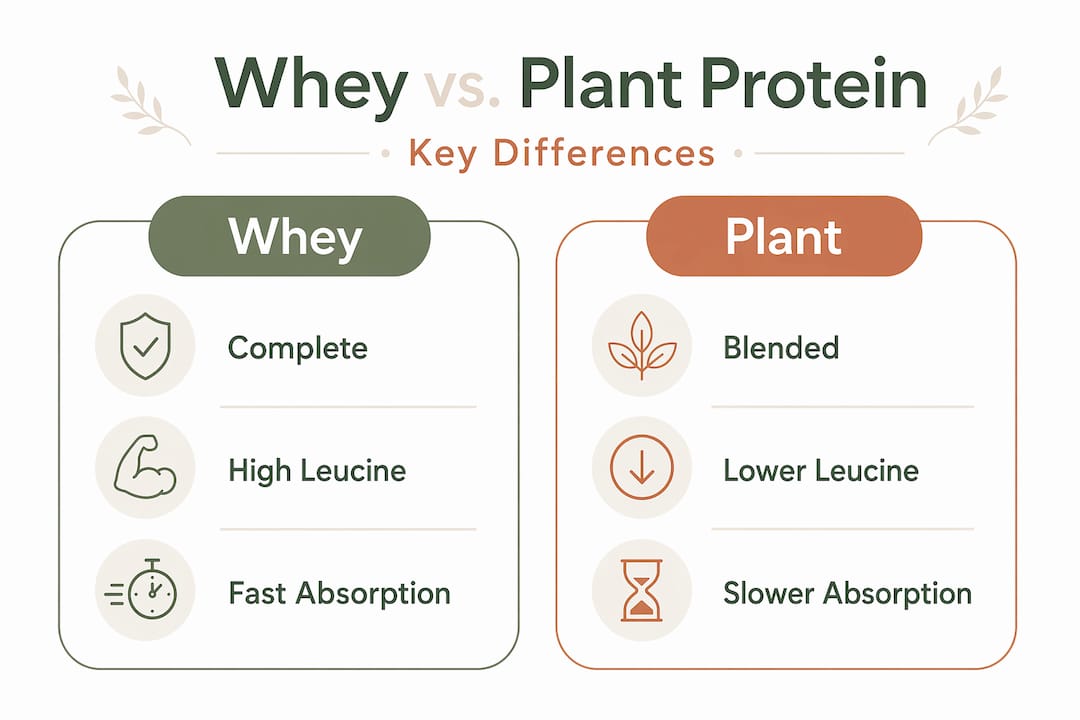
If you’re vegan, lactose intolerant, or simply prefer plant-based eating, a well-formulated blend of pea and rice protein can deliver comparable results. But for anyone without those dietary restrictions, whey still holds the edge in both research depth and practical effectiveness. Learn more about what makes whey work in this deeper look at the power of whey.
My honest take after years in the supplement space
I’ve seen a lot of trends come and go, and whey protein has outlasted all of them. In my experience, the people who dismiss it tend to fall into two camps: those who tried a cheap, overly sweetened product and had a bad experience, and those who got swept up in the plant-protein marketing wave without looking at the actual data.
What I’ve learned is that quality matters enormously. I’ve gone through enough protein powders to know that the difference between a budget tub of concentrate loaded with artificial sweeteners and a clean whey isolate is not just a matter of taste. It’s reflected in how you feel, how your digestion responds, and over time, how your body composition changes.
The fear that whey damages your kidneys? Overstated for healthy individuals. The idea that it “bulks you up” without training? Simply not how protein works. What I genuinely believe is that most people under-consume protein and over-rely on the supplement to compensate for poor overall nutrition. Whey works best when your diet is already reasonably solid. It’s a tool, not a fix.
My advice is to start with a high-quality isolate, keep your total diet protein-forward with real foods, and track how your body responds for four to six weeks before judging results. The #nutribliss approach of pairing science-backed supplements with honest nutritional habits is exactly right. Supplements fill gaps. They don’t replace foundations.
— GAURAV
Power your goals with Nutribliss

If this article got you thinking about upgrading your protein strategy, Nutribliss has done the hard work of sourcing and formulating supplements that actually hold up to scrutiny. The Nutribliss Whey Isolate is built for people who want clean, high-protein fuel without unnecessary fillers or excess sugar. Every product in the Nutribliss lineup is grounded in real science, not marketing trends. Browse the full supplement collection to find the right stack for your goals, and check out the science behind the products if you want to understand exactly what you’re putting in your body.
FAQ
What is whey protein made of?
Whey protein is made from the liquid byproduct of cheese production. It is filtered, concentrated, and dried into powder form that contains a full spectrum of essential amino acids.
What does whey protein do for your body?
Whey protein supports muscle growth, speeds up post-exercise recovery, helps manage body weight by increasing satiety, and contributes to antioxidant defense through glutathione production.
How and when should you take whey protein?
Take 20 to 30 grams within one to two hours after resistance training for the best muscle-building effect. Older adults may benefit from doses closer to 30 to 40 grams due to reduced anabolic sensitivity.
Is whey protein safe for the kidneys?
There is no evidence that whey protein harms kidneys in healthy individuals. However, people with chronic kidney disease should limit protein intake and consult a doctor before supplementing.
What is the difference between whey concentrate and isolate?
Concentrate contains 70 to 80 percent protein with some lactose and fat. Isolate contains 90 percent or more protein with nearly all lactose removed, making it better for those with lactose sensitivity or lean physique goals.