

TL;DR:
- Most people mistakenly treat nutrition label serving sizes as dietary recommendations, which hampers progress. Serving size is a standardized measurement used to calculate nutrient values, not the amount you should eat. Accurately distinguishing between serving size and portion size enables precise macro tracking and enhances performance nutrition efforts.
Most people glance at a nutrition label and assume the serving size tells them how much they should eat. That assumption is wrong, and it costs athletes and health-focused individuals real progress. According to the FDA, a serving size is simply the amount of food shown on the Nutrition Facts label, expressed in familiar household units and metric, based on what people typically eat or drink in one sitting. It is not a dietary recommendation. Understanding this single distinction can reshape how you track macros, dose your supplements, and hit your performance targets.
Table of Contents
- Defining serving size: What it really means
- Types of serving size measurements and why they vary
- Serving size vs. portion size: Why it matters for active lifestyles
- How to use serving size for nutrition tracking and supplement optimization
- Maximizing clarity: Label tips and common serving size mistakes
- Our perspective: Why serving size matters more than most people realize
- Empower your nutrition journey with NutriBliss
- Frequently asked questions
Key Takeaways
| Point | Details |
|---|---|
| Serving size is a benchmark | Serving size on labels shows typical consumption, not a dietary rule. |
| Portion size is personal | Portion size reflects your actual intake and may differ from serving size. |
| Multiply nutrients by servings | Multiply nutrient values by your actual servings to track total intake. |
| Read labels carefully | Check both serving size and servings per container to avoid hidden overconsumption. |
| Using serving size boosts results | Treating serving size as your base unit supports better nutrition and supplement tracking. |
Defining serving size: What it really means
Serving size is a standardized measurement the FDA requires on every packaged food and supplement label. It tells you the amount used to calculate all the nutrient values listed on the label, including calories, protein, fat, carbohydrates, and micronutrients. This number is not a doctor’s advice or a dietary guideline. It is a reference point rooted in data about how Americans actually eat.
The FDA bases serving sizes on food consumption surveys that track real eating habits across the population. If most people pour about one cup of cereal at breakfast, the label reflects one cup as the serving size. The goal is consistency so you can compare products side by side without confusion.
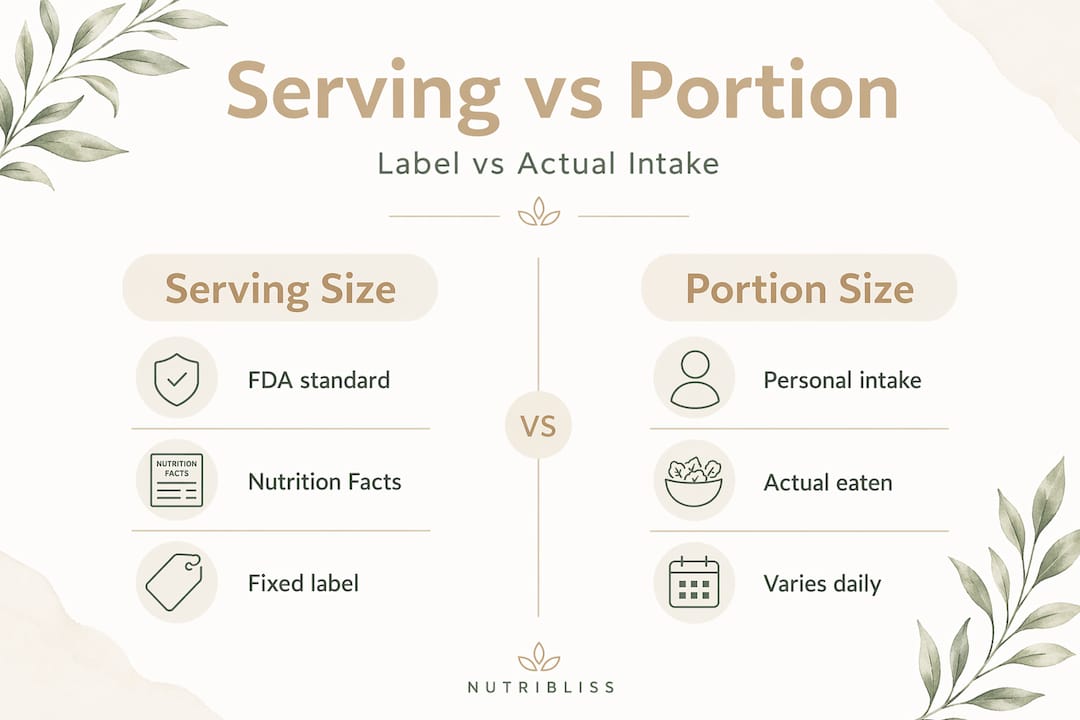
Here is where people go wrong. Many fitness enthusiasts treat the serving size as a ceiling or a goal. It is neither. As the NIDDK clarifies, portion size is how much you choose to eat at one time, while serving size is the labeled benchmark used for the Nutrition Facts calculations. These two numbers are almost never identical for most people, especially athletes who eat far above average amounts to fuel training.
Key distinctions to keep in mind:
- Serving size: The standard unit on the label, calculated from typical consumption data
- Portion size: The actual amount you put in your bowl, shaker, or plate
- Recommended intake: A guideline from a health organization or dietitian, completely separate from both
- Servings per container: How many serving-size units exist in the full package
Understanding macronutrient basics is far easier once you anchor your calculations to a clear, fixed serving size rather than guessing at your portion.
“Portion is how much you choose to eat at one time, while serving size is the labeled benchmark used for the Nutrition Facts calculations.” — NIDDK, Just Enough for You
Types of serving size measurements and why they vary
With a clear definition in mind, it is important to understand how serving sizes appear across different product categories. The unit of measurement changes based on the food or supplement type, which can make labels feel inconsistent at first glance. Once you know the pattern, reading labels becomes second nature.
Serving sizes differ by product and form, whether that is cups, pieces, or ounces, which means your actual intake may be more or less than the labeled amount depending on how much you eat. A liquid protein supplement might list its serving in fluid ounces or milliliters, while a solid protein bar lists it in grams or pieces. Both formats are valid. Both follow the same core rule: household units come first, metric units follow in parentheses.
| Product type | Common serving unit | Example |
|---|---|---|
| Beverages | Fluid ounces / mL | 8 fl oz (240 mL) |
| Cereals and grains | Cups / grams | 3/4 cup (30 g) |
| Protein bars | Pieces / grams | 1 bar (60 g) |
| Protein powder | Scoops / grams | 1 scoop (35 g) |
| Vitamins and capsules | Capsules / tablets | 2 capsules |
| Cooking oils | Tablespoons / mL | 1 tbsp (15 mL) |
| Cheese or deli meats | Slices / ounces | 1 slice (28 g) |
Why measurements vary so much:
- Liquid products use volume-based units because they pour consistently
- Solid foods with distinct pieces use count-based units (crackers, chips, gummy vitamins)
- Powdered products like protein and pre-workout use scoops tied to grams
- Dense foods use weight in ounces or grams for precision
Keeping nutrition and balance dialed in starts with knowing exactly what unit you’re working with so you can multiply accurately when your portion exceeds the labeled serving.
Pro Tip: If a supplement uses scoop measurements, weigh the first scoop with a kitchen scale to confirm it matches the gram weight on the label. Scoop packing density varies, and a loosely filled scoop can deliver 10 to 15 percent less product than intended.
Serving size vs. portion size: Why it matters for active lifestyles
Understanding different measurements on labels is one part; applying these concepts to your actual intake is where things get actionable, especially for those with active and athletic lifestyles. The gap between serving size and portion size is where most nutrition tracking errors occur, and those errors compound quickly over a week of training.

The NIDDK confirms that serving size is the labeled benchmark for Nutrition Facts calculations, while portion size is how much you choose to eat at one time. For someone eating 150 grams of protein powder per day split across multiple shakes, understanding that the label reflects 35 grams per scoop means doing simple math: roughly 4 to 5 scoops total. Without that calculation, you are guessing.
| Scenario | Serving size | Actual portion | Nutrient difference |
|---|---|---|---|
| Peanut butter | 2 tbsp / 32 g | 4 tbsp / 64 g | 2x calories, fat, protein |
| Protein shake | 1 scoop / 35 g | 2 scoops / 70 g | 2x protein and carbs |
| Sports drink | 8 fl oz | 16 fl oz bottle | 2x sodium and sugar |
| Olive oil | 1 tbsp / 14 g | 3 tbsp / 42 g | 3x fat and calories |
Steps to apply this distinction to your daily routine:
- Read the serving size before anything else on the label
- Estimate or weigh your actual portion
- Divide your portion by the serving size to get your “serving multiplier”
- Multiply each nutrient value by that number to get your true intake
- Log the adjusted values in your tracking app, not the raw label numbers
For tracking fitness progress accurately, this calculation is non-negotiable. An athlete who logs “1 serving of protein powder” but actually consumed 2 scoops has introduced a 35-gram protein error into their data. Do that daily across multiple foods and the numbers become meaningless.
Performance nutrition for athletes requires precision because marginal errors in macro intake affect recovery, muscle protein synthesis, and energy availability during training. The serving size on the label is your foundation. Your portion is your variable. Learn to separate the two clearly.
Pro Tip: Use a food scale for your first two weeks of serious nutrition tracking. It recalibrates your eye to real portion sizes and you will likely discover that your “handful” of nuts or your “scoop” of powder was never actually one serving.
How to use serving size for nutrition tracking and supplement optimization
Having seen the difference between serving size and portion size, let’s make it practical for your daily eating, supplement tracking, and fitness routines. Serving size data is most powerful when you use it as a base unit, a consistent “1” against which you measure everything else you eat or drink.
The most practical approach for fitness enthusiasts and athletes is to treat the label serving size as a standardized unit for nutrient calculations, then adjust based on how much you actually consume, because portion does not equal serving size.
A reliable system for label-based tracking:
- Start with the serving size listed, not the full container
- Note the “servings per container” to understand how many units exist in the package
- Calculate your serving multiplier based on your actual portion
- Apply that multiplier to every macro and micronutrient listed
- Track your adjusted totals, not the raw label data
- Review weekly averages to spot trends and adjust for performance goals
Did you know? A standard bag of chips often contains two and a half servings, not one. Someone eating the whole bag and logging “1 serving” underestimates their intake by 150 percent.
For managing supplement intake effectively, this same framework applies to every product in your stack. Your multivitamin, protein powder, creatine, and electrolyte supplement all have standardized serving sizes engineered for precise delivery of their active ingredients. Randomly varying your dose undermines the product’s effectiveness and makes it impossible to pinpoint what is or isn’t working.
Setting supplement goals becomes much easier when you use serving sizes consistently. You can reverse-engineer how much of any nutrient you’re getting across your full supplement and food stack, then adjust intelligently rather than guessing.
Maximizing clarity: Label tips and common serving size mistakes
You have learned how to use serving size information, but there are still a few common mistakes that can trip up even the most health-conscious athletes and eaters. These pitfalls are subtle, but their impact on your nutrition adds up fast.
“If you see a label with a ‘servings per container’ number, that figure indicates how many serving-size units are inside the package, so eating multiple servings changes the calories and nutrients proportionally.” — NIDDK, Just Enough for You
Common serving size mistakes to avoid:
- Ignoring the servings per container: Eating a “single-serving” bottle that actually holds two servings doubles every nutrient value listed
- Eyeballing liquid volumes: Pouring casually into a shaker bottle almost always delivers more than the listed serving
- Treating serving size as permission: Seeing “230 calories per serving” as license to eat the whole container without checking servings per container
- Confusing serving size with recommended intake: The label does not tell you how many servings to eat per day. Your dietitian or supplement use guidelines do
- Skipping unit conversion: When a label lists grams but you measure in tablespoons, the translation error can be substantial
Visual cues on packaging are often misleading. A “personal size” bag, a single bottle, or a “grab-and-go” container implies one serving, but many of these contain two or more. Always check the label. The container design is marketing. The Nutrition Facts panel is data.
Pro Tip: When buying any supplement, check the servings per container and the cost per serving, not just the sticker price. A $40 protein powder with 30 servings costs more per dose than a $50 one with 60 servings. Serving size makes cost-per-use math accurate.
Our perspective: Why serving size matters more than most people realize
Here is something we notice repeatedly when working with people optimizing their nutrition: the individuals who plateau, feel inconsistent energy, or get unpredictable results from supplements are almost always the same people who treat label information loosely. They are not careless. They are simply using serving size as a background detail rather than a primary data point.
The frustrating truth is that smart, motivated people can still get this wrong because the label is designed to communicate quickly. At a glance, “200 calories” looks like the whole story. But if you are consuming two and a half servings, you are eating 500 calories, not 200. Over a week, that kind of miscalculation at multiple meals can completely neutralize a calorie deficit or obscure why performance is stalling.
We believe the most underrated nutrition skill for athletes is not macro counting, meal timing, or food quality, it is consistent, accurate serving-size-based tracking. It is the foundation everything else sits on. Without it, personalized nutrition strategies are built on unstable ground. With it, you can troubleshoot quickly, adjust intelligently, and make real progress.
Once you separate serving size from portion size in your mind and start using the label as a data tool rather than a recommendation, a huge amount of nutrition confusion simply evaporates. You stop second-guessing. You start trusting your numbers. And that clarity translates directly into better energy, faster recovery, and more consistent results both in the gym and in daily life.
Empower your nutrition journey with NutriBliss
Knowing how to read a serving size is a game-changer, but it only works when the products you use are formulated for precision. NutriBliss supplements are designed with clearly labeled serving sizes, straightforward dosing, and science-backed ingredient profiles so accurate tracking is always within reach.

Whether you’re stacking protein, electrolytes, vitamins, or recovery supplements, the science behind our superfoods ensures every scoop and capsule delivers exactly what the label promises. Browse our full range of NutriBliss supplements and find the products that match your serving-size-based nutrition plan. Precise ingredients, clear labels, and real results. That is what smart supplementation looks like.
Frequently asked questions
Is serving size the same as portion size?
No, serving size is a standard labeled benchmark for Nutrition Facts calculations, while portion size is how much you actually choose to eat at one time.
Why do serving sizes on labels seem smaller than what I eat?
Serving sizes reflect what people typically eat in one sitting based on consumption surveys, not individual dietary recommendations, so your personal portion will often be larger.
How do I scale nutrients if I eat more than one serving?
Simply multiply each nutrient value by the number of servings you consumed. As the NIDDK notes, eating multiple servings changes calories and all nutrients proportionally.
Are serving sizes used for supplements different from food servings?
Supplement serving sizes are also standardized, but the units reflect the product format. As the FDA confirms, serving sizes differ by form, so supplements typically use capsules or scoops rather than cups or ounces.
Can serving size information improve my performance nutrition?
Absolutely. Treating label serving size as a standardized calculation unit, then adjusting for your actual portion, gives you precise nutrient data to optimize supplement timing, macros, and overall fitness goals.