

TL;DR:
- Tracking progress enhances motivation, accountability, and enables strategic training adjustments.
- Use simple, consistent tools like journals or apps, matching metrics to your fitness goals.
- Regular review of data helps identify plateaus, optimize recovery, and sustain long-term results.
You put in the work, session after session, but somewhere around week six, doubt creeps in. Are you actually getting stronger? Is your cardio improving? Without a reliable system to measure what’s happening, effort alone won’t tell you much. The frustrating truth is that most people train consistently yet have no clear picture of their real progress. This guide breaks down practical, evidence-backed methods to track your fitness improvements so you can stop guessing and start growing with purpose.
Table of Contents
- Why tracking fitness progress matters
- Essential tools and methods for tracking progress
- Step-by-step guide: How to track your fitness progress
- Common pitfalls and troubleshooting tips
- measuring results and maintaining long-term accountability
- Our perspective: Why tracking is the real game-changer in fitness
- Ready to boost your fitness journey? explore tools from NutriBliss
- frequently asked questions
Key Takeaways
| Point | Details |
|---|---|
| Start with clear goals | Defining what you truly want to achieve makes progress tracking meaningful and targeted. |
| Choose the right tools | Using tracking tools that fit your routine increases consistency and motivation. |
| Review and adapt | Regularly reviewing your tracking data helps you break plateaus and adjust your fitness strategy for better results. |
| Stay accountable | Partnering with others or integrating tracking into daily habits boosts long-term progress. |
Why tracking fitness progress matters
Thinking about skipping your workout log again? Consider this: tracking progress increases accountability and motivation in a way that simply “trying harder” never will. When you have data behind your decisions, you move from reactive to strategic. You stop wasting weeks on a program that isn’t working and start making adjustments that actually move the needle.
Tracking also creates what sports scientists call a feedback loop. You record, you review, you respond. That cycle is the engine behind every athlete who makes consistent, measurable gains. Without it, you’re essentially training blind. The health benefits of physical activity are well documented, but extracting those benefits at their full potential requires knowing whether your specific approach is working for your body.
Beyond performance, tracking protects you. When you notice that your squat numbers stall every time you sleep under six hours, that’s injury prevention intelligence you can act on. When your resting heart rate spikes two weeks before you feel rundown, your log already told you to back off. The data gives you a story, and that story keeps you healthy and progressing.
The functional fitness benefits of real-world strength and movement quality also become visible only when you measure them over time. And your metabolic health and fitness markers, like resting heart rate, energy levels, and recovery speed, all improve faster when you can see patterns developing.
Here’s a quick look at what consistent tracking delivers:
- Greater motivation because visible progress fuels commitment
- Strategic training adjustments before plateaus become problems
- Early detection of overtraining or recovery issues
- Clear evidence of what works for your specific body
- A sense of direction that makes workouts feel purposeful
“Athletes and regular gym-goers who track their training data are significantly more likely to hit their goals than those who rely on memory or feeling alone.”
Tracking is not about obsessing over numbers. It’s about creating clarity from effort.
Essential tools and methods for tracking progress
Once the benefits are clear, it’s time to choose the right tools for the job. Here’s how you compare your options.

The good news is that both high-tech and basic tracking tools can be effective depending on your preferences and goals. A simple notebook and a smartwatch aren’t competing. They’re just different solutions for different people.
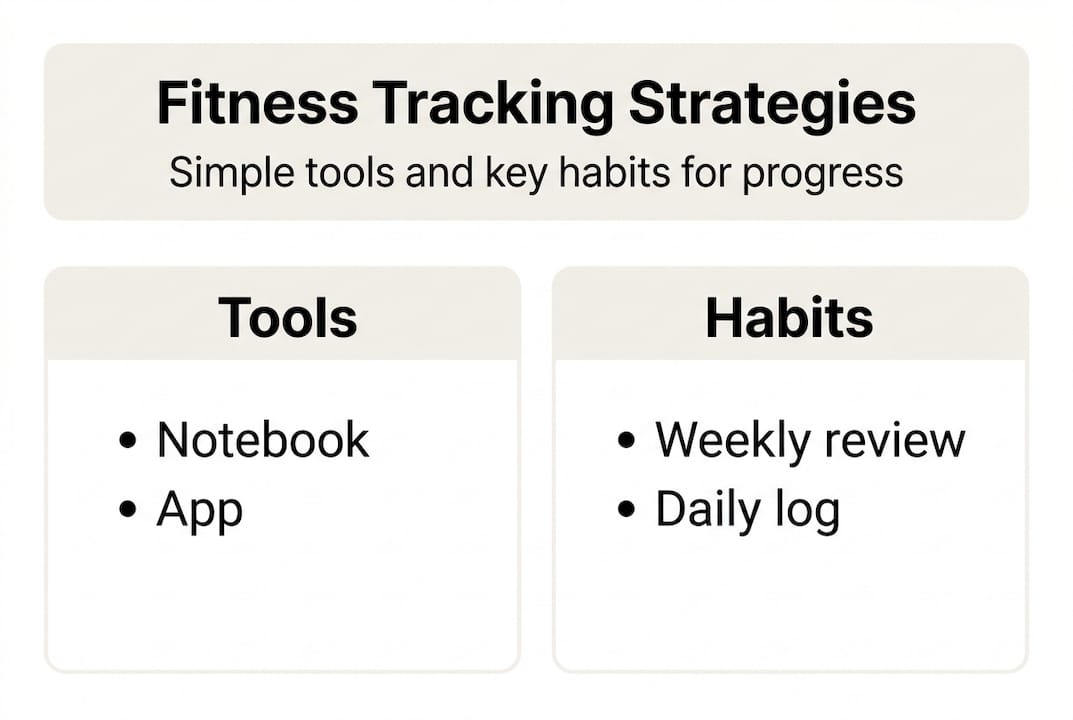
When setting wellness goals, your tracking method should match the complexity of what you’re measuring. Here’s how the most common tools stack up:
| Tool | Best for | Cost | Key limitation |
|---|---|---|---|
| Paper journal | Simple strength or cardio logs | Free | Manual entry, no data analysis |
| Mobile fitness app | Multi-metric tracking with reminders | Free to $15/month | Screen fatigue, app switching |
| GPS/fitness wearable | Heart rate, sleep, steps, HRV | $50 to $400+ | Battery dependency, learning curve |
| Body measurement tape | Body composition changes | Under $5 | No performance data |
When choosing your tool, run it through these criteria before committing:
- Will you actually use it daily? If not, it won’t work.
- Does it capture the metrics that matter for your goal?
- Is the cost sustainable for your current situation?
- How long does it take to log an entry?
Pro tip: Start with the tool you’ll use every single day, even if it’s just a notes app on your phone. A basic log used consistently beats an expensive wearable you forget to sync.
One underrated piece worth adding to your tracking system is supplement logging. Recording your fitness tracking methods alongside nutrient timing, like when you took protein or electrolytes, helps you correlate performance peaks with your recovery stack. That information is genuinely useful over time.
Step-by-step guide: How to track your fitness progress
After picking your tools, it’s time to put a system in place. Follow these clear steps for tracking.
Goal-setting is crucial before you record a single data point. Without a destination, your numbers have no meaning. Here’s the sequence that works:
- Define clear goals. Be specific. “Run a 5K in under 28 minutes” beats “get fitter.”
- Select your metrics. Match the measurement to the goal: weight lifted, pace, body measurements, or flexibility test scores.
- Complete a baseline assessment. Record where you start today. This is your reference point.
- Record consistently. Log every session, even the bad ones. Bad days are data too.
- Review and adjust. Look at your data weekly and monthly. Notice what’s moving and what isn’t.
Here’s what a sample weekly fitness log might look like:
| Day | Activity | Duration | Key metric | Notes |
|---|---|---|---|---|
| Monday | Upper body strength | 45 min | 185 lb bench press | Good energy |
| Wednesday | Zone 2 cardio | 30 min | 148 avg bpm | Easy pace |
| Friday | Lower body strength | 50 min | 225 lb squat | Left knee tight |
| Sunday | Active recovery | 20 min | Light mobility | Sleep was poor |
Personalizing your metrics is where tracking gets powerful. If strength is your goal, track reps and loads. If you’re focusing on cardio, track pace, heart rate zones, and distance. For flexibility, use a sit-and-reach test or log range of motion improvements. You can also track your setting supplement goals alongside workout data to see how your nutrition stack affects your numbers.
Need a strong starting framework? Check out setting fitness goals step by step for a full system.
Pro tip: Block ten minutes every Sunday to review your week’s log. It takes less time than one Instagram scroll session and does far more for your results.
Common pitfalls and troubleshooting tips
Even with the best tools and systems, sticking to the plan can be a challenge. Here’s how to dodge the most common pitfalls.
inconsistency and misaligned goals are the top reasons people fail to track progress effectively. The fix usually isn’t a better app. It’s simplifying what you’re doing.
Watch out for these tracking mistakes:
- Too many metrics. If you’re logging 12 variables per session, you’ll burn out fast. Pick three to five that actually connect to your goal.
- All-or-nothing thinking. Missing one entry doesn’t break the system. Just pick back up immediately.
- No review habit. Data you never look at is just noise. Schedule the review.
- Using tracking as punishment. If logging feels like homework, you’ll avoid it. Make it neutral or even satisfying.
- Not accounting for recovery. Sleep, stress, and herbal supplements for fitness all affect your numbers. Log context, not just performance.
The best troubleshooting move when you fall off is to simplify ruthlessly. Drop to one metric. Log it for two weeks. Then build back up.
Accountability partners are underrated. Even a text to a training buddy that says “hit all three sessions this week” creates a social contract that research on improving fitness adherence shows significantly boosts consistency.
Pro tip: Stack your logging habit onto something you already do every night, like reviewing your log right after brushing your teeth. You’re already in the bathroom. It takes 90 seconds.
Adjusting your recovery and supplement plan should be part of your review cycle too. If your numbers consistently drop mid-week, that might signal inadequate recovery nutrition, not a training problem.
measuring results and maintaining long-term accountability
To turn progress tracking into lasting gains, you’ll need to consistently measure and adapt. Here’s how to stay accountable.
consistent tracking is linked to higher rates of fitness goal achievement. Yet most people only look at data when something feels wrong. The real power is in reading patterns before problems show up.
Every four to six weeks, sit down and look at your log with fresh eyes. Are your numbers trending upward? Is one area lagging? Are your recovery metrics getting worse even as performance holds? These patterns tell you what to change before a plateau turns into a setback.
People who track fitness goals consistently are up to 33% more likely to achieve them than those who don’t track at all.
When you do hit a plateau, here’s a structured response:
- Check your recovery. Sleep, stress, and nutrition are usually the first culprits.
- Change one variable. Add volume, adjust intensity, or switch exercise variations.
- Review your nutrition stack. Look at maximizing electrolytes for gains if performance is flat.
- Set a short-term micro-goal. A two-week sprint target reignites focus.
- Get outside input. A coach or community forum can spot what you’re missing.
Social accountability is real. Research at tracking your progress consistently shows that sharing results, even informally, boosts adherence and outcome quality. You don’t need a public Instagram account. A small group chat or training partner is enough.
Our perspective: Why tracking is the real game-changer in fitness
With all the steps covered, here’s an honest take from our experience about what really drives results.
The fitness industry sells secrets. New methods, exotic protocols, and advanced biohacking tools grab attention. But the athletes and everyday gym-goers who make the most consistent progress rarely use anything exotic. They write things down, review them regularly, and make small corrections. That’s it.
Progress stalls not because people stop trying but because they stop receiving feedback. When you don’t know where you were last month, you can’t know if today’s effort is building on it. We’ve seen this pattern repeatedly: the person who tracks simple data, weight lifted, time run, mood score, outperforms the person chasing the perfect program every time.
The importance of metabolic health to long-term performance is a perfect example. It’s invisible until you measure it. So is your recovery quality, your strength curve, and your cardio trend. Simple, consistent data reveals all of it.
Stop waiting for the perfect system. Start with what you have today.
Ready to boost your fitness journey? explore tools from NutriBliss
Tracking your effort is the foundation. Supporting that effort with the right nutrition makes the results land harder and faster. At NutriBliss, we’ve built our product line specifically for athletes and fitness enthusiasts who take their progress seriously.

Our NutriBliss electrolytes supplement pairs perfectly with your hydration and performance tracking, helping you maintain energy and output session after session. And when recovery is the metric that needs attention, our full line of recovery supplements gives your body the raw materials to rebuild faster. Track smarter. Train harder. Support it all with science-backed nutrition from NutriBliss.
frequently asked questions
What metrics are most important to track for fitness progress?
Body measurements and performance metrics are both critical, but the most important ones depend on your goal. Focus on strength levels, cardio endurance, flexibility, body measurements, and recovery trends as your core data points.
How often should I update my fitness tracking data?
A weekly tracking system improves long-term consistency and motivation, so aim to update your log at least once per week. Daily entries are even better for performance-focused athletes.
What should I do if I’m not seeing progress despite tracking?
adjusting goals and tracking methods can get progress back on track when results stall. Start by simplifying your metrics, then get feedback from a coach or training community to identify what’s missing.
Can supplements enhance fitness tracking and results?
tracking supplement use can enhance fitness outcomes by helping you correlate nutrition timing with performance peaks and recovery quality. The right supplement stack supports both the effort and the data.
Recommended
- How to Set Fitness Goals That Work: A Step-by-Step Guide
- How to set health goals: practical steps for success
- Functional Fitness: Why It Matters for Daily Life
- How to Set Supplement Goals for Better Results
- Dip exercise muscles worked: build strength in 2026 – CP-1
- Как да балансирате хранителни добавки за оптимални резултати