

You stand in the supplement aisle, scanning bottles filled with vitamins, minerals, and performance boosters. Each label promises health benefits, but decoding the dense text, percentages, and ingredient lists feels overwhelming. Understanding how to read supplement labels isn’t just helpful—it’s essential for making safe, effective choices that align with your health goals. This guide breaks down every element of supplement labels so you can shop with confidence and clarity.
Table of Contents
- Understanding The Basics: What You Need To Know Before Reading Supplement Labels
- Decoding The Supplement Facts Panel: Your Guide To Ingredient Information
- Interpreting Ingredient Lists And Additional Label Information
- Applying Label Knowledge: Choosing Supplements Wisely With Confidence
- Explore Trusted Supplements With Clear Labeling At NutriBliss
- Frequently Asked Questions
Key takeaways
| Point | Details |
|---|---|
| Supplement Facts panel shows serving size and active ingredients | This standardized section lists what’s inside each dose and helps compare products accurately. |
| Active and inactive ingredients serve different purposes | Active ingredients provide health benefits while inactive ingredients affect texture, stability, or absorption. |
| FDA regulations mandate specific label elements to protect consumers | Compliance ensures you receive accurate information about identity, quantity, and manufacturer details. |
| Warnings and contact information are legally required | These details enable safety reporting and alert you to potential risks or interactions. |
Understanding the basics: what you need to know before reading supplement labels
Before diving into label specifics, you need context. Dietary supplements include vitamins, minerals, herbs, amino acids, and other substances intended to supplement your diet. Unlike prescription drugs, the FDA doesn’t approve supplements before they reach store shelves. Instead, manufacturers must follow regulations that govern how products are labeled and produced.
The Dietary Supplement Health and Education Act (DSHEA) established the framework for supplement regulation in 1994. Under this law and subsequent FDA rules, labels must comply with specific requirements that protect you from misleading claims and unsafe products. Every supplement label must include:
- Product identity clearly stating it’s a dietary supplement
- Net quantity of contents showing total amount in the container
- Supplement Facts panel with standardized formatting
- Ingredient list with active and inactive components
- Manufacturer, packer, or distributor name and address
These mandatory elements create consistency across brands, making comparison shopping possible. When you understand the role of supplement regulation, you recognize that compliant labels signal a manufacturer’s commitment to transparency and quality.
Pro Tip: Always check for complete contact information on any supplement you buy. If a label lacks a domestic address or phone number, consider it a red flag for potential non-compliance.
Decoding the supplement facts panel: your guide to ingredient information
The Supplement Facts panel requires specific formatting and content by law, making it your most reliable information source. This standardized box appears on every compliant supplement and breaks down exactly what you’re consuming per dose.
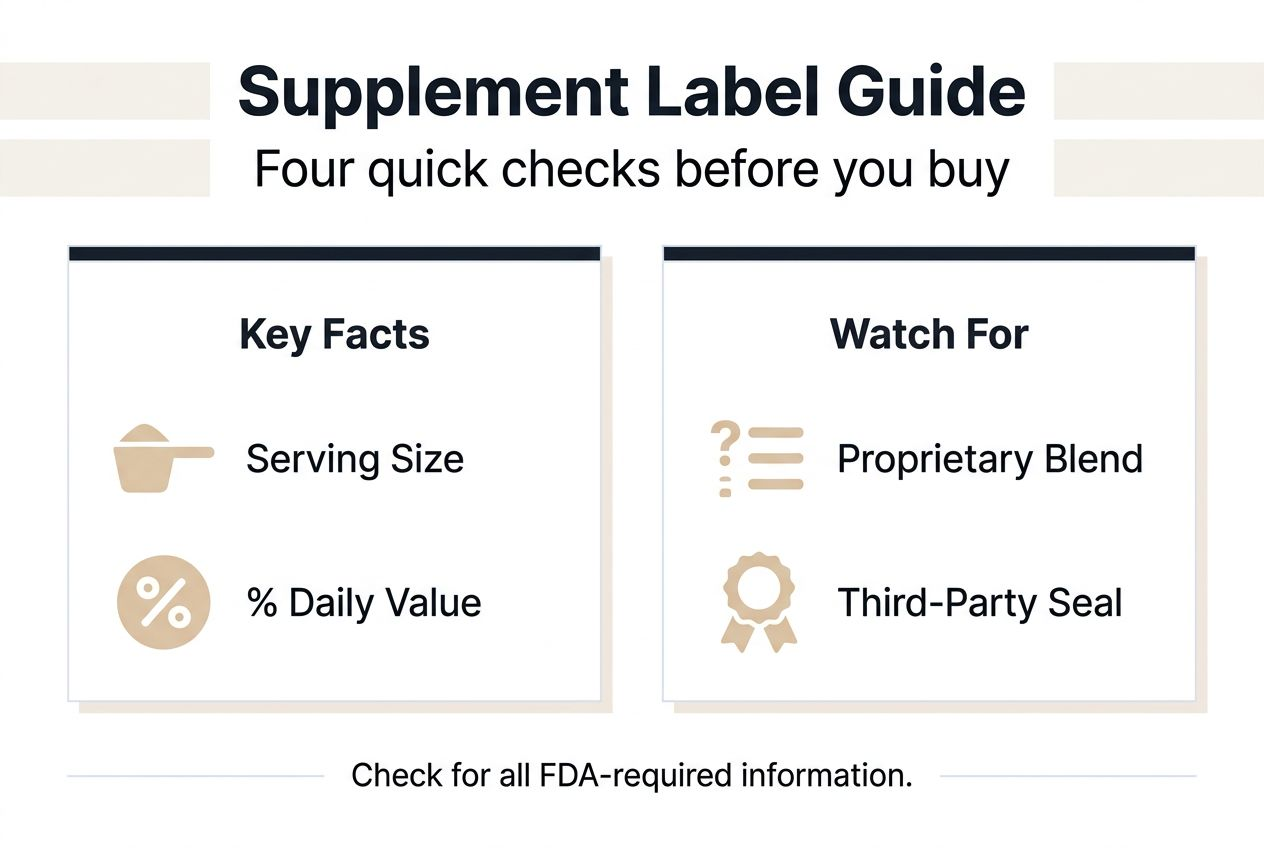
Start with serving size, listed at the top. This tells you how much product constitutes one dose, whether that’s one capsule, one scoop, or two tablets. Servings per container follows immediately after, showing total doses in the package. These numbers matter because all other values on the label reference this serving size.
Next comes the heart of the panel: active ingredients and their amounts. Ingredients must list standardized measurements like milligrams (mg), micrograms (mcg), or international units (IU). You’ll see each ingredient name followed by the amount per serving. For instance, a vitamin D supplement might list “Vitamin D3 (as cholecalciferol) 2000 IU.”
The % Daily Value (DV) column appears to the right of ingredient amounts. This percentage shows how much of the FDA’s recommended daily intake each serving provides based on a 2,000 calorie diet. A 100% DV means one serving delivers the full recommended amount. Values above 100% aren’t necessarily harmful, but they signal you’re exceeding standard recommendations.
Here’s a sample Supplement Facts panel structure:
| Element | Example Value | What It Means |
|---|---|---|
| Serving Size | 2 capsules | One dose equals two capsules |
| Servings Per Container | 30 | Bottle contains 30 doses |
| Vitamin C (as ascorbic acid) | 500 mg (556% DV) | Each dose provides over 5 times the daily recommendation |
| Zinc (as zinc gluconate) | 15 mg (136% DV) | Each dose exceeds the daily recommendation by 36% |
| Proprietary Blend | 1000 mg | Total amount of multiple ingredients not individually disclosed |
Pro Tip: Be cautious with proprietary blends. While legal, these listings hide individual ingredient amounts, making it impossible to verify effective doses. Transparent brands list each ingredient separately for supplement transparency.
Understanding measurement units prevents confusion. Milligrams (mg) measure weight in thousandths of a gram. Micrograms (mcg) are even smaller at millionths of a gram. International units (IU) measure biological activity rather than weight, commonly used for fat-soluble vitamins. When comparing products, ensure you’re matching identical units—1000 mcg equals 1 mg, but mixing these up could mean taking 1000 times too much or too little.
Your supplement selection process improves dramatically when you know how to interpret these numbers and match them to your individual needs based on age, diet, and health status.
Interpreting ingredient lists and additional label information
Beyond the Supplement Facts panel, the complete ingredient list reveals everything in the product. Active and inactive ingredients must be differentiated, with inactive components listed in descending order by weight. Active ingredients provide the intended health benefits. Inactive ingredients include binders, fillers, colors, and preservatives that affect product stability, appearance, or absorption but don’t directly support your health goals.

For botanical supplements, labels must specify the plant part used. You might see “echinacea (root)” or “green tea extract (leaf)” because different plant parts contain different active compounds. This specificity helps you verify you’re getting the researched form. Some botanicals work better from roots, others from leaves or flowers.
Every compliant label includes manufacturer contact information with the company’s name and either a domestic address or phone number. This isn’t decorative—it’s your direct line for reporting adverse effects or asking questions about sourcing and manufacturing. If you can’t find clear contact details, question the product’s legitimacy.
Warnings and disclaimers occupy critical label space. Common warnings include:
- Allergen notices for common triggers like soy, dairy, or shellfish
- Pregnancy and nursing cautions
- Age restrictions for children
- Potential drug interactions
- Maximum safe daily limits
These statements protect you from known risks. Always read warning sections completely, especially if you take medications or have chronic health conditions.
To verify label authenticity and compliance, follow these steps:
- Check for complete Supplement Facts panel with serving size, amounts, and % DV
- Confirm manufacturer contact information includes domestic address or phone
- Look for third-party testing seals from organizations like NSF, USP, or ConsumerLab
- Verify the product identity statement clearly says “dietary supplement”
- Review warnings for completeness and relevance to your health status
Third-party testing provides an extra verification layer. These independent organizations test products for purity, potency, and contamination. A seal on the label means the manufacturer voluntarily submitted to additional scrutiny beyond basic FDA requirements. Understanding supplement safety guidelines includes recognizing these quality markers.
Applying label knowledge: choosing supplements wisely with confidence
Theoretical knowledge becomes powerful when applied to real decisions. Let’s examine how to read labels for three popular supplements: fish oil, magnesium, and creatine.
For fish oil, you want EPA and DHA content clearly listed, not just “omega-3s.” Research shows fish oil with 1 to 2 grams combined EPA and DHA supports cardiovascular health. Check the Supplement Facts panel to confirm these specific fatty acids and their amounts. A label listing “1000 mg fish oil” tells you the total oil amount, but EPA and DHA might only constitute 300 mg of that total. You need the breakdown.
Magnesium supplements come in various forms with different absorption rates and uses. If you’re targeting sleep quality, magnesium glycinate at 200 to 350 mg elemental shows benefits in studies. The label should specify both the compound form (glycinate, citrate, oxide) and elemental magnesium amount. Magnesium oxide contains more elemental magnesium by weight but absorbs poorly compared to glycinate or citrate.
Creatine monohydrate remains the gold standard for strength training support. Studies confirm 3 to 5 grams daily produces results. The label should list “creatine monohydrate” specifically, not just “creatine” or proprietary blends. Serving size matters here—some products require multiple scoops to reach effective doses, increasing cost per serving.
Here’s a comparison table for label reading:
| Supplement | Key Label Check | Effective Research Dose | Common Label Pitfall |
|---|---|---|---|
| Fish Oil | Separate EPA and DHA amounts | 1-2 grams combined EPA/DHA | Lists total omega-3s without EPA/DHA breakdown |
| Magnesium | Compound form and elemental amount | 200-350 mg elemental | Shows compound weight not elemental magnesium |
| Creatine | Specifies monohydrate form | 3-5 grams daily | Hides amount in proprietary blend |
| Vitamin D | D3 (cholecalciferol) vs D2 | 1000-2000 IU for maintenance | Doesn’t specify D2 vs D3 form |
Common mistakes when reading labels include:
- Assuming serving size matches your intended dose without checking
- Ignoring ingredient forms, which dramatically affect absorption and efficacy
- Overlooking inactive ingredients that might trigger allergies or sensitivities
- Missing warning statements about timing (take with food vs empty stomach)
- Comparing products by price without calculating cost per effective dose
To verify ingredient quality and appropriate dosing:
- Research the specific compound form recommended by studies, not just the nutrient name
- Calculate elemental amounts when the label lists compounds (like magnesium citrate vs elemental magnesium)
- Check if the dose per serving matches research-backed amounts or if you’ll need multiple servings
- Look for time-release or enhanced absorption technologies that might justify different dosing
- Cross-reference with your personalized supplement plan to avoid duplicate ingredients across products
Pro Tip: Some nutrients work better together. Curcumin absorbs poorly alone but dramatically improves when paired with piperine (black pepper extract). Check labels for complementary ingredients that enhance the primary active compound. Understanding supplement stacks helps you identify beneficial combinations.
Explore trusted supplements with clear labeling at NutriBliss
You’ve learned to decode supplement labels like a pro. Now apply that knowledge to products designed with transparency and science at their core.

NutriBliss commits to clear, compliant labeling across every product line. Whether you’re exploring our electrolytes supplement for post-workout recovery or diving into the science behind superfoods that power our formulations, you’ll find detailed ingredient information that respects your right to know exactly what you’re taking. Browse NutriBliss vitamins and supplements where every label meets FDA requirements and goes beyond with third-party testing and research-backed formulations.
Frequently asked questions
What key terms should I understand on supplement labels?
Percent Daily Value (%DV) shows how much of the FDA’s recommended daily intake one serving provides based on a 2,000 calorie diet. Serving size defines the amount for which all other values are calculated, while servings per container tells you total doses in the package. Active ingredients deliver intended health benefits, whereas inactive ingredients affect product form, stability, or absorption without providing direct nutritional value. Understanding these basics lets you compare products accurately and dose appropriately.
How can I verify if a supplement label is trustworthy and accurate?
Check for all FDA-required elements including a complete Supplement Facts panel, manufacturer contact information with a domestic address or phone number, and product identity stating “dietary supplement.” Look for third-party testing seals from NSF, USP, or ConsumerLab, which indicate voluntary quality verification beyond basic requirements. Research the manufacturer’s reputation through customer reviews and check if they follow Good Manufacturing Practices (GMP). Missing required information or vague ingredient listings signal potential non-compliance.
Are there common mistakes to avoid when reading supplement labels?
Many people ignore serving sizes and assume one capsule or scoop equals the dose they need. Others overlook ingredient forms, missing that magnesium oxide differs significantly from magnesium glycinate in absorption. Skipping inactive ingredients can expose you to allergens or additives you want to avoid. Neglecting warning statements about timing, drug interactions, or maximum safe amounts creates unnecessary risks. Always read the complete label, not just the front panel marketing claims.
Why do some supplements list ingredients in international units (IU) instead of mg or mcg?
International units measure biological activity or potency rather than weight, commonly used for fat-soluble vitamins like A, D, E, and K. These vitamins come in different chemical forms with varying activity levels, so IU standardizes measurement across forms. For example, vitamin D from cholecalciferol (D3) has different potency than ergocalciferol (D2), but both can be expressed in IU for consistent comparison. Weight measurements like mg or mcg work well for minerals and water-soluble vitamins where form doesn’t dramatically affect activity.