

Two foods can carry the exact same number of carbohydrates yet send your blood sugar on completely different rides. A bowl of white rice and a bowl of lentils might both clock in at 40 grams of carbs, but your body processes them in totally different ways. That difference is what the glycemic index (GI) captures, and understanding it can change how you think about every meal. This guide breaks down what GI is, how it works, what affects it, and how to use it to make smarter food choices that support your energy, performance, and long-term health.
Table of Contents
- What is the glycemic index and how does it work?
- Understanding GI categories and real food examples
- Why does GI change? Factors that influence glycemic index
- Glycemic index vs. glycemic load: What’s the difference?
- Potential benefits and common criticisms of the glycemic index
- How to use the glycemic index for smarter food choices
- Take your nutrition further with NutriBliss
- Frequently asked questions
Key Takeaways
| Point | Details |
|---|---|
| GI shows glucose impact | Glycemic index reveals how quickly foods raise your blood sugar compared to pure glucose. |
| Food prep affects GI | Ripeness, cooking methods, and food combos can change a food’s glycemic index significantly. |
| GL makes GI more practical | Glycemic load helps you factor in portion sizes for real-world meals. |
| Low GI supports wellness | Prioritizing low GI whole foods supports steady energy and may reduce chronic disease risk. |
What is the glycemic index and how does it work?
The glycemic index is a numerical scale that ranks carbohydrate-containing foods based on how quickly they raise blood glucose levels after eating. It runs from 0 to 100, with pure glucose sitting at 100 as the reference point. The higher the number, the faster that food spikes your blood sugar.
GI is not a measure of total carbohydrates. A food can be high in carbs but still have a low GI, and vice versa. What GI actually measures is the speed of digestion and glucose absorption, not the quantity of sugar in the food.
“GI measures the incremental area under the blood glucose response curve over 2 hours after consuming 50g of available carbohydrates, following a 12-hour fast, tested in at least 10 healthy subjects, relative to glucose or white bread.”
Here is what that means in practice. When researchers test a food’s GI, participants fast overnight, eat a portion of the food containing 50 grams of digestible carbs, and then have their blood glucose measured every 15 to 30 minutes for two hours. The result is compared to the same process done with pure glucose. This is a rigorous, standardized method, not a rough estimate.
Why does this matter for your health? Because frequent blood sugar spikes drive insulin resistance over time, affect energy levels, and are linked to metabolic health issues that go far beyond just weight gain. Understanding the glycemic index) gives you a practical lens for choosing foods that keep your energy steady and your body working efficiently.
Key things GI tells you:
- How fast a food raises blood glucose
- How your body will likely respond in terms of energy and hunger
- Which carb sources are more suitable for sustained performance
Key things GI does NOT tell you:
- How many carbs are in a serving
- Whether a food is nutritious overall
- How a food behaves in a mixed meal
Understanding GI categories and real food examples
GI values fall into three clear ranges, and knowing them helps you make faster, smarter decisions at the grocery store or when planning meals.
| GI category | GI range | Examples |
|---|---|---|
| Low GI | 55 or below | Apples (39), peanuts (7), chickpeas (~30), barley (28) |
| Medium GI | 56 to 69 | Banana (62), brown rice (50), whole wheat bread (~65) |
| High GI | 70 and above | White bread (71-100), baked potato (111), white rice (89) |
These GI benchmarks reveal some surprises. A baked potato scores higher than table sugar. Peanuts sit near the bottom of the entire scale. Brown rice and white rice look similar on a nutrition label but behave very differently in your bloodstream.

Bananas are a great example of why context matters. A slightly green banana has a lower GI than a fully ripe one because the starch has not yet converted to sugar. Same food, different number depending on when you eat it.
For meal planning, these categories give you a starting framework:
- Build meals around low GI foods like legumes, most vegetables, and whole grains
- Use medium GI foods as complements rather than the base of every meal
- Limit high GI foods or pair them with protein, fat, or fiber in your diet to slow absorption
The goal is not to eliminate entire food groups. It is to understand which foods give you steady fuel versus a quick spike followed by a crash.
Why does GI change? Factors that influence glycemic index
Here is where things get interesting. GI values listed in food tables are averages, and real-world GI can shift based on several factors you actually control.
GI varies significantly based on ripeness, cooking method, processing level, and what else you eat alongside a food. Al dente pasta, for example, has a lower GI than fully cooked pasta because the denser structure slows digestion. The same principle applies to oats: steel-cut oats digest more slowly than instant oats, even though they start as the same grain.
Factors that raise GI:
- Overcooking (breaks down starch structure)
- High ripeness in fruits
- Heavy processing or refining (white flour, puffed cereals)
- Removing the fiber-rich outer layer of grains
Factors that lower GI:
- Adding fat, protein, or fiber to a meal
- Cooking to al dente rather than soft
- Cooling cooked starches (cold cooked rice has lower GI than hot)
- Choosing less processed, whole food versions
Individual response also plays a role. Two people eating the same meal can have noticeably different blood glucose curves based on gut microbiome, insulin sensitivity, and even stress levels. This is why metabolic health is so personal and why GI is a guide, not a guarantee.
Pro Tip: Cook your pasta al dente and let cooked rice cool before eating it. Both strategies lower the GI without changing the flavor or nutrition profile of your meal.
Glycemic index vs. glycemic load: What’s the difference?
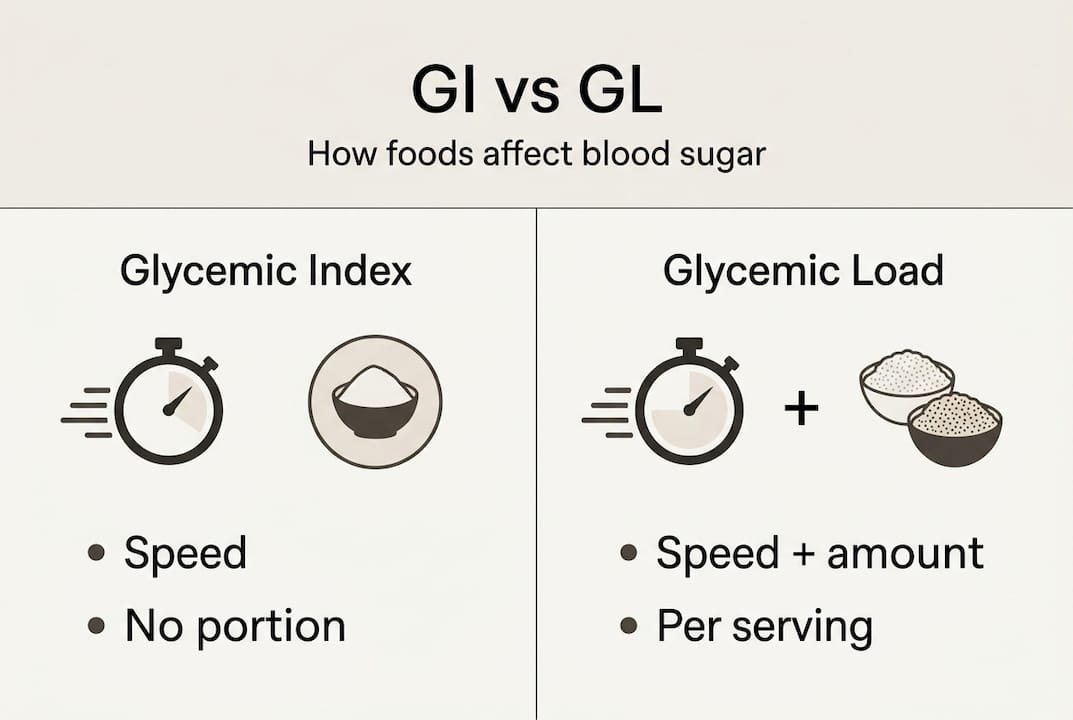
GI tells you how fast a food raises blood sugar, but it does not account for how much of that food you actually eat. That is where glycemic load (GL) comes in.
Glycemic load is calculated as: GL = (GI x grams of carbs per serving) / 100. This single formula changes how you look at certain foods entirely.
Watermelon is the classic example. It has a high GI of around 72, which sounds alarming. But a standard serving of watermelon contains very few digestible carbs, so its GL is only about 4, which is low. Eating a slice of watermelon will not spike your blood sugar the way a slice of white bread will.
| Food | GI | Carbs per serving (g) | Glycemic load |
|---|---|---|---|
| Watermelon | 72 | 6 | 4 (low) |
| White bread (1 slice) | 75 | 13 | 10 (medium) |
| Brown rice (1 cup) | 50 | 32 | 16 (medium) |
| Baked potato (medium) | 111 | 30 | 33 (high) |
How to use GI and GL together:
- Start with GI to identify which foods digest quickly
- Calculate or look up GL to factor in realistic portion sizes
- Prioritize low GL foods as your meal staples
- Use high GI foods strategically, such as glycogen loading for athletes before intense training
GL ranges: low is 10 or below, medium is 11 to 19, and high is 20 or above. Together, GI and GL give you a much more complete picture than either metric alone.
Potential benefits and common criticisms of the glycemic index
Low GI diets have a solid body of research behind them, but they are not a perfect system. Knowing both sides helps you use GI as a smart tool rather than a rigid rulebook.
Low GI diets may improve blood glucose control, reduce insulin demand, support weight management, and lower the risk of chronic diseases like type 2 diabetes and heart disease, though evidence for cardiovascular events specifically remains mixed.
The benefits are real and meaningful for health-conscious eaters. Steady blood sugar means fewer energy crashes, better appetite control, and less strain on your pancreas over time. For athletes, low GI eating between training sessions supports better recovery and more consistent energy.
Benefits supported by research:
- Better blood sugar regulation throughout the day
- Reduced insulin spikes and improved insulin sensitivity
- Support for healthy weight management
- Lower long-term risk of type 2 diabetes
- Potential support for dietary fiber benefits when low GI foods are also high in fiber
But GI has real limitations too. Critics point out that GI ignores portion size, meal context, and individual variability. Fructose, for example, has a very low GI but can still cause metabolic harm in large amounts. GI also becomes hard to predict in mixed meals where multiple foods interact.
Using GI alongside other metrics like fiber content, whole food density, and magnesium intake gives you a more complete nutritional picture. Think of GI as one useful signal in a larger dashboard, not the only number that matters.
How to use the glycemic index for smarter food choices
Knowing GI theory is one thing. Applying it at breakfast on a busy Tuesday is another. Here is a practical framework that actually fits into real life.
- Swap high GI staples for lower GI alternatives. Replace white rice with basmati or brown rice, white bread with sourdough or whole grain, and instant oats with steel-cut oats.
- Build balanced plates. Pair any higher GI food with a source of protein, healthy fat, or fiber. This combination slows digestion and flattens the blood sugar curve.
- Watch portion sizes. Even low GI foods can raise blood sugar significantly if you eat large amounts. GL thinking keeps portions in check.
- Prioritize whole, minimally processed foods. Most vegetables, legumes, and whole grains naturally fall in the low to medium GI range and come packed with nutrients.
- Track your personal response. Your body is unique. Pay attention to how you feel two hours after eating certain foods, especially energy levels and hunger.
Prioritizing low GI foods) like most fruits, vegetables, legumes, and whole grains, while pairing higher GI options with protein or fat, is one of the most practical strategies for steady energy and long-term health.
Pro Tip: Add a handful of legumes to any grain-based meal. Chickpeas, lentils, or black beans lower the overall GI of the dish while boosting protein and fiber intake at the same time.
Listening to your body matters as much as reading food tables. GI is a starting point, not a final answer. Use it to build better habits, then refine based on how you actually feel and perform.
Take your nutrition further with NutriBliss
If understanding the glycemic index has you thinking more carefully about what you put in your body, you are already on the right track. Smart eating is about more than avoiding sugar spikes. It is about fueling your body with the right nutrients at the right time.

At NutriBliss, we back every product with science and build our formulas around what your body actually needs. Whether you want to explore the science behind superfoods, browse our full range of NutriBliss supplements, or support your hydration and energy with our Electrolytes Supplement, we have options designed to complement a low GI, whole-food lifestyle. Your wellness goals deserve more than guesswork.
Frequently asked questions
Why do two foods with the same carbs have different GI values?
The structure of a food, its fiber content, ripeness, and how it was cooked all affect how fast your body breaks it down into glucose. Ripeness, cooking method, and processing can shift GI significantly even between two servings of the same food.
Is glycemic index always accurate for mixed meals?
Not always. When you combine multiple foods, the overall GI of the meal becomes difficult to predict because proteins, fats, and fibers all interact. GI is not reliably predictive in complex mixed meals, which is one of its most cited limitations.
Should I focus on GI or glycemic load for healthy eating?
Both. GI tells you how fast a food raises blood sugar, while glycemic load accounts for portion size, making it more practical for real-world meal planning. Using them together gives you the clearest picture.
What are easy ways to lower the GI of a meal?
Add fiber, protein, or healthy fat to your plate and choose less processed ingredients when possible. Fat, protein, and fiber all slow digestion and reduce the speed at which carbs enter your bloodstream.