

Most people set health goals with genuine excitement, only to watch that momentum fade within weeks. The problem is rarely a lack of willpower. It is a lack of structure. Vague intentions like “get fit” or “eat better” give you nothing concrete to work toward, so progress feels invisible and motivation collapses. This guide walks you through a proven framework for building health goals that actually stick, covering the SMART method, how dietary supplements fit into your plan, step-by-step execution, and how to troubleshoot when things go sideways.
Table of Contents
- Understand what makes a great health goal
- Prepare with the right tools, mindset, and supplements
- Step-by-step: How to set and pursue your health goals
- Troubleshoot setbacks and stay on track
- Measure your progress and optimize for performance
- Supercharge your health goals with Nutribliss solutions
- Frequently asked questions
Key Takeaways
| Point | Details |
|---|---|
| SMART goals work best | Specific and measurable goals lead to more sustained progress and motivation. |
| Small steps build momentum | Breaking big goals into manageable milestones helps prevent overwhelm and fuels consistency. |
| Supplements support, not replace | Personalized, third-party tested supplements fill nutrition gaps but whole foods come first. |
| Adapt and track progress | Regular check-ins and celebrating all improvements keep you moving forward, even after setbacks. |
Understand what makes a great health goal
Vague goals fail because they offer no clear finish line. When you cannot measure progress, you cannot feel it either. That gap between effort and reward is where most health journeys stall. The fix is not trying harder. It is thinking more precisely about what you actually want.
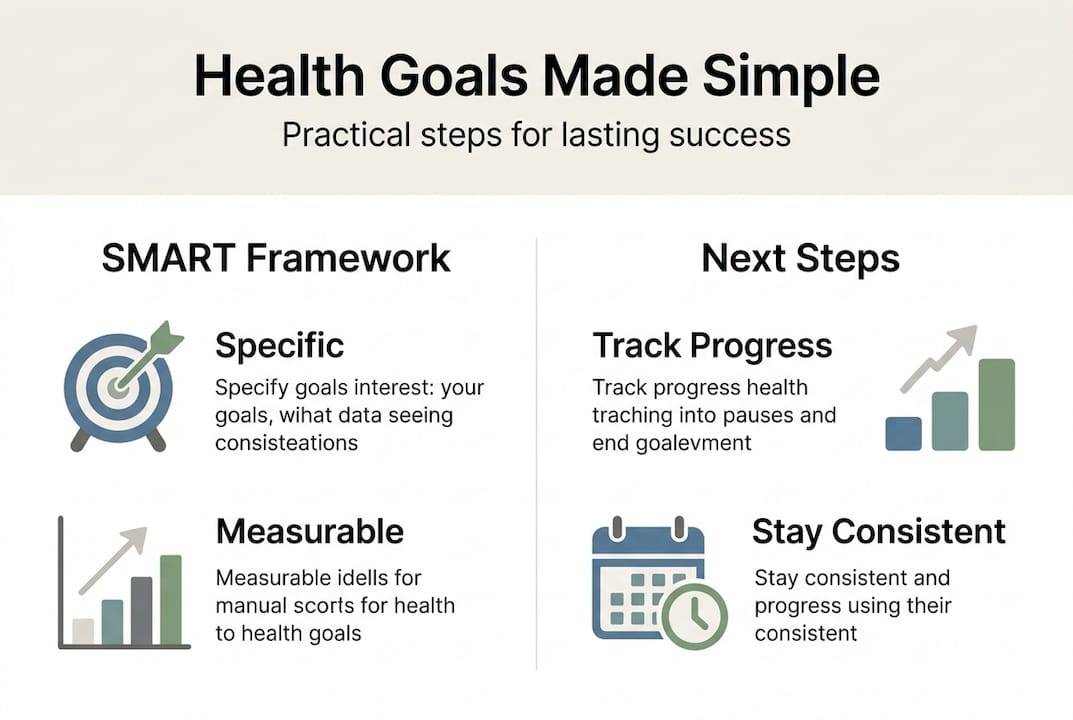
The SMART framework gives you that precision. SMART stands for Specific, Measurable, Achievable, Relevant, and Time-bound. Each element removes ambiguity and replaces it with a clear target. Instead of “get stronger,” a SMART goal sounds like “increase my squat by 20 pounds over the next 8 weeks.”
| Vague goal | SMART version |
|---|---|
| Get healthier | Walk 30 minutes, 5 days a week for 60 days |
| Lose weight | Lose 8 pounds in 10 weeks through diet and exercise |
| Take supplements | Take 5g creatine daily for 8 weeks to support strength gains |
| Sleep better | Be in bed by 10:30 PM every night for 30 days |
When you are setting wellness goals, start with process goals rather than outcome goals. A process goal focuses on the action you control, like hitting the gym three times a week. An outcome goal focuses on a result, like losing 15 pounds. Process goals build the habits that eventually produce outcomes.
- Walk or exercise for at least 20 minutes, 4 days per week
- Take a daily multivitamin every morning with breakfast for 90 days
- Drink 80 ounces of water daily for the next 30 days
- Hit a protein target of 130g per day for 6 weeks
- Sleep 7 to 8 hours per night, tracked weekly
When defining fitness goals, specificity is what separates people who make progress from those who spin their wheels. The more clearly you define what success looks like, the easier it becomes to recognize it.
Pro Tip: When starting out, write one process goal and one outcome goal. The process goal keeps you moving daily. The outcome goal reminds you why it matters.
Prepare with the right tools, mindset, and supplements
Knowing what a good goal looks like is only half the equation. You also need the right setup to pursue it. That means realistic expectations, practical tools, and a clear understanding of where supplements fit in.

Beginners often underestimate how long real change takes. Expecting dramatic results in two weeks sets you up for disappointment. A more useful mindset is committing to a 90-day window where you focus on consistency over speed. Progress will come, but it rarely arrives on your preferred schedule.
Here are the core tools that support goal success:
- A journal or notes app to log workouts, meals, and how you feel
- A habit tracking app like Habitica or Streaks
- A reliable food scale for accurate nutrition tracking
- Access to credible supplement information and third-party tested products
- A weekly check-in routine to review what is working
Dietary supplements work best when they are personalized and evidence-based, not grabbed off a shelf because of a flashy label. The food-first principle matters here. Supplements fill specific gaps. They do not replace a solid diet.
| Supplement | Primary use | Suggested dose | Best for |
|---|---|---|---|
| Creatine monohydrate | Strength and power | 3 to 5g daily | Resistance training |
| Whey protein | Muscle repair and growth | 20 to 40g post-workout | Active individuals |
| Caffeine | Endurance and focus | 3 to 6mg per kg body weight | Cardio and performance |
| Magnesium | Sleep and recovery | 200 to 400mg nightly | Anyone with poor sleep |
| Vitamin D3 | Immune and bone health | 1,000 to 2,000 IU daily | Those with low sun exposure |
When personalizing supplement plans, consider your specific goal, your current diet, and any deficiencies. A runner preparing for a half marathon has different needs than someone focused on building muscle. The supplement selection process should always start with your goal, not the other way around.
The 4Ps framework used in performance nutrition, which stands for Personalize, Periodize, Prefuel, and Prepare, is a useful lens for anyone serious about optimizing their supplement strategy around training phases.
Pro Tip: Before adding any supplement, ask yourself what specific gap it fills. If you cannot answer that clearly, hold off until you can.
Step-by-step: How to set and pursue your health goals
Once you have the right mindset and tools in place, the actual process of setting and chasing goals becomes much more manageable. Here is a clear sequence to follow.
- Define your goal clearly. Write it down in one sentence. Be specific about what you want, how you will measure it, and when you want to achieve it.
- Run it through the SMART filter. Check each element. If your goal fails any of the five criteria, revise it before moving forward.
- Break it into milestones. A 12-week goal should have 4-week checkpoints. Breaking goals into milestones builds momentum and gives you early wins to celebrate.
- Personalize your supplement plan. Match your supplement choices to your goal phase. Bulking, cutting, and endurance training each call for different support.
- Document your process. Log workouts, meals, supplement timing, energy levels, and sleep. This data becomes your feedback loop.
- Build in accountability. Tell a friend, join a community, or hire a coach. External accountability dramatically increases follow-through.
- Schedule a weekly review. Every Sunday, spend 10 minutes reviewing what worked and what did not. Adjust the next week accordingly.
Consistency beats perfection every time. Missing one workout does not derail a goal. Missing three weeks does. Small, realistic steps compound into significant results over time, which is why tracking non-scale victories like improved energy, better sleep, and faster recovery matters just as much as the number on the scale.
If you are brand new to structured goal setting, start with open-ended goals like “do my best to exercise three times this week.” Once that feels natural, layer in the SMART structure. When exploring stepwise supplement goals or personalized nutrition strategies, the same principle applies: build the habit first, then optimize.
Pro Tip: Share your goal publicly, even just with one person. The social commitment effect is real and it costs nothing.
Troubleshoot setbacks and stay on track
Even the best plans hit friction. Motivation dips, progress plateaus, and life gets in the way. The goal is not to avoid setbacks. It is to recover from them faster each time.
Common obstacles include:
- Motivation drops after the initial excitement fades
- Lack of visible progress despite consistent effort
- Confusion about which supplements to take or when
- Overtraining or under-recovering, leading to burnout
- All-or-nothing thinking that turns one bad day into a lost week
When progress stalls, the first step is to revisit your goal, not abandon it. Ask whether the goal is still realistic given your current schedule, recovery, and nutrition. Sometimes a small adjustment, like shifting from 5 workouts per week to 4, is all it takes to restore momentum.
Tracking non-scale victories is especially powerful here. Improved mood, better focus, deeper sleep, and faster recovery are all signs that your plan is working, even when the scale does not move. Sharing goals with others and tracking progress while staying flexible to adjust is one of the most reliable ways to maintain long-term success.
“Goal flexibility is not a sign of failure. It is a sign of intelligence. The ability to adapt your approach while keeping your destination in sight is what separates people who succeed long-term from those who quit after the first obstacle.”
Use this quick checklist after a lapse:
- Identify what caused the disruption without judgment
- Recommit to one small action today, not a full restart
- Review your supplement schedule to make sure it still fits your routine
- Check your supplement usage guidance to confirm you are using products correctly
- Set a new 2-week mini-goal to rebuild momentum
For deeper support on staying consistent, nutrition coaching for longevity offers practical frameworks for building habits that outlast motivation.
Measure your progress and optimize for performance
Once you are past the early obstacles, the focus shifts to measuring what matters and refining your approach. This is where serious athletes and dedicated wellness seekers separate themselves from casual goal-setters.
| Goal type | Example | Suggested metrics |
|---|---|---|
| Process goal | Train 4 days per week | Workouts completed, consistency rate |
| Outcome goal | Run a 5K in under 28 minutes | Finish time, pace per mile |
| Supplement goal | Use creatine for 8 weeks | Strength gains, recovery time |
| Wellness goal | Improve sleep quality | Hours slept, morning energy rating |
For performance-focused individuals, key metrics to track include:
- Endurance: time to fatigue, VO2 max estimates, pace improvements
- Power: one-rep max, vertical jump, sprint times
- Recovery: resting heart rate, soreness levels, sleep quality scores
- Body composition: lean mass, body fat percentage, waist measurement
The 4Ps framework for athletes, which covers Personalize, Periodize, Prefuel, and Prepare, is especially useful for adapting supplement strategies across training phases. What you need during a strength block differs from what supports a peak performance week.
On the supplement side, caffeine consistently improves power and endurance, while beta-alanine shows sport-specific benefits and most other ergogenic aids show mixed results in elite populations. That means your supplement choices should evolve as your performance data evolves.
Exploring performance nutrition strategies and functional nutrition approaches can help you align your supplement timing and selection with your actual training demands rather than guesswork.
Supercharge your health goals with Nutribliss solutions
You now have a complete framework: clear goals, the right mindset, a personalized supplement strategy, and a system for measuring and adjusting your progress. The next step is making sure the supplements you choose are actually worth taking.

At Nutribliss, every product is built around the same principles covered in this guide: evidence-based formulas, transparent ingredients, and real support for real goals. Whether you are chasing better sleep, stronger lifts, or faster recovery, the science behind our superfoods gives you the confidence to supplement with purpose. Ready to match your goals with the right products? Browse all supplements and find exactly what your plan needs.
Frequently asked questions
What is the most effective way to set health goals?
The SMART framework is the most reliable method, making goals specific, measurable, achievable, relevant, and time-bound so you always know what you are working toward and whether you are getting there.
How do dietary supplements fit into health goal setting?
Supplements should fill specific nutrition gaps that your diet cannot cover on its own. They must be personalized and evidence-based, and the 4Ps framework confirms that supplements enhance but never replace a solid diet.
What do I do if I lose motivation or can’t reach a goal?
Break the goal into smaller steps, track non-scale victories like energy and sleep, and adjust your approach without abandoning the goal entirely. Tracking progress and staying flexible is more effective than starting over from scratch.
How often should I review and adapt my health goals?
Review your goals at least once a month, checking whether your strategies, supplement choices, and timelines still reflect your current situation. Accountability and flexibility together are what keep long-term goals alive.