

TL;DR:
- Intermittent fasting is a flexible eating pattern focusing on when you eat, not what you eat, promoting sustainable health benefits. It involves alternating fasting and eating windows, with protocols like 16/8, 5:2, and alternate-day fasting suitable for different lifestyles. The method enhances fat loss, metabolic health, and cellular repair, but requires proper food choices and medical caution for some populations.
Intermittent fasting isn’t a diet in the traditional sense. It doesn’t hand you a list of forbidden foods or demand you swap carbs for celery sticks. Instead, IF cycles between eating and fasting periods, focusing entirely on when you eat rather than what lands on your plate. That single shift in thinking is why millions of health-conscious people, from weekend warriors to competitive athletes, have embraced IF as a sustainable lifestyle tool rather than yet another short-lived eating trend.
Table of Contents
- What is intermittent fasting? The core concept
- Popular intermittent fasting methods and protocols
- How intermittent fasting affects your body: The metabolic switch
- Potential benefits and proven outcomes
- Risks, who should avoid IF, and common pitfalls
- Common challenges, sustainability, and expert strategies for success
- The real story: Why intermittent fasting isn’t a magic bullet—but still works
- Find the right nutrition support for your IF journey
- Frequently asked questions
Key Takeaways
| Point | Details |
|---|---|
| Not just a diet | Intermittent fasting changes when, not just what, you eat, focusing on timing rather than restriction. |
| Variety of methods | You can choose from flexible IF approaches like 16/8 or 5:2 to suit your schedule and goals. |
| Supports weight loss | IF typically leads to moderate weight loss and better metabolic health if you eat the right foods during windows. |
| Not for everyone | Certain groups should avoid IF, and risks exist if not practiced responsibly. |
| Sustainability matters | The best IF results come from a balanced approach you can stick with over time, not quick fixes. |
What is intermittent fasting? The core concept
Intermittent fasting strips away the noise of calorie counting and macro obsessing. The foundation is simple: you eat within a defined window, fast outside of it, and let your body do the rest. Understanding energy metabolism basics helps here, because IF works precisely by manipulating how your body draws on fuel sources over time.
What makes IF distinct from traditional calorie restriction is the mechanism. A conventional diet asks you to eat less at every meal. IF asks you to compress your meals into a shorter timeframe. The result for many people is a natural calorie reduction with far less mental effort because you’re not tracking every bite.
Here’s what defines IF at its core:
- Eating window: The hours during which you consume all your meals and calories
- Fasting window: The remaining hours where only water, black coffee, or plain tea is allowed
- No required food changes: IF doesn’t mandate specific foods, though quality choices amplify results
- Flexible structure: Multiple protocols exist so you can match IF to your lifestyle
- Not starvation: IF is structured, intentional, and time-limited
“Intermittent fasting is an eating pattern that cycles between periods of fasting and eating. It doesn’t specify which foods you should eat, but rather when you should eat them.” — Cleveland Clinic
IF has surged in popularity among fitness enthusiasts for several practical reasons. It fits naturally around busy schedules, aligns with morning workout routines, and eliminates the decision fatigue of five to six small meals a day. For people who already skip breakfast without much hunger, adopting a 16/8 protocol simply formalizes a habit they already practice.
Popular intermittent fasting methods and protocols
Understanding the “when” of intermittent fasting leads naturally to the different protocols you can try. Common IF methods include 16/8, 5:2, alternate-day fasting, and eat-stop-eat, each with a different level of commitment and suitability. Let’s see how these methods compare.
| Protocol | Fasting period | Eating window | Difficulty | Best for |
|---|---|---|---|---|
| 16/8 | 16 hours daily | 8 hours daily | Beginner | Most people, daily routine |
| 5:2 | 2 days/week | 5 days normal | Moderate | Flexible schedules |
| Alternate-day | Every other day | Alternating | Advanced | Experienced fasters |
| Eat-stop-eat | 24-hour fasts | 1-2x per week | Advanced | Disciplined practitioners |
Getting started doesn’t have to feel overwhelming. Here’s a practical approach for beginners:
- Start with 12/12. Fast for 12 hours, eat for 12 hours. This is essentially stopping after dinner and skipping late-night snacking. It’s painless and builds the habit.
- Progress to 14/10. Push breakfast back an hour or two while keeping dinner at a consistent time. Most people tolerate this with minimal hunger.
- Move to 16/8 when ready. This is the sweet spot for most IF practitioners. Skip breakfast entirely, eat your first meal around noon, and finish your last meal by 8 p.m.
- Experiment with 5:2 for variety. On your two restricted days, focus on high-protein, fiber-rich foods to stay satiated on 500 to 600 calories.
- Track your supplement timing alongside your eating windows by scheduling supplements with IF so you never compromise nutrient absorption.
Pro Tip: If you feel dizzy, irritable, or excessively hungry during the first week, your fasting window is probably too aggressive. Start gentler than you think you need to. The goal is to build a sustainable habit, not to white-knuckle through hunger every morning.
How intermittent fasting affects your body: The metabolic switch
With methods in mind, let’s look at why these patterns work. What happens inside your body when you fast is far more interesting than most guides explain.
After your last meal, your body spends several hours processing and using the glucose from that food. Once glucose stores in the liver and muscles run low, typically after 10 to 16 hours of fasting, your body flips a metabolic switch from burning glucose to burning stored fat via fatty acids and ketones. This is the core mechanism behind IF’s effectiveness for fat loss and metabolic health.
| Hours fasted | Primary fuel source | Notable effect |
|---|---|---|
| 0 to 4 hours | Dietary glucose | Digestion and nutrient absorption |
| 4 to 8 hours | Liver glycogen | Blood sugar stabilization |
| 10 to 16 hours | Mixed glucose and fat | Early fat mobilization begins |
| 16 to 24 hours | Fatty acids and ketones | Active fat burning, autophagy begins |
| 24+ hours | Ketones dominant | Deep autophagy, cellular repair |
Autophagy is worth pausing on. It’s your body’s cellular cleanup process, where damaged or dysfunctional proteins and organelles get broken down and recycled. Regular fasting periods activate autophagy more consistently, which researchers link to slower cellular aging and reduced inflammation. There are also some common IF myths worth dispelling around this, since autophagy doesn’t make you invincible or reverse disease on its own.
Pairing IF with fasted cardio can amplify fat oxidation during the later fasting hours. Your body becomes highly efficient at using fat as fuel after extended fasting, making morning workouts before your eating window a strategic tool for serious fitness enthusiasts.
Pro Tip: Schedule your eating window to start earlier in the day when possible. Research shows early time-restricted eating, finishing meals by 6 p.m., offers better blood sugar and cardiovascular benefits than late-night eating windows.
Potential benefits and proven outcomes
Now let’s look beyond the science to what all this means for you: the real-world impact of IF.
The weight loss data is solid and realistic. Studies show IF leads to 3 to 8% body weight loss over 3 to 24 weeks. The 16/8 method creates roughly a 250-calorie daily deficit on average, which adds up to about half a pound per week without any deliberate portion control. Alternate-day fasting shows even stronger results in some studies, producing 1.29 kg more fat loss than continuous calorie restriction in moderate-certainty meta-analyses.
The benefits people experience with consistent IF include:
- Weight and fat loss through reduced overall calorie intake and enhanced fat mobilization
- Improved blood sugar regulation with lower fasting insulin and better insulin sensitivity
- Reduced inflammation markers including lower C-reactive protein levels
- Better blood pressure particularly with early time-restricted eating windows
- Cognitive clarity reported by many practitioners during fasted periods, possibly linked to ketone production
- Cellular repair via autophagy, which may support long-term wellness beyond simple weight metrics
Understanding metabolic health in broader terms matters here because IF influences multiple markers simultaneously. Unlike targeting only weight, IF appears to shift the entire metabolic profile toward better function when practiced consistently and paired with quality nutrition.
The critical caveat: IF is not a license to eat poorly during your eating window. If you break your fast with ultra-processed foods and refined carbohydrates, the metabolic benefits are largely negated. Whole foods, adequate protein, vegetables, and healthy fats during your eating window are what turn IF from a timing trick into a genuine health strategy.

Risks, who should avoid IF, and common pitfalls
IF isn’t right for everyone, and it comes with real caveats. To help you decide, let’s review who should use caution or avoid fasting altogether.
IF is not appropriate for pregnant or breastfeeding women, people with a history of eating disorders, type 1 diabetics, individuals over 50 with low muscle mass, cancer patients undergoing treatment, or those taking medications like insulin or blood pressure drugs that require food for safe administration.
Common risks for those who rush into IF without preparation:
- Muscle loss if protein intake is insufficient during the eating window
- Fatigue and brain fog during the adaptation phase, usually the first one to two weeks
- Headaches from electrolyte imbalance and inadequate hydration during fasting hours
- Nutrient deficiencies if the eating window is too compressed for adequate micronutrient intake
- Hypoglycemia in people sensitive to blood sugar swings, especially without medical supervision
- Disordered eating patterns if fasting becomes obsessive or emotionally driven
“Consult a healthcare provider before starting any fasting regimen, especially if you have underlying health conditions. IF is a tool, not a treatment.”
The practical safeguards are straightforward. Drink plenty of water throughout your fasting window. Add a pinch of salt or an electrolyte supplement to prevent the headaches that knock so many beginners off track in week one. Monitor your energy levels safely during your first few weeks rather than pushing through warning signs. And never let the eating window become so short that you’re genuinely unable to meet your nutritional needs.
Common challenges, sustainability, and expert strategies for success
With safety and benefits clarified, let’s close with how to make IF practical, sustainable, and rewarding for your lifestyle.
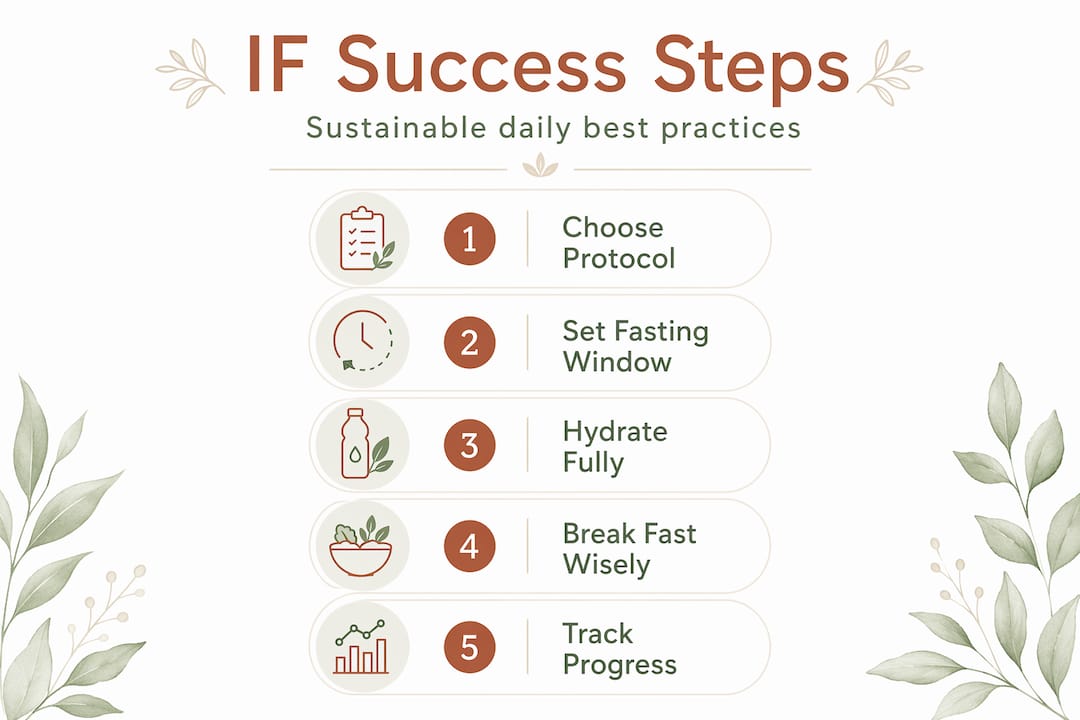
The biggest barrier to IF success isn’t hunger. It’s life. Social meals, irregular work schedules, travel across time zones, and family dynamics can all disrupt even the most committed fasting routine. A BMJ meta-analysis found that IF is not superior to continuous calorie restriction for long-term weight loss. The benefits most people experience come primarily from the calorie deficit IF creates, not from the timing itself. That’s not a knock against IF. It’s a reality check that prevents people from abandoning an otherwise solid approach the moment results slow down.
The top pitfalls that derail IF practitioners:
- Choosing too aggressive a starting protocol. Jumping straight to 20/4 or alternate-day fasting before your body has adapted causes misery and dropout.
- Neglecting food quality during the eating window. IF doesn’t cancel out poor nutrition. What you eat still matters enormously.
- Letting social situations create guilt. A birthday dinner that runs past your eating window won’t ruin your progress. Flexibility preserves the habit.
- Under-eating protein. In a compressed eating window, it’s easy to miss your protein targets, which accelerates muscle loss during weight loss phases.
- Ignoring sleep. Poor sleep disrupts hunger hormones, particularly ghrelin and leptin, making fasting much harder to sustain the following day.
To track IF success meaningfully, measure more than the scale. Track energy, sleep quality, hunger patterns, and training performance. These indicators tell a fuller story than weight alone.
Pro Tip: Build in one “flex day” per week where your eating window can shift by two to three hours based on your schedule. This single adjustment makes IF sustainable across months and years rather than a rigid experiment that collapses under real life.
The real story: Why intermittent fasting isn’t a magic bullet—but still works
Having explored the main IF frameworks and practical guidance, let’s reflect on what most guides overlook or oversell.
Here’s the uncomfortable truth: IF works brilliantly for people whose eating window is filled with intentional, nutritious meals. It works poorly for people who use the fasting period as permission to binge on whatever they want for eight hours. The timing is a framework. The food choices inside that framework determine whether you actually get healthier.
We also think the “magic bullet” framing does real damage. When someone tries 16/8 for three weeks, sees modest results, and then reads that autophagy should be reversing aging, they feel cheated. Long-term human data on IF remains limited, and the most honest position is that IF is one effective tool among several, not a standalone solution for metabolic dysfunction.
What actually separates people who succeed long-term with IF from those who abandon it after six weeks? Personalization. Someone who naturally isn’t hungry in the morning adapts to 16/8 in three days. Someone who wakes up famished every day will struggle with that same protocol indefinitely. The answer isn’t to force a protocol that fights your biology. It’s to explore the full range of IF methods and find the one that feels closest to your natural rhythm, then optimize from there.
Metabolic flexibility is the real goal. Building a body that switches efficiently between glucose and fat as fuel sources is a more durable outcome than any number on a scale. IF is one of the most effective tools for building that flexibility when used thoughtfully and consistently.
Find the right nutrition support for your IF journey
If you’re practicing intermittent fasting, the quality of your eating window matters more than most people realize. Every nutrient, every gram of protein, and every micronutrient needs to land within a compressed timeframe, which makes strategic supplementation a smart move.

At Nutribliss, we’ve built our product line around exactly this challenge. Whether you need protein to protect muscle during your eating window, electrolytes to stay sharp through fasting hours, or vitamins and minerals to cover the gaps in a compressed meal schedule, our science-backed superfoods and full supplement range are designed for people who take their nutrition seriously. Browse Nutribliss to find the tools that support your fasting lifestyle from the inside out.
Frequently asked questions
Can I drink coffee or tea while intermittent fasting?
Yes, plain coffee or tea without sugar, milk, or cream is generally allowed and won’t break your fast. These beverages may even support fat oxidation and mental focus during fasting hours.
How soon will I see results from intermittent fasting?
Most people notice energy changes within the first one to two weeks, with measurable weight loss typically appearing over a longer window. Research confirms IF produces weight loss of 3 to 8% over 3 to 24 weeks, so patience and consistency are key.
Is intermittent fasting safe for athletes or highly active people?
IF can be safe for athletes when meals are strategically planned to meet protein and calorie needs. Combining IF with adequate protein and resistance training minimizes muscle loss and supports performance.
Does intermittent fasting cause muscle loss?
Some muscle loss risk exists, particularly when protein intake is low or fasting periods are extended. Risks including muscle loss are real but preventable with sufficient protein and appropriate training during your eating window.
Can I do intermittent fasting if I have a medical condition?
People with existing health conditions should speak with their doctor before starting IF. IF is not suitable for everyone, particularly those with diabetes, eating disorder histories, or those on medications requiring food.