

Counting calories feels logical until your training stalls, your energy crashes mid-afternoon, or two people eating the same diet get completely different results. The real driver behind how your body performs, recovers, and adapts isn’t just how many calories you eat. It’s energy metabolism, the intricate system your body runs 24/7 to convert food into fuel, build and repair tissue, and keep every cell functioning. Understanding how this system works gives you a genuine edge in making smarter nutrition choices, structuring your training, and sustaining long-term health.
Table of Contents
- What is energy metabolism? The fundamentals explained
- How your body creates energy: The key metabolic pathways
- Metabolic flexibility: How your body adapts to activity, diet, and stress
- Energy metabolism in real life: Exercise, fasting, and special cases
- Eating for your metabolism: Macro balance, fitness, and diet strategies
- A fresh perspective: Why metabolic flexibility matters more than “quick fixes”
- Take your nutrition further with NutriBliss science-backed solutions
- Frequently asked questions
Key Takeaways
| Point | Details |
|---|---|
| Energy metabolism basics | Your body uses energy metabolism to turn food into the energy all cells need for activity and maintenance. |
| Macronutrient fuel | Carbohydrates and fats are the main energy fuels, with fats yielding the most per gram. |
| Adaptation is key | Your body flexibly switches fuel sources for different exercise intensities and under changing dietary conditions. |
| Eat for your goals | Balancing your carb, fat, and protein intake according to your activity boosts both health and performance. |
| Science-driven strategy | Trust your body’s adaptable metabolism more than restrictive fads—focus on flexible, sustainable nutrition for lasting results. |
What is energy metabolism? The fundamentals explained
Energy metabolism is far more than a calorie equation. Energy metabolism is the complete set of chemical reactions in cells that convert nutrients from food into usable energy, primarily in the form of ATP (adenosine triphosphate), while also building cellular components and eliminating wastes. Every heartbeat, muscle contraction, and nerve signal runs on ATP.
At its core, metabolism comprises two processes: catabolism, which breaks down molecules to release energy, and anabolism, which uses that energy to synthesize new molecules. These two processes run simultaneously and in balance, not sequentially.
Here’s what each process handles:
- Catabolism: Breaks down carbohydrates, fats, and proteins into smaller units, releasing energy captured as ATP
- Anabolism: Uses ATP to build proteins, glycogen, hormones, and new cell structures
- Waste elimination: Removes metabolic byproducts like carbon dioxide, urea, and lactic acid
- Signaling: Metabolic intermediates act as signals that regulate gene expression and cellular behavior
“ATP is the universal energy currency of the cell. Without a continuous supply, no biological process can proceed.”
This applies to every cell in your body, not just muscle fibers. Your brain, liver, immune cells, and gut lining all depend on a steady ATP supply. Understanding your macronutrients is the starting point, but knowing how they feed into these pathways is what separates surface-level nutrition from real metabolic literacy. Pairing that knowledge with the right energy vitamins can further support these cellular processes.
How your body creates energy: The key metabolic pathways
Your body doesn’t just “burn” food. It runs nutrients through a series of tightly regulated chemical steps. Key pathways include glycolysis, the conversion of pyruvate to acetyl-CoA, the citric acid (TCA/Krebs) cycle, and oxidative phosphorylation, producing roughly 36 to 38 ATP per glucose molecule under aerobic conditions.
Here’s how the process unfolds step by step:
- Glycolysis: Glucose is split into two pyruvate molecules in the cytoplasm, producing 2 ATP quickly, no oxygen needed
- Pyruvate conversion: Pyruvate enters the mitochondria and becomes acetyl-CoA, linking glycolysis to the TCA cycle
- TCA cycle: Acetyl-CoA is processed through a series of reactions, generating electron carriers (NADH, FADH2)
- Oxidative phosphorylation: Electron carriers feed the electron transport chain, driving ATP synthase to produce the bulk of your ATP
For fats, beta-oxidation breaks fatty acids into acetyl-CoA units for the TCA cycle, yielding over twice the energy per gram compared to carbohydrates or proteins. That’s why fats are your body’s preferred fuel for long, steady-state activity.

| Macronutrient | Calories per gram | Relative ATP yield |
|---|---|---|
| Carbohydrates | 4 kcal | Moderate (36-38 ATP/glucose) |
| Fats | 9 kcal | High (>2x carbs per gram) |
| Protein | 4 kcal | Low (used mainly for structure) |
Anaerobic pathways kick in when oxygen supply can’t keep up with demand, like during a sprint or heavy lift. Glycolysis runs fast but produces lactate as a byproduct. Aerobic pathways are slower but far more efficient.
Pro Tip: During high-intensity intervals, your body relies almost entirely on carbohydrates. During a long, easy run, fat dominates. Structuring your nutrition around your training type means fueling the right pathway at the right time.
Metabolic flexibility: How your body adapts to activity, diet, and stress
Metabolic flexibility is your body’s ability to efficiently switch between fuel sources depending on what’s available and what’s demanded. A metabolically flexible person burns fat easily at rest, shifts to carbohydrates during intense exercise, and recovers quickly. Someone with poor flexibility tends to feel sluggish, struggles with energy dips, and may have difficulty losing body fat.
Your body’s fuel selection is governed by molecular regulators:
- AMPK: An energy sensor that activates when cellular ATP is low, stimulating fat oxidation and glucose uptake
- mTOR: Promotes anabolism and growth when nutrients are abundant, particularly after protein intake
- SIRT1: Linked to exercise and fasting, it supports mitochondrial biogenesis and fat metabolism
These regulators respond to your energy status, diet composition, and training history. They’re not fixed. You can train them.
| Exercise intensity | Primary fuel | Pathway |
|---|---|---|
| Low (walking, easy cycling) | Fat | Aerobic beta-oxidation |
| Moderate (tempo run) | Mixed fat and carbs | Aerobic glycolysis + TCA |
| High (sprints, heavy lifts) | Carbohydrates | Anaerobic glycolysis |
Research confirms that low-intensity exercise favors fat burning, while high-intensity work shifts to carbohydrates. Periodized low-carb training may improve fat oxidation capacity, though it doesn’t always translate to peak performance gains. Understanding metabolic health gives you the context to make these trade-offs intelligently. Staying hydrated with the right electrolytes also plays a direct role in maintaining metabolic efficiency during training.
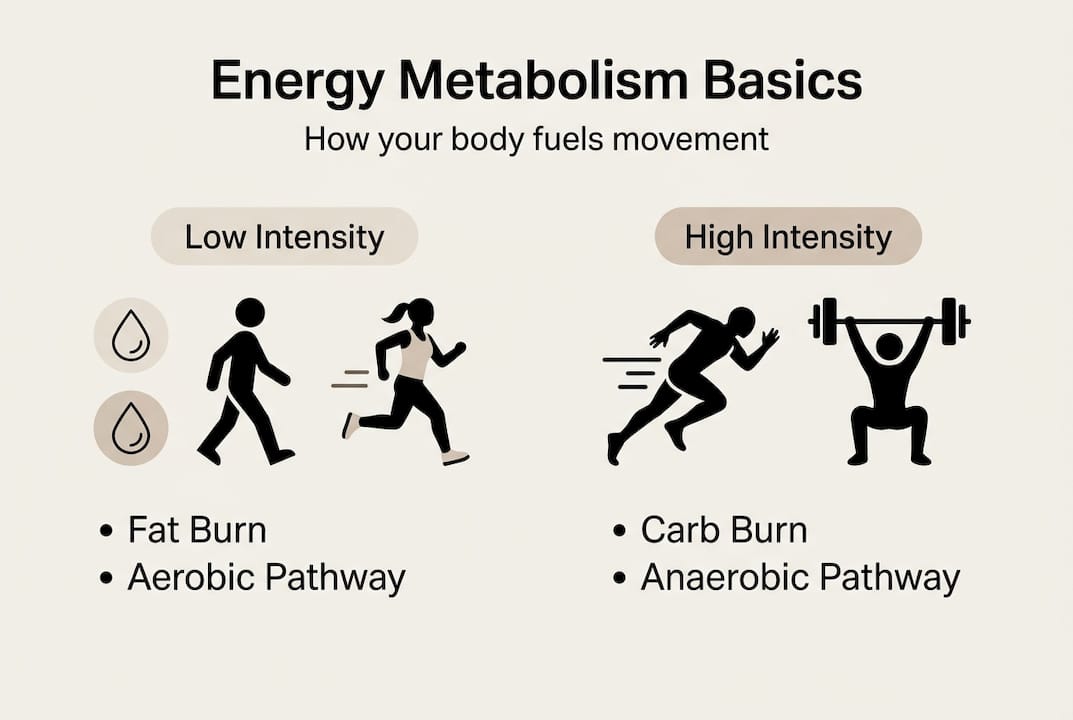
Pro Tip: Alternating between fasted low-intensity sessions and carb-fueled high-intensity workouts is one of the most practical ways to build metabolic flexibility over time.
Energy metabolism in real life: Exercise, fasting, and special cases
Knowing the pathways is one thing. Seeing how they play out in real scenarios makes the science actionable.
- Endurance training: Fat oxidation peaks at roughly 0.59 grams per minute at around 49% VO2max in trained athletes. As intensity climbs, carbohydrates take over progressively.
- Strength training: Relies heavily on phosphocreatine (the fastest ATP source) and anaerobic glycolysis for short, explosive efforts. Protein becomes critical for post-workout anabolism.
- Fasting and ketogenic diets: When carbohydrate intake drops significantly, the liver converts fatty acids into ketone bodies. Ketones become an alternative fuel for the brain and muscles, a state called ketogenesis.
- The Warburg effect: In certain conditions like hypoxia or cancer, cells switch to glycolysis even when oxygen is present. This abnormal metabolic shift is a major focus of cancer research and highlights how adaptable (and sometimes problematic) metabolism can be.
Stat to know: Fat oxidation in trained athletes can reach 0.59 g/min, but this drops sharply above moderate intensity as the body demands faster ATP production from carbohydrates.
For practical application, match your fuel to your goal. Long, slow cardio? Prioritize fat availability. High-intensity intervals or competition? Carbohydrate loading matters. For deeper guidance on fueling athletic performance or optimizing nutrient timing, the strategy shifts depending on your specific demands.
Eating for your metabolism: Macro balance, fitness, and diet strategies
Now the science becomes practical. Your macronutrient choices directly shape which metabolic pathways you activate, how efficiently you recover, and how well you perform.
Here’s the core principle: match your macros to your activity demands. High-carb intake supports performance in anaerobic and high-intensity work. Moderate fat intake sustains aerobic endurance. Protein spares glycogen and drives recovery, but contributes minimally as a direct energy source during exercise.
Steps for building a metabolism-friendly eating plan:
- Assess your training type: High-intensity athletes need more carbohydrates; endurance athletes benefit from fat adaptation strategies
- Prioritize whole food sources: Complex carbs, healthy fats, and complete proteins provide micronutrients that support enzymatic reactions in metabolic pathways
- Time your nutrients: Carbohydrates before and after high-intensity sessions, fats and protein in lower-intensity windows
- Avoid extreme restriction: Cutting entire food groups disrupts the balance between catabolism and anabolism, often at the cost of performance and muscle mass
- Track energy balance: Your basal metabolic rate (BMR) sets your floor. Eating significantly below it impairs metabolic function over time
- Personalize relentlessly: Genetics, training history, gut health, and hormonal status all affect how you process macros
A solid macronutrient guide helps you build the foundation, while targeted energy supplements can fill gaps when whole foods aren’t enough to meet your metabolic demands.
A fresh perspective: Why metabolic flexibility matters more than “quick fixes”
Here’s an uncomfortable truth: most popular diets work not because they’ve discovered a metabolic secret, but because they accidentally improve metabolic flexibility. Keto forces fat adaptation. Carb cycling trains fuel switching. Intermittent fasting activates AMPK and SIRT1. The mechanism is always the same. The diet is just the vehicle.
Chasing a single “optimal” diet misses the point entirely. Your metabolism is designed to adapt. Rigidly eliminating carbs or fats doesn’t make you metabolically superior. It makes you dependent on one fuel source, which is the opposite of resilience.
What actually drives long-term results is training your body to use both fat and carbohydrates efficiently, and adjusting your diet based on real feedback from your performance, recovery, and energy levels. That requires experimentation, not dogma.
The athletes and health-conscious individuals who thrive long-term aren’t the ones following the strictest plan. They’re the ones who understand their metabolism well enough to adjust. Prioritizing metabolic health as a foundation, rather than chasing short-term body composition goals, is what separates sustainable progress from the endless cycle of diet restarts.
Take your nutrition further with NutriBliss science-backed solutions
Understanding energy metabolism is the first step. Applying it consistently is where real change happens.

At NutriBliss, we build our product philosophy around the same science you’ve just read. Every supplement in our lineup is designed to support the metabolic processes that matter most, from ATP production and recovery to endurance and energy balance. Whether you’re looking to optimize your fueling strategy or fill nutritional gaps, explore the science behind superfoods that inform our formulations, or browse our full range of NutriBliss supplements to find what fits your goals. Your metabolism is already doing the work. Give it the right tools.
Frequently asked questions
What is the main purpose of energy metabolism in the body?
Energy metabolism converts nutrients into ATP, the energy currency every cell uses for activity, repair, and survival. Without this process, no biological function can continue.
Which macronutrient provides the most energy per gram?
Fats yield more than twice as much energy per gram as carbohydrates or proteins, making them the body’s most dense energy source. This is why fat is the preferred fuel during low-intensity, sustained activity.
How does exercise intensity affect energy metabolism?
Low-intensity exercise primarily burns fat through aerobic pathways, while high-intensity exercise shifts to carbohydrates via anaerobic glycolysis for faster ATP production. The transition between these systems is gradual, not a hard switch.
What regulates whether my body burns carbs or fat for energy?
Molecular sensors including AMPK, mTOR, and SIRT1 respond to your energy status, activity level, and nutrient intake to control which fuels are prioritized. These regulators can be influenced by training and dietary habits over time.
Is protein a major energy source during exercise?
Protein contributes minimally as a direct energy source during most exercise, primarily supporting recovery and muscle repair. It steps in more significantly during prolonged fasting or when carbohydrate and fat stores are depleted.