

TL;DR:
- Glycemic index ranks foods by how quickly they raise blood sugar, aiding better energy management.
- Food preparation, ripeness, and pairing with fats or fiber influence a food’s GI score.
- Combining GI with portion size, via glycemic load, offers practical guidance for balanced eating.
Not all carbs are created equal, and the glycemic index (GI) is the tool that proves it. The GI is a scale from 0 to 100 that ranks carbohydrate-containing foods based on how quickly they raise blood glucose compared to pure glucose. A white bread slice and a bowl of lentils both contain carbs, but their effects on your blood sugar are worlds apart. Understanding GI helps you make smarter choices for energy, weight management, and athletic performance. This guide covers what GI is, how it’s measured, what shifts it up or down, and how to use it practically every day.
Table of Contents
- What is glycemic index and how does it work?
- Glycemic index in action: Food examples and categories
- What influences glycemic index? The role of preparation, nutrients, and more
- Glycemic load and practical use: Beyond the numbers
- The health impact of glycemic index: What the science says
- An expert perspective: Why context matters more than numbers
- Your next step: Smarter nutrition choices with NutriBliss
- Frequently asked questions
Key Takeaways
| Point | Details |
|---|---|
| Glycemic index basics | GI ranks carbohydrates by how quickly they raise blood sugar compared to pure glucose. |
| Impact of food choices | Understanding GI helps you pick foods for steadier energy and better health outcomes. |
| Preparation matters | How you cook or combine foods changes their GI and their impact on your body. |
| Use GI plus GL | For practical eating, look at both the glycemic index and glycemic load. |
What is glycemic index and how does it work?
Glycemic index is a ranking system that tells you how fast a carbohydrate food raises blood glucose. The scale runs from 0 to 100, with pure glucose sitting at 100 as the reference point. Foods are classified into three categories: low GI (55 or below), medium GI (56 to 69), and high GI (70 or above). This simple classification gives you a fast way to predict how a food will behave in your body before you eat it.
The testing process is more rigorous than most people realize. GI is measured by feeding healthy volunteers 50 grams of available carbohydrates from the test food after an overnight fast. Blood glucose is then measured at regular intervals over two hours, and the results are compared to the same volunteer’s response to pure glucose. The process is repeated across multiple participants to get a reliable average score.
| GI Category | Score Range | Example Foods |
|---|---|---|
| Low GI | 0 to 55 | Lentils, apples, barley |
| Medium GI | 56 to 69 | Basmati rice, banana, oats |
| High GI | 70 and above | White bread, potatoes, rice cakes |
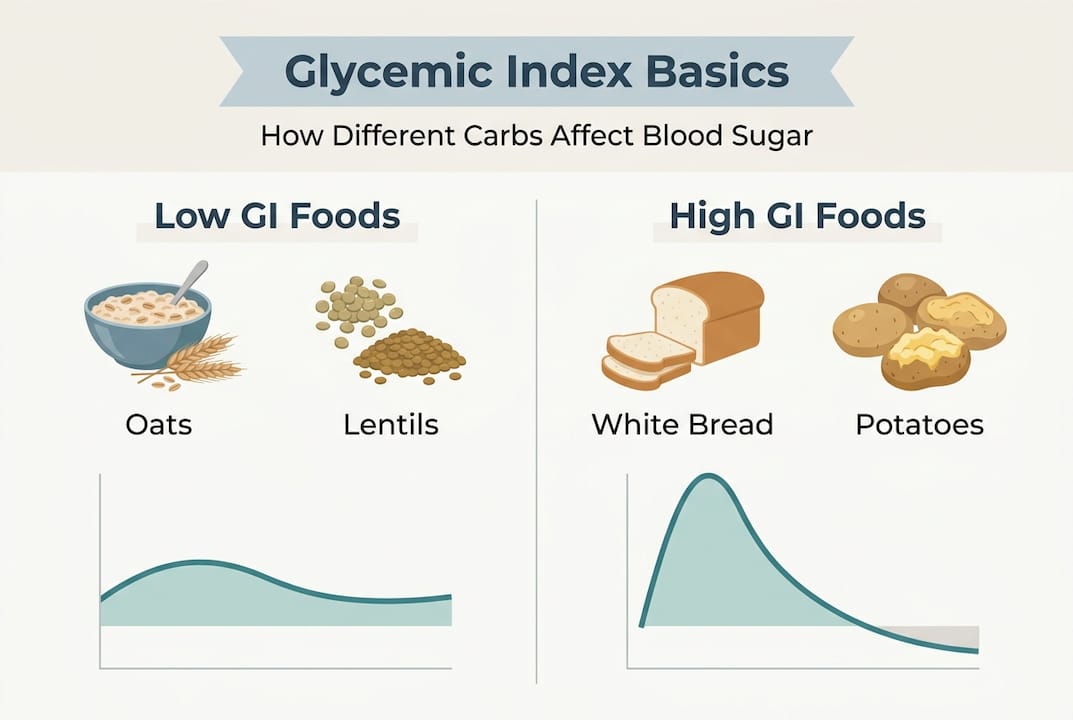
The Harvard Health glycemic index overview notes that low GI foods digest more slowly, causing a gradual rise in blood sugar rather than a sharp spike. This matters for energy levels, hunger control, and long-term metabolic health. A steady blood sugar curve keeps you focused and fueled, while a sharp spike followed by a crash leaves you tired and hungry faster.
“Choosing low GI carbohydrates is one of the simplest ways to improve blood sugar stability and sustain energy throughout the day.”
Pro Tip: GI measures only how fast carbs raise blood sugar. It says nothing about a food’s overall nutritional value. Candy and carrots can share a similar GI score, but they are not nutritionally equivalent. Always use GI alongside other quality markers when building your diet. For a deeper look, check out our glycemic index guide.
Glycemic index in action: Food examples and categories
Seeing GI in action makes the concept click fast. Real foods tell the story better than any formula. Low GI foods include apples (36 to 39), lentils (30), and barley (28), while medium GI foods include basmati rice (58) and ripe bananas. High GI foods like white bread (71 to 100), potatoes, and rice cakes digest rapidly and drive blood sugar up quickly.
| Food | GI Score | Category |
|---|---|---|
| Barley | 28 | Low |
| Lentils | 30 | Low |
| Apple | 36 to 39 | Low |
| Basmati rice | 58 | Medium |
| Banana (ripe) | 62 | Medium |
| White bread | 71 to 100 | High |
| Baked potato | 85 | High |
| Rice cakes | 82 | High |
What surprises many fitness enthusiasts is how dramatically processing changes a food’s GI score. Here are fast facts worth knowing:
- Cooking time matters. Pasta cooked al dente has a lower GI than overcooked, mushy pasta.
- Ripeness raises GI. A green banana has a GI around 30, while a fully ripe banana climbs to 62.
- Processing spikes GI. Instant oats have a higher GI than steel-cut oats, even though they start from the same grain.
- Particle size counts. Whole grain flour raises blood sugar slower than finely milled white flour.
- Cooling cooked starches helps. Cooled cooked rice or potatoes develop resistant starch, which lowers GI.
For a full breakdown of GI values of common foods, there are reliable databases you can reference when planning meals. The practical takeaway is to build familiarity with your staple foods’ GI scores so you can make easy swaps. Switching white bread for sourdough or white rice for basmati are small changes that add up over time. Pairing these swaps with balanced diet strategies gives you a solid foundation for steady energy and better body composition.
What influences glycemic index? The role of preparation, nutrients, and more
GI is not a fixed property stamped permanently onto a food. It shifts based on how you prepare it, what you eat with it, and even how ripe it is. Understanding these variables gives you real control over your blood sugar response.
Key factors that raise or lower GI include:
- Cooking method. Al dente pasta has a lower GI than well-cooked pasta because intact starch granules digest more slowly.
- Fiber content. High-fiber foods slow digestion and blunt glucose absorption. The benefits of dietary fiber extend well beyond GI management.
- Fat and protein. Both slow gastric emptying, which reduces the speed of carb absorption.
- Acid. Vinegar, lemon juice, and fermented foods like sourdough lower GI by slowing starch digestion.
- Ripeness. As fruit ripens, starches convert to sugars, pushing GI higher.
- Processing level. The more processed a food, the faster it typically digests.
According to detailed GI factors research, cooking method, fiber, fat, protein, and acid all meaningfully shift a food’s GI score. This is why a mixed meal behaves differently than eating a single food in isolation. A plate of white rice eaten alone will spike blood sugar faster than white rice served with grilled chicken, olive oil, and a side salad.

Pro Tip: Combine your carbs with a source of protein or healthy fat at every meal. This simple habit blunts blood sugar spikes without requiring you to eliminate any food group. It’s one of the most practical applications of GI science in daily eating. Learning more about fiber and health can also help you build meals that naturally lower the overall GI of your diet.
Glycemic load and practical use: Beyond the numbers
GI tells you how fast a food raises blood sugar. But it doesn’t account for how much of that food you actually eat. That’s where glycemic load (GL) becomes essential.
GL is calculated as (GI x grams of carbs per serving) divided by 100. A GL of 10 or below is low, 11 to 19 is medium, and 20 or above is high. Watermelon is the classic example: it has a high GI of around 72, but a typical serving contains so few carbs that its GL is only about 4. Eating a slice of watermelon won’t spike your blood sugar the way a bowl of white pasta will.
Here’s how to use GL and GI together for smarter meal planning:
- Identify your staple carbs. Look up the GI of the carbs you eat most often and note which are high.
- Check portion sizes. Calculate GL for your typical serving to see the real blood sugar impact.
- Prioritize low GL meals. Build meals around low to medium GL foods for steady energy and fewer cravings.
- Time your carbs around workouts. Higher GI carbs before or after training can support glycogen loading for athletes and recovery.
- Mix food groups. Add protein, fat, and fiber to every carb-containing meal to lower the effective GL.
The glycemic index explained by Cleveland Clinic reinforces that GI and GL are tools, not rules. They work best as part of a personalized nutrition approach that considers your fitness goals, health status, and food preferences together.
The health impact of glycemic index: What the science says
Research on GI has grown substantially over the past two decades. The evidence points to real benefits, especially for blood sugar management, but also highlights important nuances worth understanding.
Key science-backed benefits of low GI eating include:
- Better blood glucose control. Low GI diets improve blood glucose control in people with diabetes and reduce post-meal spikes in healthy individuals.
- Improved satiety. Low GI foods tend to keep you fuller longer, which supports calorie control without strict restriction.
- Modest A1c improvements. Studies show low GI diets can produce small but meaningful reductions in hemoglobin A1c, a key marker of long-term blood sugar.
- Weight management support. Fewer blood sugar swings mean fewer intense hunger signals, making it easier to maintain a healthy weight.
The cardiometabolic health research also suggests links between low GI eating and reduced cardiovascular risk markers, though the evidence here is still developing. Scientists agree that GI is useful for blood sugar management but debate whether it produces long-term benefits independent of overall diet quality.
“The glycemic index is a valuable tool, but it works best when it’s one part of a broader, balanced approach to eating rather than the sole guiding principle.”
The bottom line is that GI is a genuinely useful lens. It just isn’t the only one you need.
An expert perspective: Why context matters more than numbers
After reviewing the evidence, one thing stands out clearly: fixating on GI scores alone can actually lead you astray. We’ve seen health-conscious people avoid perfectly nutritious foods like carrots or watermelon because of a high GI number, while happily eating processed low GI snacks that offer little nutritional value. That’s the GI trap.
The GI varies by individual and meal context and isn’t suitable as a standalone guide. Two people eating the same meal can have completely different blood sugar responses based on gut microbiome, stress levels, sleep quality, and fitness status. This means your personal response matters as much as any published GI score.
The most effective approach we’ve seen combines lean protein, healthy fats, and varied carbs in each meal, using GI and GL as flexible reference points rather than rigid rules. A grilled salmon bowl with quinoa, avocado, and roasted vegetables doesn’t need a GI score to be an excellent choice. You already know it’s balanced. Use GI to upgrade your default carb choices and to time carbs strategically around workouts, then step back and trust the bigger picture. Check out our glycemic index guide for more practical frameworks.
Pro Tip: Experiment with your own meals. Track how you feel two hours after eating different carb sources. Your lived experience is the most relevant data point you have.
Your next step: Smarter nutrition choices with NutriBliss
Now that you understand how GI and GL shape your energy, hunger, and performance, the next step is putting that knowledge into practice.

At NutriBliss, we build our product lineup around the same science-backed principles you just read about. Whether you’re looking for fitness supplements to fuel your training or want to explore the science behind superfoods that naturally support stable blood sugar, we have options designed to complement a smart, balanced diet. Our approach is grounded in a whole nutrition philosophy that treats supplements as tools to fill gaps, not shortcuts. Browse our catalog and find what fits your goals.
Frequently asked questions
Is low glycemic index always better for health?
Low GI foods support blood sugar control and steady energy, but overall diet quality, fiber intake, and meal balance matter just as much as any individual food’s score.
Can glycemic index vary for the same food?
Yes, cooking method, ripeness, and fiber all shift a food’s GI score, which is why the same food can behave differently depending on how it’s prepared and what it’s eaten with.
How is the glycemic index of a food tested?
Healthy volunteers consume 50g of available carbohydrates from the test food after fasting overnight, and their blood glucose is tracked for two hours to calculate the GI score.
What is the difference between glycemic index and glycemic load?
GL accounts for portion size by factoring in the actual grams of carbs per serving, making it a more practical tool for real-world meal planning than GI alone.
Should people with diabetes only eat low GI foods?
Not necessarily. While low GI choices help manage blood sugar, GI is not suitable alone and works best alongside total carb amounts, meal balance, and individual health goals.