

TL;DR:
- Proper carb loading involves increasing carbohydrate intake 36 to 48 hours before endurance events longer than 90 minutes.
- It maximizes muscle glycogen stores, delaying fatigue and improving race performance.
- Tailoring carb intake based on individual needs and training through practice enhances effectiveness and reduces side effects.
That pasta dinner the night before race day is practically a ritual at this point. But if you think one plate of spaghetti is doing the work of a real carb loading protocol, you are leaving serious performance on the table. True carb loading is a deliberate, science-driven strategy that begins days before your event, not hours. When done correctly, it maximizes the glycogen stored in your muscles, pushes back the point at which your body hits the wall, and gives you a measurable edge over competitors who are still winging their nutrition. This article breaks down the exact science, the protocols that work, and the mistakes that derail even experienced athletes.
Table of Contents
- The science behind carb loading
- How to carb load: Protocols and practical steps
- Carb loading pitfalls and side effects
- Supplements and fueling during events: Beyond carb loading
- The nuanced truth: Customizing carb loading for real-world athletes
- Optimize your fueling with Nutribliss
- Frequently asked questions
Key Takeaways
| Point | Details |
|---|---|
| Carb loading increases glycogen | Strategic carb loading prior to endurance events boosts stored glycogen and delays fatigue. |
| Timing and dose matter | Optimal results require 36–48 hours of high-carb intake tailored to event length and athlete weight. |
| Watch for temporary weight gain | Extra glycogen binds water, so minor weight increases are normal and not harmful. |
| In-event fueling is essential | Even with carb loading, athletes should fuel with carbs during longer events. |
| Customization is key | Adjust protocols to individual needs for best results—there’s no universal formula. |
The science behind carb loading
Your muscles run primarily on glycogen during sustained, high-intensity effort. Glycogen is simply glucose molecules chained together and stored in your muscle tissue and liver. Think of it as your body’s high-performance fuel tank. The problem is that tank is not very large. For most athletes, a full glycogen store provides energy for roughly 90 to 120 minutes of hard effort before depletion sets in and performance craters.
Carb loading solves this problem by systematically overfilling that tank before competition. When you combine a reduction in training volume (called a taper) with a significant increase in carbohydrate intake over 36 to 48 hours, your muscles can store glycogen at levels well above their everyday baseline. The ergogenic benefits for events longer than 90 minutes are well documented in sports science literature, making this one of the most evidence-supported nutrition strategies available to endurance athletes.
The mechanism is straightforward but important to understand. During exercise, muscle glycogen breaks down rapidly to produce ATP, the currency your cells use for energy. When glycogen runs low, the body shifts to slower fat metabolism and performance drops noticeably. By starting an event with maximally loaded glycogen stores, you push that crossover point further into the race. You have more fuel available at the intensity that actually matters for competition.
Here is a quick look at how glycogen loading translates to real energy reserves:
| Glycogen state | Approx. storage (g) | Energy available (kcal) | Duration at race pace |
|---|---|---|---|
| Normal (untrained) | 300 to 400 g | 1,200 to 1,600 kcal | ~60 to 90 min |
| Trained athlete baseline | 400 to 500 g | 1,600 to 2,000 kcal | ~90 to 120 min |
| Fully carb loaded | 600 to 900 g | 2,400 to 3,600 kcal | ~150 to 180+ min |
“Carb loading is not just about eating more carbs. It’s about timing your intake to coincide with a reduced training load so your muscles can actually store the surplus rather than burn it.”
Liver glycogen is also a key part of this equation. Your liver acts as a release valve, dumping glucose into the bloodstream to maintain blood sugar levels during prolonged activity. A well-loaded liver ensures your brain and working muscles both have access to fuel when your event runs long. For deeper insight into how this process works, reviewing glycogen loading tips tailored specifically for athletes can help you put theory into practice before your next race.
How to carb load: Protocols and practical steps
Now that you understand why carb loading matters, let’s look at exactly how you can implement it for your next event.
The most important variable in your carb loading calculation is event duration. Sports medicine research is clear: carb loading for prolonged events over 90 minutes calls for a daily carbohydrate intake of approximately 10 to 12 grams per kilogram of body weight, initiated 36 to 48 hours before competition. For a 70 kg athlete, that translates to 700 to 840 grams of carbohydrate per day during the loading window. That is a significant amount and most athletes are surprised by just how much food that requires.
For shorter events under 90 minutes, the calculus changes. A full two-day loading protocol is generally unnecessary. Instead, restoring normal glycogen levels with a carbohydrate-rich diet of 6 to 12 g/kg in the 24 hours before the event is usually sufficient. You do not need to overfill a tank you are not going to empty anyway.
Here is a step-by-step protocol for a race exceeding 90 minutes:
- Two days before the event: Cut training volume to 20 to 30 percent of your normal load. Begin increasing carbohydrate intake toward the 10 to 12 g/kg daily target. Focus on low-fiber, easily digestible sources like white rice, pasta, bread, potatoes, and sports drinks.
- Day before the event: Maintain reduced training or rest completely. Continue hitting the carbohydrate target. Spread intake across 5 to 6 smaller meals rather than forcing two or three giant ones. This aids absorption and reduces digestive stress.
- Morning of the event: Eat a familiar, moderate-carbohydrate meal 2 to 3 hours before the start. Aim for 1 to 4 g/kg of carbohydrates. Prioritize foods you have tested before in training. This is not the moment to experiment with new foods.
- Hydration: Drink consistently throughout the loading period. Glycogen binds water, which increases your fluid needs noticeably during this phase.
For a 70 kg athlete targeting 10 g/kg, a typical day might look like this: oatmeal with honey and banana for breakfast, white rice and chicken for lunch, pasta with tomato sauce mid-afternoon, a sports drink during a short evening walk, and a light bagel with jam as an evening snack. That adds up to roughly 700 grams of carbohydrate without necessarily feeling like a food coma.

Pro Tip: Choosing low-fiber carbohydrate sources during the loading window is strategic, not lazy. Fiber slows absorption and can cause bloating and GI distress during competition. Save the vegetables and whole grains for your regular training weeks.
Solid performance nutrition planning that incorporates these steps is one of the clearest separators between athletes who fade in the second half of events and those who close strong. Pairing this with broader endurance nutrition strategies rounds out your entire race-week preparation.
Carb loading pitfalls and side effects
After learning the methods, it is vital to know the potential pitfalls and how to avoid them.
The most commonly reported side effect is temporary weight gain. Each gram of glycogen binds approximately 3 grams of water. As your muscles fill up, your body weight rises by 1 to 3 kilograms in many athletes. Research confirms that carb loading increases body weight temporarily and can theoretically reduce exercise efficiency, though the energy benefit from higher glycogen stores almost always outweighs this slight mechanical disadvantage in real events. Understanding this prevents unnecessary panic when you step on the scale two days before a race and see a number you have not seen in months.
Here are the most common pitfalls athletes run into:
- Overconsumption with no taper: Eating 10 to 12 g/kg while continuing hard training means you are burning through the glycogen as fast as you load it. The taper is not optional.
- Unfamiliar foods causing GI distress: Race week is the worst possible time to try a new pasta brand or a different sports gel. Stick to tested foods.
- Ignoring protein and fat completely: While carbohydrates are the priority, dropping fat and protein too aggressively can leave you feeling tired and undernourished heading into the event. A ratio of roughly 70 to 75 percent carbohydrate, 15 percent protein, and 10 to 15 percent fat works for most athletes during loading days.
- Dehydration: The water demand that comes with glycogen storage is real. If you are not consciously increasing fluid intake, you may show up to the start line mildly dehydrated, which reduces endurance performance by more than most athletes realize.
- Skipping the protocol entirely then panic eating: One large meal the night before does nothing to meaningfully raise glycogen beyond normal training levels.
Key stat: Athletes who follow a structured carb loading protocol before events over 90 minutes consistently perform better in the final third of their race compared to those fueling only with pre-race meals. This is where proper planning shows up most visibly. Good sports nutrition tips will always emphasize that the final phase of any long event is where your glycogen strategy either pays off or costs you time.
Digestive discomfort is also worth addressing directly. High carbohydrate intake, especially from processed or unfamiliar sources, can cause bloating, gas, and loose stools. Athletes sensitive to this should test their loading protocol during a training week before implementing it at a real event.
Supplements and fueling during events: Beyond carb loading
Carb loading is only part of the equation; fueling strategies during events are equally crucial.
No matter how well you carb load, a marathon, ironman, or ultra-endurance race will eventually drain those stores if you do not replenish during the effort. Exogenous carbohydrate ingestion during longer events measurably improves performance, but there are practical limits on how much your gut can absorb and use in real time.
The table below summarizes the general fueling targets by event duration:
| Event duration | Recommended in-event carb intake | Suggested sources |
|---|---|---|
| Under 60 minutes | None necessary (mouth rinse optional) | Water |
| 60 to 150 minutes | 30 to 60 g per hour | Sports drinks, gels |
| Over 150 minutes | 60 to 90 g per hour | Multiple-carb sources |
The “multiple-carb sources” note in the final row is critical. Your gut uses different transport proteins for glucose and fructose. Consuming only glucose-based carbohydrates (like maltodextrin or standard sports drinks) caps absorption at around 60 grams per hour. Mixing glucose and fructose, as you find in many modern endurance gels and drinks, allows your intestines to use both pathways simultaneously. This is how athletes absorb up to 90 grams per hour without GI overload.
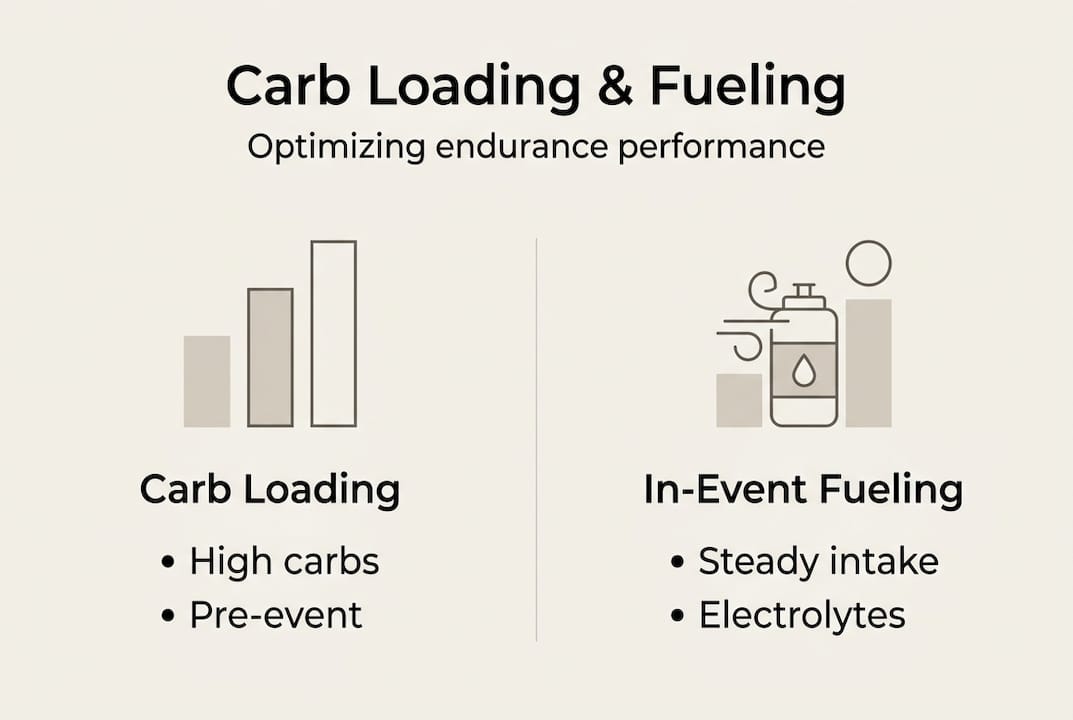
This interaction between pre-loading and in-event fueling is where the real optimization happens. Think of carb loading as filling your tank before the race starts, and in-event fueling as keeping a fuel line running throughout. Neither strategy works as well in isolation. Smart athletes treat these as two separate but connected tools. You can explore supplements for endurance specifically formulated to help bridge that in-event fueling gap with the right carbohydrate blends.
Pro Tip: Practice your in-event fueling strategy during long training sessions at race intensity. The gut adapts to consuming carbohydrates while running or cycling hard, and athletes who train this way tolerate far more carbohydrate per hour on race day with no GI issues.
Electrolytes also deserve a mention here. Carb loading increases your water retention and fluid requirements, and during the event itself, sweat loss creates an electrolyte deficit that can impair muscle function long before glycogen runs low. Pairing your carbohydrate fueling with sodium and potassium replacement keeps your hydration strategy working alongside your energy strategy.
The nuanced truth: Customizing carb loading for real-world athletes
Here is the take that most nutrition articles skim past: carb loading is not a single universal protocol that works identically for every athlete, every event, and every body.
Research has stirred ongoing debate about how high carbohydrate intake actually needs to go for meaningful glycogen supercompensation. For athletes with larger muscle mass or those doing extremely high weekly training volume, the 10 to 12 g/kg window may be genuinely necessary. For a lighter athlete or someone competing in an event lasting just over 90 minutes, a more moderate protocol of 7 to 9 g/kg may produce equivalent results with far less digestive stress.
The sports medicine community also recognizes that carb loading strategies vary considerably based on event type, athlete metabolism, and training context. A cyclist doing a six-hour gran fondo has fundamentally different needs from a half-marathon runner targeting a sub-90-minute finish. One-size-fits-all guidance often leads athletes to either under-prepare or unnecessarily stuff themselves for two days before an event that does not require it.
We think the best approach is to test your carb loading protocol in training, not just on race weekend. Schedule a B-race or a long training simulation, load deliberately for it, and note how your body responds in terms of energy, weight, digestion, and performance. That real-world data is worth more than any formula. For a tailored approach, exploring personalized nutrition strategies built around your specific physiology and event demands is the clearest path to consistent improvement.
Optimize your fueling with Nutribliss
Ready to take your carb loading and fueling to the next level?
At Nutribliss, we back every product recommendation with research that endurance athletes actually care about. We know that carb loading without the right supporting nutrition is only half the equation. Understanding the science behind superfoods and how they integrate with your training fueling plan adds another layer of competitive advantage. Whether you are looking for comprehensive Nutribliss supplements to fill gaps in your race-week nutrition, or you need a reliable electrolytes supplement to support the increased fluid demands that come with glycogen loading, we have the tools to support your entire fueling strategy from pre-race loading through to the finish line.

Frequently asked questions
What is the ideal amount of carbohydrate to consume for carb loading?
Most endurance athletes benefit from 10 to 12 g/kg daily for approximately 36 to 48 hours before events lasting longer than 90 minutes. A 70 kg athlete would target between 700 and 840 grams of carbohydrate per day during this window.
Does carb loading work for shorter events?
Full carb loading delivers the biggest benefit for events over 90 minutes. Athletes competing in shorter events can restore normal glycogen with 6 to 12 g/kg carbohydrates in the 24 hours prior without needing a multi-day loading protocol.
Will I gain weight from carb loading?
Yes, and that is expected. Carb loading increases body weight temporarily because glycogen binds water at a roughly 1:3 ratio. The temporary gain is harmless and the performance benefit from extra glycogen clearly outweighs any minor mechanical disadvantage.
How should I fuel during a long event if I’ve carb loaded?
For events over 150 minutes, target 60 to 90 grams of carbohydrate per hour during the event, using a mix of glucose and fructose sources to maximize gut absorption. For events lasting 60 to 150 minutes, 30 to 60 grams per hour is the appropriate target range.