

Despite its reputation as a pollutant in car exhaust, nitric oxide is one of the most powerful molecules your body produces. It controls how much blood reaches your muscles, how fast your nerves fire, and how well your immune system responds to threats. Essential for blood flow, it sits at the intersection of cardiovascular health and athletic performance. If you’ve ever felt a serious muscle pump during training or noticed faster recovery after a hard workout, nitric oxide played a role. This guide breaks down exactly how it works, where it comes from, and what the science actually says about boosting it.
Table of Contents
- What is nitric oxide? The basics and its role in the body
- How your body makes nitric oxide: Pathways and key sources
- Boosting nitric oxide for performance: What works, what doesn’t
- Safety, risks, and the other side: When more nitric oxide isn’t better
- Why nitric oxide isn’t a silver bullet—and what actually matters for real results
- Enhance your wellness and performance with science-backed nutrition
- Frequently asked questions
Key Takeaways
| Point | Details |
|---|---|
| Essential molecule | Nitric oxide is vital for heart health, blood flow, and exercise performance. |
| Two production pathways | Your body makes NO endogenously and from dietary nitrates, both important for athletes. |
| Best boosters | Nitrate-rich foods like beetroot and L-citrulline supplements are most effective. |
| Safety matters | Moderation is key as too much nitric oxide can be harmful. |
What is nitric oxide? The basics and its role in the body
Nitric oxide (NO) is a tiny molecule made of one nitrogen atom and one oxygen atom. Simple structure, enormous impact. Your body produces it constantly, using it as a chemical messenger to keep dozens of systems running smoothly. Unlike most molecules in your body, NO doesn’t stick around. It lasts only a few seconds before breaking down, which means your body must produce it continuously to maintain its effects.
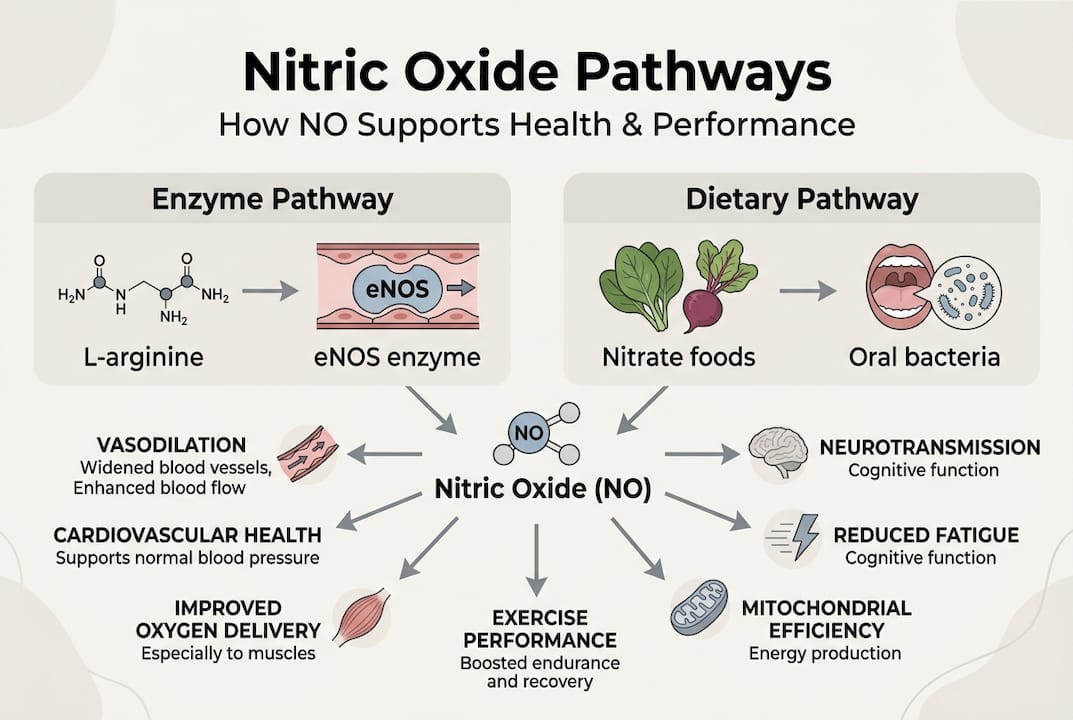
The primary way your body makes NO is by breaking down the amino acid L-arginine. A group of enzymes called nitric oxide synthases (NOS) drive this reaction. There are three main NOS isoforms, each with a distinct job:
| NOS Type | Location | Primary Role |
|---|---|---|
| eNOS (endothelial) | Blood vessel walls | Relaxes vessels, controls blood pressure |
| nNOS (neuronal) | Nervous system | Supports nerve signaling and memory |
| iNOS (inducible) | Immune cells | Fights pathogens and infection |
Each isoform targets a specific system, but they all produce the same molecule. The context determines the effect.
The most relevant function for athletes and fitness enthusiasts is vasodilation. When eNOS produces NO in your blood vessel walls, those vessels relax and widen. More blood flows through. That means more oxygen, more glucose, and faster removal of waste products like lactate from working muscles. It’s the biological engine behind the “pump” you feel during resistance training.
Beyond blood flow, NO acts as a vasodilator, neurotransmitter, and immune modulator, making it relevant well beyond the gym. It supports memory and learning through nNOS, and it helps your immune system destroy bacteria and viruses through iNOS. For anyone focused on nitric oxide for fitness, the eNOS pathway is the primary target, but the whole system works together.
- Vasodilation: increases blood flow and muscle oxygen delivery
- Neurotransmission: supports focus and nerve-to-muscle communication
- Immune defense: helps white blood cells neutralize pathogens
- Mitochondrial function: may improve energy efficiency at the cellular level
Pro Tip: If your goal is performance, focus on supplements and foods that specifically support eNOS activity. Not all NO pathways are equally relevant to exercise output.
How your body makes nitric oxide: Pathways and key sources
Your body has two distinct routes for producing nitric oxide, and understanding both changes how you approach supplementation and diet.
Route 1: The enzyme pathway (L-arginine to NO)
- You consume protein containing L-arginine, or your body synthesizes it.
- NOS enzymes bind to L-arginine along with cofactors like BH4, NADPH, and oxygen.
- The reaction converts L-arginine into L-citrulline and releases NO.
- NO diffuses into nearby cells and triggers its effects within seconds.
- NO breaks down rapidly, and the cycle must restart continuously.
Route 2: The dietary nitrate pathway
- You eat nitrate-rich foods like beetroot, spinach, or arugula.
- Nitrate (NO3) is absorbed into your bloodstream and circulated to your salivary glands.
- Oral bacteria on your tongue reduce nitrate to nitrite (NO2).
- You swallow the nitrite-rich saliva, and stomach acid converts some of it to NO.
- During exercise, low-oxygen and acidic muscle conditions accelerate this conversion further.
Dietary nitrate converts to NO via oral bacteria, which is why beetroot juice has become one of the most researched ergogenic aids in sports nutrition.
| Factor | Enzyme pathway | Dietary nitrate pathway |
|---|---|---|
| Main input | L-arginine | Nitrate-rich foods or supplements |
| Key requirement | NOS enzymes, cofactors | Oral bacteria, acidic conditions |
| Speed | Fast, continuous | Slower, peaks 2-3 hours post-intake |
| Fitness relevance | Baseline NO production | Acute performance boost |
| Best food sources | Meat, dairy, nuts | Beetroot, spinach, arugula |
For supplements for endurance athletes, the dietary nitrate pathway tends to deliver more consistent, measurable results during training. The enzyme pathway matters more for baseline cardiovascular health and recovery.

Pro Tip: Skip the antibacterial mouthwash before training. It kills the oral bacteria that convert nitrate to nitrite, which can reduce NO production from dietary sources by up to 90%. This is one of the most overlooked factors in nutrition for athletic success.
Boosting nitric oxide for performance: What works, what doesn’t
Not every supplement labeled “nitric oxide booster” actually raises your NO levels in a meaningful way. The evidence is uneven, and the marketing often runs well ahead of the science.
What actually works:
- Beetroot juice and dietary nitrate: The strongest evidence base. Beetroot juice improves time-to-exhaustion and power output in trained athletes, with effect sizes varying based on fitness level and dose.
- Spinach, arugula, and leafy greens: High natural nitrate content supports the dietary pathway consistently.
- L-citrulline: More effective than L-arginine for raising plasma arginine levels. L-citrulline shows better results because it bypasses the gut and liver metabolism that limits arginine absorption.
- Watermelon extract: A natural source of L-citrulline with growing research support.
What often falls short:
- L-arginine supplements: The “arginine paradox” is real. Even when you flood the body with arginine, NOS enzymes don’t always produce more NO because they’re already operating near capacity. Oral L-arginine is also poorly absorbed at high doses.
- Generic “pump” pre-workouts: Many contain proprietary blends with unproven doses of multiple ingredients, making it impossible to know what’s actually working.
One important nuance: the performance benefit from dietary nitrate is more pronounced in recreational and intermediate athletes than in elite competitors. Highly trained athletes already have optimized cardiovascular efficiency, leaving less room for improvement. The benefit also tends to shrink at high altitude, where oxygen dynamics shift.
When evaluating any NO boosters for performance, look for products that list specific doses of active ingredients. If a product relies on a proprietary blend, that’s a red flag. A well-dosed L-arginine supplement can still play a supporting role, especially when combined with citrulline.
Safety, risks, and the other side: When more nitric oxide isn’t better
More is not always better. Nitric oxide operates within a narrow biological window, and pushing past it creates real risks that most supplement marketing ignores.
When NO production becomes excessive, particularly during inflammation, it reacts with superoxide radicals to form peroxynitrite. This compound is highly reactive and damages proteins, lipids, and DNA. Excess NO forms harmful peroxynitrite, especially in the presence of chronic inflammation, which is a concern for anyone with underlying health conditions.
“Nitric oxide is a double-edged molecule. At physiological levels, it protects your cardiovascular system. At excessive levels, it contributes to oxidative stress and tissue damage. The goal is optimization, not maximization.”
For healthy recreational athletes, standard doses of beetroot juice or citrulline supplements are generally well tolerated. The risk increases with:
- Pre-existing low blood pressure (NO lowers blood pressure further)
- Use of medications like PDE5 inhibitors (e.g., sildenafil) that already raise NO signaling
- Chronic inflammatory conditions where iNOS is already overactive
- Stacking multiple NO-boosting supplements without tracking total intake
Safety tips for NO supplementation:
- Start with the lowest effective dose and assess your response before increasing
- Avoid combining multiple NO boosters without guidance from a healthcare provider
- Monitor blood pressure if you supplement regularly, especially with nitrate-rich products
- Pair NO-boosting supplements with antioxidants for wellness to help neutralize any oxidative byproducts
- Take a break from supplementation periodically to prevent tolerance buildup
Environmental nitric oxide (from pollution, combustion) is a different story entirely. Inhaled NO from external sources contributes to respiratory irritation and smog formation. This is chemically the same molecule but in a completely different context than what your body produces endogenously.
Why nitric oxide isn’t a silver bullet—and what actually matters for real results
Here’s the uncomfortable truth most supplement ads skip: nitric oxide is genuinely useful, but it’s not a shortcut. We’ve seen athletes obsess over beetroot shots and citrulline stacks while neglecting sleep, training consistency, and overall caloric intake. The NO boost from a supplement is real but modest. It might improve a 5K time by a few seconds or help you squeeze out an extra rep. That matters at the margins, but it won’t compensate for a poor training program or inconsistent nutrition.
The athletes who benefit most from NO-focused strategies are those who already have the fundamentals locked in. They’re using evidence-based supplements as a final layer of optimization, not a foundation. If your overall nutrition strategy is solid, adding dietary nitrate or citrulline can genuinely move the needle. If it’s not, no amount of NO boosting will close that gap.
Demand specifics from any supplement brand. Ask for the dose, the form, and the clinical evidence behind it. Vague claims about “supporting nitric oxide” without a cited mechanism or dose are marketing, not science.
Enhance your wellness and performance with science-backed nutrition
If this breakdown has you thinking more critically about what goes into your supplement stack, that’s exactly the point. Understanding the science behind nitric oxide is step one. Choosing products that actually deliver on that science is step two.

At NutriBliss, we take a research-first approach to every product we formulate. Whether you’re exploring NutriBliss science behind our formulations, reading about the science behind superfoods, or ready to browse our full lineup, you’ll find products built around evidence, not hype. Visit shop NutriBliss supplements to explore options that align with your performance and wellness goals.
Frequently asked questions
What does nitric oxide do in my body?
Nitric oxide relaxes blood vessels, improves circulation, supports nerve signaling between neurons, and helps immune cells neutralize pathogens. It functions as a signaling molecule across multiple body systems simultaneously.
What foods and supplements boost nitric oxide naturally?
Beetroot, spinach, arugula, and other nitrate-rich vegetables are the most effective natural sources. Nitrate-rich supplements like concentrated beetroot juice also show consistent results in research settings.
Are nitric oxide boosters safe?
For healthy adults following recommended doses, most NO-boosting supplements are safe. However, overproduction of NO can trigger oxidative stress, so people with low blood pressure or chronic inflammation should consult a doctor first.
Why don’t all nitric oxide supplements work?
L-arginine often fails to raise NO because NOS enzymes are already near capacity and oral arginine absorbs poorly at high doses. L-citrulline and dietary nitrate from whole foods or beetroot extracts have stronger and more consistent research backing.