

TL;DR:
- Progress tracking involves measuring specific indicators regularly to guide personal health and fitness goals. Using 1-3 focused metrics and consistent weekly reviews helps turn data into actionable insights, avoiding overwhelm and increasing adherence.
Progress tracking is the practice of measuring specific indicators consistently and reviewing them regularly to move toward your personal health, fitness, or wellness goals. Without a system in place, you are guessing. With one, you get a feedback loop that tells you what is working and what needs to change. Tools like Fitbit, habit-tracking apps, spreadsheets, and paper journals all serve this purpose. Research confirms that defining 1–3 measurable indicators per goal and reviewing them weekly is the most reliable way to link daily actions to long-term outcomes.
How to track progress: choosing the right metrics first
The first decision in any tracking system is what to measure. Most people skip this step and start logging everything, which leads to data overload and eventual burnout.
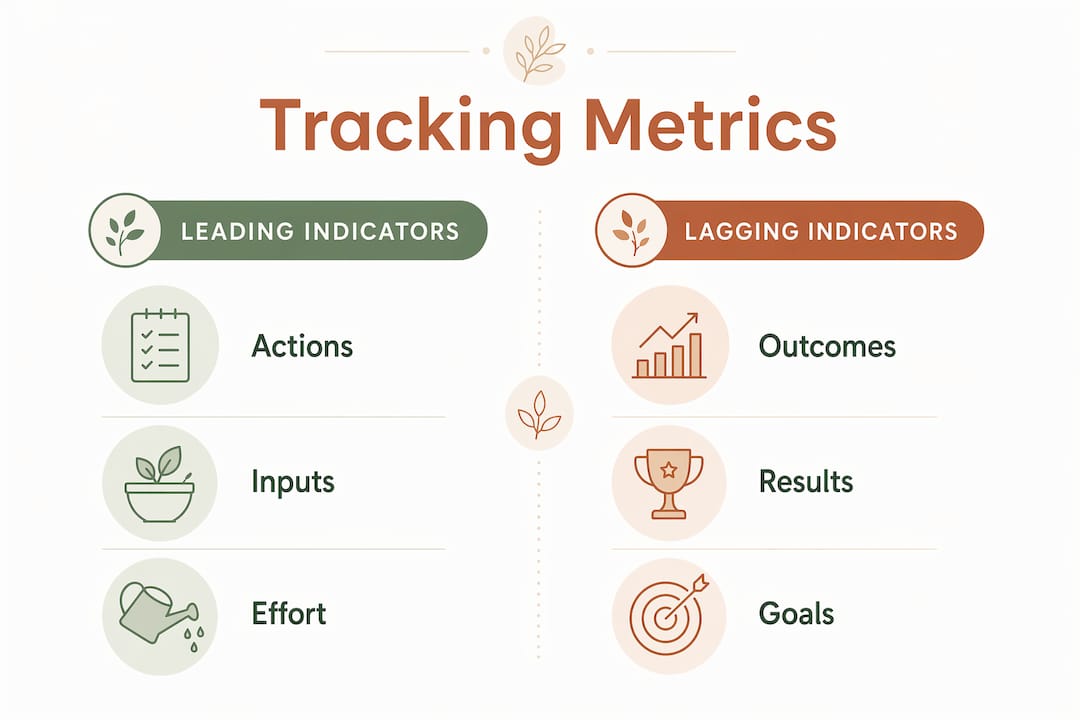
The clearest framework separates metrics into two types: leading indicators and lagging indicators. Leading indicators are controllable inputs like hours trained per week, daily step count, or glasses of water consumed. Lagging indicators are outcomes like body weight, race finish time, or resting heart rate. Leading indicators tell you what you are doing. Lagging indicators tell you if it is working.
| Indicator Type | Definition | Example |
|---|---|---|
| Leading (Input) | Actions you control directly | Hours exercised per week |
| Leading (Input) | Daily behavior metric | Step count per day |
| Lagging (Outcome) | Result of sustained input | Body weight after 8 weeks |
| Lagging (Outcome) | Performance outcome | 5K run time |
| Lagging (Outcome) | Recovery metric | Average resting heart rate |
Every goal benefits from tracking at least one of each type. The leading indicator gives you early warning when your effort drops. The lagging indicator validates whether that effort is producing results.
SMART milestones make this concrete. Breaking larger goals into smaller tasks with specific deadlines lets you check off interim achievements and know whether you are ahead or behind. A goal like “run a 5K in under 30 minutes by june” becomes trackable when you set a weekly mileage target as the leading metric and your current 5K time as the lagging metric.
Pro Tip: Limit yourself to 1–3 metrics per goal. More than that creates friction, and friction kills consistency.
For a deeper look at defining health metrics that match your specific fitness goals, Nutribliss has a practical breakdown worth reading before you build your system.
What tools actually work for monitoring achievements?
The best progress tracking tool is the one you will use every day. That sounds obvious, but most people choose tools based on features rather than fit.

Digital tools like Fitbit, Apple Health, and habit-tracking apps such as Streaks or Habitica automate data collection and generate visual trend lines. That automation is genuinely useful for metrics like step count, sleep duration, and heart rate. The tradeoff is that wearables require consistent wear to produce reliable data. Research shows that setting a minimum validity threshold, such as requiring at least 21 valid days of step data per month, significantly improves the reliability of wearable data. Without that threshold, a few missed days can distort your trend line and lead to wrong conclusions.
Analog tools like paper journals and printed spreadsheets have a different strength. Writing by hand forces you to slow down and reflect. Many athletes and coaches use a simple notebook to log workouts, note how they felt, and flag anything unusual. The act of writing itself reinforces memory and commitment.
| Tool | Best For | Key Limitation |
|---|---|---|
| Fitbit / Apple Health | Automated biometric tracking | Requires consistent device wear |
| Google Sheets / Excel | Custom metric dashboards | Requires manual data entry |
| Paper journal | Qualitative notes and reflection | No automated trend analysis |
| Habit apps (Streaks, Habitica) | Behavior streak tracking | Limited for complex metrics |
- Digital apps work best for metrics that can be captured automatically, like steps, sleep, and heart rate.
- Spreadsheets work best when you need a custom dashboard that combines multiple data types.
- Paper journals work best for capturing context, feelings, and observations that numbers cannot show.
- Hybrid systems combine a wearable or app for quantitative data with a journal for qualitative notes.
Pro Tip: Start with one tool and use it for 30 days before adding anything else. Complexity is the enemy of consistency.
If you want to establish a health baseline before you start tracking, Nutribliss has a guide on personalizing your approach that covers measurement fundamentals.
How do you turn tracking data into real results?
Raw data sitting in an app or notebook does nothing on its own. The review ritual is what converts numbers into decisions.
A three-tier review cadence works well for most health and fitness goals. Weekly reviews are tactical. You look at last week’s leading indicators, ask whether you hit your targets, and decide what to adjust. Monthly reviews are directional. You look at lagging indicators, check whether outcomes are trending the right way, and assess whether your leading metrics are the right ones to track. Quarterly reviews are strategic. You step back, evaluate the full picture, and decide whether your goal itself still makes sense.
Scheduling a recurring 15-minute block each week is the single most effective habit in any tracking system. Without a fixed time on the calendar, reviews get skipped when life gets busy. That is exactly when you need them most.
The questions to ask in each review session are straightforward:
- What worked this week and why?
- What did not work and what got in the way?
- What is one experiment to try next week?
- Do my current metrics still reflect what I am trying to achieve?
Combining quantitative metrics with qualitative notes adds context that numbers alone cannot provide. If your step count dropped this week, a journal note might reveal that you were traveling or dealing with poor sleep. That context changes the response entirely. Without it, you might overreact to a one-week dip that had a simple explanation.
Pro Tip: Keep your review notes in the same place as your tracking data. Separation creates friction and reduces the chance you will actually do the review.
What are the biggest challenges in progress tracking?
The most common failure in progress tracking is collecting data without ever learning from it. You log workouts, record meals, and wear your device faithfully, but nothing changes because you never close the feedback loop.
Here are the specific challenges most people face and how to address them:
- No baseline measurement. Starting to track without a baseline means you have nothing to compare against. Baseline data enables trend monitoring and tells you whether your actions are producing the intended outcomes. Spend the first week just measuring before you try to change anything.
- Inconsistent logging. Missing days create gaps that distort your data. If you miss a day, note it rather than leaving a blank. A recorded gap is more useful than silence.
- Tracking too many metrics. More data feels like more insight, but it usually produces more noise. Narrow your focus to the 1–3 metrics that most directly reflect your goal.
- No accountability partner. Sharing your progress with someone else, whether a friend, coach, or online community, significantly increases follow-through. The social commitment changes the stakes.
- Wrong metrics for the goal. If your lagging indicators are not moving after 6–8 weeks of consistent effort, the problem may be your metric choice, not your effort. Reassess whether you are measuring the right thing.
Separating monitoring from deeper evaluation is a discipline that experienced trackers develop over time. Day-to-day monitoring tells you if you are on track. A deeper evaluation, done monthly or quarterly, tells you whether your entire approach needs to change.
Key takeaways
Consistent progress tracking requires the right metrics, the right tools, and a regular review routine that converts data into decisions.
| Point | Details |
|---|---|
| Define leading and lagging indicators | Track one input metric and one outcome metric per goal to catch problems early. |
| Limit metrics to 1–3 per goal | Fewer metrics reduce friction and make consistent logging sustainable. |
| Set a validity threshold for wearables | Require at least 21 valid days of data per month before drawing conclusions from device data. |
| Schedule a weekly 15-minute review | A fixed calendar block turns raw data into adjustments rather than passive records. |
| Combine numbers with journal notes | Qualitative context explains why metrics moved and improves your next decision. |
What i have learned from years of tracking my own progress
The most honest thing I can tell you is that I wasted about two years over-engineering my tracking system. I had color-coded spreadsheets, three different apps syncing to each other, and a weekly review that took 45 minutes. I tracked everything and learned almost nothing, because the complexity made me dread the process.
What actually worked was stripping it down. One leading metric per goal. One lagging metric to validate it. A 15-minute Sunday review with a notebook open next to my phone. That combination gave me more useful insight in a month than my elaborate system had in a year.
The shift that made the biggest difference was adding qualitative notes to my quantitative data. When my sleep score dropped for three consecutive weeks, the numbers told me something was wrong. My journal told me I had started drinking coffee after 2 p.m. That one note led to a single change that fixed the problem. No app would have surfaced that connection on its own.
I have also learned that the review ritual matters more than the tool. I have used Fitbit, Apple Health, Google Sheets, and a plain paper notebook at different points. The tool was never the variable. The weekly review was always the variable. When I skipped it, progress stalled. When I kept it, I moved forward.
My advice: pick the simplest system you will actually maintain, set your wellness goals with clear metrics attached, and protect your review time like an appointment you cannot cancel. Perfection is not the goal. Consistency is.
— GAURAV
How Nutribliss supports your wellness tracking goals
Tracking your progress is only part of the equation. What you put into your body directly affects the numbers you are measuring.

Nutribliss products are built to support the metrics that matter most in health and fitness tracking. The Nutribliss Electrolytes Supplement helps maintain hydration levels that directly affect workout performance and recovery data. Poor hydration skews metrics like heart rate, perceived exertion, and energy output. The Nutribliss Sleep Formula Supplement supports sleep quality, one of the most powerful lagging indicators in any wellness tracking system. Better sleep means better data and better decisions. Browse the full Nutribliss catalog at nutribliss.us and use #nutribliss to share your progress with the community.
FAQ
What is the best way to start tracking personal goals?
Define one leading indicator and one lagging indicator for each goal, choose a single tool you will use daily, and schedule a weekly 15-minute review. Starting simple and staying consistent produces better results than a complex system you abandon after two weeks.
How many metrics should i track at once?
Track 1–3 metrics per goal. More than that creates friction and reduces the likelihood you will log consistently. Narrow focus produces clearer signals and faster learning.
How do i know if my tracking data is reliable?
For wearable devices, set a minimum validity threshold before drawing conclusions. Research recommends at least 21 valid days of data per month to produce reliable trend analysis. For manual logs, flag missing days rather than leaving gaps.
What should i do when my progress stalls?
Run a review using three questions: what worked, what did not work, and what one experiment to try next. If lagging indicators have not moved after 6–8 weeks of consistent effort, reassess whether you are tracking the right metrics for your goal.
How often should i review my progress data?
Use a three-tier cadence: weekly tactical reviews for leading indicators, monthly directional reviews for lagging indicators, and quarterly strategic reviews to evaluate whether your overall approach still fits your goal.