

Most people need 20–40 g of whey per serving and a daily protein total of 1.4–2.0 g/kg of body weight if they train regularly. Here is the one-line formula to get your number:
Body weight (kg) × your g/kg target = total daily protein (g). Subtract protein from whole food (~50–80 g for most mixed diets). Divide the remainder by grams per scoop to get your daily whey servings.
Quick targets by goal:
- Sedentary adult: ~0.8 g/kg/day (RDA baseline)
- Active or maintenance: ~1.2–1.6 g/kg/day
- Muscle gain or performance: ~1.4–2.0 g/kg/day
- Calorie-restricted fat loss: up to 2.0 g/kg/day to preserve lean mass
Pro Tip: Weigh yourself in the morning, pick the g/kg target that matches your goal above, and run the formula before you buy a tub. That single step stops you from over-buying or under-dosing.
Key Takeaways
For most active adults, 20–40 g of whey per serving and a daily protein target of 1.4–2.0 g/kg of body weight covers the range supported by ISSN guidelines and current meta-analytic evidence.
| Point | Details |
|---|---|
| Per-serving dose | Take 20–40 g of whey per serving; amounts above 40 g per dose show diminishing returns for most people. |
| Daily protein target | Active adults need 1.4–2.0 g/kg/day; sedentary adults can meet needs at 0.8 g/kg through whole food alone. |
| Calculator formula | Body weight (kg) × g/kg target, minus food protein (~50–80 g), divided by grams per scoop = daily whey servings. |
| Distribute across the day | Spread protein in 20–40 g servings every 3–4 hours rather than one large bolus for better MPS response. |
| Nutribliss | Nutribliss offers third-party-tested supplement collections to help you meet daily protein targets cleanly and consistently. |
Table of Contents
- What whey protein is and why people use it
- Concentrate, isolate, or hydrolysate: which type fits your goals?
- How much total protein do you actually need per day?
- Per-serving dose and timing: when and how much to take
- How to calculate your daily whey servings: four worked examples
- Safety, side effects, and when to see a clinician
- How to pick a quality whey powder
- What the research actually says about dose and muscle protein synthesis
- An honest take on dosing mistakes most people make
- Nutribliss protein supplements worth considering
- Sources
What whey protein is and why people use it
Whey is the fast-digesting protein fraction separated from milk during cheese-making. It is high in leucine, the amino acid most directly linked to triggering muscle protein synthesis, and it delivers a complete essential amino acid profile in a compact serving. For a deeper look at why protein matters beyond the gym, the complete guide to protein’s role in health covers the broader picture.
People reach for whey for a few practical reasons:
- Speed: It digests faster than casein or most plant proteins, making it useful around workouts.
- Convenience: One scoop adds 20–25 g of protein to a meal or shake in under a minute.
- Leucine density: Whey typically delivers 2–3 g of leucine per serving, enough to reliably cross the threshold for stimulating muscle repair.
- Weight management: Higher protein intake helps preserve lean mass during a calorie deficit.
Whey is a supplement, not a food replacement. Whole-food protein sources bring fiber, micronutrients, and other compounds that a scoop of powder cannot replicate. Use whey to fill gaps, not to replace meals.
Concentrate, isolate, or hydrolysate: which type fits your goals?
The three forms of whey differ mainly in how much processing they undergo and what gets removed along the way.
- Whey concentrate (WPC): Typically 70–80% protein by weight, with some lactose and fat retained. It is the least processed and usually the most affordable. Fine for most people who tolerate dairy well.
- Whey isolate (WPI): Processed further to reach 90%+ protein by weight, with most lactose removed. Better for anyone who experiences bloating or GI discomfort with concentrate.
- Whey hydrolysate (WPH): Pre-digested into smaller peptides for faster absorption. Costs more and often tastes more bitter. The speed advantage is real but modest for most recreational lifters.
Simple rules for choosing:
- Budget-conscious and no dairy issues? Concentrate works well.
- Lactose-sensitive or cutting calories tightly? Isolate is the cleaner pick.
- Competitive athlete or post-surgery recovery? Hydrolysate may be worth the premium.
When reading labels, look at grams of protein per scoop relative to total scoop weight. A 35 g scoop delivering only 20 g of protein is mostly fillers.
Pro Tip: If you are lactose-sensitive but want to stay with dairy-based protein, whey isolate is usually well-tolerated because most of the lactose is removed during processing. Still start with a half-serving to test your response.
How much total protein do you actually need per day?
The RDA for healthy adults sits at roughly 0.8 g/kg, which is the minimum to prevent deficiency, not the amount that supports performance or muscle growth. For anyone who lifts, runs, or trains consistently, that number is a floor, not a target.
The International Society of Sports Nutrition (ISSN) recommends 1.4–2.0 g/kg/day for exercising individuals, with the higher end of that range supporting muscle gain and the lower end covering maintenance and general fitness. The Dietary Guidelines for Americans 2025–2030 suggest a practical midrange of about 1.2–1.6 g/kg/day for many people, adjusted by caloric needs.
ISSN Position Stand: For most exercising individuals, a daily protein intake of 1.4–2.0 g/kg supports muscle protein synthesis and recovery. Evenly distributing intake across the day in 20–40 g servings every 3–4 hours maximizes anabolic response.
Quick conversions for US readers who think in pounds:
- 0.8 g/kg ≈ 0.36 g/lb
- 1.4 g/kg ≈ 0.64 g/lb
- 2.0 g/kg ≈ 0.91 g/lb
By goal:
- Sedentary: 0.8 g/kg (RDA minimum)
- Active/maintenance: 1.2–1.6 g/kg
- Muscle gain: 1.6–2.0 g/kg
- Fat loss with training: 1.8–2.0 g/kg (higher protein preserves lean mass in a deficit)
Research on diminishing returns suggests that gains in lean mass plateau around 1.6 g/kg/day for most people. Going higher is not harmful in healthy adults, but the marginal muscle-building benefit shrinks. The NESR DRI Protein Evidence Scan notes that no formal tolerable upper intake level for protein has been established, which means the ceiling is context-dependent rather than a hard number.
Per-serving dose and timing: when and how much to take
A single serving of 20–40 g of whey is the range most consistently supported by research for stimulating muscle protein synthesis (MPS). A meta-analysis of RCTs found that per-session whey doses across included trials ranged from 10 to 60 g, with the 20–40 g window showing reliable MPS benefits. Going above 40 g per dose tends to offer diminishing returns for muscle building and may increase adverse-effect risk in some people.

Distribution matters as much as total dose. Spreading protein across 3–4 meals or servings every 3–4 hours tends to produce a better net anabolic response than one large bolus. For whey protein recovery and athletic performance, timing around training is particularly relevant.
Practical timing guidance:
- Post-workout: 20–40 g within 1–2 hours of resistance training is the most studied window.
- Morning: A whey shake at breakfast helps hit leucine threshold early and sets a strong protein distribution pattern for the day.
- Pre-sleep: Casein is more commonly recommended here due to its slower digestion, but a moderate whey serving (20–25 g) can still contribute to overnight recovery.
- Between meals: Use whey to fill gaps when whole-food protein is not practical.
Pro Tip: Timing precision matters less than total daily intake and consistent distribution. If you miss the post-workout window by an hour, the shake still counts. Stress about the total, not the clock.
How to calculate your daily whey servings: four worked examples
Calculation steps:
- Convert your body weight to kilograms (lbs ÷ 2.2).
- Multiply by your chosen g/kg target.
- Subtract the protein you realistically get from whole food (a mixed diet typically provides 50–80 g/day).
- Divide the remainder by the grams of protein per whey serving (usually 20–25 g).
That final number is your daily whey servings. Most people land between 1 and 2 per day.
Worked examples:
- Sedentary adult, 150 lb (68 kg), no training: Target 0.8 g/kg = 54 g/day. Whole food covers ~50 g. Whey needed: ~4 g. Practical answer: no whey supplement needed; diet alone is sufficient.
- Active adult, maintenance, 150 lb (68 kg): Target 1.4 g/kg = 95 g/day. Whole food covers ~65 g. Whey gap: ~30 g. One scoop (25 g) per day closes the gap.
- Dedicated muscle-gainer, 180 lb (82 kg): Target 1.8 g/kg = 148 g/day. Whole food covers ~70 g. Whey gap: ~78 g. Three scoops (25 g each) spread across the day.
- Calorie-restricted fat loss, 180 lb (82 kg): Target 2.0 g/kg = 164 g/day. Whole food covers ~60 g (lower intake during cut). Whey gap: ~104 g. Four scoops, or two larger 40 g servings, across the day.
| Goal | Body weight | g/kg target | Total protein | Est. food protein | Whey servings/day |
|---|---|---|---|---|---|
| Sedentary | 68 kg / 150 lb | 0.8 | 54 g | ~50 g | 0 |
| Active maintenance | 68 kg / 150 lb | 1.4 | 95 g | ~65 g | 1 |
| Muscle gain | 82 kg / 180 lb | 1.8 | 148 g | ~70 g | 3 |
| Fat loss (cut) | 82 kg / 180 lb | 2.0 | 164 g | ~60 g | 4 |
A few adjustments worth noting: if your appetite drops during a cut, prioritize whole-food protein first and use whey to fill what food cannot cover. If you are gaining weight and eating at a surplus, whole-food protein naturally rises too, so your whey servings may drop even as your total target climbs.
Safety, side effects, and when to see a clinician
For healthy adults eating within reasonable ranges, whey protein is generally well-tolerated. Most short-term side effects trace back to specific ingredients, not the protein itself.
Common short-term issues:
- GI upset and bloating: Usually caused by lactose in concentrate or artificial sweeteners and fillers. Switching to isolate or a cleaner formula often resolves it.
- Acne: Reported in some individuals, possibly linked to whey’s effect on insulin-like growth factor 1 (IGF-1). Not universal, but worth noting if skin changes follow supplementation.
- Thirst and increased urination: Higher protein intake raises nitrogen excretion, which increases fluid needs. Drink more water.
On chronic excessive use: A systematic review found that reported adverse effects from whey supplementation are most commonly linked to chronic, high-volume, indiscriminate use, with kidneys and liver cited as the organs of concern in those reports. In healthy adults using whey at goal-aligned doses, the evidence does not support alarm. The risk profile changes for people with pre-existing renal or hepatic conditions.
The NESR evidence scan reinforces that no formal upper intake level for protein has been established, but that context, duration, and baseline health all shape individual risk. For more on specific symptoms and long-term risks, the Nutribliss post on whey protein side effects covers the topic in detail.
See a clinician before starting or significantly increasing whey intake if you have:
- Pre-existing kidney or liver disease
- A history of kidney stones
- Unexplained symptoms after starting supplementation
- A medical condition affecting protein metabolism
How to pick a quality whey powder
Label reading is a skill that takes about two minutes and saves you from a lot of mediocre products. Here is a practical checklist:
Buying checklist:
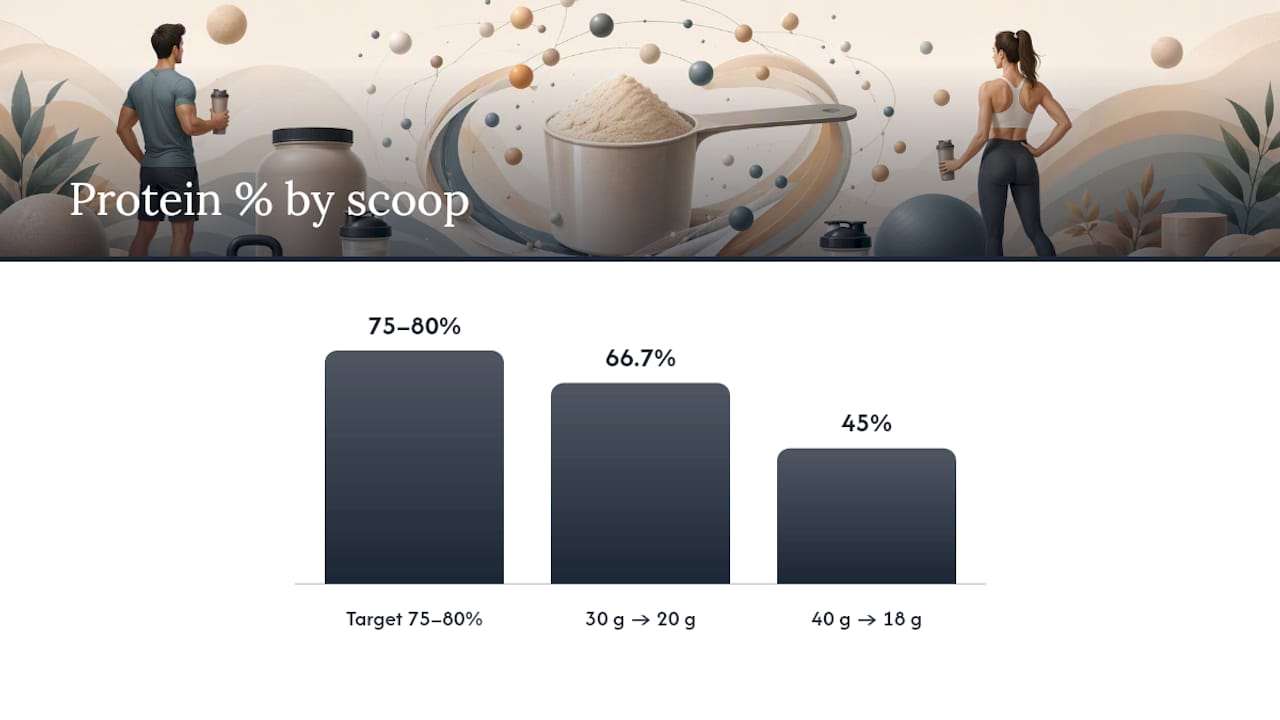
- Protein per scoop vs. scoop weight: Aim for at least 75–80% protein by weight. A 30 g scoop with 20 g protein is reasonable; a 40 g scoop with 18 g protein is mostly filler.
- Ingredient order: Whey protein (concentrate, isolate, or hydrolysate) should be the first ingredient. If sugar or maltodextrin appears before the protein source, move on.
- Added sugars: Under 3–5 g per serving is a reasonable ceiling. Many products add 10+ g of sugar, which defeats the purpose for most goals.
- Amino acid spiking: Some products add cheap free-form amino acids (glycine, taurine) to inflate the nitrogen count. Look for “whey protein” as the sole protein source, not a blend of protein plus isolated aminos.
- Third-party testing: NSF Certified for Sport, USP Verified, or Informed Sport seals indicate independent testing for label accuracy and banned substances. Especially relevant for competitive athletes.
- Batch COAs: Reputable brands make certificates of analysis available on request or on their website.
Numbered steps for reading the Supplement Facts panel:
- Check serving size and servings per container first — marketing often uses a smaller serving size to make the product look cheaper per serving.
- Find protein grams per serving and divide by total serving weight in grams. Multiply by 100 for the protein percentage.
- Scan the “Other Ingredients” list for artificial sweeteners, thickeners, or proprietary blends that obscure actual protein content.
- Look for a third-party seal on the front or back panel.
- Search the brand’s website for a COA or testing page before buying.
For a deeper walkthrough of supplement quality standards, the Nutribliss guide on evaluating supplement quality covers third-party testing and COAs step by step.
Pro Tip: Compare cost per gram of protein, not cost per tub. A $40 tub with 30 servings at 25 g protein each gives you 750 g of protein. A $30 tub with 20 servings at 20 g protein gives you 400 g. The cheaper tub costs more per gram of actual protein.
What the research actually says about dose and muscle protein synthesis
The evidence base for whey and MPS is solid, with some important caveats about who was studied.
Key finding: A systematic review and meta-analysis of 21 RCTs found that whey supplementation combined with resistance exercise significantly increases myofibrillar fractional synthetic rate (FSR), with increases ranging 1.3–2.5 fold depending on timing and dose. Per-session doses in those trials ranged from 10 to 60 g, with the 20–40 g range showing consistent benefit.
| Dose range | MPS response | Notes |
|---|---|---|
| 10–20 g | Moderate MPS stimulation | Effective for lighter individuals or lower-intensity training |
| 20–40 g | Strong, consistent MPS response | Most studied range; ISSN-recommended per-serving window |
| >40 g per dose | Diminishing returns | May not add further muscle-building benefit; possible increased risk in some contexts |
The practical ceiling for lean-mass gains from protein sits around 1.6 g/kg/day for most people, with some benefit extending toward 2.0 g/kg for those in a calorie deficit or doing very high training volumes. Beyond that, additional protein contributes calories without proportional muscle-building return.
One honest limitation: most RCTs enrolled resistance-trained men, often with small sample sizes. The findings are robust for that population. For women, older adults, and untrained beginners, the direction of the evidence is consistent but the magnitude of effect and optimal dose may differ. Women and novice lifters likely respond well to the lower end of the 20–40 g range per serving.
An honest take on dosing mistakes most people make
The math on whey dosing is simple. The execution is where things go sideways.
The most common mistake is treating a protein shake as a substitute for training rather than a complement to it. Whey accelerates recovery and supports MPS, but only when resistance training is actually happening. Without the stimulus, extra protein mostly becomes extra calories.
Second most common: ignoring whole-food protein entirely and stacking multiple shakes instead. Whole foods bring leucine, yes, but also zinc, iron, B vitamins, and satiety signals that a shake does not replicate. Three shakes a day on top of a low-protein diet is a worse strategy than two shakes plus two solid protein meals.
Realistic timelines matter too. Noticeable strength changes typically emerge after 4–6 weeks of consistent training and adequate protein. Visible muscle changes take longer, often 8–12 weeks minimum. If you are two weeks in and not seeing results, the answer is almost never “take more whey.”
Finally, chronic very-high-dose use without a clinical reason is unnecessary for most people and shifts the risk-benefit calculation. Goal-aligned supplementation paired with whole foods and consistent training is what the evidence actually supports.
If you have a specific medical condition, always confirm your protein targets with a clinician before significantly increasing intake. #nutribliss
Nutribliss protein supplements worth considering
Hitting your daily protein target consistently is easier when the product you are using is clean, tested, and actually delivers what the label says.

Nutribliss carries a range of science-backed supplement collections designed for people who want straightforward, quality-focused products without unnecessary additives. For high-output training days, pairing a quality whey with a Nutribliss electrolyte supplement supports hydration and mineral balance, which higher protein intake demands. Browse the full collection at Nutribliss to find the right fit for your goal and budget.
If you have a medical condition, kidney disease, or are pregnant, consult a clinician before starting any new supplement regimen.
Sources
- International Society of Sports Nutrition Position Stand: protein and exercise
- Whey Protein Supplementation Combined with Exercise on Muscle Protein Synthesis and the AKT/mTOR Pathway in Healthy Adults: A Systematic Review and Meta-Analysis
- Dietary Guidelines for Americans, 2025–2030
- Whey protein supplementation and its potentially adverse effects on health: a systematic review
- The scoop on protein powder - Harvard Health
- NESR: DRI Protein Evidence Scan Report
- Protein supplementation: the double-edged sword - PMC
This article is general information, not a substitute for advice from a qualified doctor. Consult a qualified healthcare professional about your own circumstances before acting on anything here.