

The main protein powder families are whey (concentrate, isolate, hydrolysate), casein, egg, and plant-derived options like pea, rice, hemp, and soy, plus collagen for joint and skin support. Match the type to the job: fast-digesting whey isolate for right after training, slow casein before bed, a pea-rice blend or soy for vegan needs, and egg white if you want a dairy-free animal protein. Whatever you pick, check the label for protein per serving and allergen disclosures before anything else.
TL;DR:
- Plant-based proteins like pea and rice can match whey in building muscle when properly dosed and combined with digestive enzymes, narrowing traditional gaps.
- They often have a lower environmental impact, as plant proteins require less land and water, while dairy-based options benefit from byproduct use but may raise allergen concerns.
- For muscle gain, the focus should be on proper dosing and complete amino acid profiles rather than the protein source, with plant blends increasingly capable of replacing whey.
- Choosing the right protein depends on your goals, allergen sensitivities, and budget, with clear label disclosures being more reliable than vague marketing claims.
- Collagen and egg proteins serve specific purposes like joint health or dairy-free amino acids but are less suitable for muscle-building compared to whey or plant blends.
Table of Contents
- What Is Protein Powder, and Why Does the Type Matter?
- The Main Types of Protein Powder, Side by Side
- How to Choose the Right Protein Powder for Your Goals
- What the Research Actually Says About Plant vs. Animal Protein
- Health Upsides and Trade-Offs by Protein Type
- Sustainability Differences Between Protein Sources
- Our Take on Picking the Right Protein Powder
- Find Your Protein Match on Nutribliss
- Sources
What Is Protein Powder, and Why Does the Type Matter?
Protein powder is a concentrated, dried form of protein extracted from milk, eggs, or plants, then processed into a powder you mix into liquid. The label terms tell you how that protein was processed, and processing changes how fast your body absorbs it and how much protein you actually get per scoop.
Concentrate keeps some fat, carbs, and lactose from the source material, typically landing around 70 to 80 percent protein by weight. Isolate goes through extra filtration to strip out most of the fat and lactose, pushing purity closer to 90 percent. Hydrolysate takes it further, pre-breaking the protein into smaller peptide chains for faster uptake, usually at a premium price.
Dairy-based powders (whey, casein) and egg protein deliver what nutrition scientists call a complete amino acid profile. That means all nine essential amino acids in ratios your body uses efficiently, with high leucine content, the amino acid most responsible for triggering muscle repair. Plant proteins are typically incomplete on their own. Pea protein runs low on methionine, rice protein runs low on lysine, and each has a different allergen risk than dairy.
- Dairy and egg proteins: fast-to-moderate digestion, complete amino acid profiles, common allergens (milk, egg)
- Plant proteins: variable digestion speed, often incomplete alone, lower allergen risk but need blending or fortification
- Protein percent on a label means grams of protein divided by total scoop weight. A 30-gram scoop with 24 grams of protein is an 80 percent product.
The Main Types of Protein Powder, Side by Side
Here is what actually separates one protein powder from another once you get past the marketing copy.
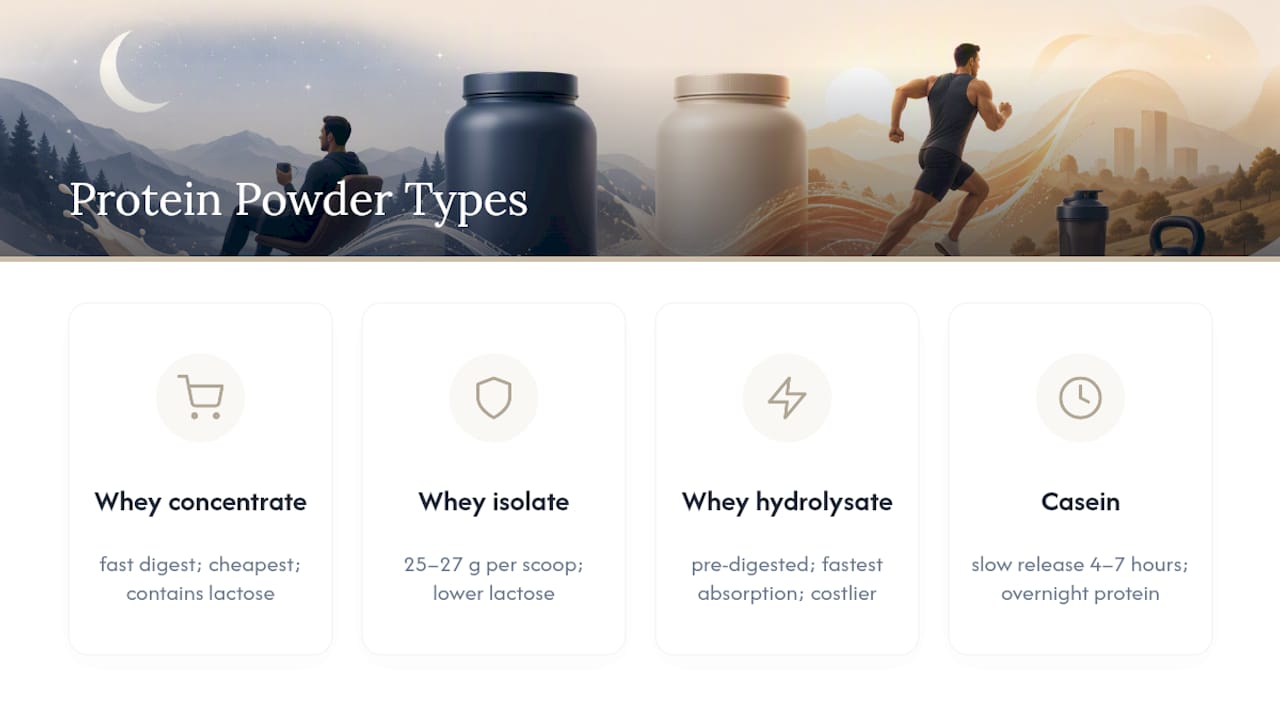
Whey concentrate. The most common and least processed whey form, delivering a substantial amount of protein per scoop. It digests quickly and carries enough leucine to be a strong post-workout pick. It still contains lactose, so it is not ideal if you are sensitive to dairy sugar. It is also the cheapest whey option, which is why it dominates gym-bag tubs everywhere.
Whey isolate. Filtered further to cut lactose and fat, isolate typically hits 25 to 27 grams of protein per scoop with a thinner, cleaner taste. Digestion speed is similar to concentrate, but the lower lactose load makes it easier on sensitive stomachs. You pay more per serving for that filtration, and if your goal is simply hitting a protein target, whey vs. whey isolate comes down to how your gut handles dairy sugar, not raw performance.
Whey hydrolysate. Pre-digested into smaller peptides, this form absorbs faster than either concentrate or isolate and is gentler on digestion, which is why it shows up in clinical and infant formulas as well as sports nutrition. It costs more and sometimes tastes more bitter due to the breakdown process.
Casein. Digests slowly, forming a gel in the stomach that releases amino acids over four to seven hours. That slow release is exactly why it is the standard overnight protein, feeding muscle tissue while you sleep rather than delivering a quick spike. It is dairy-based, so the same lactose and milk-allergy cautions apply as whey.
Egg protein. A complete, dairy-free animal protein made from dried egg whites, typically around 20 to 24 grams per serving with intermediate digestion speed. It is the go-to for anyone who wants animal-quality amino acids without dairy, though egg allergy rules it out for some.
Soy protein. The only plant protein that is naturally complete on its own, with a full essential amino acid profile close to dairy. It also carries phytoestrogens, which some buyers avoid for unrelated hormonal concerns, and soy allergy is common enough to flag clearly on packaging.
Pea protein. Hypoallergenic, easy to digest, and rich in branched-chain amino acids, but low in methionine. On its own it is not complete.
Rice protein. Gentle on digestion and allergy-friendly, but low in lysine, the mirror-image gap to pea protein.
Hemp protein. Lower in protein density than most powders (often 15 grams per scoop) but brings fiber and omega fatty acids most other powders skip entirely.
Collagen. Not a muscle-building protein in the traditional sense, since it lacks a complete amino acid profile and is very low in leucine. It is popular for joint, skin, and connective tissue support rather than post-workout recovery.
Pea and rice combined is the most common plant fix, because pea’s strength covers rice’s weakness and vice versa, producing a blend that approaches whey’s completeness. For a deeper look at how these fortified blends stack up for lifters, see 2.5 g leucine plant protein for lifters and this broader practical guide to protein powder types.
Pro Tip: If you’re comparing plant powders, check for added digestive enzymes on the label. Enzyme-fortified blends measurably increase how much amino acid actually reaches your bloodstream compared to the same blend without enzymes.
How to Choose the Right Protein Powder for Your Goals
Work through this in order rather than picking by flavor or price first.
- Define your primary use case. Post-workout recovery favors fast digestion (whey isolate or hydrolysate). Overnight or between-meal use favors casein’s slow release. Meal replacement calls for a blend with added fiber or fat. Vegan or dairy-free needs point you toward pea-rice blends, soy, or hemp.
- Read the label for protein per serving, not scoop size. A “40-gram scoop” that delivers only 20 grams of actual protein is diluted with fillers or flavoring agents.
- Check for allergen and ingredient transparency. Look for clear disclosure of milk, soy, and egg content, and be wary of “may contain” cross-contact warnings if you have a genuine allergy rather than a preference.
- Decide if isolate is worth the premium. If you tolerate lactose fine and your budget is tight, concentrate does the job for most general fitness goals. Isolate earns its price only if you are lactose-sensitive, tracking carbs tightly, or need the fastest possible absorption.
- Watch for red flags. Proprietary blends that hide exact amino acid amounts, vague “protein matrix” labeling, and undisclosed added sugars are signs to skip a product regardless of brand reputation.
Most adults need somewhere between 1.2 and 2.0 grams of protein per kilogram of body weight daily depending on training volume, and a single scoop is meant to fill gaps in that target, not replace whole meals as a habit.
What the Research Actually Says About Plant vs. Animal Protein
For years, the assumption was that plant protein simply could not keep up with whey for building muscle. The newer trial data complicates that story.
An 8-week resistance training study found that rice protein isolate produced gains in lean mass and strength comparable to whey isolate when both proteins were dosed to provide sufficient essential amino acids. Separately, pairing a pea and rice protein blend with digestive enzymes increased amino acid appearance in the bloodstream compared to the same blend without enzymes, narrowing one of whey’s traditional advantages.
That said, a broader systematic review and meta-analysis found animal proteins hold a small edge for muscle protein synthesis overall, with more uncertainty in the data and some evidence that older adults respond better to animal-based protein than younger adults do.
Dosing and formulation, not the plant-versus-animal label itself, appear to be what actually decides whether a protein source builds muscle effectively.
Total daily protein and leucine intake tend to matter more than minor timing differences between shakes.
Health Upsides and Trade-Offs by Protein Type
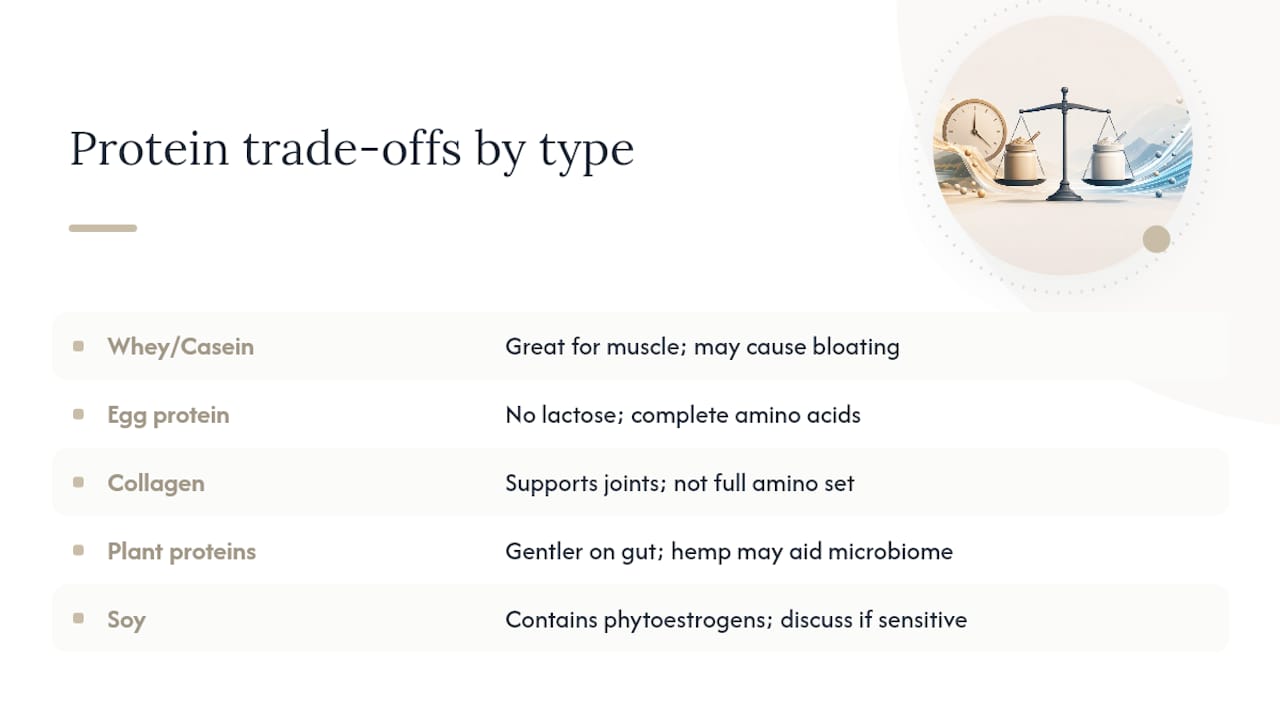
Whey and casein both support muscle repair effectively, but the lactose and casein content that makes them work can trigger bloating or digestive discomfort in people with dairy sensitivity, even short of a full allergy. Some research communities also debate whether high dairy-protein intake affects inflammation markers, though the evidence here is mixed rather than settled.
Egg protein avoids lactose entirely while keeping a complete amino acid profile, making it a reasonable middle ground for people who react to dairy but not eggs. Collagen supports joint and connective tissue health through different mechanisms than muscle-building proteins, but because it lacks a full essential amino acid spread, it should not be your only protein source if muscle gain is the goal.
Plant proteins like pea and rice tend to be gentler on the gut for people with dairy intolerance, and some early research suggests fiber-containing plant sources like hemp may support gut microbiome diversity better than heavily processed isolates. Soy carries phytoestrogen compounds that draw ongoing debate. Current evidence does not show a clear risk for moderate intake, but it is a reasonable factor for anyone managing a hormone-sensitive condition to discuss with a doctor.
Bone health research generally favors adequate total protein intake, animal or plant, over any single source being uniquely protective. The disadvantage across nearly every powder category is the same: relying on supplements instead of whole-food protein sources for the bulk of your intake means missing out on the fiber, micronutrients, and satiety that whole foods provide.
Sustainability Differences Between Protein Sources
Plant proteins generally require less land and water per gram of protein produced than dairy-based whey and casein, since they skip the animal-feeding step entirely. Pea protein in particular has a smaller water footprint than most dairy protein sources, largely because peas fix their own nitrogen and need less fertilizer input.
Whey has one sustainability argument in its favor: it is a byproduct of cheese production, meaning the environmental cost of the dairy cow is already being counted against cheese, not the protein powder. Using that byproduct rather than discarding it is a more efficient use of an existing agricultural output.
Soy production raises its own land-use questions in regions tied to deforestation, though soy grown for human protein supplements is a small fraction of global soy demand compared to animal feed. Rice protein’s footprint depends heavily on how the rice itself was farmed, since flooded rice paddies produce methane emissions that vary widely by region and practice.
There is no single “greenest” protein powder, but broadly, plant-based options tend to have a lighter environmental footprint than animal-derived ones, with whey’s byproduct status as a partial exception worth knowing.
Our Take on Picking the Right Protein Powder
Most people overthink the whey-versus-plant debate and underthink the label itself. The research now shows a well-formulated pea-rice blend can rival whey for muscle building, which means the “plant protein is inferior” assumption is outdated. But an underdosed, poorly blended plant powder absolutely can underperform.
Our product pages lean into that reality by listing full amino acid breakdowns, exact serving sizes, and allergen flags rather than vague “protein blend” claims. #nutribliss exists because ingredient transparency should not be a premium feature. If your goal is straightforward post-workout recovery, we generally point people toward whey isolate or a high-leucine plant blend. Either one works when the dosing is right.
— GAURAV
Find Your Protein Match on Nutribliss
Sorting through concentrate versus isolate versus a pea-rice blend gets easier when the product page actually tells you what is in the tub. Some brands list full amino acid profiles and exact serving sizes on every protein product, so you are not guessing at what “protein blend” means on a vague label.
If recovery is your focus, pair your protein choice with proper hydration using the electrolytes supplement on training days, and check the practical fitness guide to protein powder types if you want more detail on matching a type to your specific training schedule. Browse the current protein lineup on Nutribliss and pick the profile that fits your next scoop.