

TL;DR:
- Cortisol is essential for energy, focus, and resilience, but imbalanced levels can cause serious health issues. Managing cortisol involves lifestyle habits like quality sleep, moderate exercise, and deep breathing to maintain optimal regulation. Medical intervention is necessary when imbalance results from conditions like Cushing syndrome or severe symptoms.
Cortisol gets a bad reputation. Most people hear “cortisol” and think “stress hormone to eliminate,” but that framing misses the full picture. Cortisol is essential for keeping your body energized, focused, and resilient. The real goal isn’t to drive cortisol to zero. It’s to keep it balanced so it works for you, not against you. This guide breaks down what cortisol management actually means, why the “just reduce it” mindset falls short, and what the evidence says about practical, sustainable strategies that genuinely move the needle on your stress resilience and overall wellness.
Table of Contents
- Understanding cortisol: Function, myths, and real risks
- The pillars of practical cortisol management
- Exercise: How much, what kind, and what to avoid
- When is cortisol management medical? Recognizing the signs
- Supporting balance: Supplements and stress-relief tools
- Why most ‘cortisol hacks’ miss the mark: What actually works
- Explore science-backed ways to support your stress resilience
- Frequently asked questions
Key Takeaways
| Point | Details |
|---|---|
| Balance, not elimination | Cortisol is vital and managing it means keeping levels in a healthy range for resilience. |
| Lifestyle first | Sleep, moderate activity, and stress-reduction techniques are the foundation for cortisol management. |
| Exercise smart | Moderate, mind–body activities lower cortisol best, while excessive intensity can make it worse. |
| Medical causes matter | Abnormal cortisol needs prompt medical evaluation and often cannot be managed by lifestyle alone. |
| Supplement with care | Supplements should support, not replace, basic health routines—seek expert advice as needed. |
Understanding cortisol: Function, myths, and real risks
Cortisol is a steroid hormone produced by your adrenal glands, two small glands that sit on top of your kidneys. It regulates blood sugar, controls your sleep-wake cycle, modulates inflammation, and powers your body’s fight-or-flight response when you face a real threat. Without it, your body can’t handle stress at all.
Here’s what surprises most people: abnormally low cortisol is just as concerning as levels that are too high. Adrenal insufficiency, a condition where the adrenal glands don’t produce enough cortisol, can cause profound fatigue, low blood pressure, and dangerous electrolyte imbalances. So when someone says they want to “kill” their cortisol, they’re actually describing something that would make them very sick.
“Cortisol plays a critical role in nearly every system of the body. Disruption of the HPA axis, which controls cortisol release, can cause widespread health consequences affecting metabolism, immunity, mood, and cognitive function.” — Healthdirect, The role of cortisol in the body
Common signs of cortisol imbalance (high or low) include:
- Persistent fatigue that doesn’t improve with rest
- Unexplained weight gain, especially around the midsection, or unintended weight loss
- Sleep disruption, difficulty falling asleep, or waking frequently between 2 and 4 a.m.
- Mood shifts including anxiety, irritability, or low mood
- Brain fog, poor memory, and difficulty concentrating
- Frequent illness from a suppressed immune response
- Low blood pressure, dizziness when standing, or salt cravings
The distinction between lifestyle-driven imbalance and a medical condition matters enormously. Most people experiencing daily stress are dealing with lifestyle-driven cortisol elevation, meaning better habits can meaningfully restore balance. But conditions like Cushing syndrome involve a tumor or chronic steroid use driving cortisol to pathologically high levels. Lifestyle changes alone won’t fix a tumor. If symptoms are severe, persistent, or worsening, getting your cortisol levels formally tested is the right first move before attempting any self-management strategy.
The pillars of practical cortisol management
With a solid understanding of cortisol’s importance, let’s explore the actionable behaviors that help keep it in balance. The good news: the most effective strategies are also the most accessible. You don’t need expensive equipment or complicated protocols.
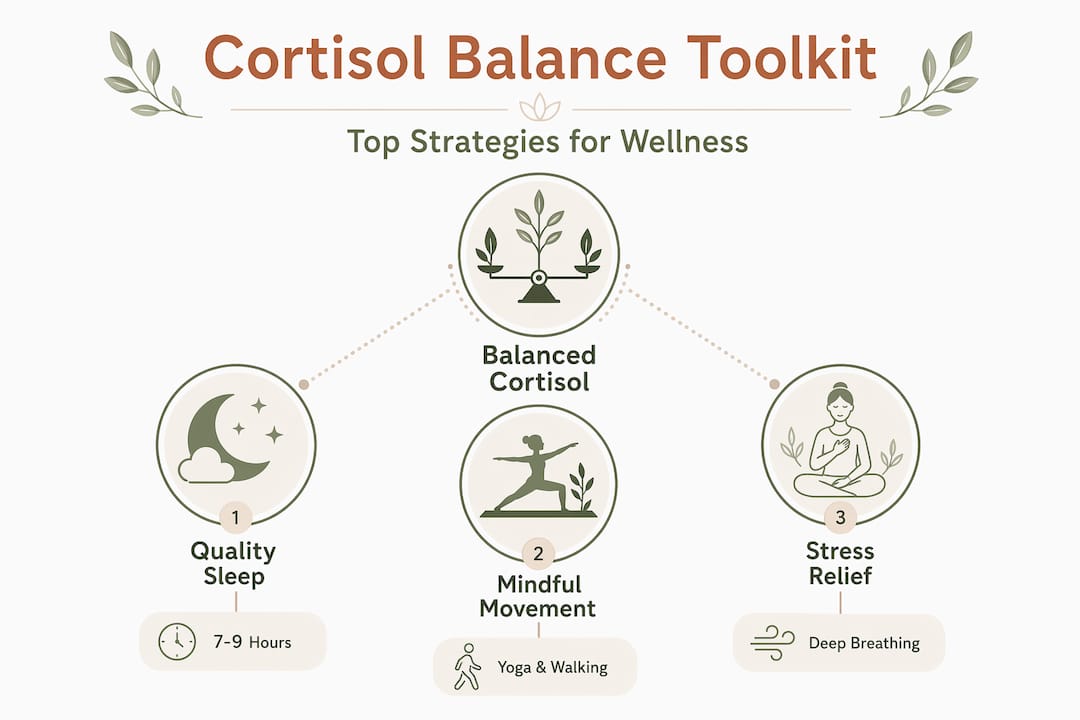
Quality sleep, regular physical activity, and deep-breathing practices are the three most consistently supported lifestyle levers for cortisol regulation. Let’s look at how each one works and how to realistically apply them.
| Strategy | How it helps cortisol | Practical difficulty | Time required |
|---|---|---|---|
| Quality sleep (7 to 9 hrs) | Resets diurnal cortisol rhythm | Low to moderate | Ongoing nightly |
| Moderate aerobic exercise | Reduces baseline cortisol over time | Moderate | 30 to 45 min, 3 to 5x/week |
| Deep breathing / box breathing | Activates parasympathetic nervous system rapidly | Very low | 5 to 10 min/day |
| Mindfulness meditation | Reduces cortisol reactivity to stressors | Low | 10 to 20 min/day |
| Social connection | Buffers cortisol stress response | Very low | Variable |
Sleep is the most underrated cortisol tool. Cortisol follows a natural daily rhythm: it peaks about 30 minutes after waking (this is called the cortisol awakening response, or CAR), then steadily declines throughout the day, reaching its lowest point around midnight. Poor sleep disrupts this rhythm. Staying up late, sleeping inconsistently, or getting fewer than seven hours causes cortisol to be elevated at the wrong times, leaving you wired at night and foggy in the morning. Improving your sleep hygiene practices is one of the fastest ways to restore a healthier cortisol pattern.

Research also shows that melatonin plays an indirect but meaningful role. Melatonin and cortisol have an inverse relationship: when melatonin rises in the evening, cortisol falls. Anything that suppresses melatonin, like blue light exposure late at night, delays that natural cortisol decline and keeps your stress system activated longer than it should be.
Deep breathing deserves more credit. Slow, controlled breathing activates the vagus nerve, which triggers the parasympathetic nervous system (your “rest and digest” state). Box breathing, which involves inhaling for four counts, holding for four, exhaling for four, and holding for four, can produce a measurable drop in salivary cortisol within minutes. That makes it one of the few cortisol strategies with nearly instant, accessible results.
Pro Tip: Try five minutes of box breathing before your most stressful part of the day, whether that’s your morning commute, a difficult meeting, or scrolling the news. Consistency matters more than duration here.
Mindfulness matters in a practical way. Regular mindfulness practice doesn’t just feel calming. It literally reduces how much cortisol your body produces in response to a stressor. After eight weeks of consistent practice, research shows measurable reductions in cortisol reactivity, meaning your stress response becomes less “hair-trigger” and more proportional to actual threats.
Exercise: How much, what kind, and what to avoid
Physical activity is crucial, but not all exercise types affect cortisol equally. Here’s a science-backed breakdown that cuts through the noise.
Exercise temporarily raises cortisol during the session itself. That’s normal and healthy. The benefit comes from what happens over time: regular moderate exercise trains your body to regulate cortisol more efficiently, reducing baseline levels and improving your overall stress response. But there’s a ceiling.
A 2025 systematic review and network meta-analysis confirmed a dose-response relationship: as exercise intensity and volume increase from sedentary to moderate, cortisol outcomes improve. Push past that threshold into chronic high-intensity overtraining, and the curve reverses. Cortisol stays elevated for hours after the session, recovery suffers, and athletes often develop what’s called “overtraining syndrome,” a prolonged state of elevated cortisol, fatigue, and depressed mood that can take weeks or months to reverse.
| Exercise type | Cortisol effect (acute) | Long-term benefit | Risk if overdone |
|---|---|---|---|
| Yoga / tai chi / qigong | Minimal rise or neutral | Strong reduction in baseline | Very low |
| Brisk walking / light cardio | Mild rise | Consistent reduction | Very low |
| Moderate strength training | Moderate rise | Positive with adequate recovery | Low to moderate |
| High-intensity interval training | Large spike | Positive if limited to 2x/week | High (overtraining) |
| Endurance running (long distance) | Very high spike | Mixed; depends on volume | High for daily practitioners |
Mind-body modalities like yoga and qigong consistently rank highest for cortisol reduction with the fewest downsides. They combine physical movement with controlled breathing and focused attention, hitting three cortisol-lowering mechanisms simultaneously. If you’re already under significant psychological stress, yoga for stress relief is often more effective than a high-intensity session that further spikes an already elevated stress response.
How to build a cortisol-friendly exercise routine:
- Start with 20 to 30 minutes of brisk walking five days per week as your baseline.
- Add two sessions of moderate resistance training, keeping intensity at a level where you could still hold a conversation.
- Include one or two yoga, tai chi, or stretching sessions per week as active recovery.
- Take at least one full rest day per week. Two is better during high-stress periods.
- Track energy levels across two weeks. If fatigue is worsening instead of improving, reduce intensity before increasing it.
Pro Tip: Your perceived effort during a workout is a surprisingly reliable proxy for cortisol load. If a session feels brutal every single time, your cortisol is likely spiking more than it should. Scale back intensity before adding volume.
When is cortisol management medical? Recognizing the signs
While healthy routines are powerful, certain cases of cortisol imbalance require expert medical treatment and no amount of meditation or sleep improvement will be sufficient.
Cushing syndrome is the classic example. It occurs when the body is exposed to very high cortisol levels for a prolonged period, either because a tumor causes the adrenal or pituitary glands to overproduce it, or because someone has been taking corticosteroid medications (like prednisone) long-term. Management of Cushing’s syndrome depends on the underlying cause and may involve surgery to remove a tumor, radiation therapy, medications that block cortisol production, or changes to steroid medication regimens.
“When cortisol imbalance stems from a structural or pharmaceutical cause, lifestyle interventions are supportive at best. The priority is identifying and treating the root cause promptly.” — NIDDK, Cushing’s Syndrome
Signs that your cortisol issue is likely medical rather than lifestyle-driven:
- A distinctive “moon face” (rounded, puffy face) or a hump of fat between the shoulders
- Purple or reddish stretch marks (striae) on the abdomen, thighs, or arms
- Muscle weakness so significant that climbing stairs or getting up from a chair is difficult
- Very slow wound healing combined with easy bruising
- Bone loss (osteoporosis) without a clear explanation
- Cortisol symptoms that appeared or worsened after starting a steroid medication
If any of these sound familiar, the priority is a conversation with your doctor, not a new supplement. Blood and urine tests can identify whether cortisol levels are outside the range that lifestyle strategies can address.
Supporting balance: Supplements and stress-relief tools
Beyond lifestyle and medical interventions, many people seek out supplements or holistic tools to support cortisol balance. The research here is genuinely interesting, but it requires a clear-eyed look at what the evidence actually supports.
Adaptogens are herbs that help the body maintain equilibrium under stress. Ashwagandha (Withania somnifera) is currently the most studied adaptogen for cortisol. Multiple clinical trials have shown that standardized ashwagandha root extract can meaningfully reduce salivary cortisol levels and self-reported stress in adults under chronic stress, typically after four to eight weeks of consistent use. Rhodiola rosea, another well-researched adaptogen, shows similar promise for reducing cortisol reactivity and improving stress-related fatigue.
Omega-3 fatty acids found in fish oil are another category worth discussing. Some research suggests omega-3s blunt the cortisol response to psychological stress, possibly by modulating the inflammatory pathways that intersect with HPA axis activity.
Evidence-based supplements for stress relief work most reliably as part of a layered approach: solid sleep, consistent movement, a real food diet, and then targeted supplementation on top. Natural supplements are not shortcuts around the foundational habits, but they can meaningfully amplify the results once the basics are in place.
Understanding what adaptogens actually do versus what they’re marketed to do is crucial. And for the specifics on ashwagandha’s benefits, the research is compelling but context-dependent: dose, extract quality, and consistency matter significantly. Stress also impacts other aspects of health that people rarely connect, reinforcing how foundational cortisol balance really is.
Pro Tip: Always talk to a healthcare provider before adding adaptogens or other cortisol-related supplements if you’re on any medications, particularly thyroid medications, sedatives, or immunosuppressants, since some herbs interact with these drug classes.
Why most ‘cortisol hacks’ miss the mark: What actually works
Social media is full of “cortisol cocktails,” extreme morning routines, and five-day detox protocols that promise to fix your stress hormones. Most of them share one fatal flaw: they treat cortisol balance as a destination rather than an ongoing practice.
The goal isn’t to switch off cortisol. It’s to keep it well-regulated so it rises when you need it and falls when you don’t. The people who see lasting improvement are rarely the ones who overhaul everything on January 1st and crash by February. They’re the ones who add one better sleep habit, then one breathing practice, then one weekly yoga session, layering changes slowly enough that each one sticks before the next is added.
Extreme or rigid routines often backfire precisely because rigidity is itself a stressor. If you’ve built a morning routine that causes you anxiety when you miss a single step, your cortisol isn’t lower. It’s found a new trigger. Understanding adaptogen facts versus marketing myths is part of developing that same clear-eyed approach: skepticism about quick fixes, combined with genuine openness to what the evidence supports.
In our experience, the most meaningful shifts come from self-awareness rather than rigid protocols. Noticing which situations reliably spike your stress and building small buffers around them is far more powerful than any single supplement or biohack. Cortisol management is ultimately a lifelong practice of moderation, recovery, and adaptation. That’s not a flaw in the system. That’s the system working exactly as it should.
Explore science-backed ways to support your stress resilience
Managing cortisol well means building a complete toolkit, not just finding one magic solution. You’ve now got the science. The next step is putting it to work.

At Nutribliss, we’ve built our product line around the same evidence-based principles covered in this guide. Whether you’re looking to understand the science behind superfoods for stress support, browse stress support supplements that pair with your existing habits, or explore our science page to evaluate the research behind what we offer, everything is designed to complement the foundational lifestyle work you’re already doing. Real, lasting resilience is built in layers, and we’re here to support each one.
Frequently asked questions
What are signs I should get my cortisol checked?
If you’re experiencing unexplained fatigue, persistent mood changes, unusual weight shifts, or difficulty recovering from stress, these are signals worth discussing with your doctor, especially if they’ve lasted more than a few weeks.
Can supplements replace lifestyle changes for cortisol management?
No. Supplements work best as an addition to healthy behaviors, not a substitute. Evidence-based stress supplements show their strongest results when sleep, movement, and stress management habits are already in place.
Which exercises are best for lowering cortisol?
Mind-body practices like yoga, tai chi, and qigong, along with moderate aerobic activity, have the strongest research support for reducing cortisol reliably without the risk of overtraining-related spikes.
When is high cortisol a medical emergency?
Seek immediate medical attention for severe muscle weakness, sudden confusion, very high blood pressure, or new and severe psychiatric symptoms, as these can indicate dangerous cortisol dysregulation that requires urgent clinical intervention.