

TL;DR:
- Whey is the liquid byproduct of cheesemaking, rich in complete proteins and bioactive compounds.
- Processed into concentrate, isolate, or hydrolysate, whey protein varies in purity, lactose content, and digestion speed to suit different needs.
Whey is defined as the liquid portion of milk that separates from the curds during cheesemaking, and it is one of the richest natural sources of complete protein available. Liquid whey is pasteurized and dried after separation to become the protein powder found in drink mixes, bars, and supplements. Many people use the term loosely, but there is a meaningful difference between raw liquid whey and the processed powder products sold on store shelves. Understanding that difference changes how you shop, how you train, and how you recover.
What is whey protein and how is it made?
Whey protein is the collection of proteins extracted from liquid whey, concentrated or isolated through filtration, then dried into powder form. The process starts in a cheese vat, where enzymes or acids are added to milk to cause coagulation. The milk splits into two components: solid curds, which become cheese, and a thin yellowish liquid, which is whey. That liquid contains water, proteins, lactose, vitamins, and minerals.
From there, the liquid whey goes through pasteurization to eliminate pathogens. Manufacturers then run it through filtration systems, most commonly microfiltration or ultrafiltration, to remove fat and lactose to varying degrees. The filtered liquid is spray-dried into a fine powder. What you scoop into your shaker bottle is the end result of that multi-step industrial process, not the raw liquid itself.
The three main forms of whey protein differ primarily in how far that filtration goes:
- Whey protein concentrate (WPC): Contains roughly 70% protein by weight, along with moderate amounts of lactose and fat. It retains more of whey’s naturally occurring bioactive compounds and tends to have a creamier taste.
- Whey protein isolate (WPI): Filtered more aggressively to reach approximately 90% protein by weight, with less than 1 gram of lactose per serving. This makes it the go-to choice for people who are lactose-sensitive but still want a dairy-derived protein.
- Whey protein hydrolysate (WPH): Enzymatically treated to break protein chains into shorter peptides, a process called hydrolysis. Degree of hydrolysis is a strictly measured and regulated metric that producers must verify analytically before labeling a product as hydrolysate. This form digests the fastest and costs the most.
Pro Tip: Read the ingredient label carefully. A product labeled “whey protein blend” often mixes concentrate and isolate to cut costs. If you need low lactose, look for isolate or hydrolysate listed as the first ingredient.
What is whey good for? Nutritional benefits explained
Whey is a complete protein, meaning it contains all nine essential amino acids your body cannot produce on its own. That alone sets it apart from most plant-based protein sources, which typically lack one or more essential amino acids. The amino acid profile is particularly high in leucine, the branched-chain amino acid most directly linked to triggering muscle protein synthesis.

The speed of digestion is what makes whey especially useful around workouts. Rapid absorption and a rich amino acid profile make whey beneficial for exercise performance and recovery, though researchers note that optimal dosing and timing still require further study. This is not a minor caveat. It means the “30-minute anabolic window” you hear about in gyms is more nuanced than popular culture suggests.
Beyond muscle, whey carries a range of bioactive compounds with broader health implications:
- Lactoferrin: An iron-binding protein with antimicrobial and immune-modulating properties.
- Beta-lactoglobulin: The most abundant whey protein, responsible for much of its amino acid delivery.
- Immunoglobulins: Antibody proteins that support immune function.
- Alpha-lactalbumin: Rich in tryptophan, which the body uses to produce serotonin.
Studies show whey impacting insulin responses, immune function, and potential therapeutic benefits for chronic conditions. That breadth of effect is why whey has moved beyond the gym and into clinical nutrition research.
“Whey protein’s popularity in fitness comes from it being a fast-digesting, amino-acid-rich protein rather than simply ‘more protein.’ The distinction matters for how and when you use it.” — Whey Protein Nutrition in Sports
For anyone tracking muscle protein synthesis, whey’s leucine content and absorption speed make it one of the most studied and consistently effective tools in sports nutrition.
How do whey protein types compare?
Choosing between concentrate, isolate, and hydrolysate is not just a matter of budget. Each form has a distinct nutritional profile, digestibility level, and practical use case. The table below lays out the key differences.
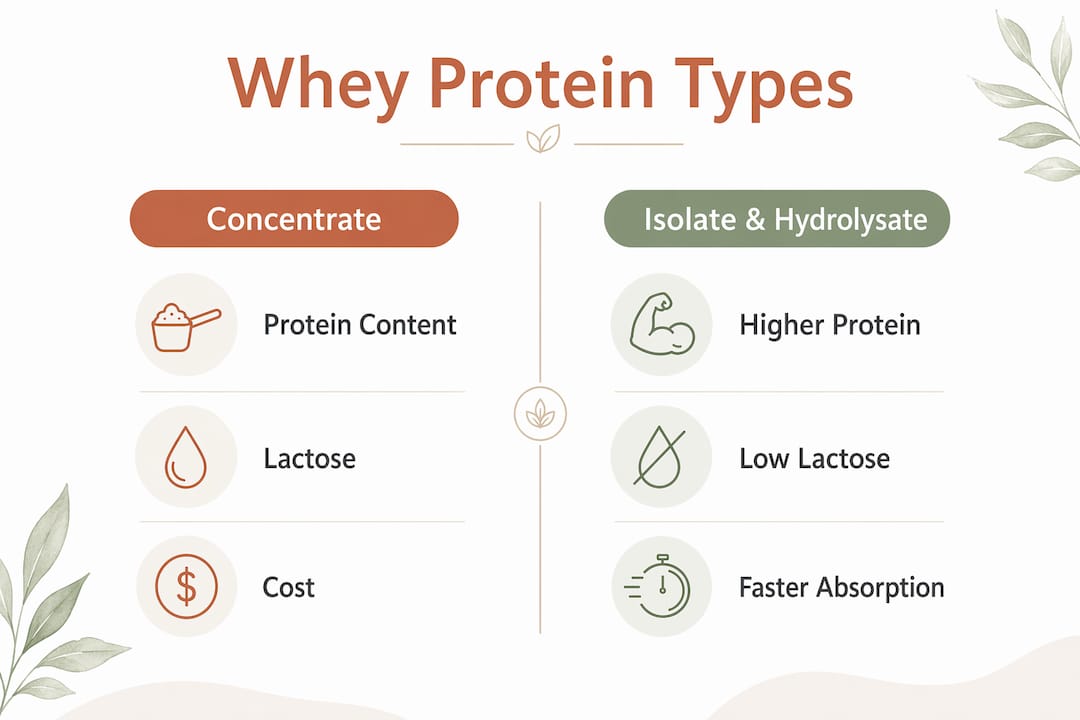
| Feature | Concentrate (WPC) | Isolate (WPI) | Hydrolysate (WPH) |
|---|---|---|---|
| Protein content | ~70% | ~90%+ | ~90%+ (pre-digested) |
| Lactose per serving | Moderate | Less than 1 gram | Minimal to none |
| Digestion speed | Moderate | Fast | Fastest |
| Taste | Creamy, mild | Slightly thinner | Often bitter |
| Cost | Lowest | Moderate | Highest |
| Best for | General use, bulking | Lactose sensitivity, cutting | Post-workout, sensitive digestion |
The functional and nutritional profiles of whey depend heavily on how the protein is processed and fractionated. This is why two products both labeled “whey protein” can perform very differently in your body and taste completely different in your shaker.
For lactose-sensitive individuals, the product type is the critical variable. Isolates and hydrolysates carry significantly less lactose than concentrates, making them far more tolerable. The ADPI’s standardized definition for hydrolysates requires producers to analytically verify the degree of peptide bond cleavage, which protects consumers from mislabeled products claiming faster digestion without the processing to back it up.
Pro Tip: If you experience bloating or discomfort with whey concentrate, switch to an isolate before assuming you cannot tolerate dairy protein at all. Many people who think they are lactose intolerant to whey do fine on a well-filtered isolate.
For a deeper look at isolate-specific benefits for muscle and recovery, the processing differences translate directly into real-world performance outcomes.
What are the uses of whey beyond protein powder?
Whey’s applications extend well past the supplement aisle. Food manufacturers use whey proteins in infant formulas, confectionery, baked goods, and beverages because of their functional properties including solubility, emulsification, foaming, and water-binding. These traits make whey a versatile ingredient in food production, not just a protein source.
| Application | Whey property used | Example product |
|---|---|---|
| Infant formula | Amino acid completeness | Stage 1 and 2 infant formulas |
| Confectionery | Emulsifying, texture | Chocolate coatings, nougat |
| Beverages | Solubility, clarity | Ready-to-drink protein shakes |
| Baked goods | Water-binding, browning | Protein-enriched breads |
| Clinical nutrition | Bioactive compounds | Medical nutrition supplements |
The therapeutic side of whey is an area of growing research. Bioactive peptides derived from whey hydrolysis show activity against hypertension, oxidative stress, and inflammation in early studies. Athletes using oxygen therapy for recovery alongside whey supplementation represent one emerging area where nutrition and recovery technology intersect.
From an environmental standpoint, utilizing whey rather than discarding it as a dairy byproduct reduces waste and adds economic value to the cheesemaking process. Whey was once treated as a waste product in cheese production. Today it is a multi-billion-dollar ingredient category. That shift reflects how thoroughly food science has reframed what counts as a resource.
Key takeaways
Whey is a complete, fast-digesting dairy protein derived from cheesemaking, and the form you choose, concentrate, isolate, or hydrolysate, determines its lactose content, digestion speed, and suitability for your specific goals.
| Point | Details |
|---|---|
| Whey’s origin | Whey is the liquid byproduct of cheesemaking, not a synthetic ingredient. |
| Three protein forms | Concentrate (~70%), isolate (~90%), and hydrolysate differ in purity, lactose, and cost. |
| Lactose sensitivity | Isolates and hydrolysates contain minimal lactose and suit most lactose-sensitive individuals. |
| Nutritional breadth | Whey delivers all nine essential amino acids plus bioactive compounds like lactoferrin and immunoglobulins. |
| Uses beyond fitness | Whey appears in infant formula, confectionery, beverages, and clinical nutrition products. |
Why most people are still choosing the wrong whey
I have spent years reading supplement labels and talking to people who train seriously, and the single most common mistake I see is treating all whey protein as interchangeable. Someone buys a concentrate because it is cheaper, experiences bloating, and concludes that whey does not work for them. That conclusion is wrong. The product failed them, not the protein category.
The second mistake is chasing hydrolysate without understanding why. Hydrolysates digest faster, yes, but the research on dosing and timing is still catching up to the marketing claims. If you are not an elite athlete with a precisely timed training and nutrition protocol, a quality isolate will serve you just as well at a lower cost.
What I find genuinely exciting is the bioactive compound research. Lactoferrin, alpha-lactalbumin, and immunoglobulins are not just bonus ingredients. They represent a category of functional nutrition that the supplement industry has barely started to communicate clearly. The next wave of whey products will likely be built around these compounds rather than just protein percentage. That is where the real innovation is heading, and it is worth paying attention to now.
My practical advice: start with a well-sourced isolate from a brand that publishes third-party testing results. Use it consistently around training. Then evaluate results before spending more on a hydrolysate. Complexity is not always better. Consistency almost always is.
— GAURAV
Explore Nutribliss whey protein supplements
If this article clarified what whey is and why the form matters, the next step is finding a product that matches your goals without compromise.

Nutribliss offers a whey isolate protein supplement formulated for athletes and active individuals who want high protein content with minimal lactose. Every product in the Nutribliss lineup is built on science-backed nutrition, from protein powders to electrolytes and specialty supplements. Browse the full Nutribliss superfoods collection to see how whey fits into a broader performance nutrition stack. Use #nutribliss to share your results and connect with a community that takes supplementation seriously.
FAQ
What is whey made of?
Whey is composed of water, proteins (including beta-lactoglobulin, alpha-lactalbumin, and immunoglobulins), lactose, vitamins, and minerals. It is the liquid that remains after milk coagulates and curds are removed during cheesemaking.
Is whey a dairy product?
Yes, whey is derived from cow’s milk and is classified as a dairy product. Individuals with a milk protein allergy should avoid it, though those with lactose intolerance may tolerate whey isolate or hydrolysate due to their very low lactose content.
What is whey protein made from?
Whey protein powder is made from liquid whey that has been pasteurized, filtered to remove fat and lactose, and spray-dried into powder form. The degree of filtration determines whether the final product is a concentrate, isolate, or hydrolysate.
How is whey different from casein?
Whey digests rapidly and peaks in the bloodstream within 60 to 90 minutes, making it ideal post-workout. Casein protein digests slowly over several hours, which makes it better suited for overnight muscle recovery.
Can lactose-intolerant people use whey protein?
Many lactose-intolerant individuals can use whey protein isolate, which contains less than 1 gram of lactose per serving, or whey hydrolysate, which has minimal to no lactose. Whey concentrate is higher in lactose and more likely to cause digestive discomfort in sensitive individuals.