

TL;DR:
- Skeletal muscle is a dynamic, multifunctional tissue responsible for movement, heat production, and metabolic regulation. It consists of hierarchical structures from whole muscle to sarcomeres, which facilitate contraction through a sliding-filament process driven by calcium and ATP. Beyond aesthetics, maintaining and training skeletal muscle enhances metabolic health, injury resilience, and overall performance.
Skeletal muscle is far more than the tissue that lets you lift weights or run a mile. It’s a dynamic, metabolically active system that drives energy production, regulates body temperature, stores amino acids for recovery, and determines your athletic ceiling. Most people treat it as a simple lever for movement, but that fundamentally underestimates what’s actually happening inside every fiber every single time you train. This guide breaks down the real structure of skeletal muscle, explains exactly how contraction works at the molecular level, and connects all of that to practical outcomes for performance, recovery, and long-term health.
Table of Contents
- What is skeletal muscle? Clarifying the basics and debunking myths
- Inside skeletal muscle: Anatomy, structure, and key layers
- How skeletal muscle works: The science of contraction and movement
- Why skeletal muscle matters for performance, metabolism, and health
- The overlooked power of skeletal muscle: What most forget when training
- Optimize your skeletal muscle health with science-backed support
- Frequently asked questions
Key Takeaways
| Point | Details |
|---|---|
| Core definition | Skeletal muscle is the primary organ for movement and strength, built from specialized fibers and contractile units. |
| Hierarchical structure | Understanding the layers of muscle structure unlocks better training and recovery results. |
| Contraction mechanism | All muscle force comes from the sliding of actin and myosin in the sarcomere. |
| Health and fitness impact | Skeletal muscle is crucial for metabolism, recovery, and performance—not just body shape. |
| Train with knowledge | Applying muscle science helps you maximize gains, recovery, and lifelong functional health. |
What is skeletal muscle? Clarifying the basics and debunking myths
Most people know they have muscles, but far fewer understand the distinctions between muscle types or why those distinctions matter. There are three types of muscle tissue in the human body: skeletal, cardiac, and smooth. Each serves a different purpose, operates under different controls, and responds differently to training and nutrition.
Skeletal muscle is the tissue attached to your bones via tendons. It’s what you flex, train, and see in the mirror. Cardiac muscle is found exclusively in the heart wall. Smooth muscle lines your internal organs and blood vessels. Understanding the differences matters because strategies that build skeletal muscle don’t directly apply to the other two.
Key distinctions between the three muscle types:
- Skeletal muscle: Voluntary control, striated appearance, multinucleated fibers, attached to bones
- Cardiac muscle: Involuntary control, striated, single nucleus per cell, self-excitable
- Smooth muscle: Involuntary control, non-striated, found in organs and vessels
| Feature | Skeletal | Cardiac | Smooth |
|---|---|---|---|
| Control | Voluntary | Involuntary | Involuntary |
| Location | Attached to skeleton | Heart wall | Organs, blood vessels |
| Appearance | Striated | Striated | Non-striated |
| Nuclei per cell | Multiple | One | One |
| Response to training | High | Moderate | Low |
One of the biggest misconceptions people carry into the gym is that skeletal muscle training is purely about getting bigger. That’s not wrong, but it’s incomplete. Skeletal muscle is central to posture, joint stability, metabolic rate, injury prevention, and even hormonal signaling. Training it intelligently means understanding it beyond aesthetics.
Structurally, skeletal muscles are made of long, multinucleated fibers organized into bundles called fascicles and surrounded by connective tissue sheaths, with the sarcomere serving as the fundamental contractile unit. That architecture is what makes it so capable of generating force repeatedly.
Another nuance worth clarifying: skeletal muscle is generally classified as voluntary, but reflexes and certain nervous system signals can cause contractions without conscious input. Touch a hot stove and your hand pulls back before your brain processes the pain. That’s your nervous system activating skeletal muscle on its own terms.
“Skeletal muscle is not just about building bulk. It is the body’s primary engine for movement, heat, and metabolic stability—and understanding it changes how you approach every training session.”
Inside skeletal muscle: Anatomy, structure, and key layers
The architecture of skeletal muscle is one of biology’s most elegant designs. It’s organized in a precise hierarchy that scales from the whole muscle you can see and feel, all the way down to molecular machinery that generates force at the nanometer scale. Here’s how each layer stacks up.
The structural hierarchy of skeletal muscle:
- Whole muscle: The complete structure you recognize, like your biceps or quadriceps, wrapped in a connective tissue sheath called the epimysium
- Fascicle: Bundles of muscle fibers grouped together within the muscle, each wrapped in perimysium
- Muscle fiber (cell): Individual muscle cells, also called myocytes, each containing dozens of myofibrils and wrapped in endomysium
- Myofibril: Thread-like structures running the length of each fiber, made up of repeating contractile units
- Sarcomere: The smallest functional contractile unit, composed of interleaved protein filaments called actin and myosin
Each layer of connective tissue (epimysium, perimysium, endomysium) isn’t just structural padding. These sheaths transmit the force generated deep inside the sarcomere outward to the tendon and ultimately to the bone. Without them, the whole mechanical system would fall apart.

The sarcomere is the fundamental contractile unit, and understanding this is a game-changer for serious athletes. It’s also responsible for the striped or “striated” appearance that distinguishes skeletal and cardiac muscle from smooth muscle. Under a microscope, those stripes are actually the alternating dark and light bands of thick (myosin) and thin (actin) filaments.
Pro Tip: When you see the term “muscle hypertrophy,” it literally means an increase in the size of individual muscle fibers, driven by more contractile protein being packed into the sarcomere level. More sarcomeres and thicker filaments equal more force capacity. If you want to go deeper on how that process unfolds, muscle growth explained is a solid starting point.
The multi-nucleated nature of muscle fibers is also worth highlighting. Most cells have one nucleus controlling protein production. Muscle fibers have many, sometimes hundreds, because each fiber is enormous and needs distributed control centers to manage the high protein turnover demands of training and recovery.
How skeletal muscle works: The science of contraction and movement
Understanding contraction at the molecular level sounds academic until you realize it directly explains why your technique, nutrition, and recovery protocols either work or don’t. Every rep, every sprint, every jump traces back to a process happening inside your sarcomeres.
The mechanism is called the sliding-filament model. Here’s the simplified version: myosin heads attach to actin filaments, rotate (like tiny oars), pull the actin filaments inward, and shorten the sarcomere. When millions of sarcomeres shorten simultaneously across all the fibers in a muscle, you get a visible, powerful contraction. The whole process requires calcium ions released from inside the cell and ATP (adenosine triphosphate) as fuel for each myosin head cycle.
What drives a single contraction:
- A motor neuron fires an electrical signal (action potential)
- The signal reaches the neuromuscular junction and releases acetylcholine
- Acetylcholine triggers calcium release inside the muscle fiber
- Calcium allows myosin heads to bind to actin
- Myosin heads pivot and pull actin filaments inward (power stroke)
- ATP detaches the myosin head, resetting it for the next cycle
- Relaxation occurs when calcium is pumped back, detaching actin from myosin
The reverse, relaxation, is just as important as contraction. Inadequate recovery means calcium isn’t pumped back efficiently, and fibers stay partially activated. That’s one physiological reason that sleep and active recovery directly affect muscle protein synthesis and next-day performance.
At the microscopic level, contraction is driven by the sliding of actin and myosin filaments within sarcomeres, producing the characteristic striated appearance that makes skeletal muscle identifiable under any microscope.
Pro Tip: If your training plateaus, consider whether your recovery is limiting the efficiency of this molecular process rather than your training volume. Nutrition (particularly protein timing) and sleep quality directly impact how well your muscle fibers reset between sessions.
One underappreciated detail: the number of motor units recruited during a movement determines the force output. A motor unit is one motor neuron plus all the muscle fibers it controls. Heavy lifts require recruiting more motor units and larger ones. This is why neural adaptations in the first weeks of training improve strength before you see any visible size change.
Why skeletal muscle matters for performance, metabolism, and health
Most fitness conversations stop at “muscle for movement.” That’s missing at least half the story. Skeletal muscle has metabolic roles that rival its mechanical ones, and athletes who understand this gain a real edge in programming, nutrition, and longevity.
Beyond movement: what skeletal muscle actually does:
- Acts as the body’s largest reservoir of stored amino acids, drawing on them during fasting, illness, or high-demand training
- Contributes significantly to resting metabolic rate, because muscle tissue is metabolically expensive to maintain
- Generates substantial body heat, especially during exercise, playing a central role in thermoregulation
- Drives glucose uptake from the bloodstream independently of insulin during exercise, directly managing blood sugar
- Produces myokines (muscle-derived signaling proteins) that communicate with fat tissue, the liver, and even the brain
Beyond movement and posture, skeletal muscle contributes to energy metabolism, thermoregulation including heat production, and whole-body protein storage and usage. In practical terms, this means more muscle mass gives you a buffer during caloric deficits, better heat management during intense workouts, and a more robust metabolic engine overall.
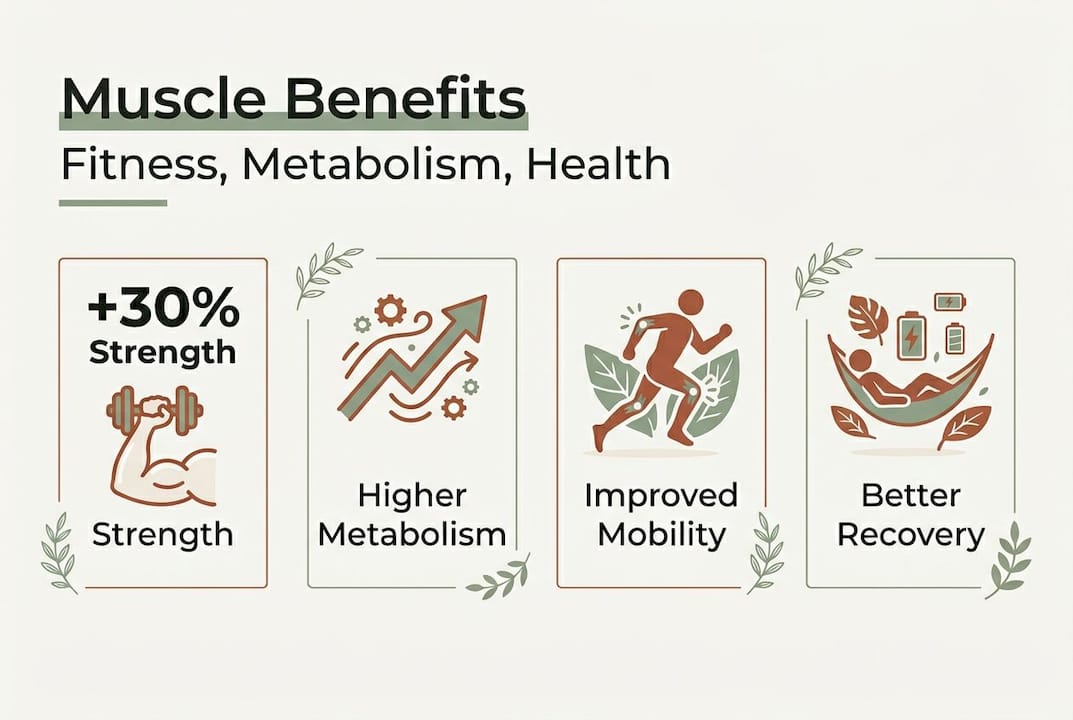
The thermoregulation point is especially important during endurance events or outdoor training. Up to 85% of the body’s heat production at rest comes from metabolic activity in muscle tissue. During high-intensity exercise, that percentage rises even further, which is why athletes with more lean mass often tolerate temperature extremes better than sedentary individuals.
On the recovery side, skeletal muscle is the dominant site of amino acid analysis and utilization after exercise. Getting enough protein post-workout isn’t just about feeding sore tissue. It’s about restoring the amino acid balance that the muscle drew down during contraction and repair.
“Muscle isn’t just stored energy. It’s an active endocrine organ that sends chemical signals throughout your body every time you train. Building and maintaining it is one of the most impactful things you can do for your health.”
For anyone focused on fat loss, this matters enormously. Every pound of skeletal muscle maintained means higher baseline energy metabolism even on rest days. The argument for why protein matters in any fitness plan is inseparable from understanding what skeletal muscle does with it.
The overlooked power of skeletal muscle: What most forget when training
Here’s a perspective that doesn’t get enough attention in fitness culture: the obsession with muscle size is often a distraction from what actually makes you better at everything you do.
Walk into any gym and you’ll hear conversations about volume, hypertrophy, and aesthetics. Those aren’t bad goals, but they often crowd out deeper questions. How well do your fibers recruit under fatigue? How quickly does your neuromuscular system recover between sessions? Is your connective tissue keeping pace with your contractile tissue growth?
The science of peptides and muscle growth shows that the molecular environment of skeletal muscle responds to a surprisingly wide range of inputs, not just resistance training volume. Sleep, protein quality, training frequency, and even stress levels all modify how your sarcomeres remodel and how efficiently your motor units fire.
Understanding the structural hierarchy from whole muscle to sarcomere changes how you interpret fatigue. When your form breaks down on rep twelve, that’s not just “tiredness.” It’s a cascade of events: glycogen depletion in specific fibers, calcium handling becoming less efficient, motor units fatiguing at different rates. That information shapes smarter programming decisions.
The role of protein supplementation is also worth reframing. It’s not about flooding your body with protein indiscriminately. It’s about supplying the specific building blocks, particularly leucine-rich essential amino acids, at times when your skeletal muscle’s protein synthesis machinery is most active, which peaks in the hours immediately following training.
Our take at Nutribliss: the athletes who make the most consistent progress are the ones who treat muscle health as a system, not a single variable. Size, strength, function, recovery, and metabolic capacity all interact. Training and supplementing with that systems view in mind is what separates long-term gains from short-term spikes.
Optimize your skeletal muscle health with science-backed support
You now have a working understanding of how skeletal muscle is built, how it contracts, and why it matters beyond aesthetics. The logical next step is connecting that knowledge to tools that actually move the needle.

At Nutribliss, we build our product line around the same science this article is grounded in. Whether you’re focused on fueling muscle protein synthesis, supporting recovery, or building a nutrition foundation that matches your training demands, we have curated supplements formulated with those mechanisms in mind. Curious about the nutritional science behind whole-food inputs? Our breakdown of superfoods for muscle is a great companion to this guide and helps you see how food-first and supplement strategies work together for real, measurable results.
Frequently asked questions
Is skeletal muscle the same as voluntary muscle?
Mostly yes. Skeletal muscle is typically voluntary, but reflexes and certain nervous system triggers can cause it to contract without any conscious input from you.
How does skeletal muscle help with fat loss?
Skeletal muscle increases your resting metabolic rate, meaning it burns more energy even between workouts. Its role in energy metabolism and glucose uptake also makes body composition management more effective the more muscle you carry.
What is a sarcomere and why is it important?
A sarcomere is the smallest contractile unit in muscle, composed of actin and myosin filaments. Every movement you make, from blinking to squatting, is the result of millions of sarcomeres shortening in coordinated sequence.
How does resistance training affect skeletal muscle?
Resistance training stresses the structural hierarchy of skeletal muscle, triggering adaptations that increase fiber size, add contractile proteins, and improve motor unit recruitment efficiency, producing both strength and size gains over time.