

TL;DR:
- Muscle hypertrophy involves enlargement of muscle fibers primarily through resistance training and proper nutrition.
- Mechanical tension from progressive overload is the key driver of muscle growth, with full range training enhancing results.
- Consistent training, adequate protein intake, and proper recovery are essential for maximizing muscle gains.
Muscle growth isn’t just about lifting heavy things and eating chicken. Most athletes spend years grinding through workouts without understanding the actual biology driving their results. Muscle hypertrophy is the increase in muscle mass through enlargement of muscle fibers, primarily driven by resistance training and smart nutrition. Once you understand the science, you stop guessing and start making decisions that produce real, measurable gains. This article breaks down the mechanisms, training parameters, and nutrition strategies that research actually supports, so you can build a routine that works with your biology instead of against it.
Table of Contents
- What is muscle hypertrophy?
- The science of hypertrophy: How muscles actually grow
- Optimal training for muscle hypertrophy: Sets, reps, and frequency
- Nutrition strategies for building muscle: Protein, calories, and supplements
- Our take: What most people get wrong about muscle hypertrophy
- Connect your muscle gains to smarter recovery and nutrition
- Frequently asked questions
Key Takeaways
| Point | Details |
|---|---|
| Hypertrophy defined | Muscle hypertrophy is the enlargement of muscle fibers driven by resistance training and proper nutrition. |
| Training parameters | Optimal growth requires 10–20 sets per muscle group weekly with moderate reps, full ROM, and progressive overload. |
| Nutrition foundation | Consuming 1.6–2.2 g protein/kg daily and a caloric surplus is essential for maximal muscle gains. |
| Individual variation | Results vary by genetics and training approach, but everyone can achieve significant muscle growth with evidence-based strategies. |
| Consistency matters | Long-term commitment to proper training and nutrition outperforms quick fixes or sporadic efforts. |
What is muscle hypertrophy?
Hypertrophy isn’t a vague concept. It has a precise biological definition: muscle fiber enlargement driven by resistance training and net muscle protein synthesis. When you consistently challenge a muscle, the fibers inside it grow larger in cross-sectional area. That’s hypertrophy.
It’s worth separating hypertrophy from hyperplasia. Hyperplasia refers to an increase in the number of muscle fibers. In humans, this is rare and not a meaningful contributor to muscle growth. Almost all the size gains you see in trained athletes come from fiber enlargement, not fiber multiplication. This distinction matters because it tells you where to focus your energy: making existing fibers bigger, not somehow generating new ones.
Here’s what drives that enlargement at the cellular level:
- Mechanical tension from resistance training activates signaling cascades, including the mTOR pathway, which tells the muscle to synthesize more protein
- Net muscle protein synthesis must exceed protein breakdown over time for fibers to grow
- Satellite cells are activated by training stress and contribute to muscle repair and growth
- Hormonal environment supports the process but doesn’t drive it independently
“Hypertrophy is not caused by a single training session or a hormonal spike. It’s the cumulative result of consistent mechanical loading paired with adequate protein intake over weeks and months.”
One common misconception worth addressing: acute hormonal spikes during training, like a brief rise in testosterone or growth hormone, don’t directly cause muscle growth. What matters is the chronic balance between protein synthesis and breakdown. Hypertrophy mechanisms research confirms that the structural adaptations happen over time, not in the hours after a single workout. This is why consistency beats intensity every single time.
Now that you know hypertrophy is more than a gym buzzword, let’s break down the mechanisms fueling muscle growth.
The science of hypertrophy: How muscles actually grow
With a clear picture of what hypertrophy is, you can look at how it actually happens inside your muscles. Think of your muscle fibers like rubber bands that get thicker the more you stretch and stress them under load. The stress signal triggers a cascade of molecular events that ultimately add more contractile protein to each fiber.

The primary driver is mechanical tension. When you perform resistance training with progressive overload, you activate the mTOR signaling pathway, which acts as the master switch for muscle protein synthesis. Mechanical tension from overload is the dominant mechanism, and everything else is secondary.
| Mechanism | Role in hypertrophy | Relative importance |
|---|---|---|
| Mechanical tension | Activates mTOR, drives protein synthesis | Primary |
| Metabolic stress | Cellular swelling, secondary signaling | Secondary |
| Muscle damage | Triggers repair and remodeling | Secondary |
Metabolic stress and muscle damage do contribute to growth, but the research is clear that they’re supporting actors, not the lead. Training with a focus on metabolic health and fitness matters, but chasing the “burn” or extreme soreness isn’t the most reliable path to hypertrophy.
Range of motion is another factor most athletes underestimate. Full ROM and lengthened positions consistently outperform shortened-range training for hypertrophy. Training a muscle when it’s in a stretched position creates greater mechanical tension at the fiber level. This is why deep squats, full-range Romanian deadlifts, and stretched-position exercises tend to produce more growth than partial reps.
Satellite cells also play a key role. These are muscle stem cells that activate in response to training stress and help repair and expand muscle fibers. Genetic variation in satellite cell activity is one reason some people respond faster to training than others. Both men and women activate these mechanisms similarly, with hormonal factors in hypertrophy showing comparable relative responses across sexes.
- Train through full range of motion when possible
- Prioritize progressive overload over chasing soreness
- Include exercises that load muscles in the stretched position
- Respect individual variation in response rates
Pro Tip: Add one lengthened-position exercise per muscle group to your program. For chest, that’s a dumbbell fly with a deep stretch. For hamstrings, it’s a Romanian deadlift with full hip hinge. These small adjustments can meaningfully improve your hypertrophy results over a training cycle.
Optimal training for muscle hypertrophy: Sets, reps, and frequency
Understanding the science guides how you should actually train for hypertrophy. The good news is the research is fairly specific about what works.
Here are the evidence-based parameters for hypertrophy training:
- Volume: 10 to 20 sets per muscle group per week is the optimal range for most athletes
- Frequency: Training each muscle group twice per week produces better results than once per week
- Rep range: 6 to 15 reps per set, using loads between 65% and 85% of your one-rep max
- Proximity to failure: Train within 2 to 4 reps of failure (this is called reps in reserve, or RIR)
- Rest intervals: 2 to 3 minutes between sets preserves strength for subsequent sets
| Training variable | Novice recommendation | Advanced recommendation |
|---|---|---|
| Weekly sets per muscle | 10-12 | 15-20 |
| Frequency | 2x per week | 2-3x per week |
| Rep range | 8-15 | 6-15 |
| Proximity to failure | 3-4 RIR | 1-3 RIR |
Novices have a significant advantage here. Novices can gain 1 to 2 kg of lean mass in 8 to 12 weeks, while advanced lifters face diminishing returns and need more volume and variation to keep progressing. If you’re newer to structured training, almost any consistent program will produce results. If you’ve been training for years, programming precision matters much more.
Variation and deloads are often misunderstood. You don’t need to completely overhaul your program every few weeks. Small variations in exercise selection, grip, or range of motion are enough to prevent adaptation stagnation. Deloads, periods of reduced volume and intensity, don’t set back your gains. They allow connective tissue and the nervous system to recover, which supports long-term progress.
- Stick with a program for at least 8 weeks before evaluating results
- Track your sets, reps, and loads to ensure progressive overload
- Rotate exercise variations every 4 to 6 weeks, not every session
- Include a deload week every 6 to 8 weeks of hard training
For individual responses to hypertrophy, research confirms that genetic variation is real but not a ceiling. Smart programming consistently narrows the gap between slow and fast responders. Explore muscle growth supplements that can support your training foundation once the basics are locked in.
Pro Tip: Use the RIR method to gauge effort. If you finish a set and feel like you could have done 5 more reps, you’re leaving too much on the table. Aim to stop with 2 to 3 reps left in the tank for most working sets.
Nutrition strategies for building muscle: Protein, calories, and supplements
Training sets the stage for muscle growth, but nutrition provides the raw materials that make hypertrophy possible. You can train perfectly and still stall if your diet doesn’t support recovery and growth.
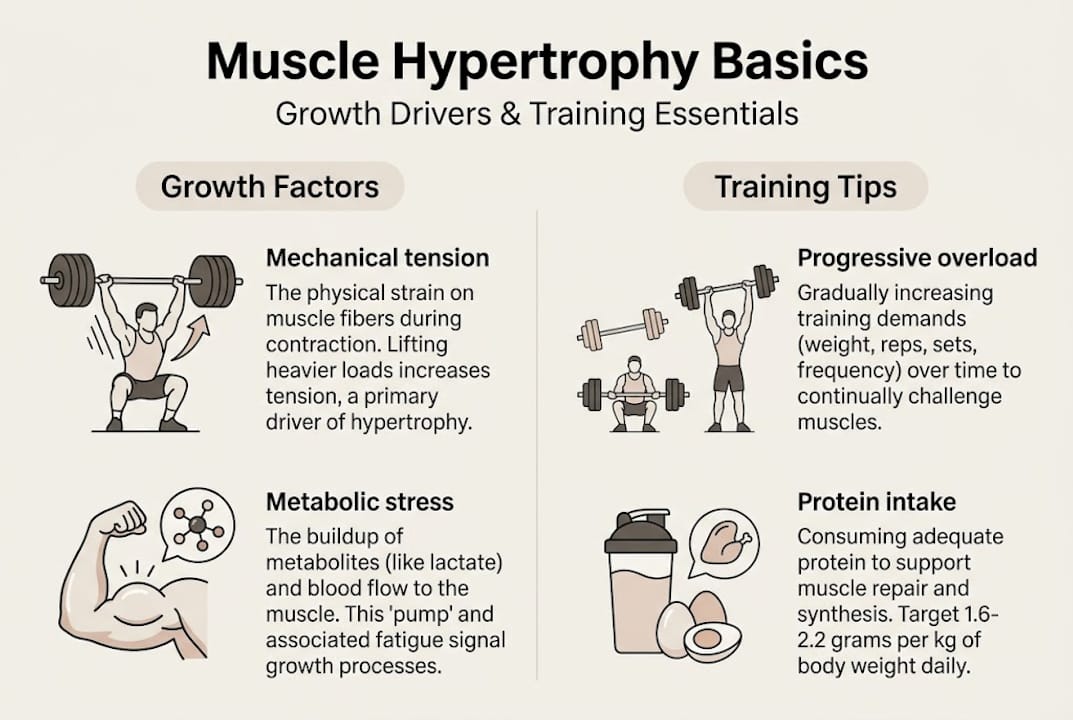
Protein is the most critical variable. Research consistently supports 1.6 to 2.2 grams of protein per kilogram of bodyweight per day for maximizing muscle protein synthesis. For a 80 kg athlete, that’s 128 to 176 grams daily. Spread that intake across 3 to 5 meals to maximize the muscle-building signal throughout the day.
| Bodyweight | Minimum protein (1.6g/kg) | Maximum protein (2.2g/kg) |
|---|---|---|
| 60 kg | 96g | 132g |
| 75 kg | 120g | 165g |
| 90 kg | 144g | 198g |
| 105 kg | 168g | 231g |
Protein distribution across meals matters as much as total intake. Each meal should contain roughly 30 to 50 grams of protein to maximally stimulate muscle protein synthesis. Cramming all your protein into one or two meals is far less effective.
Caloric surplus is also necessary for meaningful muscle gain. A modest surplus of 200 to 400 calories above maintenance supports growth without excessive fat gain. Going too aggressive with calories adds fat without proportionally more muscle.
Supplements that have strong research support include:
- Whey protein: Fast-digesting, high in leucine, ideal post-workout. Learn more about whey protein benefits
- Creatine monohydrate: Increases phosphocreatine stores, supports strength and volume output
- Protein powders: Practical for hitting daily targets. Understand using protein powder effectively
- Electrolytes: Support hydration and muscle contraction during training
Understanding why protein matters goes beyond just hitting a number. Leucine content, digestibility, and meal timing all influence how effectively your body uses dietary protein for muscle repair and growth.
Our take: What most people get wrong about muscle hypertrophy
Now, let’s take a step back and examine common pitfalls and overlooked truths about hypertrophy training.
Most athletes obsess over the next best thing: a new training split, a trending supplement, or a viral workout. What actually drives long-term hypertrophy is far less exciting. It’s consistency. Showing up three to four times per week, adding small amounts of load or volume over months, and eating enough protein every single day. That’s it.
The second most overlooked factor is training at longer muscle lengths. Long muscle length training and individual variation are consistently undervalued in mainstream fitness content. Most gym-goers use partial ranges of motion without realizing they’re leaving significant hypertrophy on the table.
Genetics do play a role. Some people respond faster, build more mass, and recover quicker. But genetics set a ceiling, not a floor. Smart programming and dialed-in nutrition through a solid protein supplementation guide can push even slow responders to impressive results over time.
Be skeptical of supplements that promise dramatic results without strong evidence. Creatine and protein are the two most validated tools in the category. Everything else requires scrutiny. Build the foundation first, then layer in targeted support.
Connect your muscle gains to smarter recovery and nutrition
You now have a solid, research-backed understanding of how hypertrophy works. The next step is making sure your recovery and nutrition are keeping pace with your training demands.

At NutriBliss, we offer science-backed supplements designed to fill the gaps that diet alone sometimes can’t cover. Whether you need to optimize hydration with our electrolytes supplement or explore our full range of recovery supplements, we have options built for athletes who take their training seriously. Pair your hypertrophy knowledge with the right nutritional support and give your muscles everything they need to grow.
Frequently asked questions
How quickly can you see muscle hypertrophy results?
Novices typically gain 1 to 2 kg of lean muscle in 8 to 12 weeks, while trained athletes see slower, incremental progress due to diminishing returns as they approach their genetic ceiling.
What is the best protein intake for muscle hypertrophy?
Research supports 1.6 to 2.2 grams per kilogram of bodyweight daily, distributed across 3 to 5 meals to consistently stimulate muscle protein synthesis throughout the day.
Does training at longer muscle lengths boost hypertrophy?
Yes. Full ROM and lengthened positions consistently outperform shortened-range training by creating greater mechanical tension at the fiber level, which drives more growth over time.
Are supplements necessary for muscle growth?
Supplements are not required, but they can help fill nutritional gaps and support recovery. Consistent training and adequate protein intake remain the true foundation of hypertrophy.
Do men and women respond differently to hypertrophy training?
No. Both sexes show similar relative muscle growth responses to resistance training, meaning women can and do build muscle just as effectively relative to their baseline when training and nutrition are optimized.