

TL;DR:
- Natural caffeine originates from plants such as coffee, tea, and guarana, but its chemical structure remains identical regardless of source. The effects of caffeine depend on dose, accompanying compounds, and individual response rather than its natural or synthetic origin. To use it effectively, consumers should examine labels, start with low doses, and consider the broader context of their health and wellness routine.
Most people assume “natural caffeine” is a fundamentally different, safer compound than the caffeine found in a pre-workout pill or energy shot. That belief drives billions of dollars in consumer choices every year, but the science tells a more complicated story. The caffeine molecule is the same whether it comes from a coffee bean or a laboratory. What actually changes is the context around it: the dose, the delivery form, the accompanying plant compounds, and how your body personally responds. This article cuts through the marketing noise and gives you a clear, evidence-based picture of what natural caffeine really is, how it works, and how to use it well.
Table of Contents
- What is natural caffeine? Definition and plant sources
- Natural vs synthetic caffeine: key differences and similarities
- How natural caffeine works in your body
- Smart ways to choose and use natural caffeine
- What most people miss about natural caffeine: our perspective
- Enhance your wellness journey with trusted natural solutions
- Frequently asked questions
Key Takeaways
| Point | Details |
|---|---|
| Natural means origin | Natural caffeine simply refers to caffeine from plant sources, not a different molecule. |
| Effects depend on dose | Whether natural or synthetic, caffeine’s benefits and side effects are shaped by how much and how you take it. |
| Watch for co-ingredients | Other compounds in drinks and products can change your caffeine experience for better or worse. |
| Individual responses matter | Sensitivity to caffeine is personal, so track how your body responds for safer use. |
What is natural caffeine? Definition and plant sources
The term “natural caffeine” gets thrown around constantly on supplement labels, café menus, and wellness blogs, yet it rarely comes with a clear definition. Let’s set the record straight.
“Natural caffeine” isn’t a separate chemical; it generally refers to caffeine that originates from plant sources such as coffee, tea, cacao, guarana, and yerba mate, rather than caffeine produced through chemical synthesis. The molecule itself is identical in both cases. The distinction lives entirely in the origin story, not in the structure or the pharmacology.
This matters for how you read labels. A product listed as “green tea caffeine” versus “caffeine anhydrous” is describing the source, not a different substance. Regulatory bodies like the FDA do not define a legal category called “natural caffeine,” which means brands can use the term fairly loosely. That creates real confusion for shoppers trying to make informed choices, and it is exactly why understanding the underlying plant sources is so valuable.
Understanding plant-based supplement benefits starts with knowing where the active ingredients actually come from. Here are the main plant sources of caffeine and what sets each apart:
| Plant source | Caffeine content (approx.) | Notable co-compounds |
|---|---|---|
| Coffee (Coffea spp.) | 80 to 100 mg per 8 oz brewed | Chlorogenic acids, antioxidants |
| Green/black tea (Camellia sinensis) | 20 to 70 mg per 8 oz | L-theanine, catechins |
| Guarana (Paullinia cupana) | Up to 4.5% by weight in seed | Tannins, theobromine |
| Yerba mate (Ilex paraguariensis) | 30 to 50 mg per 8 oz | Polyphenols, theobromine |
| Cacao (Theobroma cacao) | 12 mg per oz of dark chocolate | Theobromine, flavanols |
Key takeaways from this list:
- Guarana seeds contain some of the highest caffeine concentrations found in any plant, often surpassing coffee by weight.
- Tea pairs caffeine with L-theanine, an amino acid known for promoting calm focus.
- Cacao delivers a milder stimulant effect because theobromine acts more slowly than caffeine.
- Yerba mate combines caffeine with polyphenols, which may support metabolism and immune function.
For a broader look at how natural stimulants from plants compare in terms of energy effects, the differences in co-compound profiles are where things get genuinely interesting. These accompanying compounds are the real differentiator between plant-sourced and isolated caffeine, not the caffeine molecule itself.
Natural vs synthetic caffeine: key differences and similarities
With sources established, let’s explore how natural caffeine stacks up against its synthetic counterpart, where differences really matter and where they are just marketing.
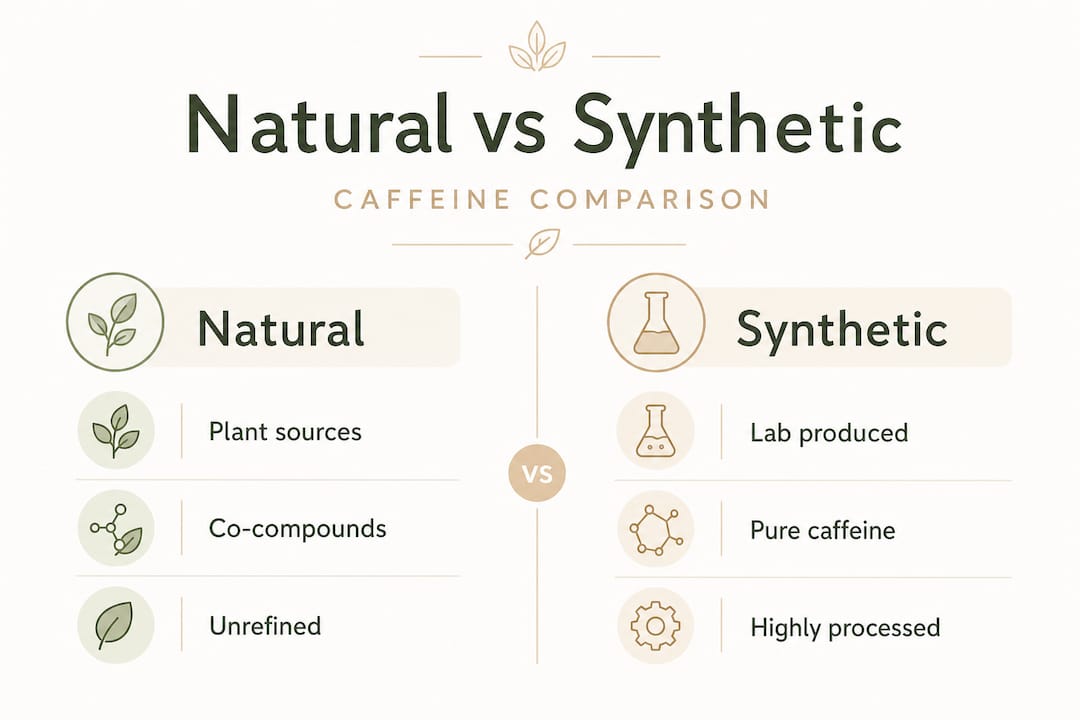
The headline finding from the research is clear. When doses are matched, the caffeine molecule is expected to have similar core physiological effects whether it comes from a plant matrix or is isolated as anhydrous caffeine. Differences in how caffeine “feels” usually come from the accompanying food or drink components and dose timing, not from the caffeine molecule itself.
That said, there are real, practical differences worth knowing.
| Feature | Natural caffeine | Synthetic (anhydrous) caffeine |
|---|---|---|
| Source | Plant-derived (coffee, tea, guarana, etc.) | Chemical synthesis in a lab |
| Molecule | Identical to synthetic | Identical to natural |
| Processing level | Minimal to moderate extraction | Highly purified, isolated |
| Co-compounds | Antioxidants, tannins, L-theanine present | Absent unless added separately |
| Typical delivery | Beverage, whole food, or soft extract | Pill, powder, energy drink |
| Regulatory label | No official “natural” caffeine category | Classified as GRAS by FDA |
| Dose control | Variable (depends on crop, brew) | Precise and consistent |
| Risk of overconsumption | Lower per serving | Higher if misused (concentrated) |
One area where clean labeling in supplements becomes critical is in understanding what else is in your product alongside the caffeine. A supplement listing “natural green tea extract” may still contain additives, fillers, or processing agents that undermine the “natural” framing. Always check the full ingredient panel.
“The accompanying compounds in a whole plant source, not the caffeine molecule, are what create the experiential difference between a cup of tea and a caffeine pill.” This is the nuance that most wellness marketing glosses over entirely.
Pro Tip: Before assuming a product labeled “natural caffeine” is gentler on your system, check the dose. A guarana extract capsule can deliver far more caffeine than a cup of coffee, and higher doses bring the same side effects regardless of source. Always verify total milligrams per serving. For context on caffeine pill safety, dose precision is the critical variable.
Understanding supplement regulation standards helps you navigate the gray zones, because the current system does not require manufacturers to prove a specific form of caffeine is safer or more effective than another.
How natural caffeine works in your body
With the science of “natural” now clear, here is how caffeine from plants actually works in your body and what wellness gains you can realistically expect.
Caffeine is a methylxanthine, which is a class of molecules that interact with specific receptors in the brain. Its primary mechanism is acting as an adenosine receptor antagonist, which reduces fatigue and increases alertness and energy. Here is the simple version: adenosine is a chemical your brain accumulates throughout the day that makes you feel progressively sleepier. Caffeine blocks the receptors that normally receive adenosine, so the “tired” signal cannot get through. You feel more awake and alert without actually needing more rest.

This mechanism kicks in within 15 to 45 minutes of consumption and peaks around 30 to 70 minutes after ingestion, depending on the form and your individual metabolism. Coffee or tea tends to deliver caffeine slightly more gradually due to the fiber and compounds slowing absorption, while an anhydrous capsule may act faster due to its isolated and concentrated nature.
Key evidence-backed benefits of caffeine from plant sources include:
- Reduced perceived fatigue during prolonged physical or mental tasks
- Faster reaction time and improved focus, particularly under stress or sleep deprivation
- Improved performance effects in the context of exercise, including enhanced endurance and mean power output
- Enhanced short-term memory recall in moderate doses
- Potential metabolic benefits from combined polyphenols in coffee and tea
Studies consistently show that caffeine can improve mean power output during exercise by roughly 3 to 5% in trained individuals. That might sound small, but in competitive athletics or sustained training blocks, it is meaningful. For everyday wellness users, the cognitive sharpness and fatigue reduction are usually the more relevant benefits.
The potential downsides are equally real and deserve honest attention. Caffeine can trigger jitters, anxiety, elevated heart rate, and gastrointestinal discomfort, especially at higher doses. It can also disrupt sleep quality when consumed within six hours of bedtime, even when you feel like it does not affect you. Some people are fast caffeine metabolizers due to genetics and feel minimal effects; others are slow metabolizers who feel anxious or ill at doses that others tolerate easily.
For those interested in sustaining energy without caffeine or in rotating caffeine with other strategies, understanding this individual variability is the first step. And if you want to compare caffeine-based approaches with other approaches, exploring top energy supplements gives you a well-rounded view of your options.
Smart ways to choose and use natural caffeine
Having explored how natural caffeine works, here is how to choose wisely and use it safely for the best health outcomes.
The most important thing to understand before purchasing any caffeine-containing product is that individual variability and potential adverse effects at higher doses are real, and optimal dosing strategies are still being studied. There is no one-size-fits-all answer, but there are smart habits that consistently lead to better outcomes.
1. Read the full ingredient panel, not just the front label. Terms like “energizing blend” or “natural energy complex” can hide synthetic caffeine or very high total doses. Find the specific caffeine milligrams per serving and the listed source.
2. Check the caffeine source explicitly. If a label says “green coffee extract” or “guarana seed extract,” that is plant-derived. If it says “caffeine anhydrous” with no further description, it is likely synthetic. Neither is inherently bad, but knowing helps you make intentional choices.
3. Start at the lower end of the recommended dose. Even among people of similar weight and health status, tolerance varies enormously. Starting at half a serving lets you gauge your personal response before committing to full doses.
4. Time your caffeine intake strategically. For exercise performance, 30 to 60 minutes before activity is the standard evidence-based window. For focus work, align it with your natural energy peaks. Avoid caffeine within six hours of your intended sleep time to protect sleep quality.
5. Look for co-compounds that enhance the experience. Products featuring green tea extract bring L-theanine alongside caffeine, which many users find promotes focused calm without the edge or jitters that come with isolated caffeine. This pairing is backed by solid evidence.
6. Monitor unexpected caffeine sources. Pre-workout formulas, certain protein bars, kombuchas, and even some supplement blends contain caffeine that is not prominently labeled. Tracking total daily intake from all sources is essential for staying in a healthy range.
7. Know when to limit or skip caffeine entirely. If you are pregnant, managing anxiety disorders, dealing with heart arrhythmias, or taking certain medications, caffeine warrants extra caution and a conversation with your healthcare provider.
For athletes and active individuals, learning how caffeine fits into a broader supplement strategy is worth the investment. Exploring endurance supplements helps you see how caffeine interacts with electrolytes, carbohydrates, and other performance-support nutrients.
Pro Tip: Keep a simple log for one week. Note your caffeine source, the dose, and the time you consumed it. Then track how you feel two hours later and how well you sleep that night. Patterns emerge quickly, and most people find their personal sweet spot within a week of honest tracking.
What most people miss about natural caffeine: our perspective
The wellness conversation around natural caffeine is almost always about the wrong thing. Consumers spend enormous energy debating source (plant vs. lab) while largely ignoring the factors that actually determine outcomes: dose, product transparency, timing, and personal biology.
Here is what concerns us most. The “natural is better” assumption is emotionally compelling, and brands exploit it constantly. A guarana extract marketed as natural can deliver 300 mg of caffeine in a single capsule, more than most people should consume in a morning. Meanwhile, a precisely dosed caffeine anhydrous supplement from a transparent brand might be the genuinely safer choice for someone with a medical condition requiring controlled intake.
The regulatory gray zone around clean labeling insights makes this worse. Because “natural caffeine” is not a protected legal term, it functions as a marketing claim first and a scientific statement second. That does not mean all natural caffeine products are misleading, but it does mean you need to look past the label to the actual data.
What we genuinely believe makes the difference for wellness-focused caffeine users is this: choose brands that show you the exact source, milligrams, and third-party testing. Start at modest doses and build only if needed. Pay attention to how caffeine makes you feel in the context of your full routine, including stress, sleep, hydration, and nutrition. Caffeine is a powerful tool, but it works best as one layer of a solid wellness foundation, not as a substitute for it.
Enhance your wellness journey with trusted natural solutions
If this article has given you a sharper lens for evaluating caffeine claims, you are already ahead of most consumers. At Nutribliss, we believe that transparency and education are the first step in any effective wellness strategy.
We bring that same commitment to every product in our catalog. From functional ingredient guides to the science behind superfoods, our resources are built to help you make confident, evidence-based choices. Whether you are exploring caffeine-containing supplements or looking for complementary wellness tools, you can discover the science driving our formulations. Ready to find products that align with your goals? Visit NutriBliss wellness solutions and browse our full collection of transparent, science-backed supplements built for health-conscious people like you.
Frequently asked questions
Is natural caffeine actually healthier than synthetic caffeine?
When consumed in similar doses, both forms have comparable effects; differences mostly come from other compounds in the food or drink, not from the caffeine molecule itself.
What are the best natural sources of caffeine?
Coffee, tea, yerba mate, guarana, and cacao are the top plant sources of natural caffeine, each with unique co-compounds like antioxidants or L-theanine that shape the experience.
How much caffeine is safe to consume per day?
Most healthy adults can safely consume up to 400 mg of caffeine daily from all sources, but individual sensitivity varies widely and some people function better at much lower amounts.
Does natural caffeine provide a smoother energy boost?
Some people report a smoother effect from beverages like tea because accompanying compounds and timing shape how caffeine feels, even though the core stimulant effect is identical to synthetic forms.
What side effects should I watch for with natural caffeine?
Watch for jitters, rapid heartbeat, stomach upset, or trouble sleeping, especially at higher doses, since adverse effects including tremors and gastrointestinal discomfort are dose-dependent regardless of caffeine source.