

TL;DR:
- “Clean label” has no official regulation and is driven by consumer expectations.
- Genuine clean supplements feature short, recognizable ingredients without artificial additives.
- Trust requires verifying labels through third-party testing and transparent sourcing.
Walk into any supplement store or scroll through any wellness site and you’ll see “clean label” everywhere. It sounds reassuring. It sounds like a promise. But here’s the thing: clean label has no legal definition recognized by the FDA or any regulatory body. It’s a marketing term shaped entirely by consumer expectations, which means two brands can use it in completely different ways. This guide breaks down what clean labeling actually means, how to recognize it on supplement shelves, and how to make smarter choices for your health.
Table of Contents
- What is clean labeling and why does it matter?
- Key features of clean label supplements
- How to read supplement labels for informed choices
- The impact of clean labeling on nutrition and wellness
- Our take: Trusting clean labels means thinking critically
- Find clean label options with NutriBliss
- Frequently asked questions
Key Takeaways
| Point | Details |
|---|---|
| No legal definition | Clean labeling is market-driven and not regulated by the FDA or government. |
| Recognize real features | Look for transparency, simple ingredients, and third-party testing to identify true clean label supplements. |
| Consumer vigilance needed | Always read ingredient lists and investigate brand claims since clean labeling can mean different things. |
| Impact on wellness | Clean labels may support better nutrition but require more than just a label for safety and efficacy. |
What is clean labeling and why does it matter?
Clean labeling is one of the most talked-about concepts in the supplement industry right now, and yet it has no official standard behind it. The FDA has not defined it, the FTC has not codified it, and no government agency enforces it as a specific category. As the clean label market has grown into a $136 billion global conversation, the term has remained entirely consumer-driven. Brands adopt it because shoppers respond to it, not because it reflects a regulated standard.
That said, the consumer intent behind clean labeling is real and valuable. People want to know what they’re putting into their bodies. They want fewer ingredients, simpler names, and no mysterious compounds buried at the bottom of a supplement facts panel. Those expectations are pushing brands toward greater transparency whether they’re legally required to provide it or not.
“There is no legal or regulatory definition for ‘clean label’ by FDA or other bodies; it is a consumer-driven marketing term, with claims subject to general truthful labeling rules.”
This gap between perception and regulation is exactly why demystifying clean label practices matters so much. When a term carries this much weight in purchasing decisions but zero legal teeth, informed consumers are the only real quality filter.
Industry strategies to meet clean label demand are varied. Some brands reformulate products to remove artificial dyes, synthetic preservatives, and chemical fillers. Others focus on sourcing certifications like organic, non-GMO, or allergen-free to signal cleanliness. The best brands lean into supplement transparency by publishing third-party testing results and disclosing exact ingredient quantities, not just a vague proprietary blend. These actions reflect genuine clean labeling intent, even if the phrase itself carries no regulatory weight.
Key features of clean label supplements
Now that we’ve defined clean labeling, let’s break down what features to look for when shopping for supplements. Knowing what separates a genuinely transparent product from one that just uses clean-sounding marketing language is a skill worth building.
Clean label supplements share several distinguishing characteristics. Here’s what to look for:
- Short, readable ingredient lists. The fewer the ingredients and the more recognizable they are, the cleaner the label tends to be. If you can pronounce everything and recognize each ingredient from a kitchen or garden, that’s a strong signal.
- No artificial additives. Artificial sweeteners like aspartame, synthetic dyes like Red 40, and chemical preservatives like BHA and BHT are the classic exclusions in clean label products. Their absence is a baseline expectation.
- Minimally processed ingredients. Clean labels often indicate that raw materials have undergone less industrial processing. Whole food concentrates, fermented nutrients, and cold-processed proteins are common examples.
- Transparent sourcing. Brands that specify where their ingredients come from, whether it’s grass-fed collagen, wild-caught fish oil, or organically grown adaptogens, are practicing ingredient transparency.
- No proprietary blends hiding doses. A proprietary blend lists multiple ingredients under one quantity, making it impossible to know how much of each ingredient you’re actually getting. Clean label products break this out individually.
- Third-party certifications. Certifications from NSF International, Informed Sport, or USP signal that the product has been independently verified, which is a meaningful layer of accountability.
Here’s a quick comparison to illustrate the difference between clean and conventional supplement labeling:
| Feature | Clean label supplement | Conventional supplement |
|---|---|---|
| Ingredient count | Typically 5 to 10 | Often 15 or more |
| Sweeteners used | Stevia, monk fruit | Aspartame, sucralose |
| Artificial colors | None | May include FD&C dyes |
| Dose transparency | Individual amounts listed | May use proprietary blends |
| Third-party testing | Common | Less consistent |
| Preservatives | Natural or none | May include synthetic |
Checking examples of clean supplements across categories like protein powders, multivitamins, and electrolytes gives you a concrete reference point for what “clean” actually looks like in practice. These real-world comparisons are far more useful than relying on front-of-package marketing claims alone.

And since the clean label food choices conversation spans both food and supplements, patterns from one category often carry over to the other. The principles stay consistent: simple, real, and transparent.
Pro Tip: Flip every supplement bottle to the ingredient list before you read a single word on the front label. Front-of-package claims are marketing. The ingredient panel is where the real story lives.
How to read supplement labels for informed choices
Understanding features is helpful, but the real challenge is reading labels effectively. Here’s how you can do it confidently, even when label language feels deliberately confusing.
Start with the Supplement Facts panel, which is the regulated section of any supplement label in the US. This panel lists the serving size, the number of servings per container, the nutrients included, and their amounts per serving. This is where clean label values show up or fall apart.
Clean label cues to look for:
- Each ingredient is listed with its individual quantity in milligrams, micrograms, or IUs
- Ingredient names match what you’d find in a food or herb, not a chemistry textbook
- No colors or artificial flavors appear in the “Other Ingredients” section
- The product has a recognizable certifying organization logo on the label
Red flags that suggest a less transparent product:
- A proprietary blend where five or more ingredients are grouped under a single quantity
- Vague ingredient descriptors like “natural flavors,” which can mean almost anything
- A long list of additional fillers, binders, and excipients that serve no nutritional purpose
- No information about where or how the ingredients were sourced
Here’s a data table showing common ingredients and how they stack up under a clean label lens:
| Ingredient | Clean label status | Notes |
|---|---|---|
| Magnesium glycinate | Clean | High bioavailability, simple form |
| Magnesium oxide | Borderline | Low absorption, common filler |
| Stevia leaf extract | Clean | Natural zero-calorie sweetener |
| Sucralose | Not clean | Artificial, controversial metabolic effects |
| Sunflower lecithin | Clean | Natural emulsifier |
| Soy lecithin (GMO) | Not clean | Allergen concern, low transparency |
| Titanium dioxide | Not clean | Synthetic whitener, safety scrutiny |
| Natural flavors | Ambiguous | Broad term, not always simple |
| Turmeric (curcumin) | Clean | Whole-food sourced, recognizable |
| Silicon dioxide | Borderline | Used as anti-caking agent, technically inert |
Learning to read supplement labels fluently is genuinely empowering. Once you know what each line means and which ingredients deserve a second look, shopping for supplements stops feeling overwhelming and starts feeling methodical.
Because clean label is not regulated by the FDA, the burden falls on you as the consumer to verify what you’re buying. Third-party testing is the best tool available. Organizations like NSF, Informed Sport, and Labdoor test supplements for label accuracy, contaminant levels, and ingredient purity. Third-party tested supplements give you documented evidence that what’s on the label actually reflects what’s in the bottle.
Pro Tip: Search for your supplement brand on Labdoor or Informed Sport’s verified database before buying. It takes two minutes and saves you from wasting money on products that don’t deliver what they claim.
The impact of clean labeling on nutrition and wellness
Once you know how to read labels, it’s important to see the broader impact of clean labeling on your health and wellness. The implications go beyond ingredient lists and touch on trust, body response, and long-term wellness strategy.
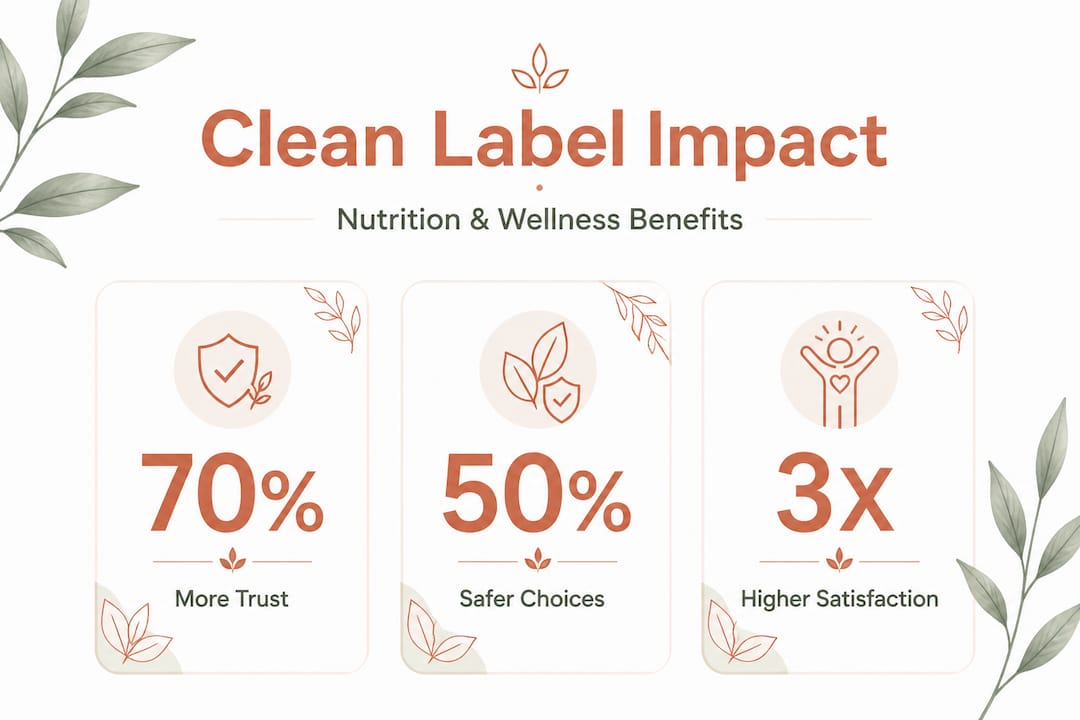
Consumer trust and perceived safety are real and measurable. Multiple market studies show that consumers are willing to pay a premium for products they believe are cleaner, simpler, and more honest. That trust has tangible economic weight, which is part of why clean label food has become a $136 billion market segment globally. Brands know that trust translates to loyalty.
From a nutrition standpoint, using simpler and more recognizable ingredients often does correlate with better outcomes. When a protein powder uses one or two sweeteners you recognize instead of a cocktail of synthetic additives, your gut may simply respond better. When a magnesium supplement uses glycinate or malate instead of oxide, the absorption rate is meaningfully higher. Simplicity is not just aesthetic. It often has functional benefits.
Wellness benefits of clean labeling include:
- Reduced exposure to synthetic additives that may disrupt gut health or hormonal balance
- Easier ingredient tracking for people managing food allergies or sensitivities
- Better alignment with whole-food dietary approaches like paleo, Mediterranean, or organic eating
- Increased confidence in dosing, since transparent labels show you exactly what you’re consuming
- Simpler stacking decisions when you know exactly what’s in each product
Limitations worth acknowledging:
- Clean label alone does not confirm that a product is effective or properly dosed
- Recognizable ingredients can still be low quality depending on the sourcing and processing
- Marketing can exploit clean label language without delivering genuine transparency
- Not all synthetic compounds are harmful, and not all natural ingredients are safe
“There is no legal or regulatory definition for ‘clean label’ by FDA or other bodies; it is a consumer-driven marketing term, with claims subject to general truthful labeling rules.”
This regulatory gap means using a supplement safety checklist alongside clean label evaluation is genuinely important. Clean labeling is a strong starting signal, but it needs to be paired with evaluating supplement quality through certifications, dosing science, and brand transparency to mean something concrete.
Our take: Trusting clean labels means thinking critically
Here’s something the wellness industry doesn’t say often enough: clean labeling is a starting point, not a finish line. At NutriBliss, we’ve seen how the phrase can be used with integrity and how it can be stretched to cover products that don’t deserve the descriptor. That gap is worth talking about honestly.
The real problem with “clean label” as a standalone claim is that it hands marketing teams a powerful phrase without demanding evidence. A brand can remove artificial colors, print “clean” across a shiny label, and still use low-grade ingredient forms, hide doses inside a proprietary blend, or skip third-party testing entirely. That product now looks cleaner without being meaningfully better.
Our perspective is that healthy skepticism and label literacy are the two tools you cannot skip. We’d rather you trust the process of verifying a product than simply trust a buzzword. That means checking supplement regulation standards to understand what protections actually exist, looking for third-party certifications from credible organizations, and comparing the ingredient forms used, not just the ingredient names.
The consumers who benefit most from clean labeling are the ones who treat it as a filter, not a guarantee. Use it to narrow your options, then do the extra verification. A brand that genuinely commits to transparency will have the documentation to back up every clean label claim it makes. Those are the brands worth building a relationship with.
Find clean label options with NutriBliss
You now have a clear framework for evaluating clean label supplements. The next step is putting that knowledge to work with products that actually hold up to scrutiny.

At NutriBliss, we prioritize transparency across our entire supplement catalog, from proteins and electrolytes to vitamins and specialty formulas. Every product we offer is selected with ingredient quality and label clarity in mind. Explore the science behind our superfoods to see how we approach sourcing and formulation, or visit our science page to understand the research framework we use to evaluate every product on our shelves. Your wellness goals deserve supplements that are as honest as they are effective.
Frequently asked questions
Is clean labeling regulated by the FDA?
No, “clean label” is not regulated by the FDA and carries no legal definition. It is entirely driven by consumer demand and market trends.
What makes a supplement “clean label”?
A clean label supplement typically avoids artificial additives, uses simple recognizable ingredients, and lists individual ingredient amounts clearly, though definitions vary widely across brands since no regulatory standard exists.
How can I identify clean label products on supplement shelves?
Look for short ingredient lists, no artificial colors or synthetic sweeteners, and certifications from third-party testing organizations. Comparing the “Other Ingredients” section across similar products is one of the fastest ways to spot real differences.
Does clean labeling guarantee supplement safety or effectiveness?
No. Clean labeling signals transparency and simplicity, but it does not guarantee safety or efficacy. Third-party certifications, dose transparency, and bioavailable ingredient forms are what actually support safety and performance claims.