

TL;DR:
- Curcumin is the primary active compound in turmeric, responsible for many health benefits.
- Its low bioavailability requires enhanced formulations or pairing with fats and piperine for effectiveness.
- Clinical evidence supports curcumin’s role in reducing inflammation, joint pain, and improving cardiovascular health.
Most people assume turmeric and curcumin are the same thing. They reach for a turmeric latte and think they’re getting a powerful anti-inflammatory dose. The reality is more nuanced. Curcumin is the primary active ingredient in turmeric, a distinct bioactive compound that does the heavy lifting behind turmeric’s health reputation. Whole turmeric contains many compounds, but curcumin is the one researchers keep returning to. In this article, we break down what curcumin actually is, how it works in your body, what the clinical evidence really shows, and why getting it to work for you is harder than it sounds.
Table of Contents
- What is curcumin? A scientific overview
- How curcumin works: Mechanisms and effects
- Curcumin’s real health benefits: What the evidence says
- Bioavailability challenges and supplement solutions
- The uncomfortable truth about curcumin: What wellness experts know
- Optimize your wellness journey with science-backed supplements
- Frequently asked questions
Key Takeaways
| Point | Details |
|---|---|
| Curcumin is not turmeric | Curcumin is the main bioactive molecule in turmeric, but only a small percentage of the root. |
| Health benefits are evidence-backed | Clinical studies support curcumin’s role in lowering inflammation, improving cholesterol, and reducing pain. |
| Absorption is the biggest hurdle | Curcumin’s poor bioavailability means that dietary pairing and enhanced supplements are key to real-world effectiveness. |
| Safe for daily use | Curcumin is safe at recommended doses, with minimal side effects reported for most users. |
What is curcumin? A scientific overview
Curcumin is a polyphenol, a plant-based chemical with a molecular structure that lets it interact with multiple biological systems at once. It comes from Curcuma longa, the turmeric plant, which has been central to Ayurvedic and Traditional Chinese medicine for thousands of years. Ancient practitioners used turmeric to treat digestive complaints, skin conditions, and joint pain long before laboratory science could explain why.
What makes curcumin stand apart from the rest of the turmeric plant is its concentration and activity. Curcumin makes up 2-9% of the turmeric root by weight, and it’s responsible for that rich yellow-orange color you see in curry powder and golden milk. That color comes from its chemical backbone, a structure called a bis-α,β-unsaturated β-diketone, which allows it to bind to proteins and enzymes in ways most plant compounds cannot.
Turmeric as a whole does offer broad health benefits, including fiber, essential oils, and other polyphenols. But when researchers want to isolate, test, and replicate a specific effect, they turn to curcumin. That’s why the supplement world has increasingly shifted away from whole turmeric powders toward turmeric extract, which is standardized to contain a specific percentage of curcuminoids.
| Feature | Whole turmeric | Curcumin extract |
|---|---|---|
| Curcumin content | 2-9% | 95% standardized |
| Form | Spice/powder | Capsule/supplement |
| Bioavailability | Low | Low to moderate |
| Research focus | Traditional use | Clinical trials |
| Best use | Culinary/dietary | Targeted supplementation |
This table shows why supplement formulas use concentrated curcumin. A teaspoon of turmeric powder delivers roughly 200mg of curcumin. To reach clinical doses used in research, you would need many tablespoons of raw turmeric daily, an impractical amount for most people.
Having addressed what curcumin is, we can now examine its impact on health.
How curcumin works: Mechanisms and effects
Curcumin does not work through a single pathway. That’s what makes it scientifically interesting and also what makes it difficult to study cleanly. It simultaneously targets multiple inflammation pathways, including NF-κB, MAPK, JAK/STAT, and NLRP3. These are molecular switches that trigger the production of inflammatory proteins in your body. When curcumin suppresses them, the downstream effect is reduced inflammation.

On the antioxidant side, curcumin activates the Nrf2/ARE pathway, which is your body’s internal antioxidant program. It signals cells to produce their own protective enzymes like superoxide dismutase and glutathione. This is different from simply donating electrons the way vitamin C does. Curcumin essentially tells your body to protect itself. It also directly inhibits key inflammatory molecules like COX-2, the same enzyme that ibuprofen targets.
Here’s a comparison of curcumin versus a common anti-inflammatory for context:
| Property | Curcumin | Ibuprofen |
|---|---|---|
| Mechanism | Multi-pathway | COX inhibition only |
| Side effects | Minimal at normal doses | GI irritation, kidney risk |
| Antioxidant activity | Yes | No |
| Bioavailability | Poor (needs enhancement) | High |
| Evidence level | Strong for inflammation | Very strong |
So what does all this science actually translate to in the real world?
Clinically supported benefits include:
- Lower LDL cholesterol and improved HDL levels
- Reduced blood pressure in people with elevated readings
- Decreased joint pain and stiffness in osteoarthritis
- Reduced inflammation markers in ulcerative colitis
- Improved insulin sensitivity in metabolic health research
Meta-analyses confirm these outcomes across lipid profiles, blood pressure, inflammation reduction, osteoarthritis pain, and gut health. This is not anecdotal. It is aggregated data from multiple randomized controlled trials.
Key insight: Curcumin works through at least four distinct anti-inflammatory pathways simultaneously. No single pharmaceutical agent matches this multi-target profile without significant side effects.
Learning how to maximize nutrient absorption is critical here, because curcumin’s effects in the body depend heavily on how well it’s absorbed. Understanding the science enables us to assess actual health applications.
Curcumin’s real health benefits: What the evidence says
The research on curcumin spans thousands of studies. The challenge is sorting solid clinical evidence from lab-dish findings that never translated to humans. Here’s what the evidence firmly supports.
Documented health benefits at clinical doses:
- Joint health: Curcumin significantly reduces pain and stiffness in osteoarthritis patients
- Cardiovascular support: Lowers LDL, triglycerides, and systolic blood pressure
- Gut health: Reduces inflammation in conditions like irritable bowel syndrome and colitis
- Metabolic health: Improves fasting blood glucose and insulin sensitivity
- Mood and cognition: Early evidence suggests benefits for depression and cognitive aging
Clinical meta-analyses show these improvements appear at doses ranging from 500 to 3000mg per day, with most studies running 8 to 12 weeks. Shorter trials and lower doses tend to show weaker effects, which is useful information if you’re evaluating a supplement regimen.
From a safety standpoint, curcumin has an excellent record. It holds FDA GRAS status, meaning it’s generally recognized as safe. Studies suggest tolerability up to 4-8g per day, far above what most supplements contain. At high doses, some users report mild nausea, loose stools, or headaches, but serious adverse effects are rare.
Pro Tip: If you’re adding curcumin for gut support, look into how it pairs with digestion support supplements for a more complete approach to digestive wellness.
A complete curcumin nutrition guide suggests that people with inflammatory conditions get the most consistent results when they maintain a daily supplementation schedule rather than using curcumin occasionally. Consistency matters more than dosage spikes.
With real evidence in mind, we now face the question of bioavailability, curcumin’s biggest practical limitation.
Bioavailability challenges and supplement solutions
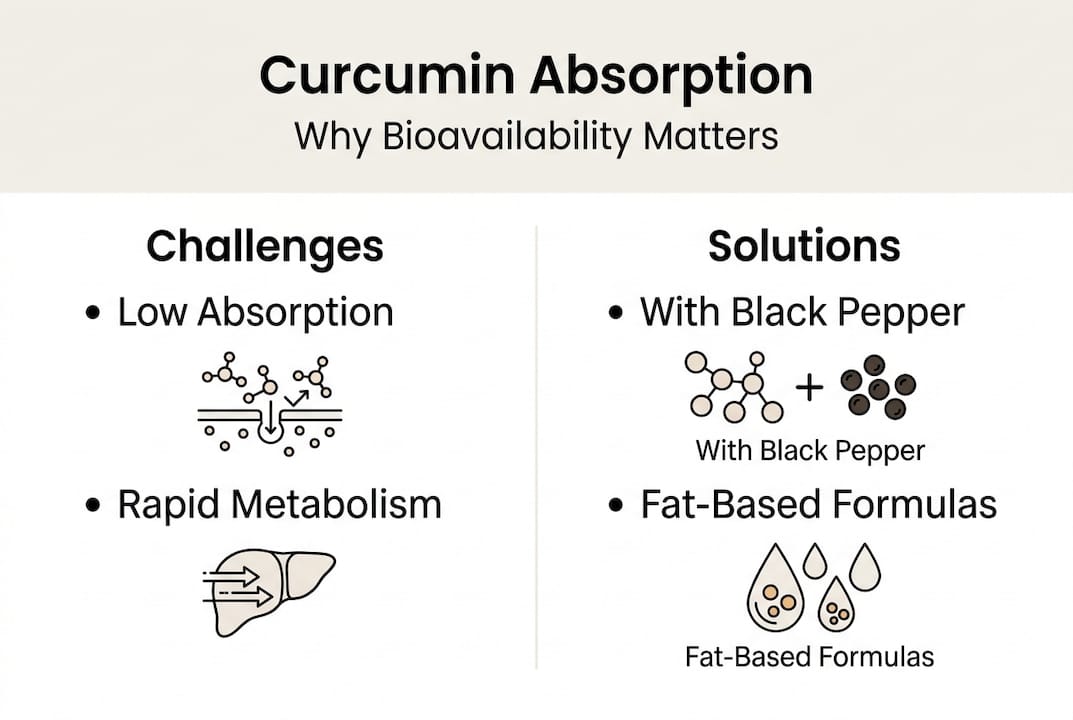
Here’s the frustrating reality: curcumin is poorly absorbed. Your gut doesn’t take it up efficiently, your liver metabolizes it quickly, and your kidneys flush it out fast. Low aqueous solubility and rapid metabolism mean that a standard curcumin capsule may produce only trace levels in your bloodstream. This is called poor bioavailability, and it’s the reason why some people take curcumin for months and feel little difference.
Researchers have been working on this problem for years. The supplement industry has responded with several enhanced formulations:
- Piperine combinations: Black pepper extract increases curcumin absorption, though benefits may be more modest than early studies suggested
- Liposomal delivery: Wrapping curcumin in fat-based spheres that protect it from metabolism
- Nanoformulations: Breaking curcumin into nano-sized particles to increase surface area
- Phytosome technology: Binding curcumin to phospholipids for better absorption through the gut wall
- Fat pairing: Taking curcumin with a high-fat meal to leverage natural fat absorption pathways
Curcumin absorption studies consistently show that enhanced formulas produce higher blood levels than standard curcumin powder, but the boost is often transient, meaning levels rise and fall quickly rather than staying elevated.
Pro Tip: Taking curcumin with a meal that contains healthy fats, like avocado, olive oil, or nuts, is one of the simplest and most effective ways to improve absorption without a specialty formulation.
“Even with enhanced bioavailability formulas, curcumin’s time in the bloodstream is short. Daily consistency and strategic meal pairing matter more than the delivery system alone.”
If you want to explore bioavailability explained in more depth, or learn how to combine supplements safely, those are smart next steps before committing to a curcumin protocol. For those looking for a proven starting point, turmeric with BioPerine combines standardized curcumin with black pepper extract to address the absorption problem head-on.
Now equipped with both scientific and practical insight, let’s evaluate curcumin’s real-world application and where the hype outpaces reality.
The uncomfortable truth about curcumin: What wellness experts know
Here’s what rarely gets said in wellness circles: most curcumin supplements may not be doing what people think they are. The gap between preclinical research (lab and animal studies) and human clinical results is significant. Curcumin kills cancer cells in a petri dish. It has not demonstrated the same results in human oncology trials, and that distinction matters enormously when people make health decisions.
For everyday wellness goals like managing inflammation, supporting joint comfort, or improving cholesterol, the evidence is real but modest. Curcumin supplements may support inflammation reduction, but low bioavailability limits how much actually reaches target tissues. What curcumin does reliably, based on current evidence, is work locally in the gut. Systemic effects, reaching muscles, joints, and organs through the bloodstream, are harder to achieve with standard supplements.
This is why some wellness practitioners argue that a daily habit of turmeric-rich food with fats and black pepper may outperform an expensive capsule for many users. It’s not a popular message in the supplement world, but it’s an honest one. That said, supplements fill gaps that diet alone often can’t, especially at therapeutic doses. Learning nutrient absorption tips and pairing curcumin with complements like ashwagandha with black pepper creates a more complete anti-inflammatory foundation. More rigorous human trials are needed before curcumin can be recommended as a standalone treatment for serious conditions.
Optimize your wellness journey with science-backed supplements
Curcumin’s science is compelling, and the best way to put it to work is through formulas designed with bioavailability in mind. At Nutribliss, every product we carry is built around the same principle: supplement what your diet can’t consistently deliver, and do it with ingredients that actually absorb.
If you’re curious about the research behind the products we recommend, explore the superfoods science page for a deeper look at how evidence shapes our formulas. Browse the full Nutribliss supplement collection to find bioavailability-focused options, from turmeric with BioPerine to targeted wellness capsules. And if you’re just getting started, the NutriBliss home page is a great place to explore what fits your health goals.
Frequently asked questions
Is curcumin the same as turmeric?
No. Curcumin is the primary active compound within turmeric, representing only about 2-9% of the root’s total weight. Turmeric contains many other compounds alongside it.
What is the most effective way to take curcumin?
Pairing curcumin with a fat-containing meal and black pepper extract improves absorption, since fats and piperine both help the compound survive digestion and enter the bloodstream more effectively.
Does curcumin have proven health benefits?
Yes. Meta-analyses confirm that curcumin consistently improves cholesterol levels, reduces blood pressure, eases joint pain, and lowers inflammatory markers when taken at consistent daily doses.
Is curcumin safe to use daily?
Curcumin is well-tolerated and carries FDA GRAS status, with studies supporting safety up to 4-8g per day. Minor side effects like nausea can occur at very high doses.
Why are curcumin supplements sometimes less effective?
The core issue is poor bioavailability. Curcumin has low water solubility and is metabolized quickly, meaning most of a standard dose never reaches systemic circulation in meaningful amounts.