

TL;DR:
- Hyaluronic acid is a naturally occurring molecule that attracts water, supporting hydration and skin resilience. Its effectiveness depends on molecular weight and delivery method, with topical, oral, and injectable options suited for different goals. While beneficial, HA should be used alongside other skincare practices, as it is not a standalone solution for all skin concerns.
Hyaluronic acid can hold up to 1,000 times its weight in water, yet most people using it have no idea how it actually works. Walk into any beauty retailer and you’ll find the ingredient stamped across serums, masks, supplements, and fillers, all making bold promises about dewy, youthful skin. But here’s the reality: not all hyaluronic acid products are created equal, and using the wrong one for your goal is like watering a plant through a sealed pot. This guide cuts through the marketing noise to give you the real science, so you can make choices that actually move the needle for your skin.
Table of Contents
- What is hyaluronic acid? The molecule behind the myth
- Types of hyaluronic acid: Molecular weights and why they matter
- How can you use hyaluronic acid? Topical, oral, and injectable options
- What to look for in hyaluronic acid products
- The uncomfortable truth: Hyaluronic acid isn’t a silver bullet for everyone
- Explore science-backed skin health solutions
- Frequently asked questions
Key Takeaways
| Point | Details |
|---|---|
| HA is essential for skin hydration | Hyaluronic acid supports moisture, elasticity, and resilience in skin tissues. |
| Molecular size impacts results | Low and high molecular weight HA act differently on and beneath the skin. |
| Multiple forms, real benefits | Topical, oral, and injectable HA each offer unique advantages for skin health. |
| Read labels and claims | Understanding product ingredients and science helps you choose what works best. |
What is hyaluronic acid? The molecule behind the myth
Hyaluronic acid, often abbreviated as HA, is not a synthetic lab invention. It’s a substance your body already produces naturally. Specifically, it’s a glycosaminoglycan, which is a type of long-chain sugar molecule that binds to water at an extraordinary rate. Think of it like a sponge woven into your skin tissue, constantly pulling in moisture and keeping everything plump and bouncy.
Hyaluronic acid is a naturally occurring glycosaminoglycan in the skin that maintains hydration and firmness, playing a central role in your skin’s extracellular matrix. This matrix is essentially the scaffolding beneath your skin’s surface. When HA levels are high, skin looks full, smooth, and resilient. When HA declines, which it does steadily after your mid-20s, you start noticing dryness, fine lines, and that overall “deflated” appearance.
HA doesn’t just live in your skin. It’s concentrated in your joints, eyes, and connective tissues throughout your body. This is part of why it’s gaining attention beyond skincare. Its core job everywhere is the same: attract and retain water, cushion tissue, and support structure.
Here’s what HA does for your skin specifically:
- Draws moisture from the environment into the upper layers of skin
- Maintains the skin barrier by supporting the lipid structure between cells
- Supports collagen and elastin by keeping the surrounding tissue hydrated and pliable
- Cushions the dermis against mechanical stress
If you’re exploring the broader relationship between structural proteins and skin health, our collagen peptide guide explains how HA and collagen work together in the skin matrix.
“Without adequate hyaluronic acid, your skin loses its ability to hold water effectively, which accelerates the visible signs of aging far more than most people realize.”
The benefits of hyaluronic acid extend well beyond surface moisturization. For anyone serious about long-term skin health, HA is foundational, not optional. Explore our skin health supplements if you want to go deeper on products that support this.
Types of hyaluronic acid: Molecular weights and why they matter
Not all hyaluronic acid products perform the same way, even when the label says the same thing. The reason comes down to molecular weight, and it’s one of the most important things you’re probably not reading on the packaging.
Molecular weight describes the size of the HA molecule and is measured in Daltons (Da). Large molecules, called high molecular weight HA (HMW-HA), sit on the surface of the skin and create a moisture-retaining film. This gives you that immediate dewy, hydrated feeling. Small molecules, called low molecular weight HA (LMW-HA), can penetrate deeper into the skin layers, where they work at a structural level.
Topical HA effectiveness depends heavily on the form and molecular weight used, since different sizes interact differently with the skin barrier. This means a high-end serum with only HMW-HA might feel incredible but deliver mostly surface results. A product combining both weights, or leaning on LMW-HA, is likely to do more for texture, fine lines, and longer-term hydration.
| HA type | Molecular weight | Skin penetration | Primary benefit |
|---|---|---|---|
| High molecular weight | Over 1,000 kDa | Surface only | Immediate plumping, barrier protection |
| Medium molecular weight | 50 to 1,000 kDa | Partial penetration | Balanced hydration |
| Low molecular weight | Under 50 kDa | Deeper layers | Structural hydration, anti-aging |
| Nano HA | Under 5 kDa | Deepest penetration | Targeted cellular hydration |
Reading labels gets tricky because many brands just list “hyaluronic acid” or “sodium hyaluronate” (the salt form, which absorbs more easily) without specifying weight. Sodium hyaluronate is actually preferable in topical products because its smaller structure makes it easier for skin to absorb compared to pure HA.
What to watch for on labels:
- “Multi-weight HA” signals that the product uses a combination, which is generally more effective
- “Sodium hyaluronate” is the more bioavailable form for topical products
- Concentration percentages below 1% are common in formulas but can still be effective
- “Hydrolyzed HA” means the molecule has been broken down, usually for better penetration
Pro Tip: If you’re comparing two serums at similar price points, check if one lists sodium hyaluronate instead of hyaluronic acid. The sodium form tends to absorb faster and work deeper, giving you more functional benefit for the cost.
This science also applies to oral supplements. If you’re curious about how collagen supplements complement HA’s structural role, our article on collagen supplements for skin breaks down the evidence clearly.
How can you use hyaluronic acid? Topical, oral, and injectable options
Once you understand what kind of HA is in your product, the next question is how you’re using it. Each delivery method has a distinct mechanism, evidence base, and use case. Here’s how each one stacks up.
Three main ways to use hyaluronic acid:
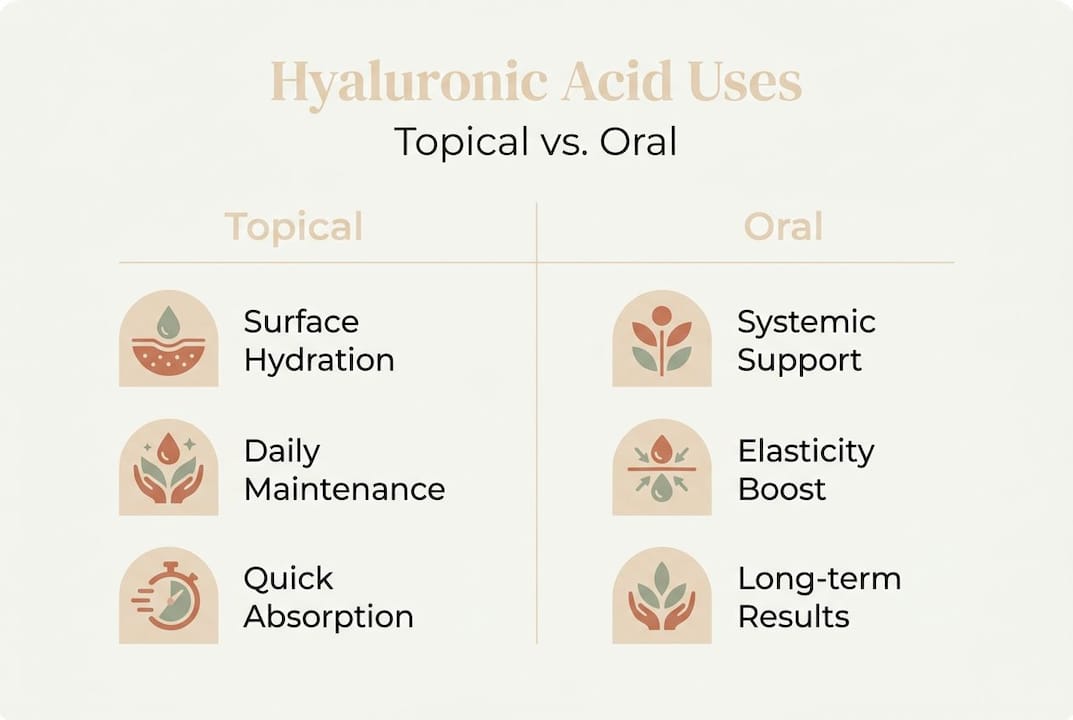
- Topical (serums, creams, masks): Applied directly to skin for surface and moderate-depth hydration
- Oral (supplements, gummies, capsules): Ingested for systemic hydration, absorbed and distributed through the bloodstream
- Injectable (fillers, mesotherapy): Administered by professionals for structural, targeted results
Topical HA is the most widely used and accessible form. It works best when applied to damp skin, since HA draws moisture from whatever is nearby. In a dry environment, it can actually pull moisture from deeper layers of your skin if there’s nothing in the air to draw from. Always apply a moisturizer on top to seal it in.
Oral HA is a growing area of research. Oral hyaluronic acid measurably improves skin hydration and elasticity in controlled trials, with meaningful results visible after 8 to 12 weeks of consistent use. This is significant because it suggests the molecule, or its breakdown products, can signal hydration pathways systemically rather than just being absorbed whole. Our article on joint health strategies also covers how oral HA is being investigated for its role in joint lubrication.

Injectable HA represents the most direct and powerful application. Used in dermal fillers and mesotherapy treatments, injectable HA improves facial skin quality, hydration, and elasticity with generally favorable safety profiles. Results are more immediate and dramatic compared to topical or oral routes, but require professional administration and carry a higher cost and risk profile.
| Delivery method | Onset of results | Duration | Cost level | Requires professional |
|---|---|---|---|---|
| Topical | Hours to days | While using product | Low | No |
| Oral | 4 to 12 weeks | While supplementing | Low to moderate | No |
| Injectable | Immediate to 2 weeks | 6 to 18 months | High | Yes |
For most people, a combined approach works best: topical HA for daily maintenance, oral HA for systemic support, and injectable options reserved for specific aesthetic goals. If you’re looking at research on how topical HA research shapes current product development, the evidence increasingly supports multi-form approaches.
You can also explore the nutribliss gummies science page to see how our oral supplement formulas are designed with bioavailability in mind.
What to look for in hyaluronic acid products
With different forms of hyaluronic acid available, here’s how to make a smart, evidence-based choice for your skincare routine rather than just buying into the best marketing.
First, prioritize products that specify molecular weight or list sodium hyaluronate as the active form. Vague labeling is often a sign of lower investment in formulation quality. HA is essential for skin hydration, elasticity, and resilience, supporting tissue structure, so what you’re after is a product that actually delivers it to where it can act.
Second, look at what HA is paired with. Combining HA with vitamin C, niacinamide, or peptides enhances its effectiveness. Pairing it with collagen is also well-supported. Our collagen gummies combine both for this reason. And if you want to understand the broader science, our breakdown of collagen protein benefits explains the synergy between the two.
What to look for in a quality HA product:
- Sodium hyaluronate listed in the top half of the ingredients
- Multi-weight or hydrolyzed HA for deeper penetration
- No alcohol high on the ingredient list (dries skin and counteracts HA’s work)
- Stable, opaque or dark packaging to preserve efficacy
- pH between 4.5 and 6.5 for optimal skin absorption
- Clinical claims backed by study references, not vague “clinically tested” language
Red flags to avoid:
- Products claiming “permanent hydration” or “wrinkle elimination”
- Formulas with very high fragrance content, which irritates skin and undermines hydration
- Unrealistically cheap products with no sourcing transparency
Pro Tip: Apply your HA serum directly after cleansing while your face is still slightly damp, then immediately follow with a moisturizer. This seals in the moisture HA has attracted and significantly boosts results compared to applying it to dry skin.
For deeper context on choosing the right filler or understanding what HA fillers involve, speaking with a dermatologist remains the gold standard before pursuing injectable options.
The uncomfortable truth: Hyaluronic acid isn’t a silver bullet for everyone
After reviewing the evidence, here’s the honest take: hyaluronic acid is genuinely useful, but the skincare industry has built a level of expectation around it that no molecule could realistically meet.
The truth is that hydration is complex. Your skin’s water content depends on your sleep, diet, stress levels, local humidity, sun exposure, and the overall integrity of your skin barrier. Hyaluronic acid addresses one piece of this picture. Stacking HA into an otherwise neglected routine, poor sleep, high alcohol intake, chronic stress, won’t give you the results the before-and-after photos promise.
Systematic reviews call for more robust trials to fully confirm HA’s long-term effects. This isn’t a reason to dismiss it. It’s a reason to stay calibrated. The existing evidence is genuinely encouraging, especially for oral HA and multi-weight topicals. But the dramatic results you see in advertisements often reflect controlled conditions, professional lighting, and selected participants.
Who benefits most from HA? People with dry or dehydrated skin types see the most noticeable improvements. People in dry climates or those whose skin has been disrupted by aggressive actives like retinol or acids benefit from HA as a repair and stabilizing tool. If you’re already well-hydrated with a solid barrier, HA is maintenance, not transformation.
Who shouldn’t rely on HA alone? Anyone dealing with deeper skin concerns like significant photodamage, deep structural volume loss, or persistent textural issues will need to pair HA with more targeted interventions. Sunscreen, antioxidants, and collagen support all matter as much, often more, than HA in isolation.
We also think it’s worth noting that HA’s role beyond skin is underexplored in mainstream beauty conversations. Its potential for joint health is a growing area of legitimate science. As the research matures, we’ll likely see more nuanced recommendations that position HA as part of whole-body hydration support rather than a purely cosmetic tool.
Explore science-backed skin health solutions
Understanding hyaluronic acid is just the starting point. Knowing which form to use, how to combine it, and what to realistically expect puts you ahead of most consumers navigating a crowded and often misleading market.

At NutriBliss, we take a science-first approach to everything we formulate, because you deserve more than marketing claims. Whether you’re exploring oral HA supplements, collagen pairings, or the broader ecosystem of skin-supporting nutrients, our science behind NutriBliss page lays out the research foundations we build on. You can also explore the superfoods science page for a broader look at how nature-derived ingredients are being validated by modern research. Smart skincare starts with understanding what you’re putting in and on your body.
Frequently asked questions
Is hyaluronic acid safe for all skin types?
Topical and oral hyaluronic acid are generally considered safe and well-tolerated across skin types, with few adverse effects reported in both observational and controlled studies. Sensitive or reactive skin types should patch test new topical products as a standard precaution.
How long does it take to see results from hyaluronic acid?
Topical HA can improve surface hydration within hours, but 12-week trials show that significant improvements in skin elasticity and wrinkle reduction typically require consistent daily use over two to three months.
Can you combine hyaluronic acid with collagen?
Yes, combining hyaluronic acid with collagen is widely recommended because they support different but complementary aspects of skin structure, with HA handling hydration and collagen maintaining firmness and density.
Does ingesting hyaluronic acid help joint or skin health?
Oral HA has shown measurable improvements in skin hydration and elasticity in controlled trials, and benefits for joint lubrication and comfort are an active area of research with early promising results.