

You finish a tough workout and notice your skin is not as firm as it used to be or your joints feel a little stiff. For many active women, the search for solutions leads to collagen protein, trusted for supporting both skin elasticity and joint health. With collagen making up a large part of bone, skin, and cartilage, understanding its true effects helps cut through confusion about supplements. Discover what matters most when it comes to choosing the right collagen for your wellness routine.
Table of Contents
- Collagen Protein Explained and Misconceptions
- Main Types of Collagen Protein
- How Collagen Supports Skin and Joints
- Collagen Protein Sources and Supplement Forms
- Risks, Safety, and Alternatives to Collagen
Key Takeaways
| Point | Details |
|---|---|
| Collagen’s Importance | Collagen is crucial for maintaining the structural integrity of skin, bones, joints, and tissues, but its production decreases with age. |
| Types and Functions | There are 29 types of collagen, with Types I, II, and III being most significant for skin elasticity and joint health. |
| Supplement Selection | Opt for hydrolyzed collagen peptides for better absorption, and consider combining them with vitamin C-rich foods for enhanced effectiveness. |
| Safety Considerations | Be cautious with collagen supplements; consult healthcare professionals and focus on whole food sources to aid natural collagen production. |
Collagen Protein Explained and Misconceptions
Collagen is the most abundant protein in the human body, serving as a critical structural component that connects tissues and forms the foundation of bones, skin, muscles, tendons, and cartilage. Protein researchers at Harvard confirm that collagen plays a fundamental role in maintaining our body’s structural integrity.
Understanding collagen requires recognizing its complex nature and the factors that influence its production. Here are the key characteristics of this essential protein:
- Composed of amino acids that create strong, flexible protein structures
- Naturally produced by the body but decreases with age
- Supports skin elasticity, joint mobility, and muscle function
- Available in multiple forms, including supplements and dietary sources
Contrary to popular misconceptions, not all collagen supplements are created equal. Absorption and effectiveness vary significantly based on several critical factors. While topical collagen products are generally ineffective due to molecular size limitations, oral collagen supplements show more promising results.
Factors that can dramatically reduce natural collagen production include:
- Advanced aging
- Prolonged sun exposure
- Smoking
- High alcohol consumption
- Poor nutrition
Pro-Tip: When selecting a collagen supplement, choose hydrolyzed collagen peptides for maximum absorption and bioavailability.
Main Types of Collagen Protein
Collagen protein is a complex structural molecule with multiple variations crucial to human physiology. Researchers have identified 29 different collagen types/03%3A_The_Cellular_Basis_of_Life/3.21%3A_Collagens) that play diverse roles throughout the body, with five primary types standing out for their significant biological functions.
The most prevalent collagen types include:
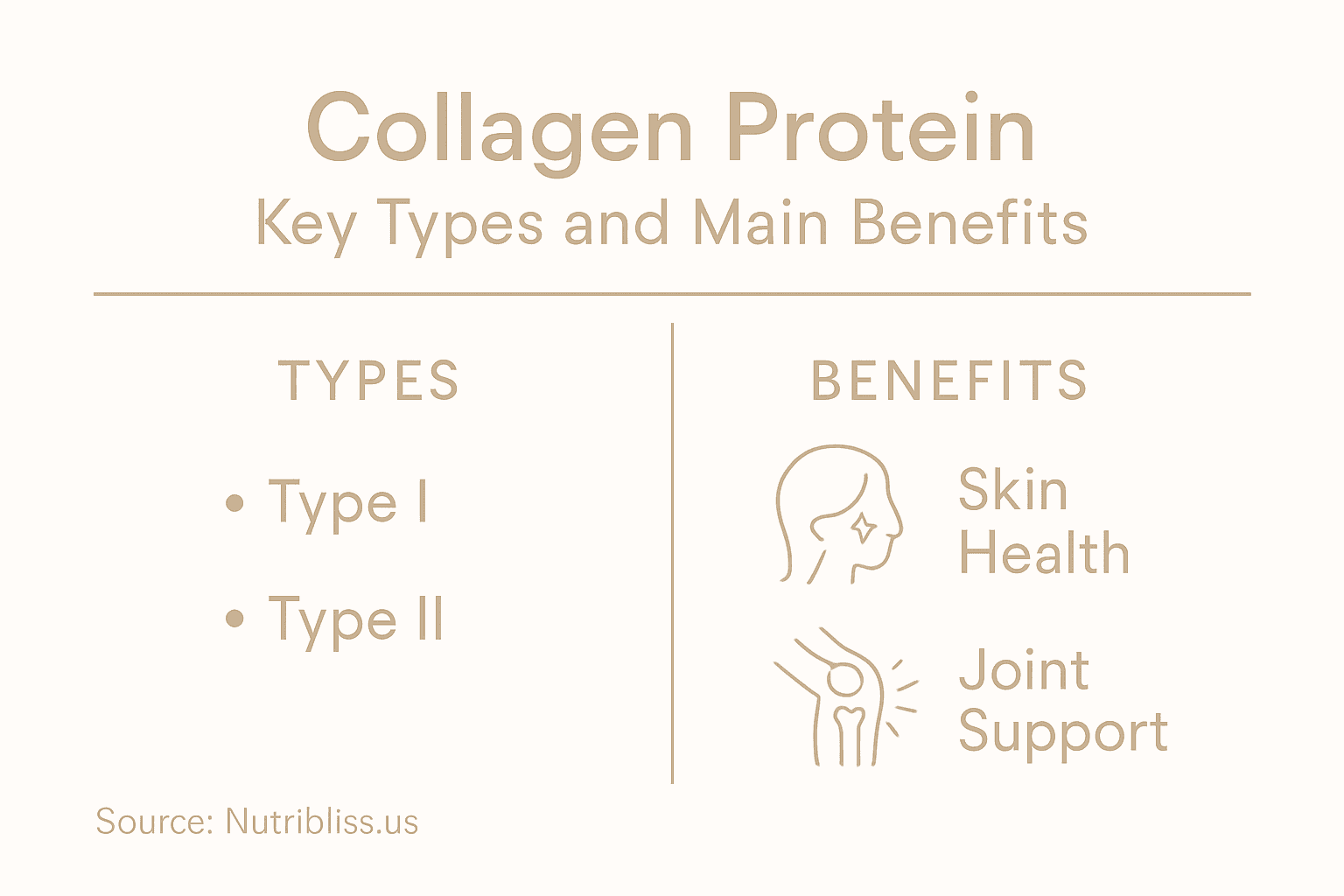
- Type I Collagen: Primary component of skin, tendons, bones, and connective tissues
- Type II Collagen: Predominantly found in cartilage
- Type III Collagen: Supports blood vessels and internal organ structures
- Type IV Collagen: Critical for forming basement membranes
- Type V Collagen: Essential for cell surfaces and placental tissue
Each collagen type has a unique structural configuration, forming intricate triple-helix protein structures that provide remarkable tensile strength and flexibility. Over 90% of human collagen consists of Type I and III variants, which are critical for maintaining skin elasticity, bone density, and tissue integrity.

Understanding the nuanced roles of different collagen types helps appreciate their complexity. These proteins aren’t just structural components but dynamic molecules that adapt and support various bodily functions across different tissue systems.
Here’s a quick reference comparing the five main types of collagen and their key body functions:
| Collagen Type | Main Location | Unique Role |
|---|---|---|
| Type I | Skin, bones, tendons | Provides structure and strength |
| Type II | Cartilage | Maintains joint cushioning |
| Type III | Blood vessels, organs | Supports soft tissue flexibility |
| Type IV | Basement membranes | Filtration and barrier functions |
| Type V | Cell surfaces, placenta | Regulates cell behavior and growth |
Pro-Tip: Consume a balanced diet rich in protein, vitamin C, and amino acids to naturally support collagen production and diversity.
How Collagen Supports Skin and Joints
Skin and joint health fundamentally depend on collagen’s remarkable structural properties. Collagen provides critical strength to connective tissues including muscles, tendons, cartilage, and skin, acting as a fundamental building block for maintaining bodily integrity.
Collagen’s impact on skin and joints can be understood through several key mechanisms:
- Provides structural support and elasticity to skin tissues
- Cushions joints and reduces friction between bones
- Helps maintain skin hydration and firmness
- Supports cartilage repair and regeneration
- Reduces inflammation in joint tissues
Scientific research demonstrates collagen peptides can increase collagen synthesis, enhancing the body’s ability to regenerate and maintain healthy skin and joint structures. This molecular process helps counteract age-related degradation by stimulating the production of essential proteins that maintain tissue strength.
Environmental factors like sun exposure, smoking, and aging can dramatically reduce natural collagen production, leading to visible skin aging and joint discomfort. Understanding these mechanisms helps individuals take proactive steps to support their body’s collagen networks and maintain overall tissue health.
Pro-Tip: Combine collagen supplementation with vitamin C-rich foods to enhance protein absorption and maximize skin and joint support.
Collagen Protein Sources and Supplement Forms
Collagen protein sources are primarily derived from animal-based foods and supplements. Collagen naturally exists in animal connective tissues like meat, fish, and bone broth, providing essential amino acids for protein synthesis.
The most common collagen supplement forms include:
- Collagen Peptides: Powdered form easily mixed into drinks
- Hydrolyzed Collagen: Broken down for better absorption
- Capsules: Convenient pill format
- Liquid Supplements: Pre-mixed drink options
- Protein Bars: Fortified with collagen compounds
Supplement research indicates multiple sourcing options, including derivatives from fish, cattle, pigs, and chicken. These supplements typically contain short amino acid chains designed to support protein production and enhance bodily functions.
Nutrient absorption can be improved by combining collagen supplements with complementary vitamins like vitamin C, which helps synthesize collagen molecules more effectively. Understanding the various sources and forms allows individuals to select the most appropriate supplement for their specific health goals.
Pro-Tip: Choose supplements that include additional nutrients like vitamin C to maximize collagen absorption and effectiveness.
Compare popular collagen supplement forms and their convenient features:
| Supplement Form | Ease of Use | Absorption Rate | Typical Application |
|---|---|---|---|
| Collagen Peptides | Mixes easily in drinks | High | Daily beverages |
| Hydrolyzed Collagen | Dissolves quickly | Superior | Versatile, general health |
| Capsules | Convenient, portable | Moderate | On-the-go routines |
| Liquid Supplements | Ready to drink | Fast | Quick boosts |
| Protein Bars | Snack format | Variable | Meal replacements or snacks |
Risks, Safety, and Alternatives to Collagen
Collagen supplement safety requires careful consideration and informed decision-making. Supplement research indicates potential benefits alongside notable risks, with scientific evidence remaining preliminary and inconclusive.
Key potential risks and safety concerns include:
- Potential allergic reactions
- Unregulated product quality
- Uncertain absorption mechanisms
- Possible contamination from manufacturing
- Individual variability in supplement response
Dietary alternatives can effectively support natural collagen production, focusing on obtaining essential nutrients through whole food sources. Natural collagen synthesis can be enhanced by consuming foods rich in:
- Protein
- Vitamin C
- Zinc
- Copper
- Amino acids
Consumers should approach collagen supplements with cautious optimism, understanding that individual results may vary significantly. Consulting healthcare professionals before starting any new supplement regimen remains the most prudent approach to ensuring personal health and safety.
Pro-Tip: Always verify supplement ingredients and consult a healthcare provider before starting any new dietary supplement.
Support Your Body’s Natural Collagen with Targeted Supplements
If you want to maintain healthy skin elasticity and strong joints, addressing the natural decline in collagen production discussed in this article is key. Many face challenges like visible skin aging, joint discomfort, and reduced tissue strength caused by factors such as aging, sun exposure, or poor nutrition. By choosing scientifically formulated collagen supplements that promote absorption and bioavailability, you can actively support your body’s structural proteins.
Discover our range of Skin Health Supplements and Joint and Bone Supplements designed to enhance collagen production. These products include hydrolyzed collagen peptides and essential nutrients like vitamin C to maximize skin firmness and joint mobility.

Take control of your skin and joint health today by exploring trusted, high-quality supplements at Nutribliss.us. Act now to support your body’s collagen and maintain youthful strength and flexibility for longer.
Frequently Asked Questions
What is collagen protein, and why is it important?
Collagen protein is the most abundant protein in the human body, serving as a structural component that connects tissues and supports skin, bones, muscles, tendons, and cartilage. It is essential for maintaining the body’s structural integrity and overall health.
How does collagen support skin and joint health?
Collagen provides structural support and elasticity to skin tissues, cushions joints, reduces friction between bones, helps maintain skin hydration and firmness, and supports cartilage repair, making it vital for both skin and joint health.
What are the different types of collagen, and what roles do they play?
There are several types of collagen, but five primary types are most important: Type I (skin, tendons, bones), Type II (cartilage), Type III (blood vessels, organs), Type IV (basement membranes), and Type V (cell surfaces, placenta). Each type has a unique structural role essential for various bodily functions.
What are the best sources of collagen protein?
Collagen protein can be obtained from animal-based foods such as meat, fish, and bone broth. Additionally, collagen supplements come in various forms, including collagen peptides, hydrolyzed collagen, capsules, and liquid options, allowing for convenient supplementation.