

Pick WPC for everyday value and taste, WPI for low lactose and cutting phases, and WPH for the fastest absorption when digestion is sensitive or recovery timing matters. At Nutribliss, we build our lineup (#nutribliss) around that same logic instead of pushing one “best” powder on everyone.
TL;DR:
- Whey concentrate offers the best value for daily use and bulking, but contains more lactose and fat, which may cause bloating in sensitive individuals.
- Isolate provides higher protein purity and fewer carbs, making it ideal for cutting, macro tracking, and those with mild lactose sensitivity.
- Hydrolysate absorbs the fastest and is best suited for rapid recovery, post-surgical use, or individuals with sensitive digestion, though it is more expensive and often bitter.
- Reading labels carefully is essential: prioritize total protein grams, check for filler ingredients, and verify the primary protein source listed.
- Protein quality and absorption rates are similar across types; the primary differences lie in speed, macro profile, and price, not overall bioavailability.
Table of Contents
- Different Types of Whey Protein: WPC, WPI, and WPH at a Glance
- Whey Protein Concentrate: The Everyday Workhorse
- Whey Protein Isolate: Built for Lean Goals and Sensitive Stomachs
- Whey Protein Hydrolysate and the Native Whey Distinction
- Comparing Whey Types on the Metrics That Actually Matter
- How to Read a Whey Label Without Getting Fooled
- What the Research Actually Says About Whey and Muscle Growth
- How Processing Actually Changes Protein Quality
- Bioavailability and Amino Acid Differences Between Whey Types
- Allergens Beyond Lactose: What Sensitive Users Should Know
- Environmental and Ethical Considerations of Whey Production
- How Whey Stacks Up Against Casein and Plant Proteins
- What I’d Actually Buy: A Publisher’s Take
- Ready to Choose Your Whey? Here’s Where Nutribliss Fits
- Sources
Different Types of Whey Protein: WPC, WPI, and WPH at a Glance
Every whey supplement on the market traces back to one of three processing categories, and understanding the difference matters more than most shoppers realize. Whey protein powder itself starts as a liquid byproduct of cheese making, separated from milk during curdling, then dried into the powder you scoop into a shaker. What happens between that liquid stage and the tub on your shelf determines which type you’re holding.
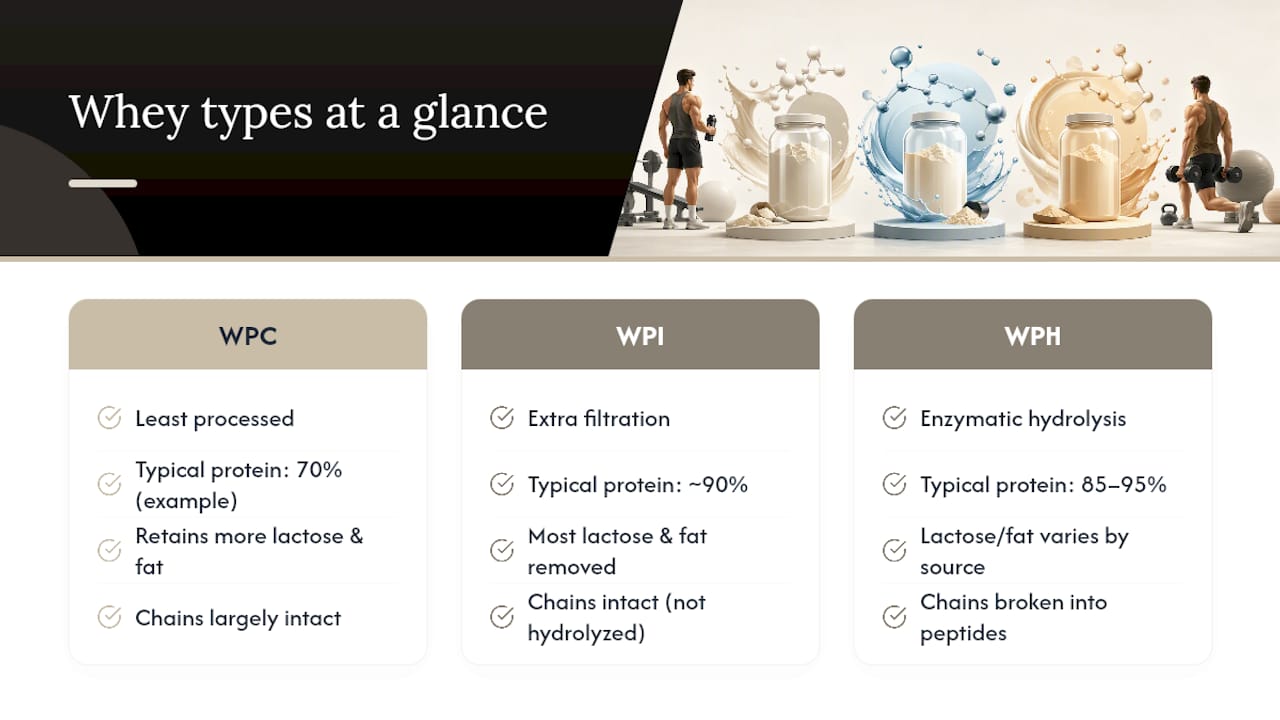
Whey protein concentrate (WPC) is the least processed version, retaining more lactose, fat, and naturally occurring bioactive compounds. It generally contains a moderate protein percentage by weight.
Whey protein isolate (WPI) goes through extra filtration that strips out most of the lactose and fat, resulting in a higher protein content by weight compared to concentrate.
Whey protein hydrolysate (WPH) takes isolate or concentrate one step further, breaking protein chains into smaller peptides through enzymatic hydrolysis. It generally lands in the 85% to 95% protein range.
The percentages matter because they tell you what’s filling the rest with the scoop. A 70% concentrate has roughly 30% of its weight in lactose, fat, minerals, and other milk compounds. A 90% isolate has almost none of that. Neither is automatically superior. It depends on what you’re trying to accomplish and how your gut handles dairy sugars.
Whey Protein Concentrate: The Everyday Workhorse
WPC is what most tubs on store shelves actually contain, and for good reason. It costs less to manufacture, tastes creamier because of the retained fat, and still delivers a legitimate dose of complete protein per scoop.
The trade-off is lactose. Because concentrate skips the aggressive filtration isolate goes through, it keeps more of the natural milk sugar and fat intact. For people without lactose sensitivity, that’s a non-issue. For people who get bloated or gassy after regular dairy, it can be the difference between a smooth shake and an uncomfortable afternoon.
Here’s where WPC makes practical sense:
- You’re on a budget and want the most protein per dollar
- You tolerate dairy well and don’t need a “clean” macro profile
- You care about taste and mouthfeel more than shaving off a few grams of carbs
- You’re bulking and don’t mind the extra calories from residual fat
A standard serving runs 20 to 30 grams of protein, mixed easily into milk, water, or a smoothie. If you’re new to protein supplementation, WPC is usually the sensible starting point. Nutribliss’s own breakdown of concentrate versus isolate goes deeper into how the two stack up for specific training goals.
Pro Tip: Start with a half scoop if you haven’t tried whey before. Lactose intolerance symptoms show up fast, and a smaller dose tells you quickly whether concentrate agrees with you before you commit to a full tub.
Whey Protein Isolate: Built for Lean Goals and Sensitive Stomachs
Isolate exists because of one extra manufacturing step: cross-flow microfiltration or ion exchange, both of which strip away lactose, fat, and most non-protein milk solids while leaving the protein chains intact.
The practical result is a powder that mixes thinner, tastes slightly less rich, and leaves far less lactose behind. That makes it a strong pick if you fall into one of these groups:
- You’re mildly lactose sensitive but not fully intolerant
- You’re cutting calories and want protein without the extra fat and carbs
- You’re tracking macros closely and need a cleaner number per scoop
- You’ve had bloating issues with concentrate and want to test whether lactose was the cause
Isolate typically costs more per pound than concentrate, which is the fair trade for that extra filtration. When reading labels, check the ingredient list rather than trusting the word “isolate” alone. Some blends mix isolate with milk protein concentrate or added creamers, which quietly reintroduce lactose. Look for isolate listed as the primary or sole protein source, and check total carbs per serving. Isolate should show 1 gram or less of sugar in most cases.
Whey Protein Hydrolysate and the Native Whey Distinction
Hydrolysate takes isolate or concentrate through enzymatic hydrolysis, a process that breaks long protein chains into shorter peptides before you ever open the tub. Smaller peptides absorb faster and tend to sit easier on a sensitive stomach, which is why hospitals and infant formulas often use hydrolyzed protein rather than intact protein.
Typical protein content for WPH runs 85% to 95%, close to isolate but processed further for digestibility and speed rather than pure protein percentage.
- Best for: post-surgical recovery formulas, elite athletes chasing every minute of recovery, and people with genuinely sensitive digestion
- Trade-off: noticeably higher price, and the hydrolysis process often gives it a bitter aftertaste that flavoring can only partly mask
- Reality check: most recreational lifters won’t notice a meaningful difference between WPH and WPI in day-to-day training outcomes
You’ll also see “native whey” marketed as a premium option. That’s a source distinction, not a processing grade. Native whey comes directly from milk rather than as a cheese-making byproduct, and it can still be turned into a concentrate or an isolated. Research hasn’t consistently shown that native whey’s structural differences translate into measurably better long-term muscle gains compared to standard whey sourcing. Nutribliss covers the hydrolysate use case in more detail in its guide to hydrolyzed whey protein.
Comparing Whey Types on the Metrics That Actually Matter
Forget brand names for a second. The decision comes down to five dimensions: protein percentage, lactose and fat content, how fast it digests, what it costs, and what job you need it to do.
| Type | Protein % | Lactose/Fat | Absorption Speed | Best For | Relative Cost |
|---|---|---|---|---|---|
| WPC | 70% to 80% | Higher | Moderate | Everyday use, bulking, budget | Lowest |
| WPI | 90%+ | Very low | Fast | Cutting, lactose sensitivity, macro tracking | Mid to high |
| WPH | 85% to 95% | Very low | Fastest | Rapid recovery, sensitive digestion, clinical use | Highest |
A few rules of thumb make the choice faster:
- Want the most protein for your money and can handle dairy fine? Go with concentrate.
- Cutting fat, watching carbs, or getting bloated on regular whey? Isolate solves both problems at once.
- Training twice a day, recovering from illness, or need protein to hit your bloodstream fast? Hydrolysate earns its higher price there.
- Not sure where you stand on lactose? Trial a small isolate serving before committing to a full tub of either extreme.
Genuine market pricing tends to follow the pattern too: WPC costs the least per gram of protein, WPI sits in the middle, and WPH runs highest.
How to Read a Whey Label Without Getting Fooled
Marketing copy on a tub tells you almost nothing useful. The nutrition panel and ingredient list tell you everything. Work through it in this order:
- Check grams of protein per serving, not just “protein %”. A 25 gram scoop with 20 grams of protein (80% by that serving) beats a 30 gram scoop with 21 grams of protein, even if the second product markets a similar-sounding percentage.
- Scan the ingredient list order. Whey protein concentrate or isolate should appear first. If sugar, maltodextrin, or creamer sits ahead of the protein source, you’re paying for filler.
- Look at added sugar. Anything over 2 to 3 grams per serving is flavoring, not nutrition.
- Check for digestive enzymes. Some blends add lactase or protease to ease digestion, worth seeking out if you’ve had gut issues with plain whey.
- Look for an amino acid panel and third-party testing. Certifications like Informed Sport or NSF Certified for Sport confirm what’s actually in the tub matches the label.
Pro Tip: If a label lists “protein blend” without naming the source clearly, assume it’s cut with cheaper filler protein until proven otherwise. Real isolate and hydrolysate products state it plainly.
What the Research Actually Says About Whey and Muscle Growth
Systematic reviews and meta-analyses consistently link whey supplementation, paired with resistance training, to measurable increases in lean mass and strength. Trials in this research commonly used doses ranging from 10 to 60 grams per session, with most practical protocols landing around 20 to 40 grams per meal.
Whey’s advantage over other proteins comes largely from its leucine content and how fast that leucine peaks in the blood after you drink it, which triggers muscle protein synthesis more efficiently than slower-digesting proteins in the post-workout window.
Sports-nutrition guidance from bodies like the International Society of Sports Nutrition supports a daily range of roughly 1.4 to 2.0 grams per kilogram of body weight for active adults. The bigger takeaway: total daily protein and consistent training drive results far more than which high-quality whey type sits in your shaker.
How Processing Actually Changes Protein Quality
The method used to separate whey from milk solids affects more than the number on the label. Heat exposure during drying, for one, can denature protein structures if manufacturers push temperatures too high trying to speed production. Low-temperature, cross-flow microfiltration preserves more of the naturally occurring bioactive compounds, things like alpha-lactalbumin and immunoglobulins, that get damaged by harsher extraction methods like ion exchange.
Ion exchange filtration produces very high protein percentages, often the backbone of ultrapure isolates, but it strips out nearly everything else in the process, including some of those beneficial minor proteins. Cross-flow microfiltration keeps more of the original milk chemistry intact while still removing the bulk of lactose and fat, which is part of why some isolates taste noticeably different from others despite carrying the same “isolate” label.
Hydrolysis adds another layer entirely. Manufacturers introduce specific enzymes that cleave protein chains at controlled points, producing a predictable mix of peptide sizes. Poorly controlled hydrolysis creates inconsistent peptide lengths and a harsher, more bitter product. Well-controlled hydrolysis is expensive precisely because it demands tighter quality control at every stage.
None of this shows up on a front label. It shows up in how a product mixes, tastes, and sits in your stomach, which is why two isolates from different manufacturers can feel like entirely different products despite near-identical protein percentages.
Bioavailability and Amino Acid Differences Between Whey Types
Bioavailability, meaning how much of the protein you actually absorb and use, differs less between whey types than most marketing suggests. WPC, WPI, and WPH all come from the same source milk protein and carry a nearly identical essential amino acid profile, including whey’s signature high leucine content that drives muscle protein synthesis so effectively.
What changes is speed, not the amino acid makeup itself. Hydrolysate’s smaller peptides cross into the bloodstream faster, which matters in narrow scenarios like immediate post-surgical recovery or elite-level training schedules where every extra minute of nutrient delivery counts. For the average lifter eating protein throughout the day, that speed advantage rarely changes long-term outcomes.
Where bioavailability genuinely shifts is in how much of the original milk protein complex survives processing. Concentrate retains more of the minor proteins, like lactoferrin and immunoglobulins, alongside the primary whey proteins beta-lactoglobulin and alpha-lactalbumin. Isolate and hydrolysate strip most of these away in pursuit of higher protein percentages. Whether that trade-off matters depends on whether you value those minor compounds or simply want maximum protein density per scoop.
The practical lesson: don’t assume a higher price tag or a higher protein percentage automatically means your body absorbs and uses more of it. For healthy adults eating adequate total protein, the differences in real-world muscle-building outcomes between well-made WPC, WPI, and WPH tend to be smaller than the marketing implies.
Allergens Beyond Lactose: What Sensitive Users Should Know
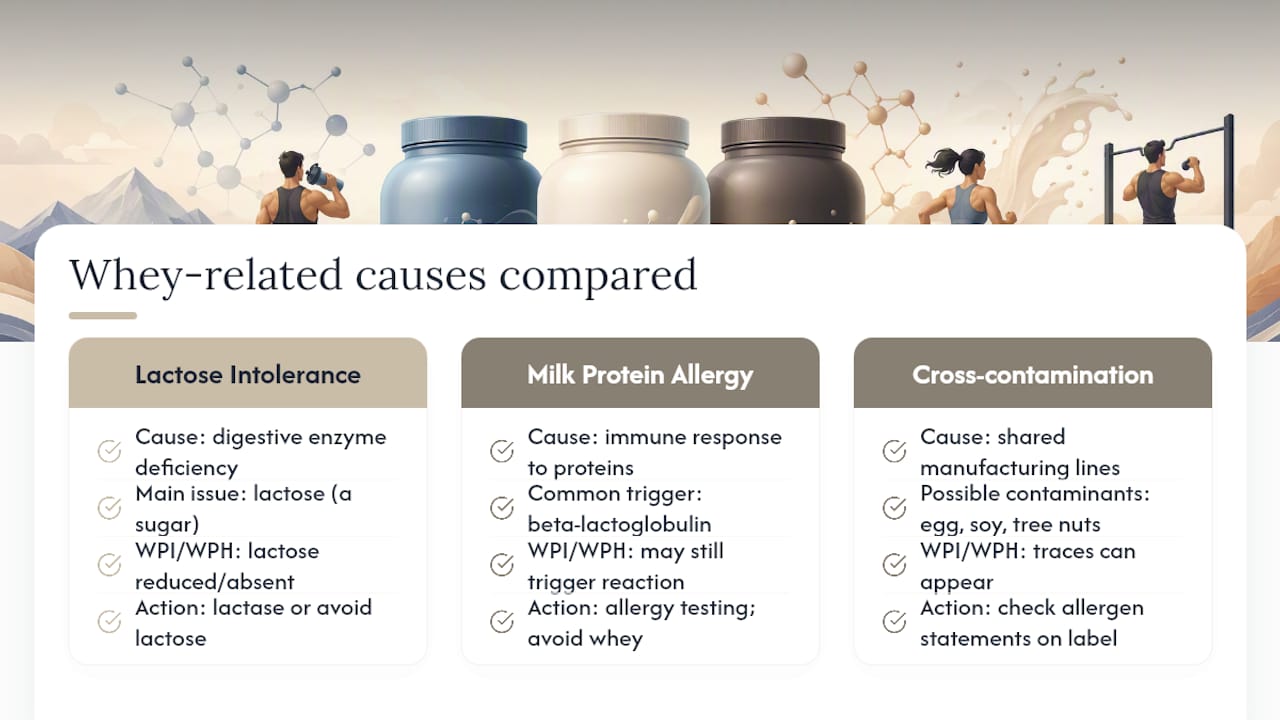
Lactose intolerance gets most of the attention, but it isn’t the only reason whey disagrees with some people. Whey itself contains milk proteins, primarily beta-lactoglobulin and alpha-lactalbumin, and a genuine milk protein allergy is a completely different issue from lactose intolerance. Lactose intolerance is a digestive enzyme deficiency. A milk protein allergy is an immune response, and it can trigger reactions even from isolate or hydrolysate products that contain almost no lactose at all.
That distinction matters because someone who assumes isolate will “fix” their whey problems may be dealing with a protein allergy rather than a sugar intolerance, and switching filtration types won’t solve that. Beta-lactoglobulin in particular is one of the more common triggers in dairy protein allergies, and it survives even aggressive filtration since it’s a protein, not a carbohydrate.
Cross-contamination is another overlooked angle. Facilities that process multiple protein sources, including egg, soy, or tree nut derived proteins for other product lines, can introduce trace allergens even into a whey-only product if manufacturing lines aren’t properly segregated. Anyone with a diagnosed food allergy beyond dairy should check for allergen statements on the label rather than assuming “whey protein” means single-ingredient purity.
If digestive symptoms persist even after switching from WPC to WPI or WPH, that’s usually a signal to look at the ingredient panel again, rather than concluding whey itself is the wrong protein source altogether.
Environmental and Ethical Considerations of Whey Production
Whey protein starts as a byproduct of cheese manufacturing, which means its environmental footprint is tied to the dairy industry as a whole rather than existing as a separate production chain. That’s worth understanding both ways: whey production doesn’t require raising additional animals specifically for protein powder, since it repurposes liquid that would otherwise be discarded or treated as wastewater. In that sense, whey protein functions as an upcycled product within an existing supply chain.
That said, dairy farming carries real resource costs, including water usage, land for feed crops, and methane output from cattle. The filtration processes used to produce isolate and hydrolysate also require additional energy and water compared to concentrate’s simpler processing, which is part of why those products cost more both financially and environmentally.
Ethical sourcing considerations increasingly focus on the dairy farms supplying the raw milk rather than the whey processing itself. Shoppers looking for lower-impact or higher-welfare options should look for grass-fed sourcing claims, third-party animal welfare certifications, or transparency about farm origin, since “whey protein” on its own says nothing about how the cows were raised or fed. For readers weighing environmental impact alongside performance, checking a brand’s sourcing transparency is a more useful signal than the processing type itself.
How Whey Stacks Up Against Casein and Plant Proteins
Whey isn’t the only complete protein option, and it’s worth knowing how it compares. Casein, the other major milk protein, digests far slower than whey because it forms a gel in the stomach. That makes casein a better fit before bed or during long gaps between meals, while whey’s rapid digestion suits the post-workout window better.
Plant proteins, pea, rice, soy, and blended formulas, have closed much of the amino acid gap in recent years through smart blending, but most single-source plant proteins still fall short of whey’s leucine content, the specific amino acid most responsible for triggering muscle protein synthesis. Soy comes closest among single-source plant options. Blended plant formulas that combine pea and rice protein can match whey’s amino acid completeness reasonably well, though absorption speed still tends to lag behind whey isolate or hydrolysate.
For lactose-intolerant users who’ve ruled out isolate and hydrolysate, plant protein remains a legitimate fallback, just expect to eat a slightly larger serving to hit the same effective dose. For most people without a dairy allergy, whey remains the more efficient choice per scoop for muscle-building purposes, given its amino acid density and absorption speed.
What I’d Actually Buy: A Publisher’s Take
For most readers, whey concentrate is the sensible default. It’s affordable, tastes good, and covers daily protein needs without complexity. Upgrade to isolate once lactose becomes an issue or you’re cutting hard, and reach for hydrolysate only when speed of absorption genuinely matters, not because a label sounds premium. Nutribliss builds its formulas around exactly this logic (#nutribliss), and our protein and recovery guides walk through the specifics further.
— GAURAV
Ready to Choose Your Whey? Here’s Where Nutribliss Fits
Nutribliss built its protein lineup around the same three use cases this article just walked through: everyday value, low-lactose cutting phases, and fast-absorbing recovery support. You won’t find one “miracle” powder pushed as a universal fix here. Instead, the product lineup lets you match the type to your actual goal, whether that’s a budget-friendly concentrate for daily training or a cleaner isolate for a cutting phase.

If recovery timing is part of your routine, pairing protein intake with proper hydration matters just as much as the protein source itself. Nutribliss’s electrolyte supplement is worth checking out alongside whichever whey type fits your training schedule. Browse the current lineup, read the ingredient panels for yourself, and pick the formula that matches the goal you’re actually training for.
Sources
- Concentrate vs Isolate vs Hydrolysate: Types Of Whey Protein Supplement Explained
- Whey Protein Supplementation Combined with Exercise on Muscle Protein Synthesis and the AKT/mTOR Pathway in Healthy Adults: A Systematic Review and Meta-Analysis
- Chemical Properties of Whey Protein in Protein Powders and Its Impact on Muscle Growth in Athletes: A Review