

TL;DR:
- A personalized natural supplement routine aims to fill nutritional gaps based on individual needs and health goals. It requires proper assessment through blood tests and ongoing review with a healthcare provider to avoid risks and ensure effectiveness. Consistent timing, verified products, and informed adjustments are key to safe, beneficial supplementation.
A natural supplement daily routine is a personalized regimen of vitamins, minerals, and herbal products designed to fill nutritional gaps and support your overall health. Nearly 50% of Americans take dietary supplements, yet most do so without first assessing whether they have an actual deficiency. That gap between intention and informed practice is where results suffer and risks grow. The U.S. Preventive Services Task Force and the CDC both emphasize that supplements work best as targeted additions to a healthy lifestyle, not as replacements for one. Nutribliss builds its product line around exactly that principle: science-backed formulations that complement what you already do well.
What does a natural supplement daily routine actually involve?
A daily natural supplements regimen is not simply swallowing a handful of capsules each morning. It is a structured, repeatable practice that matches specific nutrients to specific needs, timed for maximum absorption, and reviewed regularly against your health goals. The industry term for this approach is “targeted supplementation,” and it differs sharply from the general wellness claims printed on most bottles.

Targeted supplementation starts with a question: what does your body actually need? The answer requires objective data, not guesswork. Blood panels, dietary logs, and a conversation with your doctor give you a baseline. Without that baseline, you are spending money on nutrients your body may already have in abundance, and in some cases, adding risk.
The distinction matters because supplements are not regulated the same way prescription drugs are. The FDA does not approve dietary supplements for safety or efficacy before they reach store shelves. That regulatory gap puts the responsibility for informed choices squarely on you.
How to assess your supplement needs before you start
Blood tests identify real deficiencies before you commit to a routine. Nearly 50% of Americans take supplements without first checking for deficiencies, which increases the risk of both wasted spending and genuine harm. A basic metabolic panel, a complete blood count, and a vitamin D level test give your doctor a clear picture of where you actually stand.
Certain population groups have well-documented supplementation needs:
- Pregnant people require folate and iron at levels difficult to reach through food alone.
- Adults over 65 often absorb vitamin B12 less efficiently and benefit from targeted supplementation.
- People with limited sun exposure frequently show low vitamin D levels.
- Those following plant-based diets may need vitamin B12, zinc, and omega-3 fatty acids.
- Individuals with diagnosed malabsorption conditions (such as Crohn’s disease or celiac disease) often need physician-guided supplementation.
Drug interactions are a serious concern that most people underestimate. High doses of vitamin E can have anticoagulant effects and interact dangerously with blood-thinning medications like warfarin. A pharmacist is often the most accessible professional for catching these conflicts before they cause harm.
Pro Tip: Bring every supplement bottle you currently take to your next medical appointment. Clinicians can spot hidden ingredient overlaps that you would never catch by reading labels alone.
Your healthcare provider can also flag when a supplement is simply unnecessary. Bringing your supplements to appointments enables clinicians to identify ingredient overlaps and potential interactions that consumers routinely miss. That single habit prevents more problems than any label-reading strategy.
How do you choose safe and effective supplements for daily use?
“Natural” on a label does not mean safe. Arsenic is natural. The word signals origin, not quality or appropriate dosage. Choosing supplements wisely requires looking past marketing language and focusing on three things: third-party verification, label accuracy, and bioavailability.
Third-party verification is the clearest quality signal available to consumers. Organizations like USP (United States Pharmacopeia) and NSF International test supplements for purity, potency, and contaminants. Only about 1% of supplement products carry the USP Verified Mark. That statistic tells you how rare genuine quality assurance is, and why it matters so much when you find it.
Reading the “Daily Value” percentage on a supplement label protects you from megadosing. The Recommended Dietary Allowance covers the needs of 97–98% of healthy individuals. Exceeding it consistently, especially with fat-soluble vitamins like A, D, E, and K, risks toxicity because these vitamins accumulate in the liver and fat tissue rather than being excreted.
The following supplements appear most consistently in evidence-based natural wellness routines for energy, immunity, and nutritional support:
- Vitamin D3 supports immune function and bone density; most effective when taken with a fat-containing meal.
- Magnesium glycinate supports sleep quality and muscle recovery; well-tolerated at standard doses.
- Vitamin B12 (methylcobalamin) supports nerve function and energy metabolism; especially relevant for plant-based eaters.
- Zinc supports immune defense and wound healing; best taken with food to reduce nausea.
- Omega-3 fatty acids (EPA and DHA) support cardiovascular and cognitive health; take with the largest meal of the day.
- Iron addresses deficiency-related fatigue; requires confirmed deficiency before supplementing.
Pro Tip: Choose calcium citrate over calcium carbonate if you take acid-reducing medications. Calcium citrate is less dependent on stomach acid and absorbs more reliably across different digestive conditions.
The science behind supplement formulation matters as much as the ingredient list. Bioavailability, the percentage of a nutrient your body actually absorbs and uses, varies significantly between supplement forms. Magnesium oxide, for example, has far lower bioavailability than magnesium glycinate despite appearing on labels at similar doses.
How to integrate supplements effectively into your daily schedule
Consistency drives results more than any single supplement choice. A well-timed, repeatable schedule prevents the missed doses and accidental double-dosing that undermine most people’s routines. Combining supplements safely requires awareness of absorption interactions, meal timing, and your current medication list.
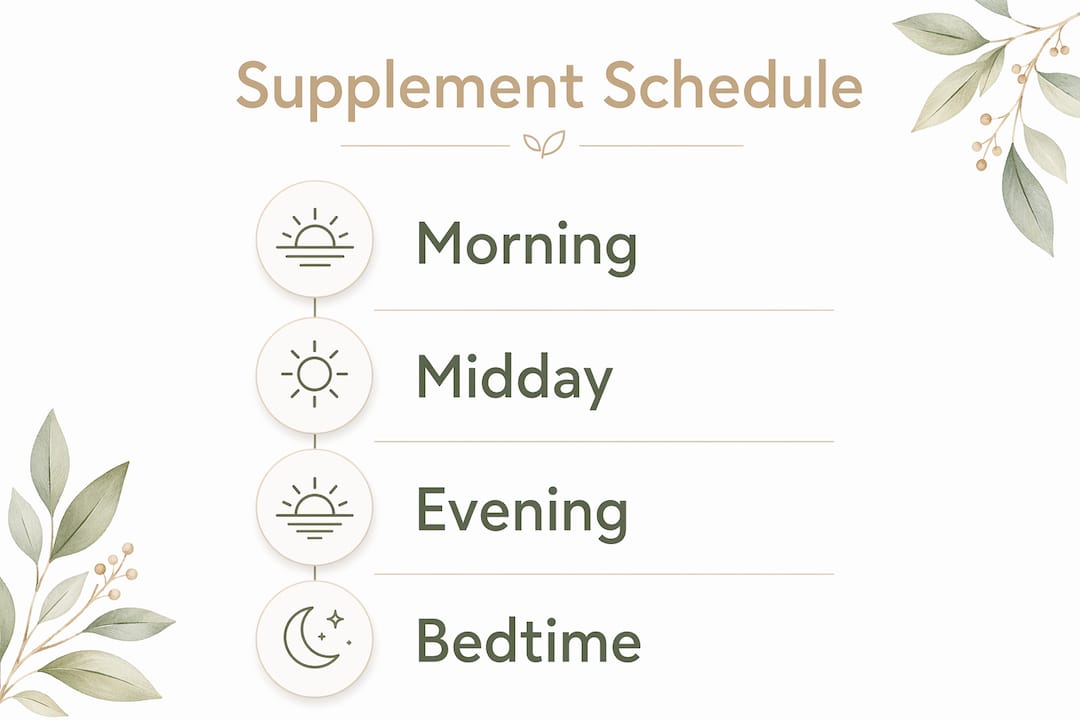
A practical daily schedule looks like this:
- Morning with breakfast: Fat-soluble vitamins (D3, K2), omega-3s, and B-complex. Fat in your meal improves absorption of fat-soluble nutrients.
- Midday with lunch: Zinc and iron (if prescribed), taken with food to reduce gastrointestinal discomfort.
- Evening with dinner: Magnesium glycinate and any remaining fat-soluble vitamins not taken in the morning.
- Before bed (if applicable): Melatonin or specific sleep-support formulas, taken 30–60 minutes before sleep.
Avoid taking calcium and iron at the same time. Calcium blocks iron absorption when both are present in the gut simultaneously. Spacing them by at least two hours preserves the effectiveness of both.
| Supplement | Best timing | Take with food? |
|---|---|---|
| Vitamin D3 | Morning | Yes (fat-containing meal) |
| Magnesium glycinate | Evening | Optional |
| Vitamin B12 | Morning | Optional |
| Zinc | Midday | Yes |
| Omega-3 fatty acids | Largest meal | Yes |
| Iron | Midday | Yes (avoid calcium) |
Pro Tip: Track your supplement intake and any physical changes in a simple journal or a free app like Cronometer. Patterns in energy, sleep, and digestion become visible within four to six weeks, giving you real feedback to share with your doctor.
Managing your supplement intake over time is as important as the initial setup. Your needs shift with age, season, stress levels, and dietary changes. A routine that works well in january may need adjustment by july if your sun exposure, diet, or activity level changes significantly.
What are the most common mistakes in a supplement routine?
The most frequent mistake is treating supplements as a substitute for foundational health habits. Supplements cannot compensate for poor diet, chronic sleep deprivation, or physical inactivity. They fill gaps; they do not build the foundation.
Watch for these specific pitfalls:
- Ignoring toxicity signs: Nausea, headaches, fatigue, or unusual hair loss can signal over-supplementation, particularly with fat-soluble vitamins.
- Chasing fad stacks: Multi-ingredient “wellness stacks” with unverified claims often contain undisclosed interactions and inconsistent dosing.
- Skipping label review: Ingredients like vitamin A appear in multiple products simultaneously, making accidental megadosing easy.
- Stopping too soon: Many deficiency-related benefits take eight to twelve weeks of consistent intake to become measurable.
- Self-diagnosing deficiencies: Fatigue alone does not confirm iron deficiency. Blood tests confirm it.
“Targeted supplementation aligned with life stage and documented deficiencies is prudent over general wellness claims. Consumers must understand that ‘natural’ labeling does not guarantee safety or efficacy, and pharmacist review is critical to avoid harmful interactions.”
Adjusting your routine based on feedback is not a sign of failure. It is the correct process. Avoiding supplement mistakes requires ongoing attention, not a one-time setup. Schedule a review with your healthcare provider every six to twelve months, especially if your medications, diet, or health status change.
Key Takeaways
A safe and effective natural supplement daily routine requires individual assessment, third-party verified products, precise timing, and regular review with a qualified healthcare provider.
| Point | Details |
|---|---|
| Assess before you supplement | Get blood tests to confirm deficiencies before starting any daily supplement regimen. |
| Verify product quality | Choose supplements carrying USP or NSF certification to confirm purity and potency. |
| Time intake with meals | Take fat-soluble vitamins with fat-containing meals and space calcium and iron by two hours. |
| Track and adjust | Log your intake and symptoms for four to six weeks, then review with your doctor. |
| Supplements support lifestyle | No supplement replaces consistent sleep, diet, and exercise as the foundation of health. |
What I’ve learned from years of watching people supplement wrong
Most people approach supplements the way they approach a new app: download it, skip the setup, and expect results. That rarely works with technology, and it never works with nutrition.
The single most common pattern I see is people adding supplements to a lifestyle that has not changed at all. They sleep five hours, eat processed food most days, and then wonder why their vitamin D capsule is not making them feel better. Supplements are tools, not cures. A hammer does not build a house on its own.
The research on multivitamins makes this concrete. Large studies like COSMOS found modest cognitive benefits in older adults, roughly equivalent to three years less cognitive aging, but no meaningful disease prevention. That is a real but narrow benefit. It does not justify treating a multivitamin as health insurance.
What actually works is specificity. People who identify a real deficiency, choose a verified product in a bioavailable form, take it consistently at the right time, and review their results with a clinician see measurable improvements. That process is slower and less exciting than buying a “complete wellness stack,” but it is the one that holds up.
My honest recommendation: start with one or two targeted supplements based on confirmed needs. Give them twelve weeks. Measure what changes. Then decide what to add or remove. That approach respects both the real value supplements offer and the real limits they have.
— GAURAV
Nutribliss: supplements built on science, not marketing claims
Nutribliss designs its supplement line around the same principles this article covers: verified ingredients, appropriate dosing, and formulations grounded in published research. Every product reflects a commitment to quality that goes beyond label claims.

Whether you need targeted support for energy, immunity, or nutritional balance, the Nutribliss supplement range covers the categories that matter most for a well-structured daily routine. The science behind each formulation is documented and accessible, so you can make informed decisions rather than guesses. Use #nutribliss when you share your routine and connect with others building the same habits.
FAQ
What is a natural supplement daily routine?
A natural supplement daily routine is a structured regimen of vitamins, minerals, and herbal products taken consistently to fill nutritional gaps and support health goals. It works best when based on confirmed deficiencies rather than general wellness claims.
Are natural supplements safe to take every day?
Most supplements are safe at recommended doses, but fat-soluble vitamins like A, D, E, and K accumulate in the body and can cause toxicity if taken in excess. Always check the Daily Value percentage on labels and consult a healthcare provider before starting.
Do I need a blood test before taking supplements?
A blood test is the most reliable way to confirm whether you have an actual deficiency before supplementing. Taking supplements without this step risks spending money unnecessarily and, in some cases, causing harm through excess intake.
Can supplements replace a healthy diet?
Supplements cannot replace a healthy diet, consistent sleep, or regular exercise. They fill specific nutritional gaps but do not replicate the full range of compounds found in whole foods.
How long does it take to see results from daily supplements?
Most deficiency-related benefits become measurable after eight to twelve weeks of consistent intake. Tracking symptoms and energy levels in a journal helps you identify changes and gives your doctor useful data at your next appointment.