

TL;DR:
- Protein powders are generally safe for healthy adults but pose risks like heavy metal contamination and added sugars if not chosen carefully. Certain groups, such as those with kidney disease or pregnant women, should exercise caution and consult healthcare professionals before use. Selecting third-party tested products and monitoring intake can significantly reduce potential health hazards.
Protein powders are not categorically bad, but they can cause real harm in specific situations and to specific people. The short answer: most healthy adults can use them safely, but the risks from added sugars, heavy metal contamination, and excessive intake are well-documented and worth taking seriously. Before you scoop, check the label for added sugars (some powders pack up to 23 g per scoop), look for a third-party testing seal, and consult a clinician if you have kidney disease, are pregnant, or take multiple medications.
Key red flags to check immediately:
- Added sugar: Some powders contain up to 23 g added sugar per scoop, which is near or above the American Heart Association’s daily limit for women.
- Heavy metals: Independent testing by the Clean Label Project and Consumer Reports found lead, cadmium, arsenic, and mercury in many tested products.
- No third-party seal: The FDA does not require premarket safety testing for supplements.
- High-risk users: Kidney disease, pregnancy, and certain medications change the risk calculus entirely.
Table of Contents
- Why are protein powders bad for you? The main risks explained
- Who should be cautious about protein powder use
- How common are contaminants, and what does U.S. regulation actually cover
- How to choose safer protein powders
- How much protein is actually safe to take
- Whole-food alternatives that skip the powder entirely
- When to stop using a powder and talk to a doctor
- The verdict: a three-step action plan
- Key Takeaways
- A more honest take on protein powder safety
- Nutribliss takes a different approach to supplement safety
- Useful sources for further reading
Why are protein powders bad for you? The main risks explained
Protein powders are not inherently toxic, but several documented risks make them worth scrutinizing. Understanding the difference between short-term discomfort and long-term exposure risk helps you make a smarter call.
Short-term side effects most people encounter first:
- Gas, bloating, diarrhea, and stomach cramping, especially with whey or casein in lactose-sensitive people
- Worsened acne in susceptible individuals, with some observational reports linking servings above 40 g to skin flare-ups
- Blood sugar spikes from high-sugar formulas
Longer-term and more serious concerns:
- Potential heavy metal exposure risk from regular use of contaminated powders
- Potential acceleration of kidney decline in people with pre-existing kidney disease at high protein intakes
- Research suggesting very high BCAA intake may activate metabolic pathways linked to insulin resistance and cardiovascular risk
- Cumulative contaminant load when powders are used alongside other supplement-heavy diets
The risks are real, but they are also largely avoidable with the right product choices and sensible dosing.
Who should be cautious about protein powder use
Not everyone faces the same level of risk. A few groups genuinely need to pause before adding a daily scoop.

People with chronic kidney disease (CKD) face the clearest danger. Research shows that CKD patients consuming high levels of protein daily may experience a faster decline in kidney function over time. Protein powders are concentrated sources, so they can push total intake past safe thresholds quickly.
Pregnant people and children are especially vulnerable to heavy metal exposure. Lead and cadmium accumulate in the body over time, and developing brains and kidneys have lower tolerance thresholds than healthy adults.
People on chronic medications should also be careful. A study of individuals on HIV pre-exposure prophylaxis found elevated creatinine levels in supplement users, pointing to potential interactions between high protein loads and drugs that already stress renal function.
Others who warrant extra caution: people with diabetes or insulin resistance (given the BCAA-mTOR pathway concerns), those with a history of kidney stones, and anyone already consuming multiple supplements daily.
Pro Tip: Before starting any protein powder, ask your pharmacist to review your current medications for interactions. Then request a Certificate of Analysis (COA) from the manufacturer to confirm batch-specific heavy metal testing.
How common are contaminants, and what does U.S. regulation actually cover
The regulatory gap here is significant. Protein powders are classified as dietary supplements, which means the FDA does not require premarket safety testing or set specific heavy-metal limits for these products. Manufacturers are responsible for their own safety and labeling. That structure creates real exposure risk for consumers.
Independent testing has filled some of that gap. The Clean Label Project screened 134 products and found that plant-based powders contained roughly three times more lead than whey-based options. Chocolate-flavored powders showed significantly higher cadmium levels compared to vanilla in sample comparisons. Consumer Reports found multiple products with lead levels exceeding their own level of concern thresholds and called on the FDA to set stricter limits.
| Finding | Detail | Source |
|---|---|---|
| Added sugar per scoop | Up to 23 g in some products | Harvard Health |
| Cadmium (chocolate vs. vanilla) | — | Clean Label Project |
| Lead prevalence | ~75% of tested products had detectable lead | Clean Label Project |
| Consumer Reports lead findings | Multiple products exceeded their concern threshold | Consumer Reports |
Contamination enters powders through soil uptake in plant ingredients, animal feed quality, and manufacturing equipment. Organic and plant-based products are not automatically safer. Earlier testing cycles also flagged BPA from packaging, though the Clean Label Project has noted improvement in more recent rounds.
One important nuance: private testing groups like the Clean Label Project use thresholds stricter than FDA interim reference levels. Exceeding a private threshold is not automatically a federal violation, but it still signals avoidable risk, especially for daily users.
How to choose safer protein powders
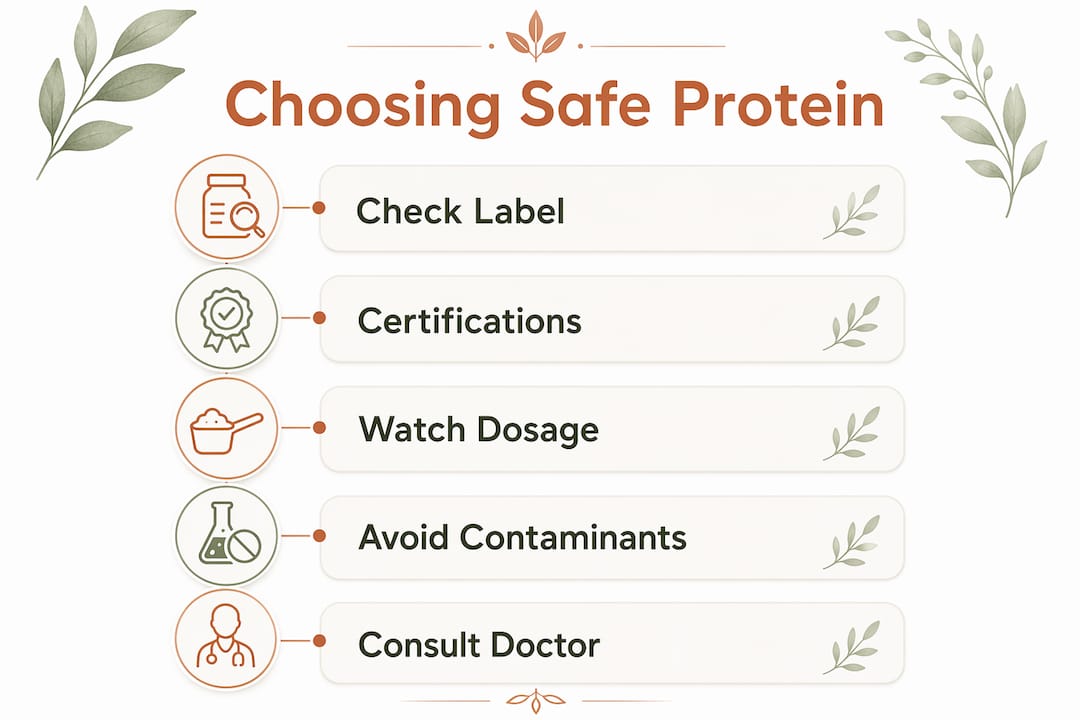
The label tells you a lot if you know what to look for. Use this checklist before buying.
- Third-party certification: Look for NSF Certified for Sport, USP, or Informed-Sport seals. Each verifies different things, but all require independent testing.
- COA availability: A reputable brand publishes batch-specific Certificates of Analysis on its website.
- Added sugar under 5 g per serving: Anything above that starts eating into your daily AHA limit fast.
- Transparent sourcing: Know whether the protein is whey, pea, soy, or rice, and understand that plant-based and chocolate-flavored options tend to carry higher contaminant averages.
- Allergen statements: Clear labeling for milk, soy, and gluten matters if you have sensitivities.
- Additive watch list: Caffeine, creatine, and certain artificial sweeteners can cause their own side effects and are not always obvious on the front panel.
| Certification | What It Tests | Heavy Metals? |
|---|---|---|
| NSF Certified for Sport | Banned substances, label accuracy | Yes |
| USP Verified | Label accuracy, purity, potency | Yes |
| Informed-Sport | Banned substances, contamination | Yes |
| Clean Label Project | Heavy metals, pesticides, BPA | Yes (primary focus) |
Pro Tip: Whey and collagen proteins have shown lower average contaminant levels in independent studies compared to plant-based blends. If you prefer plant-based, prioritize products with a published COA and an NSF or USP seal. The Nutribliss supplement safety checklist walks through each step in detail.
For a deeper breakdown of protein types and which carry different risk profiles, the types of protein powder guide covers the key differences.
How much protein is actually safe to take
Most healthy adults need 0.8 g of protein per kilogram of body weight per day. Active adults and athletes typically target 1.2–1.6 g/kg. Here is how to apply that practically:
- Calculate your target. A 165-lb (75 kg) sedentary adult needs roughly 60 g/day. An athlete at the same weight targeting 1.6 g/kg needs about 120 g/day.
- Tally food sources first. Three eggs (18 g), a chicken breast (35 g), and Greek yogurt (17 g) already covers 70 g before any powder.
- Size the supplement gap. If food covers 80 g and your target is 120 g, one 20–25 g scoop closes the gap without excess.
- Watch for warning signs. Persistent bloating, worsening acne, unexplained weight gain, concentrated urine, or frequent dehydration all suggest you may be overshooting.
Servings above 40 g have been associated with digestive issues and acne in observational reports. Spreading protein across three to four meals also improves absorption compared to loading it all into one shake.
Whole-food alternatives that skip the powder entirely
Healthcare professionals consistently note that most healthy adults can meet protein needs through food alone. Powders are a convenience tool, not a requirement.
High-protein whole foods with quick portion equivalents:
- 3 large eggs: 18 g protein, zero contaminant risk
- 1 cup cottage cheese: 25 g protein, high calcium
- 1 can tuna (5 oz): 30 g protein, portable and inexpensive
- 1 cup cooked lentils: 18 g protein, high fiber
- 6 oz Greek yogurt: 17 g protein, probiotic benefit
- 3 oz tempeh: 16 g protein, plant-based with lower heavy-metal risk than most powders
For plant-based eaters looking for creative swaps, the best protein powder substitutes guide has practical meal ideas.
Quick powder-free smoothie: Blend 6 oz plain Greek yogurt, 1 cup frozen berries, 1 tablespoon almond butter, and a handful of spinach. You get roughly 22 g of protein, natural fiber, and antioxidants without any added sugar, heavy metals, or artificial sweeteners. It takes about the same time as mixing a scoop.
For more recipe-style ideas using protein-rich foods, Bell’s Protein Pantry offers practical high-protein food approaches worth exploring.
When to stop using a powder and talk to a doctor
Some situations call for a conversation with a clinician before you open the next container.
Red flags that warrant medical review:
- Diagnosed kidney disease or a history of kidney stones
- Pregnancy or breastfeeding
- Neurological symptoms, unexplained fatigue, or anemia that coincides with powder use
- Taking medications that affect kidney or liver function
- Using multiple supplements simultaneously
Tests a clinician may order: basic metabolic panel (kidney function, electrolytes), blood lead testing if heavy metal exposure is a concern, and a full medication review for interactions.
Questions to bring to your appointment:
- What is my safe total daily protein target given my health status?
- Do I actually need a supplement, or can food cover my needs?
- Can you help me interpret a product’s COA or lab report?
- Are any of my current medications affected by high protein intake?
The verdict: a three-step action plan
Protein powders are useful tools when chosen carefully and used at appropriate doses. The risks are real but manageable. Here is what to do now:
- Audit your current powder. Check added sugar, look for a third-party seal, and find the COA on the manufacturer’s site. No COA available? That is a reason to switch.
- Compare your intake against your actual needs. Use the 0.8–1.6 g/kg range, tally your food protein first, and size the supplement to fill only the gap.
- Consult a clinician if you are in a risk group. Kidney disease, pregnancy, chronic medications, and pediatric use all change the equation.
Pro Tip: Tag your supplement questions with #nutribliss on social media to connect with the Nutribliss community and get product-specific guidance from people who have done the label-reading work already.
Key Takeaways
Protein powders carry real but avoidable risks: added sugars, heavy metal contamination, and excessive intake are the three levers most worth controlling.
| Point | Details |
|---|---|
| Sugar per scoop | Some powders contain up to 23 g added sugar, which is near or above the AHA’s daily limit for women. |
| Contamination risk | Clean Label Project found significantly higher cadmium levels in chocolate-flavored powders compared to vanilla; plant-based powders averaged higher lead than whey. |
| Kidney risk is conditional | Excess protein accelerates decline in CKD patients; healthy kidneys handle normal intakes without issue. |
| Third-party seals matter | NSF Certified for Sport, USP, and Informed-Sport each require independent testing the FDA does not mandate. |
| Nutribliss approach | Nutribliss publishes science-backed product information and emphasizes transparency; browse vetted options at Nutribliss supplements. |
A more honest take on protein powder safety
The conversation around protein powder risks tends to land in one of two bad places: either “it’s just food, stop worrying” or “it’s basically poison.” Neither is useful.
The more honest framing is this: the supplement industry has a structural problem. Because the FDA does not require premarket testing, the safety burden falls entirely on the manufacturer, and not every manufacturer takes that seriously. Independent testing by Consumer Reports and the Clean Label Project has repeatedly found that some products carry contaminant loads that, with daily use over months or years, push cumulative exposure past levels that matter. That is not a scare story. It is a documented gap between what consumers assume and what the regulatory framework actually guarantees.
What gets underestimated is the cumulative exposure angle. People already exposed to lead and cadmium through food, water, and environment can push their total daily intake past safety benchmarks simply by adding a contaminated powder to an otherwise reasonable diet. The powder is not the only source. It is one more source, and that distinction matters when you are using it every day.
The good news: the fix is not complicated. Third-party seals exist precisely because the regulatory gap does. A product with an NSF Certified for Sport or USP seal has been independently verified. That is not a marketing claim. It is a tested result.
Protein powders are worth using when they solve a real problem. They are not worth using carelessly.
Nutribliss takes a different approach to supplement safety
If you still want a protein powder after reading this, the question becomes: how do you find one that has actually done the work?
Nutribliss approaches supplements the way this article approaches the topic: with transparency and evidence behind every product. The science behind Nutribliss formulations covers testing approaches and purity standards so you are not taking the label at face value. Every product in the Nutribliss collection is selected with ingredient quality and third-party verification in mind. Browse the full range and read the science before you buy. This is not medical advice; consult a clinician for decisions specific to your health status. #nutribliss
Useful sources for further reading
- Harvard Health: The hidden dangers of protein powders — Covers added sugar risks, kidney concerns, and the regulatory gap; one of the most cited clinical summaries on the topic.
- Clean Label Project Protein Study Whitepaper — Primary data source for heavy metal findings, plant vs. whey comparisons, and flavor-based contamination differences.
- Consumer Reports: Lead in protein powders — Documents lead levels exceeding concern thresholds and calls for FDA action.
- UPMC: Excess protein risks — Explains metabolic and cardiovascular pathways linked to very high protein and BCAA intake.
- Health.com: Safe protein powder dosage — Practical thresholds and side-effect summaries for everyday consumers.
- PMC: Whey protein health implications review — Peer-reviewed narrative review covering liver, kidney, acne, and metabolic effects across 21 studies.