

NutriBliss Vitamin K2 + D3 is our top pick for the best D3+K2 supplement in 2026, combining clinician-style dosing, BioPerine for enhanced absorption, and full ingredient transparency. If you want a single recommendation you can act on right now, that’s it.
For readers who want to compare before buying, here are the strongest runners-up:
- Best clinician-grade: Thorne Vitamin D + K2 — practitioner-formulated, minimal excipients, professional distribution
- Best value: NOW Foods Vitamin D‑3 & K‑2 — widely available, competitive price per serving
- Best vegan: JS Health Vegan Vitamin D — lichen-derived D3, animal-free formula
- Best hypoallergenic D3: Pure Encapsulations Vitamin D3 — simple ingredient list, professional sourcing
If you have confirmed vitamin D deficiency, are over 60, or take a blood thinner like warfarin, talk to your clinician before starting any D3+K2 supplement. Everyone else who eats a standard Western diet and gets limited sun exposure is a reasonable candidate for maintenance dosing.
Stat to know: NIH/ODS data confirms D3 raises serum 25(OH)D more effectively and sustains higher levels longer than D2, making D3 the preferred supplemental form.
Key Takeaways
NutriBliss Vitamin K2 + D3 is a well-formulated combined D3+K2 supplement targeting clinical dosing with MK‑7 K2 and accessible third-party testing.
| Point | Details |
|---|---|
| Test before you dose | Get a 25(OH)D blood test first; deficiency is below 20 ng/mL, sufficiency is 30–50 ng/mL. |
| Prefer MK‑7 for once-daily use | MK‑7 has a longer half-life than MK‑4, making a single daily dose practical for steady K2 levels. |
| Take with dietary fat | D3 and K2 are fat-soluble; absorption improves when taken with a fat-containing meal. |
| Pair high-dose D3 with K2 | High-dose D3 increases calcium absorption and raises the need for K2 to direct that calcium safely. |
| NutriBliss top pick | NutriBliss Vitamin K2 + D3 offers 5,000 IU D3, 100 mcg MK‑7, BioPerine, and a publicly accessible COA. |
Most people starting standard maintenance dosing can expect to see measurable changes in serum 25(OH)D within 8–12 weeks.
Table of Contents
- How the top D3+K2 supplements compare at a glance
- Product-by-product reviews of every D3+K2 pick
- How to pick the right D3+K2 supplement for your needs
- What the research shows about D3 and K2 taken together
- What fillers, allergens, and additives to watch for
- Consumer reviews and brand reputation
- Why NutriBliss earned the top spot on this list
- NutriBliss Vitamin K2 + D3: where to buy and what you get
- Sources
How the top D3+K2 supplements compare at a glance
Price per serving is calculated from publicly listed MSRP divided by the number of servings per container. Prices fluctuate by retailer. All products listed are available to U.S. buyers through brand websites, Amazon, or major supplement retailers.
Pro Tip: Products that list both D3 IU and K2 mcg clearly on the label are the ones editorial roundups consistently favor. That label clarity is itself a quality signal.
Product-by-product reviews of every D3+K2 pick
1. NutriBliss Vitamin K2 + D3
The strongest combined formula for buyers who want clinical-level dosing without a prescription channel. Each softgel delivers 5,000 IU D3 alongside 100 mcg MK‑7 K2, plus BioPerine (black pepper extract) to support absorption. Nutribliss publishes its Certificate of Analysis on the brand page, which puts it ahead of most retail options on transparency.
Pros: High D3 dose, MK‑7 K2 form, BioPerine, COA accessible, transparent labeling Cons: 5,000 IU is a correction-level dose — not ideal for people who already have sufficient vitamin D levels
Dose callout: 5,000 IU D3 / 100 mcg MK‑7 per serving. Available at Nutribliss.
2. Thorne Vitamin D + K2
Thorne is the go-to for clinicians who want a combined formula they can recommend by name. It uses MK‑4 rather than MK‑7, which requires more frequent dosing to maintain steady blood levels, but the NSF Certified for Sport credential and Thorne’s reputation for purity make it a legitimate choice for anyone whose doctor already recommends the brand.
Pros: NSF Certified for Sport, professional-grade purity, widely trusted by practitioners Cons: MK‑4 form requires more frequent dosing; lower D3 dose (1,000 IU) may not correct deficiency
Dose callout: 1,000 IU D3 / 200 mcg MK‑4 per serving. Available through Thorne’s website and practitioner dispensaries.
3. NOW Foods Vitamin D‑3 & K‑2
At roughly $0.10 per serving, this is the most accessible combined D3+K2 product on the list. The K2 dose is lower than some alternatives (45 mcg MK‑7), but for maintenance dosing at 1,000 IU D3, it covers the basics at a price that makes daily compliance easy. GMP-certified manufacturing adds a baseline quality assurance.
Pros: Very low price per serving, MK‑7 form, GMP certified, widely available Cons: 45 mcg MK‑7 is on the lower end; 1,000 IU D3 may be insufficient for people with confirmed deficiency
Dose callout: 1,000 IU D3 / 45 mcg MK‑7 per serving. Available at Amazon, Walmart, iHerb, and health food stores.
4. Pure Encapsulations Vitamin D3
Pure Encapsulations is the standard recommendation for people with multiple food sensitivities or allergies. No D3+K2 combo here — this is D3 only, in a hypoallergenic capsule with a minimal excipient list. Pair it with a separate MK‑7 supplement if you want the full synergy. Clinicians frequently recommend it for patients who react to fillers in standard formulas.
Pros: Hypoallergenic, third-party tested, simple ingredient list, multiple dose options Cons: D3 only — requires a separate K2 supplement for the combined benefit
Dose callout: 1,000–5,000 IU D3 per serving (varies by product). Available through Pure Encapsulations’ website and practitioner channels.
5. Zooki Vitamin D3+K2
Zooki uses an oil-based softgel format, which supports fat-soluble vitamin absorption without requiring you to time the dose around a meal. The 3,000 IU D3 and 75 mcg MK‑7 combination sits between maintenance and correction territory. A reasonable pick for general wellness buyers who want a combined formula in a convenient delivery format.
Pros: Oil-based softgel aids absorption, combined formula, MK‑7 form Cons: Less widely available in U.S. retail; third-party testing not prominently listed
Dose callout: 3,000 IU D3 / 75 mcg MK‑7 per serving. Available online through Zooki’s website and select U.S. retailers.
6. NOW Foods Vitamin D3
The standalone D3 option for buyers who want to control their K2 dose separately. At roughly $0.05 per IU, it’s the most economical way to get D3 on this list. Useful if your clinician has prescribed a specific K2 dose that doesn’t match any combined product, or if you’re already getting K2 from diet or another supplement.
Pros: Extremely low price per IU, flexible dosing, GMP certified, widely available Cons: No K2 — you need to source and manage K2 separately
Dose callout: 1,000–5,000 IU D3 per serving (varies by SKU). Available at most major retailers.
7. HUM Nutrition Vitamin D3
HUM’s D3 is a lifestyle-brand product with clean labeling and digestible packaging. It’s D3 only at 2,000 IU, which is a standard maintenance dose. The appeal is the brand’s aesthetic and its positioning within broader supplement stacks. If you’re already using HUM products and want to add D3, it fits cleanly. For pure clinical value, other options on this list offer more per dollar.
Pros: Clean label, lifestyle-brand ecosystem, third-party tested Cons: D3 only; higher price per serving relative to NOW Foods for comparable IU
Dose callout: 2,000 IU D3 per serving. Available at HUM’s website and select retailers.
8. ZipVit Vitamin D3 (higher dose D3 option for correction, no K2)
A higher-dose D3 tablet aimed at short-term correction protocols. The 4,000 IU dose sits at the upper end of what’s commonly used for loading, and it’s D3 only. If a clinician has recommended a loading protocol, this covers the D3 side. Pair with K2 separately, because high-dose D3 without adequate K2 increases the theoretical demand for K2 to manage calcium trafficking.
Pros: High IU per serving, low price, useful for correction protocols Cons: D3 only; tablet form; limited U.S. retail presence
Dose callout: 4,000 IU D3 per serving. Available online.
9. Vitabright Vitamin D3
A standard retail D3 at 1,000 IU. Vitabright is a store-brand-style option for buyers who want basic D3 supplementation without complexity. Nothing distinctive in the formulation, but accessible and affordable. D3 only — no K2.
Dose callout: 1,000 IU D3 per serving. Available through online retailers.
10. JS Health Vegan Vitamin D
The strongest vegan D3 option on this list. JS Health uses lichen-derived D3, which is the established plant-based alternative to lanolin (sheep’s wool) sourced D3. For people avoiding animal products, this is the clearest choice. D3 only, so pair with a vegan MK‑7 K2 supplement to get the full calcium-directing benefit.
Pros: Lichen-derived D3, vegan-certified, clean label Cons: D3 only; lower dose (1,000 IU); may need a separate vegan K2
Dose callout: 1,000 IU lichen-derived D3 per serving. Available through JS Health’s website.
11. Vitl Vitamin D3
Vitl positions its D3 around clinically guided dosing, with options at 1,000–2,000 IU. It appears in some editorial roundups as a considered choice for buyers who want dosing framed around clinical guidance rather than maximum IU. D3 only.
Dose callout: 1,000–2,000 IU D3 per serving. Available through Vitl’s website.
How to pick the right D3+K2 supplement for your needs
The single most useful thing you can do before buying any D3+K2 supplement is get a 25-hydroxyvitamin D blood test. Without that baseline, you’re guessing at dose. The NIH/ODS recommends testing serum 25(OH)D to determine actual status, and most primary care clinicians can order it.
A practical selection checklist:
- Test first. Know your 25(OH)D level before choosing a dose. Deficiency is typically below 20 ng/mL; insufficiency is 20–29 ng/mL; sufficiency is 30–50 ng/mL.
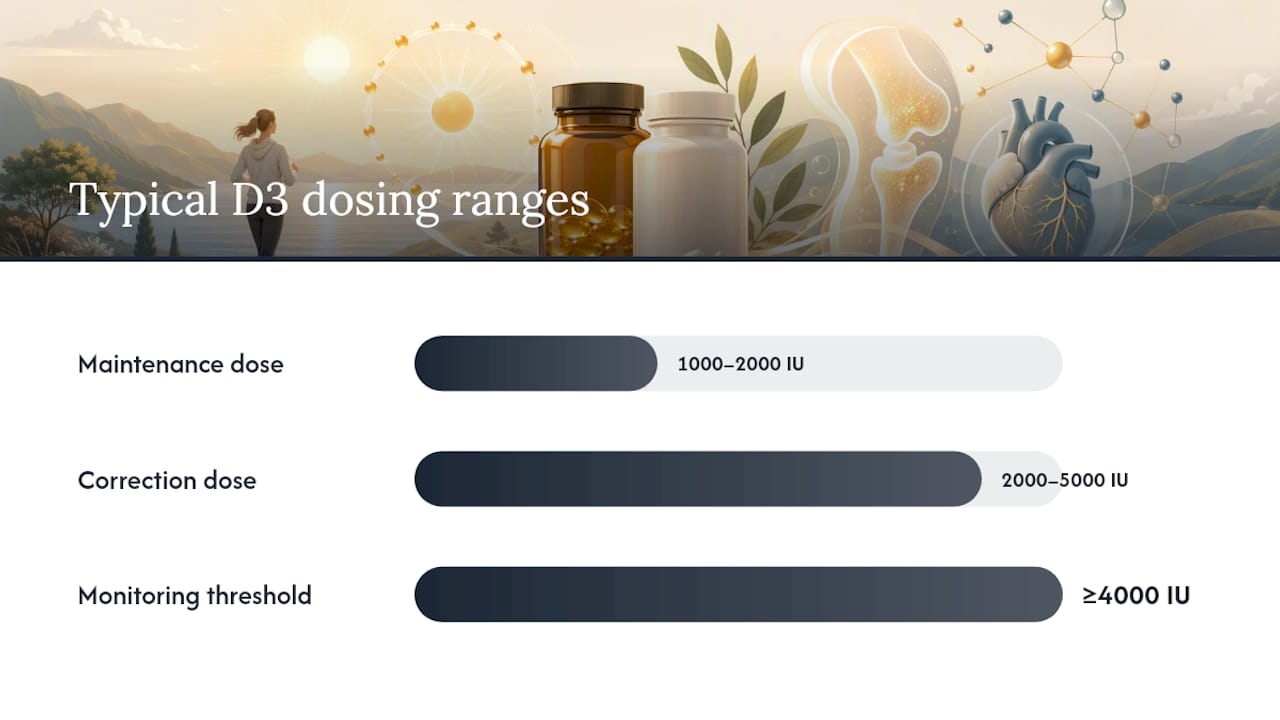
- Match IU to your status. Maintenance dosing typically runs 1,000–2,000 IU daily. Correction dosing for deficiency often runs 2,000–5,000 IU, ideally under clinician guidance.
- Choose MK‑7 over MK‑4 for once-daily dosing. MK‑7 has a longer half-life, which means steadier blood levels from a single daily dose. MK‑7 is commonly recommended at 100–200 mcg daily alongside standard maintenance D3.
- Check the label for both IU and mcg. A product that lists D3 in IU and K2 in mcg separately is giving you the information you need to compare. One that lists only “vitamin D” without specifying D3 or IU is a red flag.
- Take it with a fat-containing meal. Both D3 and K2 are fat-soluble. NIH consumer guidance confirms absorption improves meaningfully when taken with dietary fat. A meal with avocado, olive oil, eggs, or nuts works well.
Safety callout — read this before you start:
- Warfarin and blood thinners: K2 (particularly MK‑4) can interact with warfarin by affecting vitamin K-dependent clotting factors. If you take any anticoagulant, consult your clinician before adding K2.
- Very high-dose D3 (above 4,000 IU daily): Sustained high doses can raise blood calcium. Anyone taking 4,000 IU or more daily should have periodic 25(OH)D and calcium monitoring.
- Hypercalcemia risk: Symptoms of vitamin D toxicity include nausea, weakness, and frequent urination. This is rare at standard doses but real at sustained megadoses.
Pro Tip: When comparing products, divide the total K2 mcg by the D3 IU to get a rough ratio. A practical clinician-used ratio is approximately 100 mcg MK‑7 per 1,000–2,000 IU D3 for maintenance dosing.
Form factor matters less than most marketing suggests, but it does matter. Oil-based softgels deliver fat-soluble vitamins in a pre-dissolved matrix, which can improve absorption compared to dry tablets. Liquids and sprays are useful for people who have difficulty swallowing capsules. Vegan capsules using lichen-derived D3 are available and perform comparably to lanolin-sourced D3 in most contexts.
What the research shows about D3 and K2 taken together
The biological case for combining D3 and K2 is straightforward: D3 increases calcium absorption from the gut, raising circulating calcium. K2 then activates two key proteins, osteocalcin and Matrix Gla Protein (MGP), that direct that calcium into bone and away from arterial walls. Without adequate K2, the calcium D3 mobilizes has no clear routing mechanism.
The stepwise mechanism looks like this: D3 increases intestinal calcium absorption → circulating calcium rises → K2 activates osteocalcin (binds calcium into bone matrix) and MGP (inhibits calcium deposits in arterial walls) → calcium is deposited in bone, not soft tissue. You can read more about K2’s role in calcium direction in Nutribliss’s detailed breakdown.
Where the evidence is strongest:
Clinical review data shows the benefits of combined D3+K2 supplementation are most pronounced in people with baseline deficiencies. For people already at sufficient vitamin D levels, the primary value shifts to maintenance of bone density and glucose homeostasis rather than dramatic correction.
Observational data from the Rotterdam Study and similar cohorts links higher dietary K2 intake with lower rates of arterial calcification and reduced cardiovascular mortality. The caveat: most of this evidence is observational. Large randomized controlled trials specifically on combined D3+K2 supplementation remain limited, and optimal K2 dosing has not been established by RCT evidence alone.
Evidence summary:
What fillers, allergens, and additives to watch for
Most supplement labels list “other ingredients” after the active nutrients. That section is where quality differences show up most clearly.
Common fillers to scrutinize:
- Magnesium stearate and silicon dioxide are flow agents used in capsule manufacturing. They’re generally recognized as safe, but some buyers prefer to avoid them. Their presence isn’t a dealbreaker, but their absence in a premium product is a positive signal.
- Titanium dioxide is a whitening agent found in some tablet coatings. The European Food Safety Authority has raised concerns about its nanoparticle form; U.S. regulations still permit it, but it’s worth noting.
- Artificial colors and flavors have no place in a supplement designed for clinical use. Any product using FD&C dyes in a D3+K2 capsule is prioritizing appearance over formulation integrity.
- Soybean oil is a common carrier oil in D3 softgels. For buyers with soy allergies or sensitivities, check the label. Some products use sunflower or olive oil as the carrier instead.
- Gelatin capsules are derived from animal sources (usually bovine or porcine). Vegans and people with religious dietary restrictions should look for products that specify plant-based capsules (hydroxypropyl methylcellulose, or HPMC).
Allergens to check:
Gluten, dairy, and soy are the most common allergens that appear in supplement excipients. Products marketed as hypoallergenic (Pure Encapsulations is the clearest example on this list) are manufactured to avoid cross-contamination with these allergens and typically undergo third-party verification.
A short ingredient list is usually a better sign than a long one. If you can’t identify what every ingredient does, that’s worth a quick search before you commit to a bottle.
Consumer reviews and brand reputation
Brand reputation in the supplement space is built on three things: manufacturing transparency, consistency of results across batches, and how a company responds when something goes wrong.
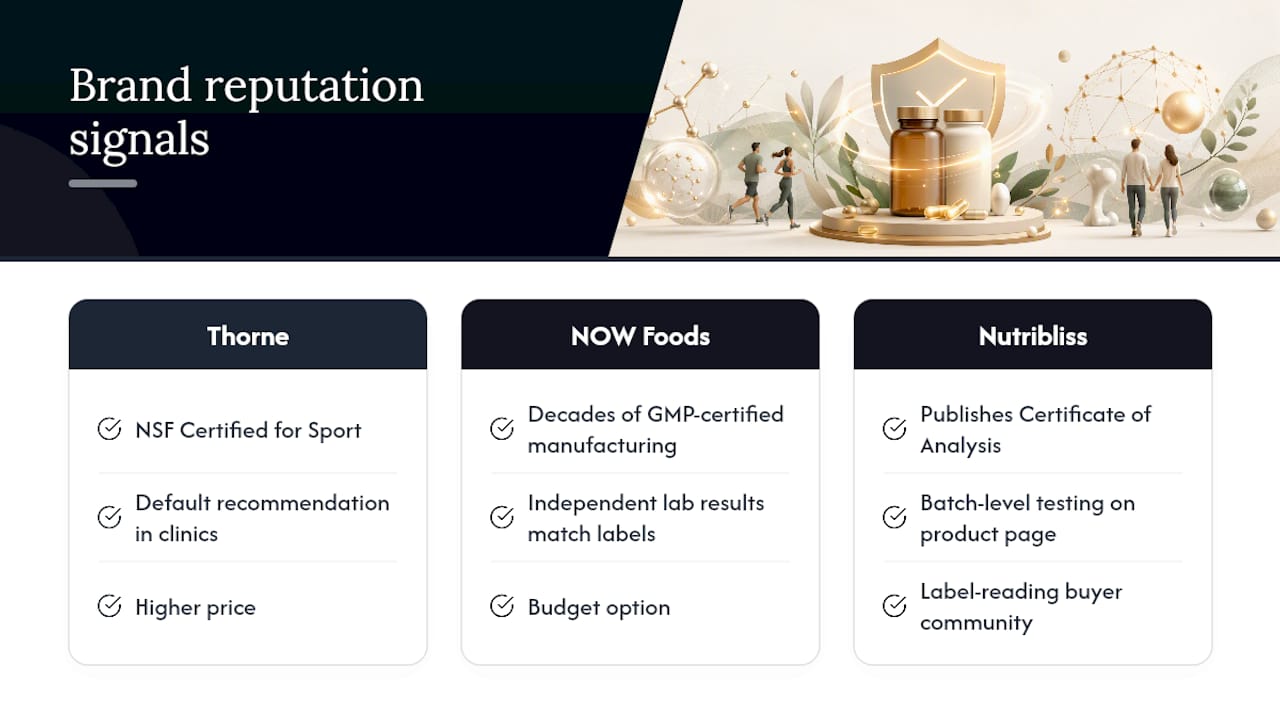
Thorne has the strongest institutional reputation on this list. Its NSF Certified for Sport credential means every batch is tested for banned substances and label accuracy, which is why it’s the default recommendation in many clinical settings. The trade-off is price.
NOW Foods has decades of GMP-certified manufacturing behind it and a track record of consistent formulations. Its products appear in independent lab tests (Labdoor, ConsumerLab) with results that generally match label claims. For a budget option, that consistency is meaningful.
Pure Encapsulations is the standard in integrative medicine practices for hypoallergenic formulations. Its reputation is built on what it leaves out as much as what it puts in.
Nutribliss publishes its Certificate of Analysis on the product page, which puts it in a smaller group of direct-to-consumer brands that make batch-level testing data accessible. For a buyer who wants to verify what they’re taking rather than trust a marketing claim, that’s a concrete differentiator. The #nutribliss community on social platforms reflects a buyer base that skews toward health-conscious adults who read labels rather than just brand names.
Smaller or newer brands on this list (Zooki, Vitabright, ZipVit, Vitl) have more limited public testing records. That doesn’t mean their products are poor quality, but it does mean you’re relying more heavily on the brand’s self-reporting. When third-party COAs aren’t publicly available, it’s reasonable to contact the brand directly and ask.
One pattern worth noting: brands that invest in third-party testing tend to also invest in cleaner excipient lists. The two quality signals often travel together.
Why NutriBliss earned the top spot on this list
The editorial criteria for this list were: clear D3 IU and K2 mcg on the label, MK‑7 as the preferred K2 form, accessible third-party testing documentation, a combined formula (not D3-only), and U.S. availability.
NutriBliss Vitamin K2 + D3 met all five. The 5,000 IU D3 and 100 mcg MK‑7 combination aligns with the practical dosing ratio used in clinical practice for people with insufficiency or deficiency. The BioPerine addition is a formulation choice that reflects attention to bioavailability, not just label claims. The publicly accessible COA is the kind of transparency that most retail brands don’t offer.
Thorne is the stronger choice if your clinician already recommends it by name, or if you need NSF Certified for Sport documentation. NOW Foods is the right call if budget is the primary constraint and 1,000 IU D3 is sufficient for your needs. JS Health is the clearest vegan option.
Limitations to know: NutriBliss Vitamin K2 + D3 uses lanolin-derived D3, which is standard but not vegan. The 5,000 IU dose is appropriate for correction or for people with confirmed insufficiency, but it’s higher than what most people need for maintenance. If your 25(OH)D levels are already in the sufficient range, a lower-dose product may be more appropriate.
The selection here is based on publicly available formulation data, label transparency, and third-party testing documentation. No product on this list was evaluated based on paid placement.
NutriBliss Vitamin K2 + D3: where to buy and what you get
NutriBliss Vitamin K2 + D3 delivers 5,000 IU D3 and 100 mcg MK‑7 K2 per softgel, with BioPerine to support absorption. The formula uses transparent labeling, and the Certificate of Analysis is accessible through the brand page so you can verify what’s in each batch before you buy.

The product ships within the United States and is available directly through Nutribliss’s supplement store. For buyers who want to understand the formulation approach before purchasing, Nutribliss publishes its science and research methodology on the brand site.
At roughly $0.50 per serving for a combined 5,000 IU D3 and 100 mcg MK‑7 formula with BioPerine, it competes favorably against clinician-grade options that charge significantly more for comparable dosing. The 60-capsule bottle covers a two-month supply at one softgel daily.
Ready to add a transparent, clinician-dosed D3+K2 formula to your routine? Shop NutriBliss Vitamin K2 + D3 and check the COA before your first order.
Sources
The sources below were used to evaluate products, verify dosing guidance, and assess the clinical evidence for D3+K2 supplementation.
- Vitamin D - Health Professional Fact Sheet
- Vitamin D, calcium, and cardiovascular risk review
- 8 Best Vitamin D Supplements for 2025 - Healthline
- Vitamin D and K2: do you need both? | OnDose
This article is for general informational purposes only and is not a substitute for professional medical advice. Consult a qualified healthcare provider before starting any new supplement, particularly if you take prescription medications or have a diagnosed health condition.