

TL;DR:
- Taking vitamin D3 alone may lead calcium to deposit in arteries rather than bones, risking vascular calcification. Vitamin K2 activates proteins like osteocalcin and MGP, guiding calcium to bones and preventing arterial deposits. Combining D3 with MK-7 form K2 optimizes calcium distribution and supports bone and cardiovascular health.
If you’re taking vitamin D3 to support your bones or immune system, you’re making a smart choice. But there’s a good chance you’re missing half the equation. The question of why take vitamin K2 with D3 comes down to one overlooked problem: vitamin D3 pulls calcium into your bloodstream, but it has no say in where that calcium actually ends up. Without vitamin K2, known clinically as menaquinone, that calcium can drift toward your arteries instead of your bones. This article breaks down the biology, the evidence, and exactly what you should do about it.
Key Takeaways
| Point | Details |
|---|---|
| D3 raises calcium, K2 directs it | Vitamin D3 boosts calcium absorption by up to 40%; K2 activates proteins that route it to bones, not arteries. |
| Two key proteins depend on K2 | Osteocalcin mineralizes bone; Matrix Gla Protein (MGP) blocks arterial calcium deposits. Both require K2 to function. |
| MK-7 is the preferred K2 form | MK-7 stays active in the body longer than MK-4, making it the better choice for daily supplementation. |
| Take both with fat for best results | Absorption of these fat-soluble vitamins improves by 30 to 50% when taken with a meal containing fat. |
| Not mandatory for everyone, but worthwhile | Healthy adults on a balanced diet may have adequate K2 intake, but those at risk of deficiency benefit most from combining both. |
Why take vitamin K2 with D3: the calcium traffic problem
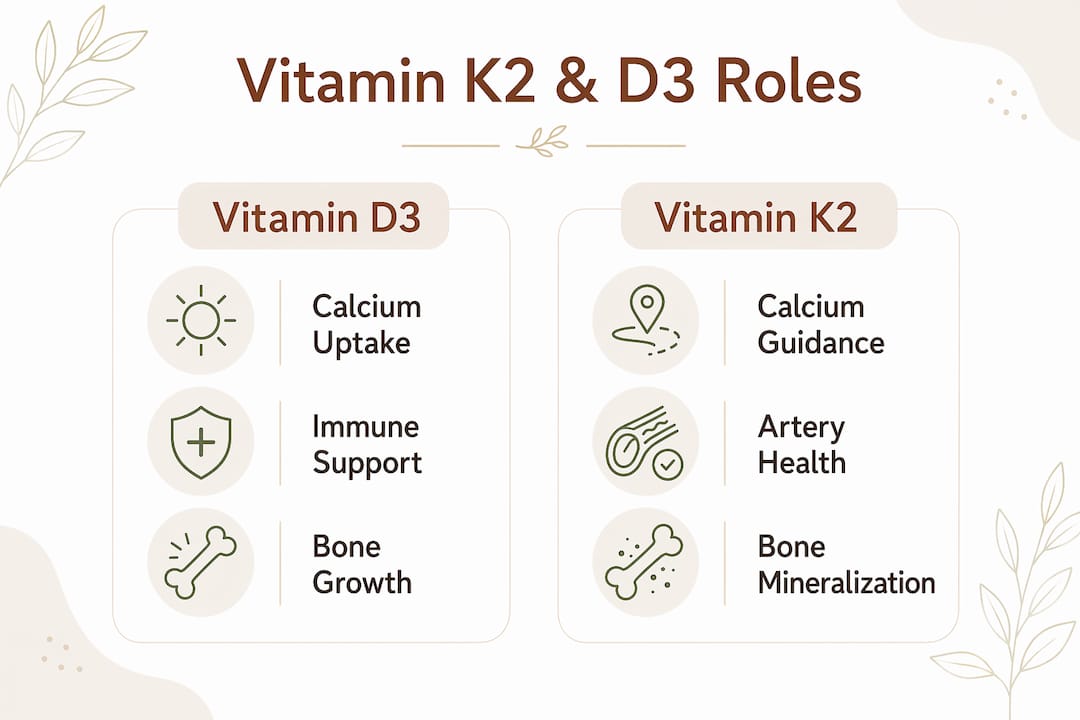
Think of vitamin D3 as a pump that floods your system with calcium and vitamin K2 as the traffic controller deciding where it goes. Without the controller, calcium doesn’t disappear. It just ends up somewhere you don’t want it.

Calcium absorption can increase up to 40% when you supplement with D3. That’s the good news. The challenge is that elevated blood calcium needs to be handled correctly, and that’s where vitamin K2 earns its place.
How osteocalcin and MGP work together
Vitamin K2 activates two critical proteins through a process called gamma-carboxylation (often written as γ-carboxylation). Here’s what each one does:
- Osteocalcin is a protein produced by bone cells. When K2 carboxylates it, osteocalcin binds calcium to the bone matrix, strengthening mineralization. Without enough K2, osteocalcin stays undercarboxylated and ineffective, leaving bones weaker despite high calcium levels.
- Matrix Gla Protein (MGP) does the opposite job in your blood vessels. K2 activates MGP via carboxylation to prevent calcium from depositing in arterial walls, a process called vascular calcification. Stiff, calcified arteries are a major cardiovascular risk factor.
Without adequate K2, both proteins remain partially inactive. Calcium circulates freely and deposits where it shouldn’t. The biological case for why D3 and K2 together make sense is built on this mechanism.
Pro Tip: If you’ve been taking high-dose D3 for months without adding K2, consider getting your vitamin K2 status checked through an undercarboxylated osteocalcin (ucOCN) test. It tells you how well your proteins are actually being activated.
What the research actually says
The biological synergy between these two vitamins is well-supported at the mechanistic level. But it’s worth being honest about the current state of clinical evidence before drawing firm conclusions.
Clinical trials have not definitively shown that taking vitamin D without K2 causes direct harm. The mechanisms are plausible and the observational data is compelling, but large-scale randomized controlled trials confirming that adding K2 to D3 definitively prevents bone fractures or heart attacks in healthy populations are still limited.
That said, the epidemiological signals are hard to ignore. The Rotterdam Study found that higher K2 intake (MK-7 form) linked to up to 50% reduction in arterial calcification and cardiovascular deaths. That’s a significant association, even if it doesn’t settle the debate entirely.
Here’s a useful side-by-side comparison of what we know:
| Factor | D3 alone | D3 plus K2 |
|---|---|---|
| Calcium absorption | Significantly increased | Significantly increased |
| Calcium placement in bone | Uncontrolled | Supported via osteocalcin activation |
| Arterial calcification risk | Potentially increased over time | Reduced via MGP activation |
| Bone biomarker response | May be muted | More reliable improvement |
| Current clinical trial support | Moderate | Growing, mechanistically strong |
Bone biomarker improvements can be muted with vitamin D interventions alone, precisely because bone-ready osteocalcin requires K2 for activation. This explains why some people supplement with D3 diligently and still see underwhelming results on bone density scans.
“Vitamin K2 is not just another bone vitamin. It plays a unique, essential role activating proteins critical to calcium handling.” — Osteocalcin Beyond Bone, MDPI
For people looking to understand why D3 and K2 together represent a more complete approach, the evidence points clearly in one direction even if the science is still being refined.
How to take D3 and K2 correctly
Understanding the biology is one thing. Getting the most from supplementation in practice requires attention to form, dose, and timing.
-
Choose MK-7 over MK-4 for K2. MK-7 is the long-chain form of menaquinone found in fermented foods like natto. It has a half-life of several days in the body, compared to hours for MK-4. That longer activity window makes MK-7 far more effective for daily supplementation.
-
Match your doses to your risk profile. For most adults pairing K2 with D3, 100 to 200 mcg of K2 MK-7 alongside 1,000 to 4,000 IU of D3 is a reasonable starting range. Higher D3 doses (above 5,000 IU) used therapeutically call for proportionally more K2.
-
Take both with a fat-containing meal. D3 and K2 are fat-soluble vitamins. Absorption improves by 30 to 50% when taken alongside dietary fat. Avocado, eggs, olive oil, or even a handful of nuts is enough. Many quality combination supplements use an oil base for exactly this reason.
-
Be consistent rather than obsessing over timing. Whether you take your supplement in the morning or evening matters far less than taking it daily. Building a habit around a meal you eat every day without fail is more important than any specific time window.
-
Check for drug interactions before starting. If you take warfarin or any other vitamin K antagonist, stop here and talk to your doctor. Warfarin inhibits vitamin K recycling, so adding K2 can alter your INR and affect how your medication works. Even small, consistent changes in vitamin K intake shift anticoagulation control.
Pro Tip: Look for a combination supplement that lists both the IU of D3 and the mcg of K2 MK-7 clearly on the label. Vague proprietary blends make it impossible to know if you’re getting a therapeutic amount of either.
You can also explore how calcium supports bone health more broadly and why K2’s role in directing it is central to that picture.
Common concerns and misconceptions
Plenty of misinformation circulates about this combination, and it’s worth addressing the most common questions directly.
Is K2 mandatory if you take D3? No. Most healthy individuals do not require mandatory K2 supplementation when taking D3. If your diet regularly includes natto, aged cheeses, egg yolks, and grass-fed animal products, you may already have adequate K2 intake. The decision should reflect your individual diet, health status, and goals.
Does K2 cause blood clots? This is a common fear and it’s wrong. Vitamin K2 does not promote clotting. It activates proteins involved in calcium regulation, not the coagulation cascade directly. The concern about vitamin K and blood clotting applies to warfarin management, where changes in K intake affect the drug’s efficacy. That’s a medication interaction, not an inherent danger of K2 itself.
Who benefits most from combining D3 with K2 includes:
- Older adults, where both bone density loss and arterial stiffening accelerate.
- People with low dietary K2 intake (those eating few fermented foods or animal products).
- Individuals with conditions affecting fat absorption, such as Crohn’s disease or post-bariatric surgery (read more about bariatric nutrient needs for this population).
- Anyone supplementing with higher therapeutic doses of D3 under medical supervision.
- People with documented low bone mineral density or elevated cardiovascular risk.
The nuance here is that supplementation decisions should be personalized rather than applied universally. If you’re unsure, reviewing your labs and current diet with a healthcare provider gives you far better information than any general recommendation.
Review supplement safety guidelines if you want a broader framework for making these decisions responsibly.
My take after years of working with supplementation
By Gaurav
I’ve watched a lot of people spend years diligently taking vitamin D3 and wondering why their bone density numbers weren’t moving the way they expected. In most cases, the missing piece was K2. Not a higher D3 dose, not more calcium. Just the vitamin that tells calcium where to go.
What I’ve learned is that the biological logic here is genuinely compelling, even if the randomized trial data is still catching up. The K2 cofactor requirement for osteocalcin activation isn’t theoretical. It’s the reason why measuring vitamin D levels alone gives you an incomplete picture of what your bones are actually getting.
I also want to be clear about the nuance. I’m not convinced that D3 supplementation without K2 is dangerous for healthy people eating a reasonable diet. But if you’re already taking the trouble to supplement, pairing both is a low-risk, mechanistically sound choice with solid observational support behind it.
Where I urge real caution is with anyone on anticoagulants. That’s a conversation for a prescribing physician, full stop. The #nutribliss approach is always about thoughtful, evidence-informed supplementation, not one-size-fits-all protocols.
— Gaurav
Get more from your D3 with Nutribliss
If you’ve read this far, you already understand more about the D3 and K2 pairing than most people who take these supplements daily.

Nutribliss formulates its supplements with this kind of science in mind. The vitamin D3 and K2 products in the Nutribliss supplement collection use the MK-7 form of K2 paired with D3 in ratios that reflect current research, delivered in an oil-based format that supports fat-soluble absorption from the first dose. If you want to go deeper on the research foundation behind the formulations, the science behind Nutribliss products is worth exploring. No guesswork. No vague proprietary blends. Just clear, science-backed supplementation built for people who take their health seriously.
FAQ
Why does vitamin D3 need vitamin K2?
Vitamin D3 raises calcium levels in the blood but does not control where calcium deposits. Vitamin K2 activates proteins that direct calcium into bones and prevent it from accumulating in arteries.
What does K2 do with D3 specifically?
K2 activates osteocalcin for bone mineralization and Matrix Gla Protein to block arterial calcification. Both processes are triggered by vitamin D3’s effect on calcium absorption, making K2 the essential downstream regulator.
Is it safe to take D3 without K2?
For most healthy adults, taking D3 without K2 is not acutely harmful, especially with a diet rich in K2 food sources. However, those supplementing with higher D3 doses or with limited dietary K2 intake gain additional protection by including K2.
How much K2 should I take with D3?
A general range for adults is 100 to 200 mcg of K2 MK-7 paired with 1,000 to 4,000 IU of D3 daily. Those using therapeutic D3 doses under medical guidance may need proportionally more K2.
Can I take K2 with D3 if I’m on warfarin?
No, not without medical supervision. Warfarin works by blocking vitamin K recycling, so adding K2 supplementation can destabilize your INR and reduce the drug’s effectiveness. Always consult your prescribing physician first.