

TL;DR:
- Vitamin K2 activates osteocalcin and MGP via γ-carboxylation, directing calcium to bones and preventing artery calcification. Its support extends beyond mineralization, influencing bone remodeling and vascular health by maintaining protein activation in extrahepatic tissues. Supplementation with MK-7 and vitamin D3 ensures optimal calcium utilization, promoting stronger bones and healthier arteries through consistent, science-backed dosing.
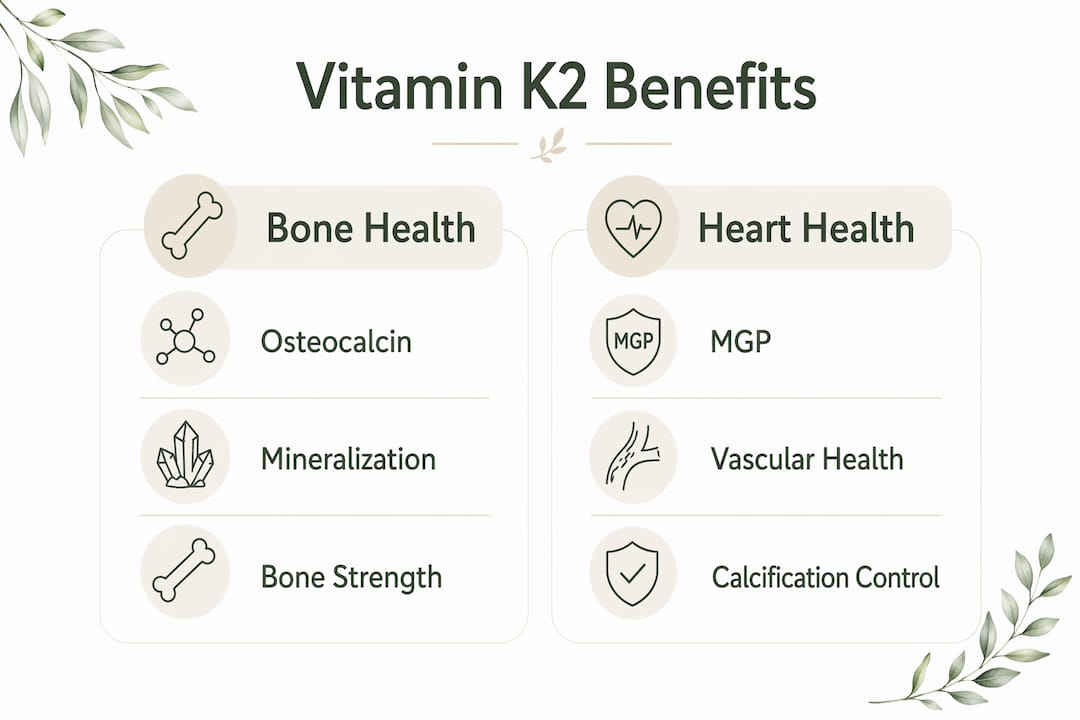
Vitamin K2 is defined by its core biological function: activating vitamin K-dependent proteins through a chemical process called γ-carboxylation, which enables those proteins to bind calcium and direct it to the right places in your body. The two most critical proteins in this system are osteocalcin, which anchors calcium into bone tissue, and matrix Gla protein (MGP), which prevents calcium from depositing inside your arteries. Without adequate K2, both proteins remain in an undercarboxylated, inactive state. The result is weaker bones and a higher risk of vascular calcification. Understanding how K2 works at this molecular level changes how you think about calcium supplementation entirely.
What is the function of vitamin K2 in the body?
The function of vitamin K2 centers on one enzymatic process: γ-carboxylation, which converts inactive precursor proteins into their fully functional forms. Think of it as a molecular activation switch. When K2 participates in the vitamin K cycle, it donates electrons to carboxylase enzymes that attach carboxyl groups to specific glutamic acid residues on target proteins. This structural change allows those proteins to bind calcium ions with high affinity.
The vitamin K cycle itself depends on an enzyme called vitamin K epoxide reductase (VKOR). VKOR regenerates the reduced form of K2 after each carboxylation reaction, keeping the cycle running continuously. Anticoagulant drugs like warfarin work precisely by blocking VKOR, which is why patients on warfarin must monitor their vitamin K intake carefully. Disrupting this cycle doesn’t just affect blood clotting. It shuts down the activation of every K-dependent protein in the body, including osteocalcin and MGP.
Vitamin K2 status is measurable through biomarkers. Specifically, the ratio of carboxylated to undercarboxylated osteocalcin (cOCN vs. ucOCN) tells clinicians how efficiently your body is running γ-carboxylation. Elevated ucOCN is a functional marker of K2 deficiency, even when dietary intake appears adequate. This distinction matters because it means the critical determinant of K2 function is not just how much you consume but whether your VKOR cycle is intact and operating efficiently.
How does vitamin K2 support bone health?
Vitamin K2 supports bone health by ensuring osteocalcin is fully carboxylated so it can bind hydroxyapatite, the mineral crystal that gives bone its hardness and density. Without this step, osteocalcin accumulates in its inactive form and bone mineralization becomes impaired. The bone matrix forms but lacks the mineral anchoring that makes it structurally strong.

Clinical evidence confirms this mechanism translates into measurable outcomes. Long-term MK-7 supplementation improves osteocalcin carboxylation and bone mineral density, with the most pronounced benefits seen in postmenopausal women who face accelerated bone loss. MK-7 is the menaquinone-7 form of K2, favored in supplements because of its longer half-life in circulation compared to MK-4. Daily doses of 180 to 375 µg of MK-7 have produced sustained improvements in bone quality in randomized controlled trials over multiple years.
What most articles miss is that K2’s role in bone goes beyond mineralization. A 2026 study published in Bone Research found that vitamin K-dependent carboxylation in osteoblasts regulates osteoclast maturation and activity through a signaling protein called GAS6. Osteoblasts are the cells that build bone; osteoclasts are the cells that break it down. K2 influences the communication between them, meaning it affects not just how bone is built but how the entire remodeling cycle is balanced. This osteoblast-osteoclast signaling pathway expands K2’s functional scope well beyond what was understood even five years ago.
| Bone health factor | What vitamin K2 does |
|---|---|
| Osteocalcin activation | Carboxylates osteocalcin so it binds hydroxyapatite in bone matrix |
| Bone mineral density | MK-7 at 180 µg/day improves density, especially in postmenopausal women |
| Fracture risk | Reduced ucOCN levels correlate with lower fracture incidence |
| Bone remodeling | GAS6 signaling modulates osteoclast number and activity via osteoblasts |
Pro Tip: If you take a bone health supplement, check whether it contains MK-7 specifically. MK-4 is the form found in animal products, but MK-7 from fermented foods like natto has a longer half-life and produces more consistent increases in carboxylated osteocalcin at lower doses.
Vitamin K2 and blood clotting: what’s the real difference?
Vitamin K’s role in blood clotting is the oldest and most established function in the literature. Clotting factors II, VII, IX, and X all require γ-carboxylation to become active, and this process happens primarily in the liver. Vitamin K1 (phylloquinone), found in leafy greens, is the dominant form used by the liver for clotting factor activation. Vitamin K2 contributes here too, but its more distinctive role lies outside the liver in what researchers call extrahepatic tissues.
The key distinction between K1 and K2 comes down to tissue distribution. K1 is rapidly cleared by the liver and used almost entirely for clotting. K2, particularly the longer-chain menaquinones like MK-7, circulates in the bloodstream for much longer and reaches tissues like bone, arterial walls, and kidneys. This is where proteins like MGP depend on K2 for activation. The liver gets first priority on available vitamin K, which means when intake is marginal, clotting function is preserved at the expense of extrahepatic proteins like osteocalcin and MGP.
Several common misconceptions are worth addressing directly:
- K2 does not thin the blood. That is the effect of warfarin, which blocks the vitamin K cycle. K2 itself supports normal clotting factor activation.
- Taking K2 does not counteract anticoagulant therapy in the way that high-dose K1 does, though anyone on warfarin should consult their physician before supplementing.
- K2 deficiency does not cause bleeding disorders in otherwise healthy adults because the liver prioritizes K1 for clotting. The deficiency shows up in bone and vascular health first.
- The role of vit K2 in vascular and skeletal health is independent of its contribution to the coagulation cascade.
Pro Tip: If your doctor has told you your vitamin K levels are fine based on clotting tests, that does not mean your K2 status is adequate for bone and vascular protection. Clotting tests measure hepatic K function, not extrahepatic K2 activity.
How does vitamin K2 protect heart health and prevent vascular calcification?
Vitamin K2 and heart health are connected through one protein: matrix Gla protein (MGP). MGP is produced by vascular smooth muscle cells and acts as the body’s primary inhibitor of calcium deposition in arterial walls. When MGP is fully carboxylated by K2-dependent enzymes, it actively blocks calcium crystals from forming in soft tissue. When K2 is insufficient, MGP remains undercarboxylated and loses this inhibitory function, leaving arteries vulnerable to calcification.
Vascular calcification is not a minor cosmetic issue. Arterial stiffness from calcium deposits is a direct contributor to elevated blood pressure, reduced cardiac output, and increased cardiovascular event risk. Undercarboxylated MGP is now recognized as a biomarker for calcification risk, particularly in patients with chronic kidney disease, where K2 deficiency is common and vascular calcification is accelerated.
One expert clarification that gets overlooked in popular wellness content:
Vitamin K2 inhibits new calcification from forming. It does not dissolve or reverse existing calcium deposits in arteries. Its vascular role is preventive and regulatory, not corrective.
This distinction matters for setting realistic expectations. K2 is not a treatment for established arterial disease. It is a protective mechanism that works best when maintained consistently over time, before calcification takes hold.
The practical steps for supporting vascular health through K2 follow a clear logic:
- Maintain adequate daily K2 intake through diet or supplementation to keep MGP in its active, carboxylated state.
- Monitor undercarboxylated MGP levels if you have cardiovascular risk factors or kidney disease.
- Avoid long-term use of medications that disrupt the vitamin K cycle without discussing K2 status with your physician.
- Pair K2 with vitamin D3, since vitamin D increases calcium absorption and K2 ensures that calcium goes to bone rather than arterial walls.
Vitamin K2 with vitamin D, and the best sources to get enough
Vitamin D and vitamin K2 operate as a functional pair in calcium metabolism. Vitamin D3 increases the absorption of calcium from the gut, raising circulating calcium levels significantly. K2 then activates osteocalcin and MGP to direct that calcium into bone and teeth while keeping it out of soft tissues. Without K2, the calcium mobilized by vitamin D has no clear destination and may deposit in arteries instead of bones. This is why taking K2 alongside D3 is not just a supplement trend but a physiologically grounded strategy.
The best dietary sources of vitamin K2 include:
- Natto (fermented soybeans): the richest known food source, containing MK-7 at levels that can meet daily needs in a single serving
- Hard and soft cheeses: particularly Gouda and Brie, which contain MK-8 and MK-9 from bacterial fermentation
- Egg yolks: provide MK-4, especially from pasture-raised hens
- Chicken liver and dark meat: among the highest animal-source concentrations of MK-4
- Fermented dairy like kefir and certain yogurts: contain variable but meaningful amounts of menaquinones
For most people in Western countries, dietary intake of K2 falls short of what clinical trials use to demonstrate bone and vascular benefits. Daily supplementation with 180 µg MK-7 produced sustained improvements in osteocalcin carboxylation and bone quality in healthy adults over multiple years in randomized trials. That dose is the most widely studied and supported in the literature.
| Source type | Form of K2 | Practical notes |
|---|---|---|
| Natto | MK-7 | Highest concentration; strong flavor limits regular use for many |
| Gouda/Brie cheese | MK-8, MK-9 | Moderate amounts; accessible for most diets |
| Egg yolks | MK-4 | Lower dose per serving; pairs well with fat for absorption |
| MK-7 supplements | MK-7 | 180 µg/day is the clinically validated dose for bone benefits |
Pro Tip: Vitamin K2 is fat-soluble, meaning it absorbs significantly better when taken with a meal that contains fat. Taking your K2 supplement with breakfast or dinner rather than on an empty stomach makes a measurable difference in bioavailability.
Key takeaways
Vitamin K2 functions by activating osteocalcin and MGP through γ-carboxylation, directing calcium to bones while preventing it from depositing in arteries.
| Point | Details |
|---|---|
| Core mechanism | γ-carboxylation activates K-dependent proteins; VKOR cycle must be intact for this to work. |
| Bone protection | MK-7 at 180 µg/day improves bone mineral density and reduces fracture risk, especially post-menopause. |
| Vascular role | Carboxylated MGP inhibits new arterial calcification; K2 prevents deposits, it does not reverse them. |
| K2 vs. K1 | K1 serves the liver for clotting; K2 reaches extrahepatic tissues like bone and arterial walls. |
| Best pairing | K2 combined with vitamin D3 ensures absorbed calcium goes to bone, not soft tissue. |
Why K2 deserves more attention than it gets
I’ve spent years reading nutrition research, and vitamin K2 is one of the most underappreciated nutrients in the entire supplement space. Most people have heard of vitamin D, calcium, and magnesium for bone health. Very few have heard of osteocalcin carboxylation or MGP activation, and that gap in understanding leads to real gaps in health outcomes.
What strikes me most about the 2026 research on GAS6 signaling is that it reframes K2 from a passive cofactor into an active regulator of bone remodeling. The idea that K2 influences how osteoblasts and osteoclasts communicate with each other means its role in skeletal health is more dynamic than we thought. This is not just about getting calcium into bone. It is about maintaining the ongoing balance between bone formation and resorption throughout your life.
The vascular calcification story is equally important, and equally misunderstood. I regularly see wellness content claiming that K2 can “clean out” arteries. That is not what the science says. What K2 does is prevent the problem from worsening by keeping MGP active. That is a meaningful benefit, but it requires consistency over years, not weeks.
My practical recommendation: if you are already taking vitamin D3, you are almost certainly not getting enough K2 to match the calcium your body is now absorbing. The D3 and K2 combination is not optional for people supplementing with higher doses of D3. It is the physiologically complete approach.
— GAURAV
Support your bones and heart with Nutribliss K2 + D3
Nutribliss formulates its Vitamin K2 + D3 supplement to reflect exactly what the clinical research supports: MK-7 paired with D3 and BioPerine for enhanced bioavailability. If you have been taking vitamin D alone and wondering why your bone health markers have not shifted, the missing piece is almost certainly K2.

The Nutribliss K2 + D3 capsules combine science-backed doses in a single daily capsule, removing the guesswork from pairing these two nutrients. Every formulation in the Nutribliss catalog is built on published research, not marketing trends. Browse the full Nutribliss supplements collection to find products that match your specific wellness goals. Use #nutribliss to share your results and connect with a community that takes nutrition seriously.
FAQ
What is the primary function of vitamin K2?
The primary function of vitamin K2 is to activate vitamin K-dependent proteins through γ-carboxylation, enabling osteocalcin to mineralize bone and MGP to prevent calcium deposits in arteries. Without this activation, both proteins remain inactive regardless of calcium or vitamin D intake.
What are the main vitamin K2 deficiency symptoms?
Vitamin K2 deficiency symptoms do not typically include bleeding, since the liver prioritizes K1 for clotting. Instead, deficiency shows up as elevated undercarboxylated osteocalcin (a marker of poor bone mineralization), reduced bone mineral density, and increased vascular calcification risk over time.
How does vitamin K2 differ from vitamin K1?
Vitamin K1 is used primarily by the liver to activate clotting factors and is found in leafy green vegetables. Vitamin K2, particularly MK-7, circulates longer in the bloodstream and reaches extrahepatic tissues like bone and arterial walls where osteocalcin and MGP require activation.
What are the best food sources of vitamin K2?
Natto (fermented soybeans) is the richest dietary source of MK-7, followed by aged cheeses like Gouda and Brie, egg yolks from pasture-raised hens, and chicken liver. Most Western diets provide insufficient K2 from food alone, making supplementation with 180 µg MK-7 a practical option.
Can vitamin K2 reverse arterial calcification?
Vitamin K2 cannot reverse existing arterial calcium deposits. Its vascular role is to keep MGP carboxylated and active, which inhibits new calcification from forming in smooth muscle tissue. This is a preventive function that works best when K2 intake is consistent over the long term.