

TL;DR:
- Collagen is the most abundant protein in the human body, serving as a vital structural component for tissues like skin, bones, and cartilage. Its synthesis depends on essential nutrients such as vitamin C, zinc, and copper, which support fiber stability and cross-linking. While collagen supplements can offer some benefits, especially for joint and bone health, they are most effective when combined with a nutrient-rich lifestyle and proper long-term habits.
Collagen is the most abundant protein in your body, yet most people only connect it to beauty creams or trendy supplements. Here’s what surprises many: collagen is roughly 30% of human protein mass, acting as the structural backbone for skin, bones, tendons, cartilage, and more. It’s less a beauty ingredient and more a fundamental building material your body absolutely cannot function without. This article cuts through the marketing noise to explain what collagen actually is, how it works at a molecular level, what the current research really says about supplements, and how to make smarter, evidence-informed choices.
Table of Contents
- What is collagen? The foundation of your body
- How collagen works: Structure, synthesis, and nutrition
- Collagen benefits: Separating evidence from hype
- What happens when you ingest collagen?
- The real story: What most guides miss about collagen
- Explore smart options for collagen and wellness
- Frequently asked questions
Key Takeaways
| Point | Details |
|---|---|
| Vital body protein | Collagen makes up about 30 percent of your body’s protein and is crucial for skin, bone, and tendon strength. |
| Requires nutrition | Proper collagen function relies on nutrients like vitamin C for synthesis and stability. |
| Supplements are nuanced | Collagen supplements may offer benefits, but effects depend on the individual, formulation, and overall lifestyle. |
| Digested, not directly absorbed | Your body breaks down oral collagen into amino acids, which are then used for various proteins, not just skin or joints. |
What is collagen? The foundation of your body
Collagen isn’t just one thing. It’s actually a family of proteins, with over 28 types identified in humans, though Types I, II, and III account for the vast majority of what’s found in your body. Think of collagen as the rebar inside concrete: it gives your tissues tensile strength, flexibility, and resilience without it, structures would simply collapse.
According to current research, collagen is a major structural protein found abundantly in connective tissues including skin, bones, tendons, and cartilage. That’s a broad and essential list. Type I collagen dominates skin and bone. Type II is concentrated in cartilage. Type III shows up heavily in blood vessels and organs. Each type has a specialized job, but they all share the same mission: holding your body together.
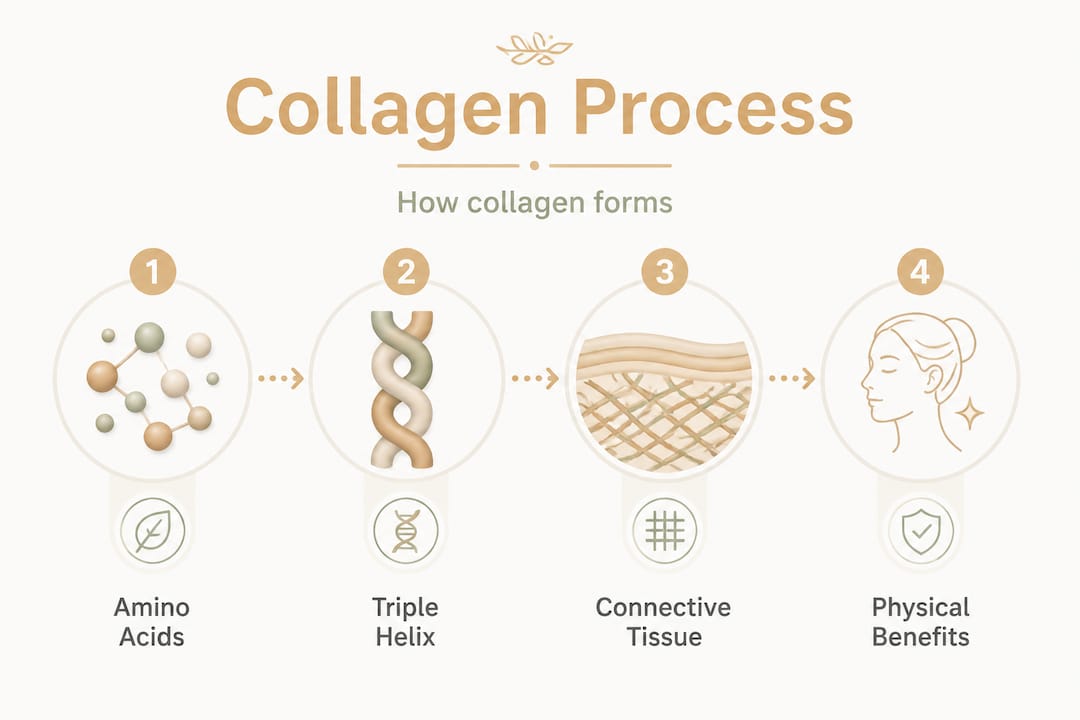
Here’s where the real picture gets interesting. Collagen isn’t static. Your body continuously breaks it down and rebuilds it, a cycle regulated by enzymes, nutrients, hormones, and aging. By your late 20s, natural collagen production starts declining at roughly 1% per year. By your 40s and 50s, that reduction is noticeable in skin elasticity, joint comfort, and recovery time.
Key tissues and roles of collagen at a glance:
- Skin: Provides elasticity, firmness, and moisture retention
- Bones: Gives bone its tensile flexibility alongside minerals like calcium
- Tendons and ligaments: Enables movement and withstands mechanical stress
- Cartilage: Cushions joints and absorbs impact
- Gut lining: Supports intestinal integrity and barrier function
“Collagen’s importance extends far beyond cosmetic appeal. It’s a foundational element of nearly every major tissue in the human body.”
Understanding collagen’s benefits fully means recognizing it as a systemic protein, not a skin cream ingredient. Once you see it that way, supplement conversations become far more nuanced and far more interesting.
How collagen works: Structure, synthesis, and nutrition
What makes collagen uniquely suited to its structural role is its molecular architecture. Most proteins fold into globular shapes. Collagen does something different: it forms a triple-helical structure, where three polypeptide chains wind around each other like a twisted rope. This triple helix is built on a repeating Gly-X-Y amino acid pattern, where glycine (Gly) sits at every third position to keep the helix tight, and the X and Y positions are most often proline and hydroxyproline.
Proline and hydroxyproline are critical. They provide the rigidity and stability that make the helix so mechanically strong. Without sufficient hydroxyproline, the entire structure loses integrity. This is why nutrition matters so deeply to collagen function, because collagen assembly and cross-linking depend on enzyme-driven, nutrient-dependent steps.
| Nutrient | Role in collagen synthesis | Deficiency consequence |
|---|---|---|
| Vitamin C | Hydroxylates proline and lysine residues | Weak, unstable collagen (scurvy) |
| Zinc | Activates collagen-producing enzymes | Impaired wound healing |
| Copper | Required for cross-linking fibers | Fragile connective tissue |
| Glycine | Primary amino acid in collagen chain | Reduced collagen output |
| Proline | Core structural component | Structurally compromised collagen |
Vitamin C deserves special attention here. The hydroxylation of proline, the step that locks the triple helix into stable form, requires vitamin C as a cofactor. This is why scurvy, the disease of severe vitamin C deficiency, causes the literal disintegration of connective tissue. Sailors historically died because their collagen fell apart. That’s not a metaphor. Gums bled, wounds reopened, joints failed.
Understanding the collagen peptide structure also helps explain why certain hydrolyzed collagen supplements are designed the way they are. Manufacturers break intact collagen into smaller peptide chains to potentially improve absorption, a point we’ll return to shortly.
Pro Tip: If you’re serious about optimizing your collagen status, don’t just buy a collagen supplement. Check whether your diet consistently delivers vitamin C, zinc, and copper. These cofactors are what allow your body to actually build and stabilize collagen fibers, with or without supplementation.
Collagen benefits: Separating evidence from hype
Now for the part most supplement marketing glosses over. The science on collagen benefits is real, but it’s also genuinely complicated. Skin, joint, and bone are the three main areas studied, and the evidence varies significantly across each.
Skin: Several randomized controlled trials do show improvements in skin elasticity and hydration with collagen peptide supplementation over 8 to 12 weeks. However, evidence is mixed and some analyses find that results depend heavily on study quality and who funds the research. Industry-sponsored trials consistently report stronger effects than independent ones. That’s a pattern worth watching.

Expert guidance urges skepticism around oral collagen’s impact on skin because large-scale, high-quality proof remains limited. In comparison, consistent sunscreen use, retinoids, and a nutrient-rich diet have far stronger and more consistent evidence bases for skin health. Multivitamins for skin health also show better documented support in some clinical contexts. That doesn’t mean collagen is useless for skin, it just means don’t throw out your sunscreen in favor of a collagen smoothie.
Joints and bones: This is where the evidence gets more genuinely encouraging. Meta-analyses suggest possible benefit for bone and muscle health, especially when collagen is combined with complementary nutrients like calcium and vitamin D. For those looking into joint and bone supplement options, the combination approach tends to outperform collagen alone.
A practical comparison:
| Benefit area | Evidence strength | Key factors that matter |
|---|---|---|
| Skin elasticity | Moderate (mixed quality) | Dose, peptide type, funding source |
| Joint comfort | Moderate to strong | Type II collagen, plus nutrients |
| Bone density | Moderate | Combined with calcium/vitamin D |
| Muscle recovery | Emerging | Combined with resistance training |
| Gut health | Preliminary | Limited human trials |
Here’s a more grounded way to think about this:
- Collagen supplements likely offer some benefit in skin and joint health for certain populations, particularly older adults and active individuals.
- The benefit is additive, meaning it works better alongside good nutrition and lifestyle habits, not instead of them.
- Hydrolyzed collagen peptides appear to perform better than unprocessed collagen, based on absorption data.
- Anyone dealing with specific concerns around collagen for active lifestyles may see more practical benefit than someone already in optimal health.
For a deeper look at how collagen peptides and skin interact at a cellular level, the distinction between peptide types matters more than most people realize. And if you’re interested in how supplementation fits into longer-term health, exploring supplements in aging provides broader context.
Pro Tip: When reading collagen studies, check who funded the research. Industry-sponsored trials consistently report larger effect sizes. Look for independent, peer-reviewed research when making supplement decisions.
What happens when you ingest collagen?
This section might be the most important one in terms of managing expectations. When you swallow a collagen supplement, your digestive system doesn’t recognize it as “collagen for skin” or “collagen for joints.” It treats it like any other protein.
Stomach acid and digestive enzymes break collagen down into individual amino acids and short peptide chains. As WebMD clearly explains, collagen supplements are broken down before absorption and are not incorporated as whole collagen into tissues. Your body then uses those amino acids as building blocks for whatever protein synthesis it prioritizes, which could be muscle repair, enzyme production, or immune function, not necessarily cartilage or skin.
This is a critical concept to internalize. You can’t eat collagen and expect it to travel intact to your knee cartilage. The body doesn’t work that way. What you’re actually doing is supplying a rich source of glycine, proline, and hydroxyproline, the specific amino acids most needed for collagen synthesis. If your diet is otherwise low in these amino acids, supplementing can meaningfully support collagen production. If your diet already includes plenty of bone broth, meats, and organ meats, the marginal benefit is smaller.
What collagen actually provides when digested:
- Glycine: supports muscle protein synthesis and neurotransmitter function
- Proline: feeds collagen-producing fibroblasts in connective tissue
- Hydroxyproline: a collagen-specific amino acid that may signal fibroblast activity
- Arginine: supports circulation and nitric oxide production
Hydrolyzed collagen, or collagen peptides, are processed to have smaller molecular sizes. Evidence from studies using tracers suggests these peptide supplement fragments may accumulate in skin and cartilage at higher rates than random amino acids. This is one of the stronger arguments for choosing hydrolyzed collagen over gelatin or intact collagen in supplement form.
| Form | Molecular size | Absorption potential | Best use case |
|---|---|---|---|
| Intact collagen | Large | Low | Food sources (bone broth) |
| Gelatin | Medium | Moderate | Cooking, some gut support |
| Hydrolyzed collagen peptides | Small | Higher | Supplements, targeted use |
Pro Tip: Take collagen supplements alongside a vitamin C source. The timing may support the hydroxylation step required for collagen synthesis in your tissues, giving those amino acids the best chance of being used effectively.
The real story: What most guides miss about collagen
Here’s a perspective you won’t find in most supplement marketing: the collagen conversation is almost entirely backwards. Most content starts with the supplement and works backward to justify it. The actual science starts with the biology and works forward to ask whether a supplement makes sense for a specific person in a specific context.
Collagen supplements are not magic, and treating them as a single-ingredient solution to aging skin or creaky joints misses how deeply interconnected these systems are. We’ve seen countless people double their collagen doses while still smoking, sleeping poorly, and eating diets high in processed sugar, which actively accelerates collagen degradation. The supplement doesn’t stand a chance in that environment.
The uncomfortable truth is that your lifestyle does more to determine your collagen status than any supplement. Sun exposure without protection, chronic stress, poor sleep, and diets low in vitamin C and zinc will degrade collagen faster than any supplement can rebuild it. So the first priority is eliminating the damage, then supporting synthesis.
That said, we’re not anti-collagen supplementation. Far from it. When used strategically as part of a balanced protocol, hydrolyzed collagen peptides can provide real support, especially for active individuals, older adults with joint concerns, and people recovering from injury. The key word is “complement.” Collagen works best when it complements evidence-backed habits, not when it’s expected to compensate for their absence.
What truly makes the difference is synergy. A routine that combines consistent physical activity, a protein-rich diet with adequate micronutrients, smart sun protection, and a targeted collagen supplement is genuinely more powerful than any single element alone. This is where choosing the right collagen supplement within a comprehensive approach separates informed consumers from those chasing trends.
The brands worth trusting are the ones that are honest about the nuance, not the ones promising transformative results in 30 days. Real results take 2 to 3 months of consistent use within a supportive lifestyle. That’s the honest timeline.
Explore smart options for collagen and wellness
Making informed choices about collagen starts with understanding the science, and that’s exactly what we’ve tried to give you here. At NutriBliss, we believe the best supplement decisions are grounded in biology, not marketing. Our team curates products with that standard in mind.

Whether you’re exploring collagen peptides for joint support, skin health, or athletic recovery, the right starting point is knowing what you’re looking for and why. Browse our full collection to find evidence-based formulas designed to complement your wellness routine. Explore the science behind superfoods to understand what goes into each formula, then browse all supplements to find products matched to your specific goals. Ready to take the next step? Shop NutriBliss for curated options backed by nutritional science, not hype.
Frequently asked questions
Is collagen safe to take as a supplement?
Collagen supplements are typically well tolerated with rare, mild side effects when taken as directed, making them suitable for most healthy adults.
How quickly can you see results from collagen supplements?
Visible results often take 4 to 12 weeks, as studies report visible changes across 1 to 3 months depending on the supplement type and individual factors like age and lifestyle.
Does taking more collagen lead to better skin?
Not necessarily. Since oral collagen is broken down into amino acids regardless of dose, taking excessive amounts simply means the extra amino acids are used for other bodily functions rather than boosting skin collagen further.
Are there ways to boost your body’s collagen naturally?
Yes. Good nutrition and sun protection are among the most well-documented strategies, alongside not smoking, managing stress, and consuming adequate vitamin C, zinc, and glycine-rich foods.
What’s the difference between collagen and collagen peptides?
Collagen peptides are hydrolyzed fragments of intact collagen proteins that have been broken into smaller chains, which research suggests may be absorbed more efficiently and potentially accumulate in target tissues like skin and cartilage.