

TL;DR:
- Clean label is a consumer-driven marketing term with no official regulatory definition. It emphasizes simple, recognizable ingredients, minimal processing, and transparency. Consumers should carefully read ingredient lists to verify claims, as “clean label” products may still contain unhealthy or misleading ingredients.
Most people assume “clean label” is a regulated, government-backed standard, like USDA Organic or Non-GMO Project Verified. It isn’t. There is no official regulatory definition; it is a consumer-driven marketing term shaped entirely by perception and demand. That gap between assumption and reality is where confusion, and sometimes manipulation, thrives. This guide breaks down what clean label actually means, how manufacturers use it, where the real gray areas lie, and how you can use this knowledge to make smarter, more informed choices at the store and online.
Table of Contents
- Understanding clean label: Definition and key principles
- The science behind clean label: What’s actually in your food?
- Clean label in the real world: Market trends, costs, and consumer behaviors
- Gray areas: Challenges and criticisms of clean label
- Our perspective: What most people miss about clean label products
- Take the next step with clean label nutrition
- Frequently asked questions
Key Takeaways
| Point | Details |
|---|---|
| No strict definition | Clean label is a consumer-driven term with no single legal definition or government standard. |
| Focus on transparency | Products labeled clean typically feature simple, familiar ingredients and avoid artificial additives. |
| Read labels carefully | Always check product ingredient lists, as ‘clean’ claims can be vague or inconsistent. |
| Premium price explained | Clean label foods often cost more due to higher-quality ingredients and shorter shelf lives. |
| Balance with evidence | Choose foods based on real nutritional value, not just marketing—quality, fiber, and protein matter too. |
Understanding clean label: Definition and key principles
So if there’s no legal rulebook, what does clean label actually mean? The most widely accepted definition is straightforward: clean label refers to products with simple, recognizable ingredients, minimal processing, and no artificial additives, preservatives, colors, or flavors. Think ingredients you could find in your own kitchen, not a chemistry textbook.
The concept grew out of a real consumer frustration. People started flipping packages over, reading ingredient lists, and asking, “What even is sodium stearoyl lactylate?” When the answer required a degree to understand, trust eroded. Clean label became the shorthand for “I can read and recognize every ingredient on this list.”
Here are the core principles most brands and industry groups agree on:
- Simple ingredients: Short ingredient lists with familiar, whole-food-based components
- No artificial additives: No synthetic colors, flavors, or flavor enhancers
- No artificial preservatives: Shelf stability achieved through natural means or refrigeration
- Minimal processing: Ingredients that haven’t been heavily refined or chemically altered
- Transparency: Clear, honest labeling that doesn’t hide behind vague terms
It’s also worth noting what clean label is not. It does not automatically mean organic, non-GMO, low-calorie, or nutritionally superior. A product can have five recognizable ingredients and still be high in sugar or low in protein. Clean label is about ingredient simplicity and transparency, not a nutrition guarantee.
“Clean label is ultimately about trust. Consumers want to know what they’re eating, and they want to feel good about that answer.”
For a broader look at how this connects to your daily diet, clean eating explained covers the lifestyle side of the equation. And if you’re curious about what this looks like in the supplement world specifically, examples of clean supplements gives you real-world product context.
The science behind clean label: What’s actually in your food?
Once you understand the definition, the next logical question is: How do manufacturers actually make clean label products? Removing synthetic preservatives and artificial stabilizers isn’t as simple as just leaving them out. Food still needs to taste good, look appealing, and stay safe to eat.

The answer lies in a combination of recipe reformulation and advanced food technologies. Methodologies include simplifying recipes, using natural alternatives like rosemary extract or plant-based antioxidants, and applying technologies such as high-pressure processing (HPP) and REV drying to maintain quality without synthetic inputs. HPP, for example, uses intense water pressure to kill pathogens without heat, preserving both safety and nutrition.
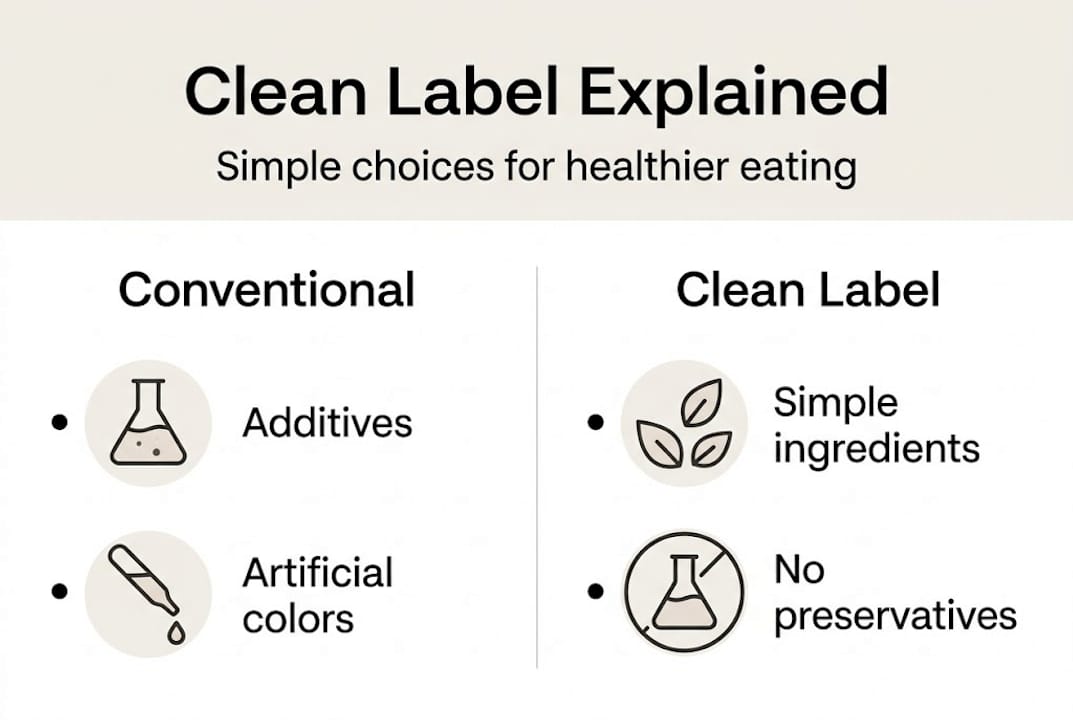
Here’s a quick comparison of conventional versus clean label approaches:
| Function | Conventional approach | Clean label alternative |
|---|---|---|
| Preservation | Sodium benzoate, BHA/BHT | Rosemary extract, vitamin E |
| Color | FD&C Red 40, Yellow 5 | Beet juice, turmeric, spirulina |
| Texture/stability | Carrageenan, DATEM | Sunflower lecithin, guar gum |
| Flavor enhancement | MSG, artificial flavors | Yeast extract, natural flavors |
| Shelf stability | Chemical preservatives | HPP, modified atmosphere packaging |
One area where consumer confusion runs high is so-called “natural” ingredients that still carry E-numbers (the European classification system for food additives). Citric acid, for example, is derived from fermentation and sounds natural, but it carries the E330 designation. Many consumers reject it on sight, even though it’s considered safe and is found in lemons. This is where the gap between consumer perception and food science becomes a real challenge for manufacturers.
Pro Tip: When evaluating a supplement or food product, look beyond the marketing claims on the front of the package. Flip it over and scan the ingredient list for anything you wouldn’t recognize in a grocery store. That’s your fastest clean label filter.
Understanding how products are regulated, even loosely, helps here. The regulation of supplements page gives a useful overview of how oversight works in the U.S., and supplement label transparency digs into what brands are actually required to disclose.
Clean label in the real world: Market trends, costs, and consumer behaviors
Clean label isn’t a niche trend anymore. It’s a mainstream market force reshaping how food and supplement companies formulate and market their products globally.
The numbers tell a clear story. Roughly 30% of new food and beverage launches carry clean label claims. Among consumers, 79% report concern about food quality, 58% say transparency is a top priority, and 45% will prioritize nutrition over price when making purchasing decisions. Strikingly, many shoppers are willing to pay a 20 to 30% premium for products they perceive as cleaner.
Why are clean label products more expensive? A few reasons:
- Higher ingredient costs: Natural preservatives and plant-based colorants cost more than their synthetic counterparts
- Shorter shelf life: Without chemical preservatives, products spoil faster, increasing waste and logistics costs
- Smaller production runs: Clean label products often come from smaller manufacturers with less economies of scale
- More rigorous sourcing: Tracing ingredients back to their origin takes time and resources
The behavioral data is equally compelling. Nearly 1 in 2 consumers bought more fresh or unprocessed foods in the past year, and 1 in 4 are actively eliminating processed foods from their diet. Ethical and environmental claims are the fastest-growing segment, expanding at a 15% compound annual growth rate (CAGR).
This shift is being driven by a generation of consumers who grew up reading ingredient lists and watching documentaries about food systems. They connect clean eating habits with broader values around health, sustainability, and corporate accountability. For athletes and fitness enthusiasts in particular, clean label supplements align with a performance-focused mindset where what goes in directly affects what comes out. Understanding the functional food benefits behind these choices adds another layer to that decision-making.
Gray areas: Challenges and criticisms of clean label
Clean label sounds like a straightforward win for consumers. But the reality is messier, and there are real risks if you take every claim at face value.
The biggest problem is the absence of a legal definition. Without a regulatory standard, any brand can call its product “clean” without meeting any specific criteria. This opens the door to cleanwashing, a term for when companies use vague or misleading clean claims to capitalize on consumer trust without genuinely reformulating their products. Consumer perception drives clean label more than regulation does, which means the burden of scrutiny falls entirely on you.
Here are four specific pitfalls to watch for:
- Vague front-of-pack claims: “Made with natural ingredients” doesn’t mean every ingredient is natural or that artificial additives are absent
- Incomplete disclosure: A short ingredient list can still hide processing aids used during manufacturing that don’t appear on the label
- Natural doesn’t equal healthy: Cane sugar, coconut oil, and sea salt are all natural. That doesn’t make a product nutritionally balanced
- Texture and taste tradeoffs: Removing stabilizers and emulsifiers can change how a product feels and tastes, which some brands compensate for with excess sugar or fat
“The word ‘natural’ on a label tells you almost nothing about whether a product is good for you. Read the full list.”
There’s also a technical irony worth knowing. Natural ingredients with E-numbers, like citric acid, may be rejected by consumers despite being safe and naturally derived. Meanwhile, removing certain additives shortens shelf life, increases production costs, and can noticeably alter texture. Clean label reformulation is genuinely difficult, and not every brand does it well.
And again, no official regulatory definition exists, which means the term carries zero legal weight in the U.S. Your best defense is reading labels carefully. Resources like third-party tested supplements and reading supplement labels give you the tools to verify claims independently.
Our perspective: What most people miss about clean label products
Here’s something most brands won’t say out loud: clean label is primarily a trust signal, not a health guarantee. It tells you a company is willing to be transparent about what’s in their product. That matters. But transparency alone doesn’t make something good for you.
We’ve seen fitness-focused consumers swap out a well-formulated protein powder for a “clean” alternative that had half the protein and twice the sugar, simply because the ingredient list was shorter. That’s not a better choice. That’s marketing winning over nutrition.
The smarter move is to treat clean label as a starting point, not a finish line. Use it to filter out products with unnecessary synthetic additives, but then go deeper. Check the macros. Look at the amino acid profile if it’s a protein. Verify the micronutrient forms. A clean label product with solid nutritional fundamentals is genuinely excellent. A clean label product with poor nutritional value is just… pretty packaging.
For those serious about optimizing their health, personalized nutrition solutions offer a more targeted framework that goes well beyond what any label claim can deliver.
Take the next step with clean label nutrition
Understanding clean label is one thing. Finding products that actually live up to it is another.

At NutriBliss, we believe transparency isn’t optional. Our formulations are built around recognizable, science-backed ingredients, and we make the reasoning behind every choice visible. You can explore our science-backed approach to see exactly how we think about formulation, or check out the superfood transparency page for a closer look at the ingredients we use and why. If you’re ready to shop with confidence, browse the full range of NutriBliss vitamins and supplements and put clean label principles into practice today.
Frequently asked questions
Does clean label mean organic, non-GMO, or healthy?
No. Clean label simply means simple, recognizable ingredients and no artificial additives. It carries no guarantee of organic certification, non-GMO status, or superior nutritional value.
Is there any regulation enforcing clean label standards?
There is no official regulation. Clean label is a consumer-driven marketing term with no legal definition in the U.S. or most other markets.
Why are clean label products more expensive?
Clean label formulations rely on higher-cost natural ingredients and avoid preservatives, which means shorter shelf life and higher production costs get passed on to the consumer.
Can I trust all products labeled as clean?
Not automatically. Without a legal standard, brands can make vague clean claims, so always read the full ingredient list before buying.