

TL;DR:
- Persistent fatigue may indicate underlying conditions such as sleep apnea, iron deficiency, or B12 deficiency rather than just needing more rest. Proper diagnosis and targeted treatment, including medical tests and lifestyle adjustments, are essential for effective energy restoration. Supplements like B12 and iron support can help once underlying causes are addressed, emphasizing that fatigue is a signal, not a character flaw.
You feel exhausted even after a full night of sleep. Sound familiar? What causes fatigue is rarely as simple as “you need more rest.” In fact, persistent tiredness can signal conditions like sleep apnea, iron deficiency, or vitamin B12 deficiency, each of which quietly drains your energy while remaining undetected for months. Understanding the actual reasons for fatigue, not just dismissing it as poor willpower or stress, is often the first step that changes everything. This article breaks down the real culprits and what you can actually do about them.
Table of Contents
- How sleep disorders cause persistent fatigue
- Iron deficiency and anemia: gradual fatigue buildup
- Vitamin B12 deficiency and its impact on energy levels
- Evaluating unexplained fatigue: diagnostic approach and management
- Lifestyle and dietary supplements to support energy and reduce fatigue
- Rethinking fatigue: beyond willpower and focusing on root causes
- Explore Nutribliss supplements for natural energy support
- Frequently asked questions
How sleep disorders cause persistent fatigue
Most people assume eight hours of sleep is a guarantee of feeling rested. It is not. If you have obstructive sleep apnea, your airway partially or fully collapses during sleep, causing your brain to briefly wake you up to resume breathing. These awakenings can happen dozens of times per hour, and you will almost never remember them. The result: you clock eight or nine hours in bed and still feel wrecked in the morning.
Obstructive sleep apnea causes repeated awakenings and oxygen drops that disrupt deep, restorative sleep, producing severe daytime fatigue regardless of total sleep time. This is one of the most underdiagnosed reasons for fatigue because most people have no idea it is happening.
Common signs of sleep apnea and other sleep disorders include:
- Waking up with a headache or dry mouth
- Feeling unrested despite sleeping more than 8 hours
- Loud snoring reported by a partner
- Falling asleep involuntarily during the day
- Mood changes, irritability, and poor concentration
Beyond sleep apnea, other sleep disorders like restless leg syndrome and periodic limb movement disorder also fragment sleep and contribute to chronic fatigue factors. Restless leg syndrome causes uncomfortable urges to move the legs at night, repeatedly pulling you out of deeper sleep stages.
The distinction between “not enough sleep” and “poor quality sleep” matters enormously for diagnosis. Someone with sleep apnea needs a sleep study, not an earlier bedtime.
Pro Tip: If you consistently wake up tired despite adequate hours in bed, ask your doctor for a referral to a sleep specialist before assuming lifestyle changes will fix it. A home sleep test can now screen for apnea conveniently.
For broader strategies, exploring ways to increase your energy naturally is worth doing alongside medical evaluation, since sleep disorders rarely exist in isolation.
Iron deficiency and anemia: gradual fatigue buildup
Iron deficiency is one of the most common fatigue causes and symptoms, and it rarely announces itself loudly. The tiredness builds gradually, which means most people adapt to feeling progressively worse without recognizing the pattern. Iron is essential for producing hemoglobin, the protein in red blood cells that carries oxygen to every tissue in your body. When iron is low, your muscles and brain run short on oxygen and fatigue sets in.

Iron deficiency without anemia can cause nonspecific symptoms like fatigue and poor concentration long before anemia develops, which means a normal complete blood count alone will not catch it.
How iron deficiency progresses into anemia:
- Iron stores in the body (measured by ferritin) begin to deplete
- Production of hemoglobin-rich red blood cells slows
- Oxygen delivery to tissues decreases
- Fatigue, weakness, and breathlessness emerge
- Advanced stages may cause pale skin, brittle nails, and rapid heartbeat
The most common causes of iron loss include heavy menstrual bleeding, pregnancy, gastrointestinal bleeding (from ulcers or polyps), and poor dietary intake. Notably, frequent blood donation and intense endurance exercise can also deplete iron faster than the body can replace it.
| Symptom | Early deficiency | Established anemia |
|---|---|---|
| Fatigue | Mild, intermittent | Persistent, debilitating |
| Concentration issues | Subtle | Noticeable |
| Breathlessness | Rare | Common with exertion |
| Pale skin | Absent | Often present |
| Rapid heartbeat | Absent | Possible |
Iron deficiency anemia causes fatigue and breathlessness, and treatment involves oral supplements taken over several months to fully rebuild iron stores.
Pro Tip: Ask your doctor to test both hemoglobin and ferritin. Ferritin below 30 ng/mL is often linked to fatigue even when hemoglobin is still normal. Many standard panels skip ferritin unless you specifically request it.
Recovery from iron deficiency takes time. Most people feel improvements in energy within four to six weeks of consistent supplementation, but replenishing storage iron can take three to six months. Understanding the benefits of iron supplements can help you make informed decisions about what to take and when.
Vitamin B12 deficiency and its impact on energy levels
Vitamin B12 is critical for nerve function, DNA synthesis, and the production of red blood cells. A deficiency does not happen overnight, since the liver stores enough B12 for three to five years. But once those stores run low, the signs of fatigue become pronounced and sometimes neurological.
The unique challenge with B12 is absorption. Your stomach produces a protein called intrinsic factor that binds to B12 and allows it to be absorbed in the small intestine. If you have pernicious anemia (an autoimmune condition that destroys intrinsic factor), celiac disease, Crohn’s disease, or have had gastric surgery, your gut simply cannot absorb B12 from food or oral supplements effectively.
Key signs of B12 deficiency to know:
- Persistent fatigue and general weakness
- Tingling or numbness in hands and feet
- Memory problems and difficulty concentrating
- Pale or yellowish skin tone
- Mood changes including depression or irritability
- Balance problems in severe cases
Because these fatigue causes and symptoms overlap with so many conditions, B12 deficiency is frequently missed for months. A simple blood test measuring serum B12 levels and, when needed, methylmalonic acid can confirm it.
Vitamin B12 deficiency treatment via injection leads to rapid symptomatic improvement, often within 48 to 72 hours, in cases where absorption is the underlying issue. That is one of the more striking facts about this condition: the right treatment works fast when the diagnosis is accurate.
Pro Tip: If you follow a vegan or vegetarian diet, regular B12 testing is important since the primary dietary sources are animal products. Plant-based B12 is minimal, and supplementation is often necessary rather than optional.
Understanding the importance of vitamin B12 will give you a clearer picture of dosing, timing, and which forms of B12 are most bioavailable.
Evaluating unexplained fatigue: diagnostic approach and management
When fatigue does not improve with rest, the responsible next step is testing, not guessing. Knowing what tests to ask for puts you in a far better position when talking to your doctor.
Key lab tests for unexplained fatigue typically include:
- Complete blood count (CBC) to check for anemia
- Serum ferritin to assess iron stores
- Serum vitamin B12 levels
- Thyroid function tests (TSH, T3, T4) to rule out hypothyroidism
- Fasting glucose and HbA1c for blood sugar issues
- Vitamin D levels, which are commonly low and linked to fatigue
Effective fatigue management requires laboratory assessment to identify underlying causes rather than relying solely on supplements, since treating the wrong problem delays real recovery.
The table below compares two common diagnostic paths:
| Approach | Starting point | Risk if skipped |
|---|---|---|
| Lab testing first | Identify root cause | Miss treatable conditions |
| Supplement first | Symptom relief attempt | Mask serious illness |
| Combined approach | Test, treat, supplement | Safest and most effective |
Appropriate fatigue management includes identifying and treating the cause of iron loss, not just prescribing supplements in isolation.
Self-diagnosing is a real trap here. Someone who buys B12 supplements and feels slightly better may not realize they have a bleeding ulcer causing ongoing iron loss. Supplements can complement treatment, but they do not replace it. Guidance on iron supplements and vitamin B12 and fatigue becomes far more useful once you know what you are actually addressing.
Pro Tip: Bring a written list of all symptoms and their duration to your appointment. Doctors who see a pattern across fatigue, concentration issues, and neurological symptoms are more likely to run a targeted panel upfront.
Lifestyle and dietary supplements to support energy and reduce fatigue
Once you have addressed any underlying medical cause, or if your fatigue is primarily driven by lifestyle factors, targeted supplementation and behavioral changes can make a genuine difference. This is where fatigue and lifestyle effects become highly actionable.
Supplements and habits with solid evidence behind them:
- Vitamin B12 and iron: These remain the most directly linked nutrients to fatigue when deficient, and supplementing appropriately can restore energy significantly
- Magnesium: Involved in over 300 enzymatic reactions, including energy production; deficiency is common and often overlooked
- Ashwagandha: A well-researched adaptogen shown in clinical trials to reduce perceived fatigue and stress
- CoQ10 (coenzyme Q10): Supports mitochondrial energy production; particularly helpful for people over 40 or those taking statin medications
- Electrolytes: Dehydration is a surprisingly common and correctable reason for fatigue, especially during warmer months or after exercise
Behavioral habits matter just as much as what you take. Keeping a consistent sleep schedule, reducing screen exposure before bed, and avoiding caffeine after 2 PM all support deeper sleep and more consistent energy levels. Alcohol, even in moderate amounts, reduces sleep quality significantly, so timing matters.
Pro Tip: Avoid relying on caffeine as your primary energy strategy. It borrows energy from tomorrow, accelerates adrenal fatigue, and creates dependency. Learning energy without caffeine approaches is a better long-term investment.
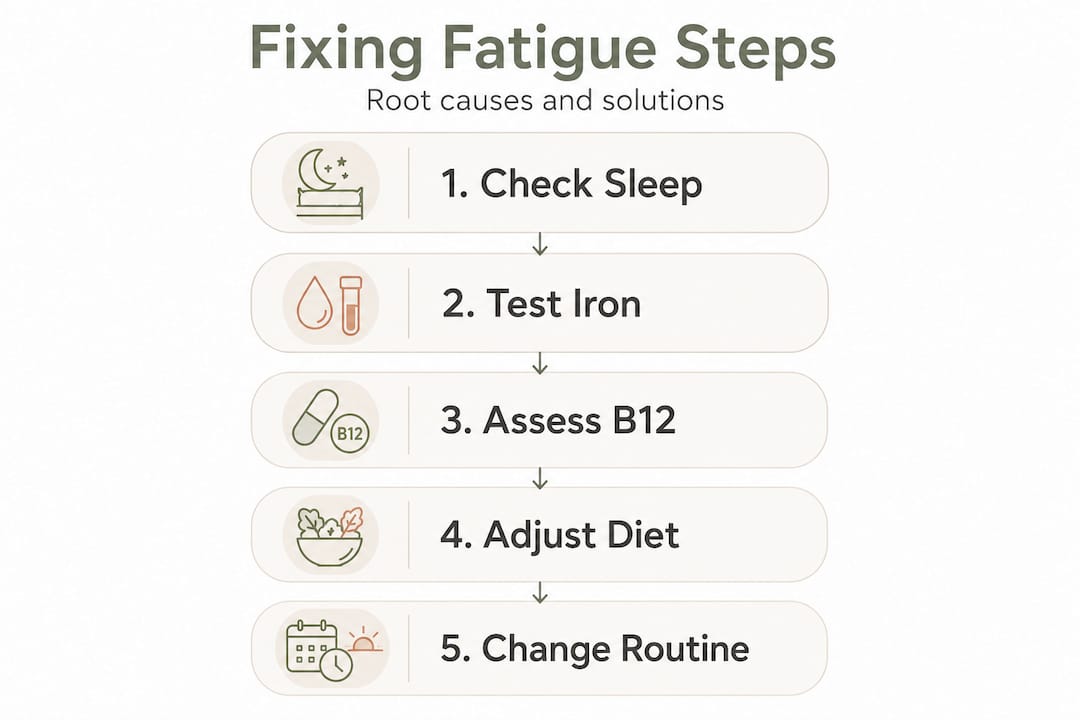
For a broader picture of what works, exploring natural energy boosters and natural stamina supplements can help you build a supplement plan that is targeted, not random.
Rethinking fatigue: beyond willpower and focusing on root causes
Here is something worth saying directly: fatigue is not a character flaw. It is not laziness dressed up in medical language. Yet culturally, people experiencing chronic tiredness are still frequently told to “push through it” or “exercise more,” when what they actually need is a diagnosis.
Sleep apnea is routinely misread as simply “being tired” when it represents a serious medical condition requiring real intervention. The same is true of iron deficiency and B12 deficiency. These are physiological problems with physiological solutions. Willpower does not fix an oxygen-depleted bloodstream.
What we find most damaging is the supplement-first culture that has built up around fatigue. Someone reads an article, buys a stack of supplements, and feels no better, sometimes worse. Supplementing without identifying the underlying cause is a mistake that clinical guidelines actively warn against, because it can delay diagnosis of conditions that genuinely need treatment.
The more useful framework: fatigue is a signal, not a sentence. Your body is communicating a deficit, whether in sleep quality, iron, B12, or another factor. The goal is to identify what that deficit is and address it with the right tool, whether that is a CPAP machine, an iron infusion, B12 injections, or a targeted supplement regimen.
Patience also matters. Iron stores take months to rebuild. Neurological symptoms from B12 deficiency can take a year to fully resolve even with proper treatment. If you understand the timeline going in, you are far less likely to abandon a treatment that is actually working.
The strongest outcomes come from combining accurate diagnosis, targeted nutrition or supplementation, and consistent lifestyle adjustments. No single element is enough on its own. To increase your energy naturally, you need to know what you are working with first.
Explore Nutribliss supplements for natural energy support
Understanding what causes fatigue puts you in control, but having the right support makes the journey faster.

At Nutribliss, we offer a range of science-backed supplements designed to address the nutritional factors most commonly linked to fatigue. From B12 and iron support to electrolytes and stamina-building formulas, each product is built around evidence and natural ingredients. Whether you are recovering from a deficiency or simply want to sustain energy throughout the day, our full supplements collection has targeted options for your needs. Curious about the research behind our formulas? Visit our page on the science behind superfoods to understand exactly what goes into every product.
Frequently asked questions
Can lack of sleep alone cause constant fatigue?
Yes, but even with adequate hours, sleep disorders like sleep apnea can prevent restorative sleep by causing repeated oxygen drops and awakenings, producing chronic daytime fatigue regardless of time spent in bed.
How does iron deficiency cause fatigue if I don’t have anemia?
Iron deficiency without anemia can produce fatigue and poor concentration by depleting iron stores before hemoglobin levels drop, which is why ferritin testing is essential and often more revealing than a basic blood count.
How quickly can vitamin B12 injections improve fatigue symptoms?
People receiving B12 injections for absorption-related deficiency often notice improvement within 48 to 72 hours of starting treatment, making it one of the faster-resolving causes of fatigue when properly identified.
Is it safe to take iron or B12 supplements without a confirmed diagnosis?
Taking supplements without knowing the cause of your fatigue can delay proper treatment for a serious underlying condition. Diagnosis before supplementing is what clinical guidelines consistently recommend.
What lifestyle changes can help reduce fatigue naturally?
Improving sleep hygiene, eating a nutrient-rich diet, timing caffeine and alcohol intake carefully, staying hydrated with proper electrolytes, and using targeted supplements like those from Nutribliss can all contribute to sustained, natural energy levels.