

TL;DR:
- Genuine sustainable sourcing involves environmental, social, and economic responsibility throughout the supply chain.
- Verified certifications and detailed transparency reports help distinguish true sustainability from greenwashing.
- Long-term supplier engagement and accountability drive meaningful supply chain improvements and product quality.
Scanning a supplement label and seeing words like “natural,” “eco-friendly,” or “responsibly harvested” can feel reassuring. Most health-conscious buyers assume these phrases mean the product is good for them and the planet. That assumption is often wrong. The reality of sustainable sourcing in dietary supplements involves environmental accountability, fair labor practices, and verifiable supply chain data that go far beyond any single label claim. This guide breaks down exactly what sustainable sourcing means, how it’s measured, and what it takes to make genuinely informed choices when you’re shopping for supplements that align with your values.
Table of Contents
- What does sustainable sourcing really mean?
- How sustainable sourcing is measured and verified
- The real impact: does sustainable sourcing change anything?
- How to spot (and avoid) greenwashing when shopping for supplements
- Why most supplement shoppers miss the bigger picture of sustainable sourcing
- Want to buy supplements you can trust?
- Frequently asked questions
Key Takeaways
| Point | Details |
|---|---|
| Sustainable sourcing pillars | True sustainability considers environmental, social, and economic impacts together. |
| Verification matters | Look for transparent certifications and actual outcomes, not just green labels. |
| Real results | Sustainable sourcing can reduce emissions, protect workers, and build consumer trust when done right. |
| Spot greenwashing | Always verify claims with third-party proof and check for outcome data, not just promises. |
What does sustainable sourcing really mean?
Understanding what sustainable sourcing is sets the stage for recognizing how it shapes the supplement industry and why it should matter to every supplement buyer.
Sustainable sourcing is more than a buzzword or a design element on product packaging. By definition, sustainable sourcing integrates environmental, social, and economic considerations into the procurement of goods and services to minimize negative impacts while ensuring long-term viability. That definition covers a lot of ground, and each component pulls real weight.
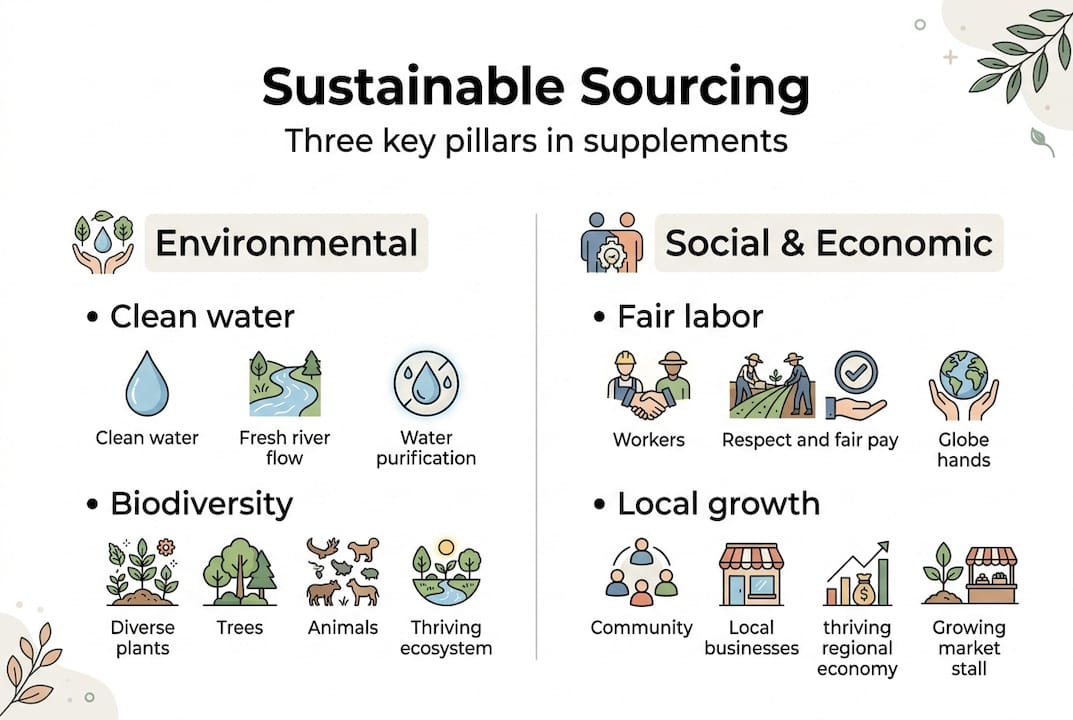
The framework breaks into three core pillars:
- Environmental responsibility: Reducing carbon emissions, minimizing land degradation, protecting biodiversity, and managing water use at every stage of ingredient sourcing
- Social responsibility: Guaranteeing fair labor conditions, upholding human rights across supplier networks, and supporting the farming communities that grow raw ingredients
- Economic viability: Building fair trade relationships, creating supply chain resilience, and ensuring that sourcing decisions don’t compromise long-term business integrity
These three pillars aren’t separate concerns. Key components like environmental protection and fair labor are interdependent, and when one breaks down, the others follow. A supplement company that sources cheap plant extracts from farms with exploitative labor practices isn’t sustainable, regardless of any organic certification on the bottle.
Why does this matter specifically for supplements? Dietary supplements often pull from complex global supply chains. Ingredients like ashwagandha, turmeric, and elderberry may pass through several countries before reaching a manufacturing facility. At each step, environmental and social risks accumulate. Exploring why sustainable supplements matter reveals just how much the origin of an ingredient shapes the integrity of the final product you’re consuming.
| Pillar | What it covers | Why it matters for supplements |
|---|---|---|
| Environmental | Emissions, biodiversity, water | Cleaner raw ingredients, less contamination risk |
| Social | Labor rights, fair pay | Ethical supply chains, traceability |
| Economic | Fair trade, supplier stability | Consistent quality, fewer supply disruptions |
“Sustainable sourcing isn’t a destination. It’s a continuous process of accountability at every link in the supply chain.”
The table above illustrates why all three dimensions need to work together. A supplement can’t be truly sustainable if it scores high on environmental metrics but ignores who harvested those ingredients and under what conditions.
How sustainable sourcing is measured and verified
With the basics understood, it’s crucial to uncover how sustainability declarations are actually measured and backed up in the real world, because the gap between a claim and real verification is wider than most shoppers realize.
Measurement in supplement supply chains typically involves several distinct approaches:
- Supplier audits: Third-party or brand-led audits assess whether a supplier meets defined environmental and social standards. These can be scheduled or surprise visits.
- Risk-based due diligence: Brands assess which parts of their supply chain carry the highest ethical or environmental risk and focus resources there first.
- Sustainability scoring: Platforms like EcoVadis score suppliers on a 0 to 100 scale, evaluating environment, labor, ethics, and procurement practices across thousands of companies globally.
- Cohort improvement programs: Brands work with groups of suppliers over time to build capacity and drive measurable change, rather than just passing or failing audits.
- Embedding sustainability in procurement: The most advanced brands tie supplier sustainability scores to purchasing decisions, rewarding better performers with more business.
These methodologies are more robust than a simple certification check, but they come with limitations. The uncomfortable truth is that many sustainability programs rely heavily on self-reported data. Only about 31% of emissions data is independently verified, and ESG rating correlation between agencies sits around 0.54, meaning two credible rating agencies often assess the same supplier very differently. Even rigorous audit-based approaches yield only 8 to 12% improvement in actual supplier practices.
The most recognized certifications you’ll encounter in the supplement space include:
- USDA Organic: Confirms agricultural practices meet specific environmental standards, including soil health and prohibited substances
- Fair Trade Certified: Addresses fair wages, safe working conditions, and community reinvestment in producing regions
- B Corp: Evaluates overall company impact across governance, environment, workers, customers, and community
None of these certifications are perfect. Each covers a portion of the sustainability picture. Before you buy, using a supplement safety checklist can help you stack these signals alongside label claims to form a more complete picture. Similarly, learning to evaluate supplement quality beyond certifications helps you move from guesswork to grounded decisions.
Pro Tip: Don’t rely on a single certification as proof of sustainability. Look for brands that stack multiple verifications and publish detailed transparency reports showing real supplier data, not just policies.
The real impact: does sustainable sourcing change anything?
Having explored measurement, let’s put outcomes under the microscope and see what improvements sustainable practices have actually achieved in supplement and consumer goods supply chains.
The data is more encouraging than skeptics might expect. A PwC study found that 80% of consumers are willing to pay 10% more for sustainably sourced goods. This sustained demand is pushing brands to take real action, and the results show up in hard numbers. Suppliers who participated in CDP supplier engagement programs for three or more years reduced Scope 1 and 2 emissions by 12.3%, compared to just 4.1% for non-participants. Suppliers that were re-assessed through EcoVadis improved their scores by an average of 6.2 points. These aren’t marginal shifts. They represent real reductions in carbon output and measurable improvements in supply chain ethics.
| Program/Initiative | Key outcome | Improvement metric |
|---|---|---|
| CDP supplier engagement (3+ years) | Scope 1+2 emissions reduction | 12.3% vs. 4.1% (non-participants) |
| EcoVadis re-assessed suppliers | Sustainability score improvement | +6.2 points on average |
| Cohort-based supplier programs | Score improvement range | 22 to 28% |
| Unilever strategic suppliers (82% spend) | Scope 3 emissions reduction | 18.4% (4.2M tCO2e) |
The Unilever case is particularly instructive. By focusing sustainable sourcing efforts on strategic suppliers representing 82% of spend, Unilever’s cohort-based programs drove Scope 3 emission reductions of 18.4%, equivalent to 4.2 million metric tons of CO2. Cohort programs showed score improvements of 22 to 28% when suppliers engaged over time. The lesson: impact scales when brands commit to ongoing supplier relationships, not one-time checks.

Stat to know: 80% of consumers will pay more for sustainably sourced goods, and they’re right to expect something in return. The data confirms that sustained engagement programs deliver real reductions, not just better paperwork.
What does this mean for supplement quality specifically? Sustainable sourcing often correlates with more rigorous traceability and quality controls. Brands that know where their raw ingredients come from and work closely with their suppliers tend to catch contamination risks, mislabeling, and adulteration earlier. This is especially important for plant-based supplement ingredients, where botanical identity errors and heavy metal contamination are well-documented risks.
Pro Tip: Ask a brand where their top three ingredients come from. If they can answer specifically, with supplier names and origin regions, that’s a strong signal of genuine supply chain visibility. Vague answers like “trusted suppliers” should prompt more questions.
How to spot (and avoid) greenwashing when shopping for supplements
Understanding the stakes makes knowing how to distinguish real sustainability from hype both empowering and essential, especially in a market where green claims are cheap and consequences are rare.
Greenwashing in supplements is pervasive. A brand can print “sustainably sourced” on a label without any obligation to verify that claim. Recognizing genuine sustainability requires knowing what to look for and what to walk away from.
Signs of genuine sustainable sourcing:
- Third-party certifications from recognized bodies like USDA Organic, Fair Trade, or B Corp
- Detailed ingredient traceability showing country, region, or named suppliers
- Published transparency or sustainability reports with outcome data, not just goals
- Evidence of ongoing supplier engagement and improvement programs
- Specific emissions or labor metrics, not vague commitments
Red flags to watch for:
- Eco-language without any supporting certification or documentation
- Generic terms like “natural” or “green” that have no regulatory definition
- No mention of where ingredients come from or who grows them
- Absence of any third-party verification or audit disclosure
- Only goal-setting language with no measured outcomes
Prioritizing supplements with USDA Organic, Fair Trade, and B Corp certifications alongside detailed traceability and transparency reports gives you a meaningful filter that cuts through marketing noise. These tools don’t guarantee perfection, but they raise the floor significantly.
One critical distinction that’s easy to miss: sustainable sourcing focuses primarily on environmental outcomes, ethical sourcing on social issues like labor rights, and responsible sourcing combines both while adding integrity in business practices. Each label carries a different scope, and a product certified in one category may fall short in another. A supplement can be organically grown but sourced from workers earning poverty wages. Neither certification system catches that gap alone.
Questions worth asking before you buy:
- Does this brand publish a list of verified suppliers?
- Are their environmental claims tied to measurable outcomes like emission reductions?
- Has their sustainability performance been independently assessed and reported?
- Do they show improvement over time, or just repeated policy statements?
Applying these questions turns you from a passive label reader into an active, informed buyer. To go deeper on building a wellness strategy that holds up to scrutiny, check out this science-backed wellness guide that connects supplement quality to overall health outcomes.
Why most supplement shoppers miss the bigger picture of sustainable sourcing
Equipped with practical detection tips, readers are ready for an honest look at what’s often overlooked in the supplement industry’s sustainability conversation. And this is where we want to push back on the dominant narrative, even the one we’ve been building in this guide.
Most of the sustainability discussion in supplements focuses on certifications. Get the right label, pass the audit, publish a goal. That framework is better than nothing, but it obscures the most important driver of real impact: ongoing supplier relationships and accountability over time.
Here’s what the data actually shows. Audit-based approaches alone yield only 8 to 12% improvement in supplier practices. Cohort programs and sustained engagement drive improvements of 22 to 28%. The gap is enormous. Yet the supplement industry defaults to audit snapshots because they’re easier to market than long-term engagement programs that take years to show results.
Consumers reinforce this by looking for certification badges. Brands respond by acquiring those badges. Neither party is asking the harder question: what has this brand actually improved in its supply chain over the past three years?
We’ve noticed that the most trustworthy supplement brands aren’t necessarily the ones with the most certifications. They’re the ones willing to show you the messy, ongoing work. They publish supplier lists. They disclose audit results, including failures. They track specific metrics and show trend data. They hold themselves accountable in ways that a single certification cycle never could.
The other piece most shoppers overlook is the economic pillar of sustainability. Fair trade isn’t just about ethics. It creates supply chain stability that directly protects supplement quality. When farmers earn fair prices, they invest in better agricultural practices. When suppliers maintain long-term contracts, they can invest in quality infrastructure. You end up with more consistent, purer raw ingredients reaching your supplement bottle.
Understanding why sustainable supplements matter at this deeper level shifts your approach from label checking to brand accountability. The question isn’t “does this bottle have a green badge?” It’s “does this brand show up for its suppliers the way it asks its suppliers to show up for the environment?”
That shift in framing changes what you buy, who you support, and what standards the industry is forced to meet.
Want to buy supplements you can trust?
Now that you know what genuine sustainable sourcing looks like, explore supplement options that actually meet your standards.

At NutriBliss, we believe that ingredient transparency isn’t a marketing strategy. It’s a baseline. Our science approach outlines how we evaluate ingredients against research standards, and our Science behind Superfoods page breaks down why origin, form, and quality of each ingredient matters to your health outcomes. We’re built for buyers who ask the hard questions and want clear answers, not greener packaging. Browse our full range at NutriBliss supplements and find products that reflect the values you’ve just spent time understanding.
Frequently asked questions
What is the difference between sustainable, ethical, and responsible sourcing?
Sustainable focuses on environmental impacts, ethical on social issues like labor rights, and responsible sourcing combines both approaches plus integrity in business practices. Each framework has a different scope, and a brand may excel in one while lagging in another.
How can I be sure a supplement brand uses sustainable sourcing?
Look for third-party certifications, supply chain transparency reports, and brands that share verified improvements. Certifications like USDA Organic, Fair Trade, and B Corp alongside detailed traceability give you a stronger basis than label language alone.
Does sustainable sourcing guarantee higher supplement quality?
It does not guarantee quality, but brands with genuine supply chain visibility and ongoing supplier accountability tend to catch contamination and adulteration risks earlier. EcoVadis re-assessed suppliers improved by 6.2 points on average, reflecting better practices that translate across quality dimensions.
What red flags signal greenwashing in supplement sourcing?
Vague eco-claims with no third-party verification, absent supply chain data, and no outcome metrics are the clearest warning signs. Only 31% of emissions data is independently verified across supplier programs, which means self-reported claims should always be treated with skepticism until backed by documented, external confirmation.