

TL;DR:
- Most beginners plateau within three months due to poor advice or inappropriate program choices that overlook fundamentals.
- A structured approach emphasizing proper volume, progressive overload, and adequate nutrition yields sustainable muscle growth and long-term progress.
Most people who start lifting weights plateau within their first three months. Not because they lack effort, but because they are following bad advice, skipping fundamentals, or copying advanced programs that don’t fit their level. Step by step muscle building isn’t complicated when you have a clear framework grounded in science. This guide cuts through the noise and gives you a training and nutrition roadmap that actually works, whether you’re picking up a barbell for the first time or trying to break through a frustrating stall.
Table of Contents
- Key takeaways
- Step by step muscle building: laying the foundation
- Your workout plan: volume, frequency, and progression
- Nutrition strategies that support muscle growth
- Common mistakes that kill progress
- Measuring progress and realistic timelines
- My take on what actually works
- Support your training with Nutribliss
- FAQ
Key takeaways
| Point | Details |
|---|---|
| Start with the right volume | Beginners need 6-10 hard sets per muscle per week to trigger growth without overloading recovery. |
| Protein intake is non-negotiable | Aim for 1.6-2.2g of protein per kilogram of body weight daily, spread across 3-5 meals. |
| Progressive overload drives gains | Add reps before adding weight; this double progression method is the safest path to long-term strength. |
| Track everything from day one | Logging sets, reps, and weight is the only way to know if you’re moving forward or spinning your wheels. |
| Recovery is where growth happens | Sleep, deload weeks, and smart intensity management determine how much muscle you actually keep. |
Step by step muscle building: laying the foundation
Before you write a single workout, you need to understand why muscles grow. Muscle growth, called hypertrophy, is triggered by mechanical tension during training. That means placing the muscle under load through a full range of motion with controlled movement. Lifting maximum weight with sloppy form does the opposite. It shifts tension to joints and connective tissue, increasing your injury risk while limiting actual muscle stimulus.
Setting realistic goals
A beginner who trains consistently can gain between 12 and 24 pounds of muscle in their first year. That’s a wide range, and it depends heavily on consistency, nutrition, and sleep. Set a three-month goal first. Something specific: add 10 pounds to your squat, hit a bodyweight chin-up, or gain two pounds of scale weight while keeping your waist measurement stable.
Equipment and environment
You don’t need a full commercial gym. A barbell, a rack, a set of dumbbells, and a bench cover 90% of what you need for a beginner muscle routine. If you train at home, resistance bands and a pull-up bar fill the gaps. What matters more than equipment is consistency of access. Training three times per week beats training seven times and burning out by week two.
Pre-training essentials
- Assess your baseline: Do a simple strength test. How many push-ups can you complete with good form? Can you squat your bodyweight? Record these numbers.
- Set up a training log: A notebook or a free app works fine. Log every set and every rep from session one.
- Build a warm-up habit: Spend 8-10 minutes on dynamic mobility before every session. Hip circles, band pull-aparts, bodyweight squats, and arm swings prepare your joints and prime your nervous system.
- Nail your protein target: Research confirms that optimal muscle growth requires 1.6-2.2g of protein per kilogram of body weight daily.
| Bodyweight | Minimum protein (1.6g/kg) | Upper end (2.2g/kg) |
|---|---|---|
| 150 lbs (68 kg) | 109g | 150g |
| 180 lbs (82 kg) | 131g | 180g |
| 200 lbs (91 kg) | 146g | 200g |
Pro Tip: Weigh your food for the first two weeks. Most people underestimate portion sizes by 30-40%, which means they’re missing their protein target without knowing it.
Your workout plan: volume, frequency, and progression
This is where most muscle gain guides go wrong. They either give beginners too much volume or they skip the logic behind program design entirely. Here’s what the science actually says.
Beginners respond best to three full-body sessions per week, hitting each muscle group two to three times. That frequency creates more muscle protein synthesis spikes than once-per-week training, and the lower per-session volume keeps recovery manageable.
Weekly volume by training level
Volume is dose-dependent. Start at the lower end and add sets gradually over months, not weeks.
| Experience level | Recommended sets per muscle per week |
|---|---|
| Beginner (0-6 months) | 6-10 sets |
| Intermediate (6-24 months) | 10-16 sets |
| Advanced (2+ years) | 16-20+ sets |
How to structure your three-day week
- Day 1: Full body (push focus). Bench press, squat, dumbbell shoulder press, lat pulldown. Three sets of 8-12 reps each.
- Day 2: Rest or active recovery. Walk, stretch, or do light mobility work.
- Day 3: Full body (pull focus). Barbell row, Romanian deadlift, dumbbell curl, tricep pushdown. Three sets of 8-12 reps each.
- Day 4: Rest.
- Day 5: Full body (balanced). Overhead press, deadlift variation, incline dumbbell press, cable row. Three sets of 8-12 reps each.
- Days 6 and 7: Rest or light activity.
The double progression method
Progressive overload via double progression is the most effective and sustainable approach for building strength and size. Here’s how it works:
- Pick a rep range, say 8 to 12.
- Start a movement at the low end. If your bench press allows 8 clean reps at 135 pounds, start there.
- Each session, try to add one or two reps until you reach the top of the range (12 reps).
- Once you hit 12 clean reps, increase the load by 2.5 to 5 pounds and restart from 8 reps.
This cycle removes the guesswork from weightlifting step by step. You always know exactly what “progress” looks like for every exercise.
Managing intensity and avoiding failure
Training 1-2 reps short of failure maximizes hypertrophy stimulus while limiting the fatigue that tanks your next set. If you have 10 reps in you, stop at 8 or 9. This is called leaving reps in reserve (RIR), and it’s one of the most underused strength training methods for beginners.

Every four to five weeks, take a deload week. Reduce your training volume by about 40% and keep the weights moderate. This is not weakness. Deload weeks prevent stalling and allow your connective tissue to recover so you can train hard the next block.
Pro Tip: Record your RIR for each set. If a set feels like you could have done five more reps, the weight is too light. If you can barely control the last rep, back off.
Nutrition strategies that support muscle growth
Training breaks muscle down. Nutrition builds it back up, bigger and stronger. Miss the nutrition side and you’ll spin your wheels no matter how hard you train.
The foundation is a modest caloric surplus. Add 200 to 300 calories above your maintenance level. Going higher accelerates fat gain without meaningfully speeding up muscle growth. Distribute your food across three to five meals per day to maximize muscle protein synthesis throughout the day.
Building a muscle-friendly meal
A simple formula for each meal: one palm of protein, one fist of carbs, one thumb of fat.
- Protein sources: Eggs, chicken breast, Greek yogurt, cottage cheese, lean beef, canned tuna, whey protein.
- Carbohydrate sources: Rice, oats, potatoes, fruit, whole grain bread.
- Fat sources: Olive oil, avocado, nuts, seeds.
The role of supplements
Food comes first. But two supplements have strong evidence behind them and belong in any beginner stack: whey protein and creatine monohydrate. Whey protein is fast-digesting and convenient for post-workout meals. Creatine increases strength output per session and has decades of safety data behind it. Brands like #nutribliss carry both, and their science-backed formulations make it easy to close nutritional gaps without overthinking your stack.
Hydration matters more than most beginners realize. Even mild dehydration cuts strength output by 5 to 8%. Keep water intake around 3 liters per day and pay attention to electrolyte balance, especially sodium, potassium, and magnesium, during hard training blocks.
| Nutrient focus | Daily target | Timing |
|---|---|---|
| Protein | 1.6-2.2g per kg bodyweight | Spread across 3-5 meals |
| Total calories | Maintenance + 200-300 kcal | Consistent daily |
| Creatine | 3-5g | Any time, daily |
| Water | 2.5-3.5 liters | Throughout the day |
Pro Tip: Eat your largest carbohydrate serving in the meal before and after training. This supports performance going in and recovery coming out.
Common mistakes that kill progress
Even with a good plan, certain habits quietly undermine your results. Knowing these in advance is one of the most practical muscle building tips you can get.
- Chasing failure every set. Training to failure on every set creates so much fatigue that your later sets become junk. You end up doing more damage than growth stimulus.
- Prioritizing heavy weight over form. Beginners often add weight before they’ve mastered the movement pattern. Poor form limits mechanical tension and raises injury risk significantly.
- Not tracking workouts. If you’re not logging your sets and reps, you’re guessing. Tracking training volume is the only way to confirm whether you’re progressing or stalling.
- Skipping sleep. Most muscle repair happens during sleep. Less than seven hours per night measurably slows recovery and hormone production.
- Ignoring overuse injury warning signs. Nagging joint pain is not something to train through. Addressing it early prevents months of forced rest. Athletic overuse injuries are common in beginners who increase load too quickly.
“Quality volume, not maximum volume, is what drives hypertrophy. Junk volume far from failure wastes your recovery without building muscle.”
Pro Tip: If progress stalls for two consecutive weeks, don’t add more volume. First check sleep, protein intake, and stress levels. Those three factors solve most plateaus before you ever need to change your program.
Measuring progress and realistic timelines
Knowing what to expect keeps you from quitting when results seem slow.
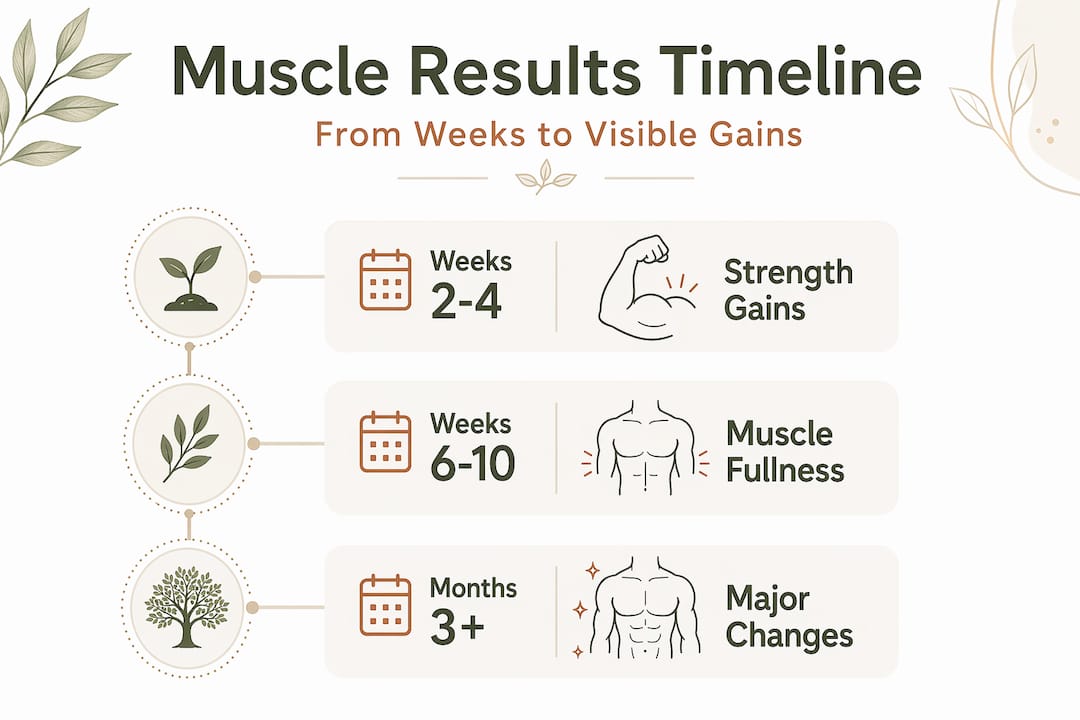
Most beginners notice visible changes within 6 to 10 weeks. Strength gains typically come first. You’ll add weight to the bar before your mirror reflects a noticeable change, and that’s completely normal. The muscle is there. Your body fat percentage just needs to shift slightly for it to show clearly.
How to track your progress
- Weekly photos: Same lighting, same time of day, same poses. Compare month to month, not week to week.
- Tape measurements: Measure your chest, arms, waist, hips, and thighs every two weeks.
- Workout log review: Check if your working weights are increasing over time. Strength is the most reliable leading indicator of muscle growth over time.
- Body weight: Weigh yourself three mornings per week and average the numbers. A gradual upward trend of 0.25 to 0.5 pounds per week on a bulk is a positive sign.
| Milestone | Approximate timeline |
|---|---|
| Noticeable strength gains | Weeks 2-4 |
| Visible muscle fullness | Weeks 6-10 |
| Measurable size changes | Months 2-4 |
| Significant physique shift | Months 6-12 |
Celebrate small wins. When you hit a new rep personal record or add weight to a lift for the first time, acknowledge it. Long-term consistency is built on recognizing that progress is real, even when it feels slow.
My take on what actually works
I’ve watched a lot of people start strong and burn out by month two. The pattern is almost always the same. They find an advanced program online, ignore the volume recommendations, train six days a week, and then wonder why they’re exhausted and not growing.
What I’ve learned over years of studying and applying these principles is this: the boring fundamentals are the secret weapon. Compound lifts with controlled tempo, consistent protein intake, and progressive overload three times per week will outperform any “optimal” advanced strategy if the advanced strategy isn’t executed consistently.
I’ve also seen how much damage ego lifting does to beginners. Chasing heavy weights before mastering form doesn’t just slow your progress. It builds movement patterns that take months to undo. Spend your first three months building movement quality and hypertrophy science together. The heavy weights will come, and they’ll be sustainable.
The other thing nobody talks about enough is tracking. Most people eyeball their progress and then claim they’re “not responding.” When I started logging every set and meal, my results doubled within two months. Not because I trained harder, but because I could finally see what was working and what wasn’t.
Stay patient. Trust the process. The readers who build the best physiques aren’t the ones who trained hardest in month one. They’re the ones who were still showing up consistently in month twelve.
— GAURAV
Support your training with Nutribliss

Every effective muscle building plan has a nutrition layer that diet alone sometimes struggles to fill. Nutribliss exists to close that gap with supplements that are grounded in science, not marketing. Whether you need a fast-digesting protein source post-workout or a way to maintain hydration and electrolyte balance through tough training blocks, Nutribliss has products built specifically for that purpose.
The full Nutribliss supplement collection covers whey protein, creatine, electrolytes, vitamins, and recovery-focused products. If you want to understand the research behind the formulations before you buy, the science behind Nutribliss superfoods breaks it all down clearly. No guesswork. No hype. Just products that support what you’re already doing in the gym.
FAQ
How many sets per muscle should a beginner do?
Beginners should perform 6-10 hard sets per muscle group per week for effective hypertrophy without overloading recovery. Increasing volume gradually as your fitness level improves leads to better long-term gains.
What is the best protein intake for muscle building?
Research confirms that 1.6-2.2g of protein per kilogram of body weight daily is optimal for muscle growth. Distribute this across 3-5 meals throughout the day for best results.
How long before I see muscle building results?
Most beginners notice measurable strength gains within 2-4 weeks and visible physique changes between weeks 6-10. Consistent training, adequate protein, and quality sleep are the three biggest factors in that timeline.
What does progressive overload mean in practice?
Progressive overload means systematically increasing the demand on your muscles over time. The double progression method, which involves adding reps first and then increasing weight, is the most practical way to apply this for beginners.
Should beginners train to failure?
No. Training 1-2 reps short of failure maximizes muscle stimulus while preserving training quality across all sets in a session. Failure on every set generates excessive fatigue that reduces your total productive volume.