

Omega-3s lower triglycerides at therapeutic doses, support brain and eye development through DHA, and offer probable heart-health benefits for people with existing cardiovascular disease. Effects vary sharply by dose and formulation, and very high supplemental intakes carry a real risk of atrial fibrillation. Food sources come first for most people; high-dose therapy belongs under a clinician’s supervision, not on your own judgment.
TL;DR:
- Therapeutic doses of omega-3s (2 to 4 grams daily) reliably reduce triglycerides by 20% to 50%, but may not significantly affect LDL cholesterol.
- High-dose supplementation (above 750 milligrams daily) can raise the risk of atrial fibrillation and should be supervised by a clinician.
- Most people obtain omega-3s from food sources; supplements are most beneficial when dietary intake is low, especially for pregnant individuals or those with cardiovascular disease.
- The effectiveness of omega-3s varies based on formulation, dose, and individual baseline levels, with personalized testing like the omega-3 index guiding optimal intake.
- Consuming fatty fish at least twice a week provides a good foundation, with supplements targeting specific health conditions under medical advice.
Table of Contents
- What Are Omega Fatty Acids and How Do They Work?
- What Are the Real Health Benefits of Omega-3s?
- How Strong Is the Evidence, and What Should Your Dose Be?
- Who Benefits Most From Omega-3 Supplements?
- How Do You Actually Choose the Right Amount?
- What Most People Get Wrong About Omega-3 Supplementation
- Where to Start if You’re Ready to Supplement
- Sources
- FAQ
What Are Omega Fatty Acids and How Do They Work?
“Omega” isn’t one nutrient. It’s a family label based on where the first double bond sits in a fatty acid’s carbon chain, and three branches matter for health: omega-3, omega-6, and omega-9. Omega-9s (like the oleic acid in olive oil) are nonessential. Your body makes them. Omega-3s and most omega-6s are essential, meaning you have to get them from food because your body can’t build them from scratch.
Within omega-3s, three fatty acids do almost all the work:
- ALA (alpha-linolenic acid): found in flaxseed, walnuts, and chia seeds. Plant-based, but metabolically limited.
- EPA (eicosapentaenoic acid): found mainly in fatty fish and algae, active in inflammation regulation.
- DHA (docosahexaenoic acid): concentrated in fish and algal oil, structurally vital for the brain and retina.
Here’s the detail most articles skip: your body can technically convert ALA into EPA and DHA, but that conversion is inefficient, often in the low single digits as a percentage of intake. If your only omega-3 source is flaxseed oil, you’re likely falling short of the EPA and DHA levels your tissues actually need. People relying on plant-based diets do better with algal DHA supplements or direct marine sources rather than counting on their own metabolism to bridge the gap.
Mechanistically, EPA and DHA get incorporated directly into cell membranes, which changes membrane fluidity and how cells signal to each other. EPA also serves as raw material for a class of anti-inflammatory compounds called resolvins and protectins, which are part of why omega-3s show up in inflammation research. DHA, meanwhile, makes up a notably high share of the fatty acid content in retinal and neuronal membranes, which is why deficiency during fetal development gets so much attention from researchers. The National Institutes of Health notes that EPA and DHA are essential nutrients concentrated in brain and retinal tissue, with fatty fish consumption linked to lower risk of several chronic conditions, even though supplement trials on those same outcomes produce more mixed results. For a deeper primer on how these fatty acids compare structurally, this breakdown of omega-3 fatty acid types is worth a look.
What Are the Real Health Benefits of Omega-3s?
Evidence quality varies a lot depending on which organ system you’re asking about. Some claims rest on large randomized trials. Others rest on observational associations that sound compelling in a headline but fall apart under closer trial scrutiny. Here’s the honest breakdown, system by system.
Cardiovascular Health and Triglycerides
Triglyceride lowering is where omega-3s have their most reliable, reproducible effect. At therapeutic doses of roughly 2 to 4 grams per day of combined EPA and DHA, triglyceride reductions in the range of 20% to 50% show up consistently across studies, depending on baseline levels and formulation.
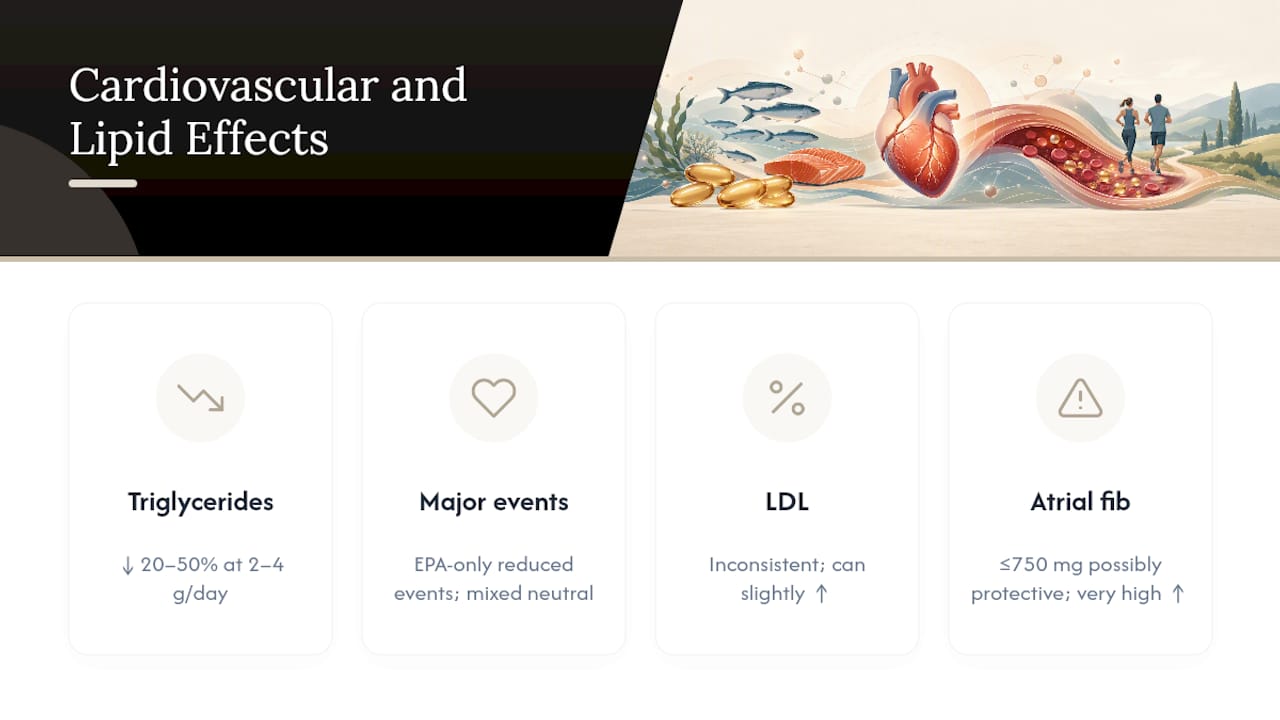
The picture for heart attacks and strokes gets murkier. The REDUCE-IT trial, which used a high-dose, purified EPA formulation, found a significant reduction in major cardiovascular events among high-risk patients. Other trials using mixed EPA/DHA formulations at lower doses have shown neutral results for the same endpoints. That divergence isn’t a contradiction. It is a clue that formulation, dose, and patient population all shape the outcome, not just whether someone “took fish oil.”
Pooled cohort studies and meta-analyses generally link higher blood levels of EPA and DHA to fewer cardiovascular events, and a 2026 review compiling pooled analyses alongside developmental data found reductions in heart attack risk and coronary death across combined datasets, even while acknowledging that individual randomized trials disagree. If you’re trying to reconcile “the studies say different things,” this is the reason: population-level associations and controlled-trial outcomes measure related but distinct questions.
Statistic Callout: Therapeutic doses of EPA and DHA (2 to 4 grams per day) can lower triglycerides by roughly 20% to 50%, but the same dose range shows no consistent effect on LDL cholesterol, and can sometimes raise it slightly depending on formulation.
There’s a safety wrinkle here too. Moderate EPA and DHA intake, up to around 750 milligrams daily, appears protective against atrial fibrillation in some research. But very high supplemental doses have been linked to an increased AF risk in other studies, which is exactly why the dosing research on cardiovascular outcomes treats “more is better” as a myth rather than a rule. Dose response here isn’t linear. It’s closer to a U shape, with both too little and too much carrying distinct risk profiles. If you want more detail on how omega-3s interact with cholesterol specifically, this breakdown of omega-3 and lipid effects covers the mechanism in more depth.
Brain Function and Cognitive Health
DHA is structurally non-negotiable for a developing brain. It’s a major building block of neuronal membranes, and deficits during fetal and infant development have measurable downstream effects on visual and cognitive outcomes.
For adults hoping omega-3s will sharpen memory or fend off dementia, the evidence is far less clean. Observational studies linking higher fish consumption to lower dementia risk are common, but supplement trials in older adults trying to prevent cognitive decline have mostly produced null or marginal results. The likely explanation: by the time cognitive decline is measurable, the intervention window may have already closed. DHA seems to matter most during the building phase of brain development, not necessarily as a late-stage rescue. Readers interested in the cognition angle specifically can find more detail in this look at omega-3 and brain health evidence.
Eye Health
The retina holds one of the highest concentrations of DHA in the human body, which is why eye health keeps coming up in omega-3 research. Observational studies link higher dietary omega-3 intake to a lower risk of developing age-related macular degeneration (AMD). Once AMD has already progressed, though, omega-3 supplementation hasn’t been shown to reverse or meaningfully slow it in controlled trials. This is a pattern worth remembering: omega-3s look most protective as prevention, not treatment, once a condition has already taken hold.
Inflammation and Joint Health
In rheumatoid arthritis and other inflammatory conditions, omega-3 supplementation shows up repeatedly as a useful adjunct therapy, meaning it works alongside standard treatment rather than replacing it. Patients using omega-3s alongside NSAIDs or disease-modifying drugs report reduced joint stiffness and pain in some trials, likely tied to EPA’s role in producing anti-inflammatory eicosanoids. It’s a support tool, not a cure, and the effect sizes are modest compared to prescription anti-inflammatory therapy.
Mental Health
EPA in particular has drawn attention as an adjunct for certain depression subtypes, especially cases with an inflammatory component. The signal is real but narrow: it applies best to specific patient populations and specific EPA-heavy formulations, not omega-3 supplementation broadly. If you’re managing depression clinically, omega-3s belong in a “discuss with your prescriber” category, not a self-directed swap for treatment.
Pregnancy and Infant Development
Dietary DHA intake during pregnancy correlates with better visual and neurodevelopmental outcomes in infants, and this is one of the more consistent findings in omega-3 research. However, direct supplementation trials during pregnancy have produced mixed results on hard outcomes like IQ scores or diagnosed developmental delays. A 2026 review on omega-3 supplementation and children’s development found LC-PUFAs are essential for neurodevelopment and may offer modest benefits for cognition and attention in some studies, but heterogeneity across trials limits how confidently anyone can generalize those findings. The practical takeaway for pregnant people: prioritize dietary DHA sources first, and treat supplementation as a conversation with your obstetric provider rather than a blanket recommendation.
How Strong Is the Evidence, and What Should Your Dose Be?
Why do omega-3 trials seem to contradict each other so often? Four variables explain most of the disagreement: dose, formulation (EPA alone versus EPA/DHA combinations), the placebo used for comparison (some trials use mineral oil, which isn’t metabolically neutral), and background dietary intake of the study population. A trial in a population that already eats fish three times a week will show a smaller supplement effect than a trial in a population that rarely eats seafood, even with identical doses.
This is why headlines summarizing “omega-3 supplements don’t work” or “omega-3 supplements cut heart attacks by half” can both be technically accurate descriptions of different trials, while neither captures the full picture.
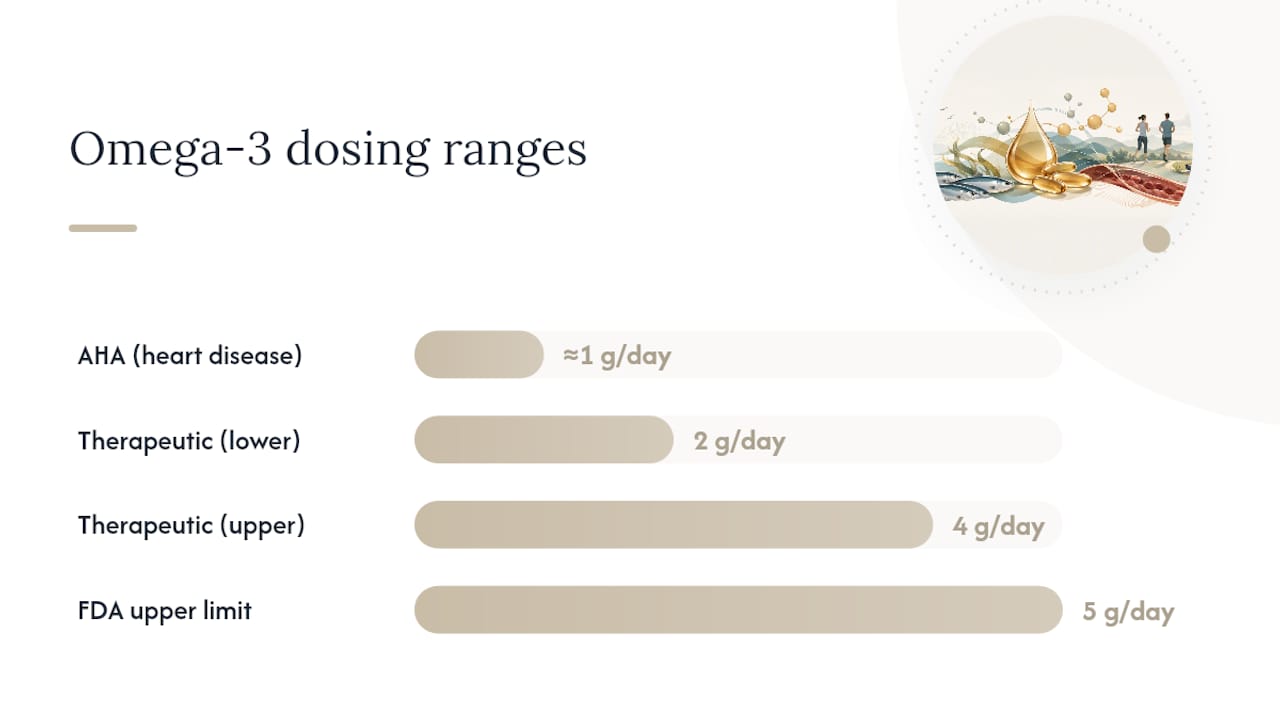
Authoritative bodies have settled on dosing guidance that reflects this nuance rather than a single blanket number:
- General health: food-first approach; no universal RDA exists for EPA/DHA specifically, though adequate intake levels are established for ALA.
- Existing heart disease: the American Heart Association recommends about 1 gram per day of combined EPA and DHA under medical guidance.
- High triglycerides: therapeutic doses of 2 to 4 grams per day, typically prescription-strength and supervised by a clinician.
- Upper safety limit: the FDA caps supplemental EPA/DHA intake at 5 grams per day for the general population.
Statistic Callout: The gap between the AHA’s heart-disease guidance (about 1 g/day) and the FDA’s upper safety cap (5 g/day) is a five-fold range. That’s not an inconsistency. It reflects the difference between a maintenance dose and a monitored, therapeutic one.
Bleeding risk is the other safety consideration worth taking seriously, especially at higher doses or alongside blood thinners. Omega-3s have mild antiplatelet effects, which is part of why they help with triglycerides but also why anyone on anticoagulant medication needs a clinician’s input before adding a high-dose supplement. The atrial fibrillation risk mentioned earlier compounds this concern at the upper end of the dosing range. If you’re targeting therapeutic doses for a diagnosed lipid problem, this isn’t a decision to make solo based on a supplement label.
Who Benefits Most From Omega-3 Supplements?
Not everyone needs to supplement, and blanket dosing ignores how much individual baseline status matters. A handful of groups consistently show the clearest benefit signal:
- People with diagnosed high triglycerides or existing cardiovascular disease.
- Pregnant people with low dietary DHA intake, given the fetal neurodevelopmental stakes.
- Anyone eating fatty fish fewer than twice a week with no plant-based alternative strategy.
- People managing inflammatory joint conditions as an adjunct to standard treatment.
A more precise approach, gaining traction in clinical circles, is the omega-3 index: a blood test measuring the percentage of EPA and DHA in red blood cell membranes. An index above 8% is generally associated with lower cardiovascular risk, while levels below 4% correlate with higher risk, giving clinicians and motivated patients an actual number to target instead of guessing. Testing makes the most sense for people with cardiovascular risk factors or those already supplementing who want to confirm the dose is actually working. Recent reviews increasingly push toward this kind of biomarker-guided personalization rather than one-size-fits-all dosing, since efficacy varies by individual bioavailability, oxidation exposure, and baseline nutrient status.
If you’re considering higher-dose therapy for a diagnosed lipid or cardiovascular condition, that conversation belongs with a clinician who can weigh your specific bleeding risk, medication list, and baseline labs, not a generic dosing chart.
How Do You Actually Choose the Right Amount?
Translating all of this into a personal plan comes down to a few concrete steps.
Start with your goal. General wellness maintenance calls for a food-first target: two fish servings weekly, or roughly 250 to 500 mg combined EPA/DHA daily if you’re supplementing to fill gaps. Diagnosed heart disease shifts that target to about 1 gram per day under medical guidance. High triglycerides requiring therapeutic intervention move into the 2 to 4 gram per day range, and that tier should always be clinician-supervised given the AF and bleeding risk profile discussed earlier.
Reading a label correctly matters more than people assume. A supplement listing “1,200 mg fish oil” is not the same as 1,200 mg of EPA and DHA. Check the supplement facts panel for the actual EPA and DHA amounts listed separately, add them together, and compare that sum against your target, not the total oil weight on the front of the bottle.
- Check for interactions if you take anticoagulants, antiplatelet drugs, or have an upcoming surgery.
- Pregnant people should pair DHA intake goals with standard mercury-avoidance guidance around fish species and serving frequency.
- Stop and consult a clinician if you notice unusual bruising, prolonged bleeding, or irregular heartbeat after starting a higher-dose regimen.
Statistic Callout: The FDA’s 5 gram per day supplemental cap applies to combined EPA and DHA from supplements specifically, not total dietary intake from food, which is why fish-heavy diets rarely raise the same safety concerns as concentrated capsules.
For a practical walkthrough on translating these numbers into an actual buying decision, this guide on what omega-3s are for covers dosing scenarios in more detail.
What Most People Get Wrong About Omega-3 Supplementation
The biggest misconception isn’t about whether omega-3s work. It’s about assuming a single dose or product applies to every goal. Someone taking a general wellness capsule for joint comfort and someone managing diagnosed hypertriglyceridemia are on completely different ends of the dosing spectrum, and treating them as interchangeable is where most of the “omega-3s don’t work” disappointment comes from.
The other underappreciated issue is product quality. Two bottles labeled “1,000 mg fish oil” can deliver wildly different actual EPA/DHA content, and an oxidized product can undercut the very anti-inflammatory benefit you bought it for. That’s a manufacturing and sourcing problem, not a failure of the nutrient itself.
Food-first is the right starting philosophy for most healthy adults. Supplements earn their place when dietary intake falls short, during pregnancy with confirmed low DHA intake, or when a diagnosed lipid condition calls for therapeutic dosing under supervision. A good practice for product transparency is ensuring EPA/DHA content per serving, sourcing, and third-party testing are legible on the label, not buried in marketing copy.
— GAURAV
Where to Start if You’re Ready to Supplement
If you’ve read this far, you already know the honest version: omega-3s aren’t a cure-all, but the evidence for triglyceride reduction and developmental DHA support is genuinely solid, and the difference between a good and a mediocre fish oil capsule often comes down to sourcing and oxidation control most shoppers never think to check.

Some supplement brands emphasize ingredient transparency on every product page, showing EPA/DHA content per serving instead of making consumers guess from front-label numbers. The electrolytes supplement page is a good example of how the brand documents formulation details for readers who want to check what they’re actually buying before checkout. If sleep quality is part of your wellness routine alongside omega-3 intake, the sleep formula supplement page follows the same transparency approach. Read the label, compare the EPA/DHA numbers against your specific goal from the sections above, and talk to a clinician before starting any high-dose therapeutic regimen. That’s the next concrete step, not a guess.
Sources
This article draws primarily from the NIH Office of Dietary Supplements consumer fact sheet on omega-3 fatty acids, dosing guidance from the FDA and AHA as summarized by Oklahoma State University Extension, cardiovascular outcome data on EPA/DHA and atrial fibrillation risk, a 2026 review of omega-3 supplementation and children’s development, and a 2026 comprehensive scientific review on formulation quality and personalized dosing. These represent the primary evidence base for the claims made throughout.
This article is general information, not a substitute for advice from a qualified doctor. Consult a qualified healthcare professional about your own circumstances before acting on anything here.
- N-3 Fatty Acids (EPA and DHA) and cardiovascular outcomes — updated reviews (PubMed record)
- Extension
- Omega-3 Fatty Acids — Consumer fact sheet (NIH/ODS)
- Omega-3 fatty acids: a comprehensive scientific review (PubMed record, 2026)
FAQ
What Is Omega-3 Good For?
Omega-3s, primarily EPA and DHA, are best supported by evidence for lowering triglycerides, supporting fetal brain and eye development, and providing modest cardiovascular benefit for people with existing heart disease at guided doses.
What Happens if I Take Omega-3 Every Day?
Daily intake within recommended ranges (around 250 to 1,000 mg for general health, up to 4 grams under supervision for high triglycerides) is generally well tolerated, though doses above the FDA’s 5 gram supplemental cap raise bleeding and atrial fibrillation risk.
What Are the Main Benefits of Taking Omega-3 Vitamins?
The most evidence-backed benefits are triglyceride reduction, structural support for brain and retinal tissue via DHA, and cardiovascular support for people with diagnosed heart disease, alongside more modest signals for inflammation and mood in specific populations.
What Are the Symptoms of Low Omega-3 Levels?
True deficiency is uncommon in healthy people but can appear as dry skin, brittle nails, and fatigue or cognitive symptoms in severe cases, usually tied to malabsorption conditions rather than typical dietary gaps.