

Yes, omega-3 fatty acids support brain function, but the evidence is stronger for some people than others. Observational studies and several meta-analyses link higher EPA and DHA levels to better cognitive outcomes, while individual randomized controlled trials produce mixed results depending on who is being studied. A dose-response meta-analysis of 24 studies covering 9,660 people found an upward trend in executive function benefits within the first 12 months of supplementation, particularly above 500 mg per day.
The strongest signals show up in people who start with low blood or dietary omega-3 levels, not in those already getting enough. If you eat fish rarely, the smartest first move is checking your dietary intake or asking about a blood biomarker test before jumping to high-dose supplements, and talking to a clinician if you take blood thinners or other medications.
Key Takeaways
Omega-3 fatty acids, particularly EPA and DHA, support brain function through membrane fluidity, anti-inflammatory pathways, and neurotrophic signaling, with the clearest cognitive benefits appearing in people who start with low baseline levels.
| Point | Details |
|---|---|
| Verdict is conditional | Omega-3s show real cognitive benefit potential, but effects depend heavily on your starting omega-3 status. |
| Dose signals matter | Meta-analyses point to benefits above 500 mg/day combined EPA/DHA, with EPA-specific signals near 420 mg/day. |
| Timeline runs long | Measurable executive function gains often build over months, with the clearest effects reported around 12 months. |
| Biggest winners are low-baseline groups | Older adults, people with MCI, and anyone with low dietary fish intake see the most consistent gains. |
| Nutribliss offers a tested option | The Nutribliss Omega-3 Fish Oil Supplement lists clear EPA/DHA content per serving for those closing a dietary gap. |
Table of Contents
- Omega 3 Brain Health: DHA, EPA, and Where They Come From
- How Omega-3s Support Brain Function
- What the Research Says About Omega-3s and Cognition
- Who Benefits Most From Omega-3s, and How Long It Takes
- Food First, Then Supplements: Dosing and Safety
- What Health-Conscious Adults Should Take From the Research
- Frequently Asked Questions
- Sources
Omega 3 Brain Health: DHA, EPA, and Where They Come From
DHA and EPA are the two long-chain omega-3s that matter most for cognition, and they do different jobs. DHA is the dominant structural fat in neuronal membranes, making up a huge share of the fatty acids in gray matter. EPA plays a smaller structural role but carries more weight in anti-inflammatory signaling and mood-related processes.

Food remains the most reliable source for both. A 3.5-ounce serving of salmon delivers roughly 1,000 to 1,800 mg of combined EPA and DHA, while sardines and mackerel come in at similar or higher levels. People who don’t eat fish can get equivalent DHA from algal oil, the same source fish themselves rely on.
Common supplement forms include:
- Fish oil in triglyceride form (generally better absorbed)
- Fish oil in ethyl ester form (more common, less expensive)
- Algal oil (vegan, DHA-focused)
- Krill oil (phospholipid-bound, includes astaxanthin)
If you want an objective read on your status rather than guessing from diet recall, ask about an erythrocyte omega-3 index test, which measures DHA and EPA levels directly in red blood cell membranes.
How Omega-3s Support Brain Function
The brain’s dependence on DHA starts at the cellular level, as detailed in Brain Peptide Research: Mechanisms and Applications. Neuronal membranes need DHA to stay fluid enough for proper signal transmission between synapses, and a membrane low in DHA behaves more rigidly, which can slow communication between neurons.
Several distinct mechanisms explain how omega-3 fatty acids for the brain might translate into measurable cognitive effects:
- Membrane fluidity: DHA keeps synaptic membranes flexible, supporting efficient neurotransmitter release.
- Inflammation control: EPA and DHA convert into specialized pro-resolving mediators like resolvins and neuroprotectin D1, which actively dial down neuroinflammation rather than just blocking it.
- Neurotrophic support: Omega-3 intake is associated with higher brain-derived neurotrophic factor (BDNF) activity, a protein tied to neuron growth and survival.
- Cerebrovascular effects: Some research links adequate omega-3 status to better blood flow and white matter integrity in aging brains.
- Amyloid pathways: Cohort data connects higher DHA biomarkers to lower measures of amyloid-beta accumulation, one of the hallmarks tracked in Alzheimer’s research.
These mechanisms explain why the hypothesis is biologically plausible, even when individual trials disagree on outcomes. Plausibility and proof are different things, and the next section gets into where the human data actually lands.
What the Research Says About Omega-3s and Cognition
Cohort studies and meta-analyses tell a fairly consistent story. RCTs, especially short ones in healthy people, tell a messier one. Both matter, and understanding why they diverge helps you interpret headlines that oversimplify either side.
Long-running cohort work backs the protective association most clearly. Data from the ADNI cohort found that long-term omega-3 supplement users had a 64% lower risk of Alzheimer’s disease compared to non-users, and pooled analyses across multiple cohorts associated higher dietary or biomarker DHA and EPA with roughly a 20% lower risk of cognitive decline. That’s association, not causation, but the consistency across different study populations adds weight.
RCTs split along a few predictable lines:
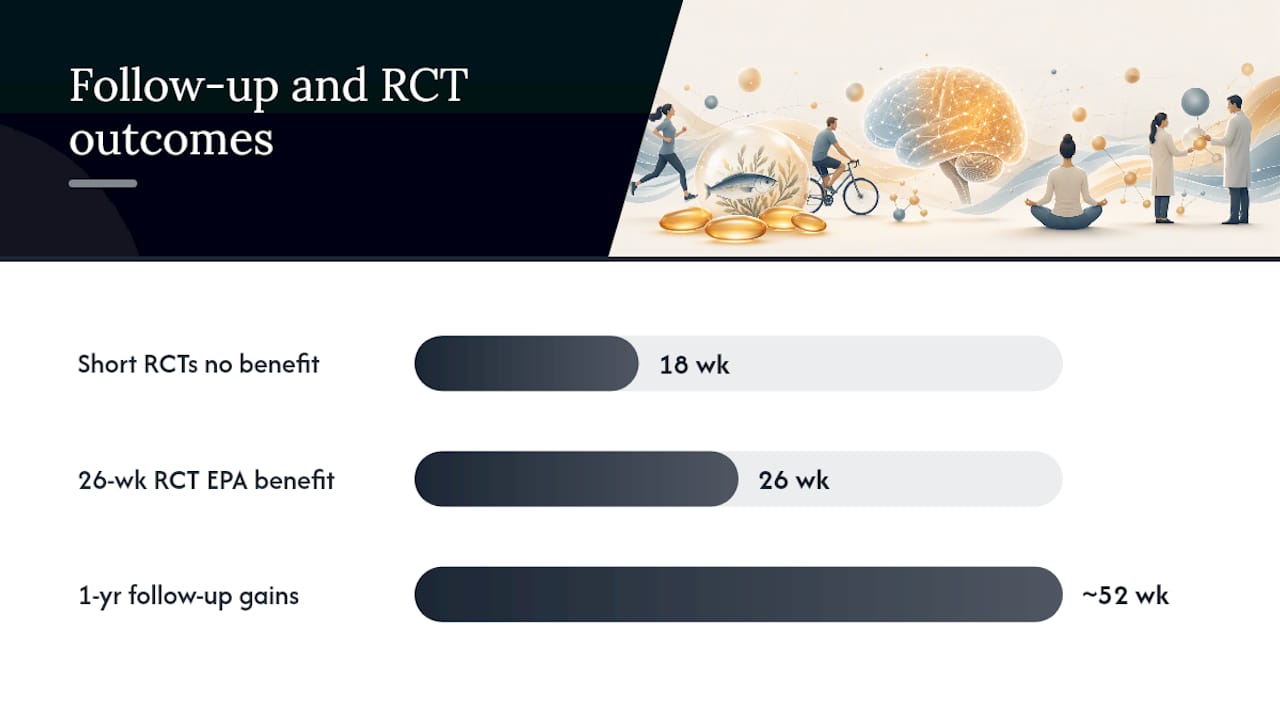
- A placebo-controlled trial in mid-life adults using about 1,400 mg per day of combined EPA and DHA for 18 weeks found no overall cognitive benefit. But when researchers looked only at participants who started with low baseline DHA, executive function improved. Participants who were already sufficient saw nothing extra.
- In people with mild cognitive impairment, n-3 PUFA supplementation showed potential to aid global cognitive function and reduce inflammatory and amyloid-related biomarkers, though the researchers themselves called for larger, better-powered trials before treating this as settled.
- A 26-week trial in healthy young and mid-age adults found that an EPA-rich oil improved global cognitive accuracy and processing speed compared to both placebo and a DHA-rich oil, suggesting EPA and DHA may not be interchangeable for every outcome.
The dose-response meta-analysis added that benefits for executive function tended to increase over about a year of use, with positive signals emerging above moderate daily intakes of total n-3 PUFA and EPA specifically. Beyond certain thresholds, the curve flattened or reversed slightly, meaning more was not automatically better. Separate domain-specific analysis in Scientific Reports found modest improvements concentrated in memory, visuospatial function, and perceptual speed, with a suggested optimal window between 1,000 and 2,500 mg per day, though certainty varied by cognitive domain.
Genetics likely plays a role too. Some dementia-risk research points to APOE ε4 carriers responding differently to omega-3 intake than non-carriers, though this moderating effect isn’t fully mapped out yet. Put together, the divergence between cohort and trial data mostly traces back to baseline omega-3 status, dose, formulation, and how long people were followed, not to the underlying biology being wrong.
Who Benefits Most From Omega-3s, and How Long It Takes
Not everyone should expect the same payoff, and knowing where you fall changes how much urgency this deserves.
People most likely to see a benefit:
- Older adults, especially those with mild cognitive impairment
- Anyone with low dietary fish intake or a low blood omega-3 index
- Mid-life adults whose baseline DHA levels test low, even without symptoms
People less likely to see a measurable difference:
- Cognitively healthy mid-life adults who already eat fish regularly
- Anyone with a normal to high blood DHA/EPA status, where added supplementation shows diminishing returns
On timeline, patience matters more than people expect. Trial data suggests initial cognitive signals often emerge within a few months, with the clearest executive function gains reported around the 12-month mark in dose-response analyses. Effects don’t scale forever. Some analyses suggest benefits plateau or partially reverse beyond that window, particularly at higher EPA doses, reinforcing that omega-3 supplementation works more like a slow correction of deficiency than a fast-acting stimulant.
Food First, Then Supplements: Dosing and Safety
Real food gets you most of the way there. Two servings of fatty fish per week (salmon, sardines, mackerel, or anchovies) typically deliver 250 to 1,000 mg per day of combined EPA and DHA when averaged out, which lands squarely in the range most meta-analyses associate with cognitive benefit. If you can’t or won’t eat fish twice weekly, that gap is where supplementation earns its place.

For supplement dosing, the research points to a few practical benchmarks: totals above 500 mg per day of combined EPA and DHA, and around 420 mg per day of EPA specifically, show up repeatedly in trials linked to executive function gains. Very high doses beyond typical trial ranges haven’t shown proportionally larger benefits and, in some analyses, correlate with weaker or mixed results.
When picking a product, run through this checklist:
- Check the EPA and DHA milligrams per serving, not just “fish oil” total weight.
- Look for third-party testing that verifies oxidation levels and purity.
- Note the formulation. Triglyceride-form fish oil tends to absorb better than ethyl ester.
- Confirm freshness and expiration dates. Oxidized fish oil smells rancid and loses potency.
- Check allergen labeling if you have shellfish or fish sensitivities.
A resource like our guide to choosing an omega-3 supplement walks through these criteria in more depth. On safety, high-dose fish oil can increase bleeding risk, particularly for people on anticoagulants or preparing for surgery, so check with a clinician before starting anything above standard dietary levels, and consider a blood biomarker test if you’re pursuing a targeted approach rather than general wellness support.
What Health-Conscious Adults Should Take From the Research
The most useful heuristic from all this data: test or assess before you supplement heavily. People with low baseline dietary intake or low blood DHA/EPA consistently show the largest, most reliable gains, while people who are already sufficient often see nothing extra from adding more.
Dosing isn’t linear, either. Several meta-analyses point to a mid-range sweet spot rather than a “more is better” curve, with diminishing or mixed returns at higher doses and longer durations. If your goal is short-term mental clarity or processing speed, an EPA-heavy approach has the better trial support. If you’re thinking long-term structural brain health as you age, DHA’s role in neuronal membranes makes it the more relevant target.
Pro Tip: Don’t chase the highest-dose bottle on the shelf. Match the formulation to your goal, EPA-leaning for short-term cognitive processing, DHA-leaning for long-term structural support, rather than assuming more total omega-3 automatically means more benefit.
A Publisher’s Note on Weighing the Evidence
I read this evidence the way I’d want a friend to: skeptically, but not dismissively. Food comes first in my own thinking, supplements fill the gap. That’s the honest, unglamorous takeaway. If you’re curious whether a tested option fits your routine, #nutribliss is worth a look, but no supplement replaces a conversation with your clinician about dosing or medication interactions.
A Straightforward Way to Close the Gap
If your diet doesn’t reliably hit two fish servings a week, closing that gap with food alone gets complicated fast. That’s the specific problem a well-formulated supplement solves. It doesn’t require meal planning, doesn’t spoil, and gives you a consistent, labeled dose every day instead of guessing what you got from lunch.

Nutribliss’s Omega-3 Fish Oil Supplement lists clear EPA and DHA content per serving, so you’re not left estimating milligrams the way you would with a plate of salmon. It’s part of a broader lineup in the supplements for health collection, built around the same food-first, test-before-you-supplement thinking laid out in this article. If you take blood thinners or other prescription medication, check with your clinician before adding a fish oil supplement to your routine, then browse the collection to see which potency fits your daily target.
Frequently Asked Questions
Does omega-3 actually improve memory? Some studies show modest improvements in memory-related domains, especially in older adults with mild cognitive impairment or low baseline omega-3 levels. Healthy adults with adequate intake tend to see smaller or no measurable memory changes.
How long does it take to notice omega-3 brain benefits? Most trial data shows initial cognitive signals within a few months, with the strongest executive function effects reported around 12 months of consistent intake.
Is EPA or DHA better for brain function? It depends on the outcome you’re targeting. EPA shows stronger results for short-term cognitive processing speed and accuracy, while DHA is more closely tied to long-term structural brain health as you age.
Can I get enough omega-3 from food alone? Two servings per week of fatty fish like salmon or sardines can deliver 250 to 1,000 mg per day of combined EPA and DHA on average, which falls within the range linked to cognitive benefit in several meta-analyses.
Are there risks to taking omega-3 supplements? High doses can increase bleeding risk, particularly for people on blood thinners. Check with a clinician before starting a supplement, especially at doses above typical dietary levels.
This article is general information, not a substitute for advice from a qualified doctor. Consult a qualified healthcare professional about your own circumstances before acting on anything here.
Sources
- The influence of n-3 polyunsaturated fatty acids on cognitive function in individuals without dementia: a systematic review and dose–response meta-analysis