

Fish oil reliably lowers triglycerides at therapeutic doses, but it does not consistently lower LDL cholesterol. Some formulations, particularly those containing DHA, can modestly raise LDL. That makes fish oil a solid tool for triglyceride management, not a replacement for statins or dietary changes when LDL is the main problem.
A 2024 genetic-interaction study using UK Biobank data, covering more than 441,000 participants, found that regular fish oil users showed a weaker link between their genetic risk scores and their actual total cholesterol, LDL, and triglyceride levels compared to non-users. In other words, fish oil appeared to blunt some of the genetic predisposition toward higher lipid levels.
Here’s the practical breakdown:
- Triglycerides: consistently lowered, sometimes substantially
- LDL cholesterol: inconsistent, occasionally increases
- HDL cholesterol: minor changes, sometimes slightly favorable
The bottom line: fish oil is genuinely useful if your triglycerides run high. It is not a substitute for statins, diet changes, or exercise if LDL is driving your cardiovascular risk.
Key Takeaways
Fish oil consistently and meaningfully lowers triglycerides but does not reliably lower LDL cholesterol, and some formulations can raise it slightly.
| Point | Details |
|---|---|
| Triglycerides respond best | Therapeutic doses of 2 to 4 grams EPA plus DHA daily lower triglycerides significantly. |
| LDL response is inconsistent | DHA-containing formulations sometimes raise LDL even as triglycerides drop. |
| Genetics play a role | UK Biobank research found fish oil users had weaker links between genetic risk and observed cholesterol levels. |
| Statins still matter | Fish oil is an adjunct for triglycerides, not a substitute for statins or diet when LDL drives your risk. |
| Dose and quality determine results | Nutribliss offers a third-party-tested omega-3 softgel formulated with labeled EPA and DHA amounts per serving. |
Table of Contents
- Does Fish Oil to Lower Cholesterol Actually Work? What Trials Show
- How Does Fish Oil Change Your Cholesterol Numbers?
- What Dose of Fish Oil Actually Lowers Triglycerides?
- Who Actually Benefits From Fish Oil for Cholesterol?
- Where Does Fish Oil Fit in a Cholesterol Management Plan?
- How Do You Choose a Quality Fish Oil Supplement?
- Why the Triglyceride Story Gets Buried Under LDL Headlines
- Get Started With a Quality Omega-3 Supplement
- Frequently Asked Questions
- Sources
Does Fish Oil to Lower Cholesterol Actually Work? What Trials Show
Clinical trials answer this question with more nuance than most headlines suggest. The strongest, most repeatable finding across systematic reviews is triglyceride reduction. Therapeutic doses of EPA and DHA lower triglycerides by a significant and dose-dependent amount. That’s a meaningful shift for anyone with triglycerides above 200 mg/dL.
The picture gets murkier when you look at LDL and hard outcomes like heart attacks or strokes. Reviews compiled in the NCBI Bookshelf summary describe small or mixed LDL and HDL changes, and the evidence for preventing major cardiovascular events remains inconclusive. Fish oil isn’t proven to prevent heart attacks the way a statin is.
Professional guidance reflects this split. The Merck Manual lists triglyceride lowering as the one clinically established benefit of fish oil, while flagging that other suspected cardiovascular benefits lack solid proof. The NIH Office of Dietary Supplements frames omega-3s the same way: useful as an add-on, not a frontline defense against LDL-driven risk.
What does this mean for you if you’re weighing fish oil against other options? A few things stand out:
- Triglyceride response tends to show up faster and more reliably than any LDL change.
- Higher doses (in the 2 to 4 gram range of combined EPA and DHA) drive bigger triglyceride drops than the 1 gram softgels most people take.
- Cardiovascular outcome data remains the weakest link in the entire evidence base, despite decades of research.
How Does Fish Oil Change Your Cholesterol Numbers?
The mechanism behind triglyceride lowering comes down to the liver. Omega-3 fatty acids reduce the liver’s production of VLDL, the particle that carries triglycerides through your bloodstream, and shift how your body metabolizes fat overall. Less VLDL production means less circulating triglyceride, and that’s a fairly direct, dose-responsive relationship.
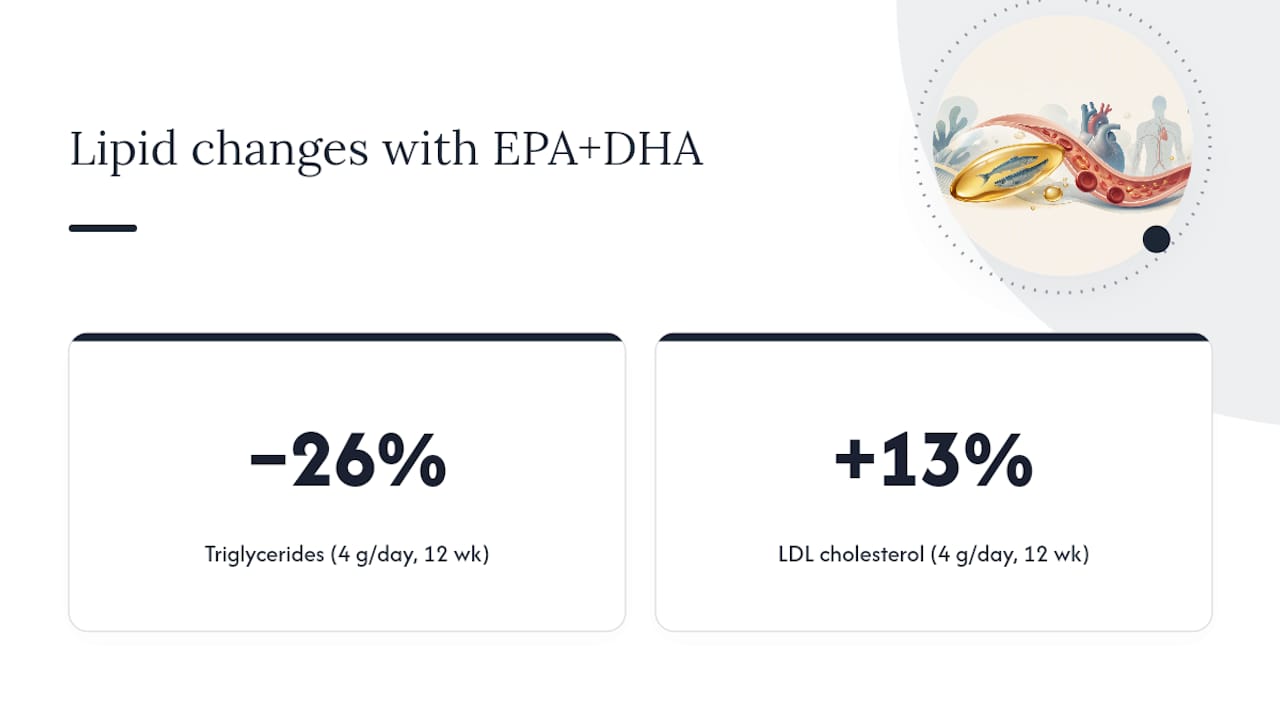
LDL behaves differently, and the formulation matters more than most people realize. DHA in particular has been linked to LDL increases in some trials, while EPA-only formulations tend to leave LDL alone or barely move it. One randomized trial found that 4 grams per day of combined EPA and DHA over 12 weeks cut triglycerides by about 26% while raising LDL by roughly 13% in the same patients. That’s the tradeoff in a single data point: real triglyceride benefit, real LDL cost, in the same bottle.
A modest LDL rise isn’t automatically bad news. Some research suggests fish oil shifts LDL particles toward a larger, less dense subtype, which some cardiologists consider less atherogenic than the small, dense particles typically associated with higher risk. That nuance rarely makes it into a basic lipid panel, though.
Pro Tip: If your LDL ticks up after starting fish oil, don’t panic and don’t quit cold turkey. Ask your doctor whether your triglycerides improved enough to offset it, and whether an EPA-only formulation might sidestep the DHA-linked LDL bump.

What Dose of Fish Oil Actually Lowers Triglycerides?
Most people underestimate how much fish oil it takes to move triglycerides. The dose on a standard grocery store softgel and the dose used in clinical trials are not the same ballpark.
- Standard OTC softgels typically deliver around 1 gram of combined EPA and DHA per serving, useful for general omega-3 intake but well below the therapeutic threshold.
- Therapeutic triglyceride-lowering doses run 2 to 4 grams per day of EPA plus DHA, the range reflected in AHA-aligned guidance and the trial data behind most triglyceride studies.
- Prescription options, like icosapent ethyl, contain purified EPA rather than a mix, and carry a distinct evidence profile from OTC blends, including different effects on LDL.
That gap between 1 gram and 4 grams explains why some people take fish oil for years and see no lipid change at all. They’re simply underdosed for the outcome they want.
Before buying anything, run through this checklist:
- Confirm actual EPA and DHA milligrams per serving, not just “fish oil” on the front label.
- Check how many capsules you’d need daily to hit a therapeutic dose.
- Look for third-party testing (USP, NSF, or IFOS) confirming purity and contaminant screening.
Who Actually Benefits From Fish Oil for Cholesterol?
The clearest candidates are people with elevated triglycerides, especially readings at or above 200 mg/dL, or mixed dyslipidemia where triglycerides are the dominant concern alongside cholesterol. If your LDL is the primary issue and your triglycerides are normal, fish oil has less to offer you.
A few safety notes matter here, and they’re not optional reading:
- Never stop or delay a prescribed statin because you’ve started fish oil. They address different problems, and LDL-driven risk still needs LDL-focused treatment.
- High-dose fish oil can interact with anticoagulants and increase bleeding risk, so talk to your doctor if you’re on blood thinners.
- GI side effects like fishy aftertaste, bloating, or loose stools are common at higher doses.
- Pregnant women and children should get personalized guidance before starting therapeutic doses.
Get a baseline lipid panel before you start, then recheck at the interval your doctor recommends.
Where Does Fish Oil Fit in a Cholesterol Management Plan?
Fish oil works best as an add-on, not a foundation. Diet changes, cutting saturated fat, adding fiber, along with regular exercise and statins when prescribed, remain the primary levers for LDL-driven cardiovascular risk. Fish oil’s job is triglyceride control, and it does that job well within its lane.
- Start with lifestyle changes and any prescribed LDL therapy; these carry the strongest outcome evidence.
- Add fish oil or a prescription omega-3 specifically when triglycerides remain elevated despite those steps.
- Recheck your lipid panel 6 to 12 weeks after starting or adjusting dose, since that’s typically enough time to see a meaningful triglyceride shift.
Clinicians frequently combine a statin with a prescription omega-3 when a patient has both high LDL and high triglycerides. Each drug handles a different lipid, and monitoring both together avoids surprises.
Pro Tip: Mark your calendar for that 6 to 12 week recheck the same day you start fish oil. Without a follow-up number, you’re just guessing whether it’s working.
How Do You Choose a Quality Fish Oil Supplement?
Not all fish oil bottles are created equal, and the difference between them often comes down to details buried in fine print. The EPA:DHA ratio, the molecular form (triglyceride versus ethyl ester), and oxidation levels all affect how well a product performs once it’s actually in your bloodstream.
Before you buy, check the label for these specifics:
- Total EPA and DHA milligrams per serving, not the total “fish oil” weight
- How many softgels you’d need daily to reach a therapeutic dose
- Third-party testing marks confirming purity and low contaminant levels
- Whether you need an OTC supplement or should ask your doctor about a prescription option for very high triglycerides
A supplement that hides its actual EPA/DHA count behind a vague “fish oil 1000mg” label is telling you almost nothing useful about whether it can move your triglycerides.
For a deeper breakdown of what to look for, our guide on choosing a good omega-3 supplement walks through label reading step by step. If you want to see what a properly dosed, third-party-tested option looks like, check out #nutribliss and its own omega-3 fish oil softgels.
Why the Triglyceride Story Gets Buried Under LDL Headlines
Most consumer coverage of fish oil treats cholesterol as one number, and that’s the core problem with how this supplement gets marketed and misunderstood. Triglycerides and LDL are different lipids that respond to different interventions, and conflating them sets people up for disappointment when their LDL doesn’t budge after months of fish oil capsules.
The UK Biobank findings deserve more attention than they’ve gotten. A genetic-interaction study covering over 441,000 people is a large enough sample to take seriously, and the finding that fish oil use attenuated genetic risk associations for multiple lipids suggests something more interesting than a simple triglyceride story. It hints that habitual use may interact with your underlying biology in ways a single trial can’t capture.
My honest read: skip the products that hide their actual EPA and DHA content behind a vague “fish oil” number on the label. If triglycerides are your issue, dose matters more than brand loyalty. If LDL is your issue, put your energy into diet and, if prescribed, your statin. Fish oil supports one part of the picture. It was never built to replace the whole plan.
Get Started With a Quality Omega-3 Supplement
Most OTC fish oil products fall short of the therapeutic dose your triglycerides actually need, forcing you to guess at label math or take a handful of capsules to reach 2 grams of EPA and DHA. Nutribliss solves that gap with a fish oil softgel that lists exact EPA and DHA amounts per serving, so you can calculate your dose without a spreadsheet.

Every Nutribliss supplement, from the omega-3 softgels to the broader lineup of protein powders, electrolytes, and multivitamins, comes with transparent labeling and detailed ingredient breakdowns, so you know exactly what you’re taking and why. If your last lipid panel showed elevated triglycerides, the Nutribliss omega-3 fish oil supplement gives you a documented starting point instead of a guess. Check the product page for exact serving sizes and third-party testing details, then talk to your doctor about how it fits your next lipid recheck.
Frequently Asked Questions
Does fish oil to lower cholesterol actually work for LDL? Not reliably. Fish oil is well documented for lowering triglycerides, but its effect on LDL is inconsistent, and some formulations containing DHA can modestly raise LDL even as triglycerides fall.
How much fish oil do I need to lower triglycerides? Most trial evidence points to 2 to 4 grams per day of combined EPA and DHA, well above the roughly 1 gram found in typical OTC softgels.
Is prescription omega-3 different from the fish oil sold over the counter? Yes. Prescription options like icosapent ethyl contain purified EPA rather than an EPA/DHA blend, and they carry a distinct evidence profile and dosing standard compared to standard supplements.
Can I take fish oil instead of my statin? No. Fish oil targets triglycerides, while statins are the established therapy for LDL-driven cardiovascular risk. Stopping a prescribed statin in favor of fish oil isn’t supported by the evidence.
How soon will I see a change in my triglycerides? Most clinical monitoring rechecks lipid panels 6 to 12 weeks after starting or adjusting an omega-3 dose, which is generally enough time to see a measurable triglyceride shift.
Sources
- PubMed: Fish oil supplementation … (Genetic interaction study)
- Merck Manual: Fish oil (professional edition)
- NCBI Bookshelf: Omega-3 fatty acids and cardiovascular outcomes
- Comparing the impact of prescription omega-3 fatty acid products on low-density lipoprotein cholesterol | American Journal of Cardiovascular Drugs