

TL;DR:
- MCT oil is rapidly converted into energy or ketones, unlike longer-chain fats.
- It supports ketosis, fat burning, mental clarity, and endurance performance.
- Use MCT oil as a supplement within a balanced diet, starting with small doses.
Most people assume all dietary fats work the same way in the body. MCT oil breaks that assumption completely. Unlike the fats in your olive oil or butter, MCT oil is rapidly converted to energy or ketones rather than being stored. That single difference makes it a standout tool for fitness enthusiasts, keto dieters, and anyone chasing sharper mental focus or better body composition. In this guide, you will learn exactly what MCT oil is, how it works at a metabolic level, what the science says about its benefits, how it compares to coconut oil, and how to use it safely without overdoing it.
Table of Contents
- Understanding MCT oil: What is it and how does it work?
- The health and performance benefits of MCT oil
- MCT oil vs. coconut oil and other fats: What makes it unique?
- Potential side effects and how to use MCT oil safely
- How to incorporate MCT oil into your diet and fitness routine
- Why MCT oil shouldn’t be treated as a magic bullet
- Elevate your wellness with Nutribliss
- Frequently asked questions
Key Takeaways
| Point | Details |
|---|---|
| Fast-acting energy source | MCT oil is quickly absorbed and converted to energy, useful for both mental and physical performance. |
| Weight management support | Evidence shows MCT oil can modestly boost fat burning and lower energy intake when replacing other fats. |
| Safe, gradual introduction | Start with small doses and increase gradually to minimize digestive side effects. |
| Balance with essential fats | Combine MCT oil with omega-3s and other healthy fats for optimal results and well-being. |
Understanding MCT oil: What is it and how does it work?
Not all fats are built alike. Most dietary fats are long-chain triglycerides (LCTs), which have 13 to 21 carbon atoms in their fatty acid chain. Your body processes these slowly, packaging them into particles that travel through your lymphatic system before reaching the bloodstream. MCTs are different. MCTs are medium-chain triglycerides with 6 to 12 carbon atoms, derived primarily from coconut oil or palm kernel oil. That shorter chain length means they skip the slow lymphatic route and go straight to your liver, where they are rapidly converted into usable energy or ketones.
This is the core reason MCT oil has gained serious traction in fitness and wellness communities. It behaves less like a stored fat and more like a fast fuel. Think of LCTs as logs on a fire and MCTs as lighter fluid. Both burn, but one ignites immediately.
The most common MCT subtypes found in supplements are:
- C8 (caprylic acid): The fastest to convert into ketones; most efficient for energy
- C10 (capric acid): Slightly slower than C8, still rapid; supports energy and immune function
- C12 (lauric acid): Found abundantly in coconut oil; behaves more like an LCT in the body
- C6 (caproic acid): Rarely used in supplements due to poor taste and GI irritation
High-quality MCT oil products focus on C8 and C10 because they deliver the fastest metabolic response. Coconut oil, by contrast, is about 50% lauric acid (C12), which does not behave the same way in terms of rapid liver conversion. Understanding this distinction matters when you are reading labels and comparing products.
For a broader look at MCT oil benefits and how they connect to your overall wellness goals, it helps to understand the full picture of what is MCT oil before adding it to your routine. The science behind metabolism support also plays a key role in understanding why MCT oil works the way it does.
The health and performance benefits of MCT oil
With a clear view of what MCT oil is, let’s explore how it may impact your health and fitness goals.
MCT oil’s most talked-about benefit is its role in weight management. Research shows that MCT oil increases post-meal energy expenditure and fat oxidation in overweight adults, meaning your body burns more calories and fat after eating it compared to LCTs. The effect is real but modest. Do not expect dramatic results from MCT oil alone.
Here is how MCT oil may support your performance and wellness goals:
- Rapid energy supply: MCTs convert to ketones quickly, providing fast fuel for both the brain and muscles without requiring insulin.
- Weight management support: By increasing thermogenesis and fat oxidation, MCT oil can support supporting metabolism when used as a replacement for other fats.
- Keto diet compatibility: MCT oil raises blood ketone levels efficiently, making it a staple for anyone on a ketogenic or low-carb eating plan.
- Endurance training support: Evidence shows that MCT enhances ketone utilization for endurance training without hindering glucose metabolism, which is a meaningful advantage for athletes.
- Mental clarity: Ketones produced from MCTs are a preferred fuel source for the brain, which is why many people report sharper focus after adding MCT oil to their morning routine.
“MCT oil is not a replacement for a solid nutrition plan. It is a precision tool that works best when layered on top of smart eating habits and consistent training.”
One critical point: MCT oil works best as a replacement for other dietary fats, not as an addition. Adding it on top of your current caloric intake without adjusting elsewhere will not deliver weight loss benefits. It is also worth exploring the omega-3 role in fitness to understand how different fats complement each other in a performance-focused diet.

Pro Tip: Add MCT oil to your pre-workout coffee or smoothie instead of your usual creamer. You get fast fuel without the sugar crash.
MCT oil vs. coconut oil and other fats: What makes it unique?
To further clarify your choices, let’s compare MCT oil directly to coconut oil and other common fats.
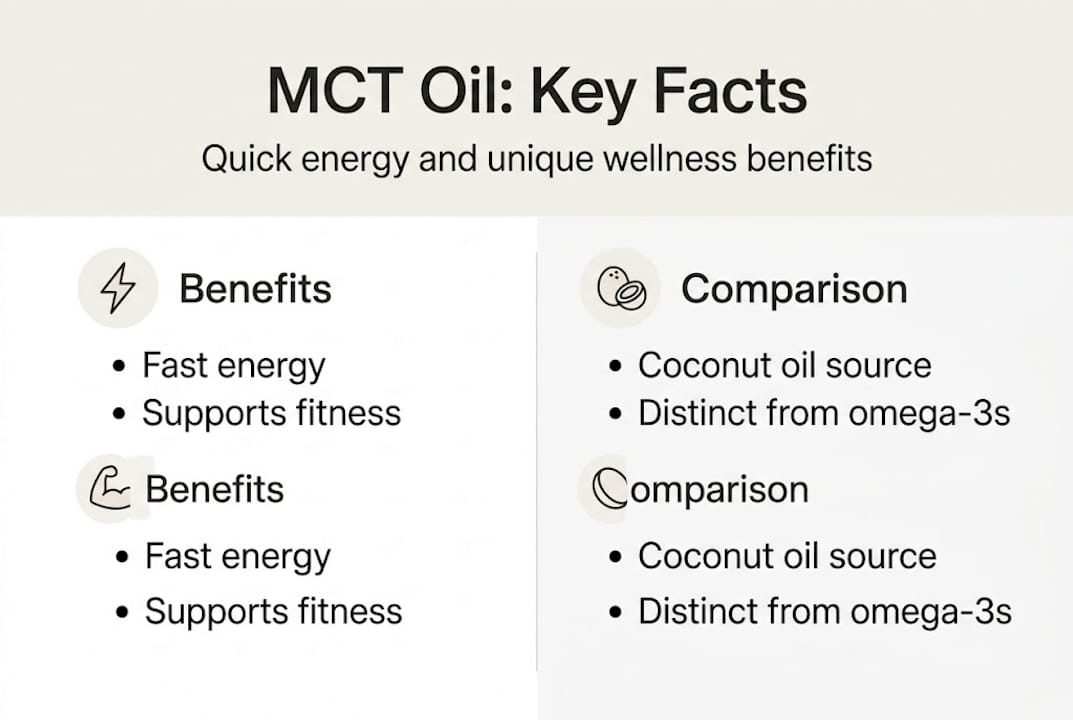
The confusion between MCT oil and coconut oil is understandable. Coconut oil is the primary source of MCTs, so people assume they are interchangeable. They are not. MCT oil is mostly C8 and C10, while coconut oil contains more lauric acid (C12), which behaves more like a long-chain triglyceride in the body. That distinction changes how each fat is metabolized.
| Fat source | Main fatty acids | Metabolic speed | Best use |
|---|---|---|---|
| MCT oil | C8, C10 | Very fast (liver direct) | Energy, ketosis, performance |
| Coconut oil | C12, C8, C10 | Moderate | Cooking, general health |
| Olive oil | Oleic acid (C18:1) | Slow | Heart health, cooking |
| Butter | Mixed LCTs | Slow | Cooking, flavor |
Key differences worth knowing:
- MCT oil is flavorless and odorless, making it easy to add to any meal or drink
- Coconut oil has a higher smoke point and is better suited for cooking at heat
- MCT oil is not ideal for high-heat cooking because it has a lower smoke point
- LCTs from sources like olive oil and avocado are still essential for hormone production and fat-soluble vitamin absorption
MCT oil is not a replacement for a well-rounded fat intake. Omega-3 fatty acids, for example, provide anti-inflammatory benefits that MCTs simply do not. The Omega-3 fatty acids guide is a great resource for understanding how to balance your fat sources for both performance and long-term health. Think of MCT oil as a specialized tool in your nutrition toolkit, not the whole toolkit.
Potential side effects and how to use MCT oil safely
After understanding how MCT oil compares to other fats, it’s important to know how to use it safely and effectively.
MCT oil is generally well-tolerated, but jumping in with a large dose is a common mistake. GI issues like diarrhea, bloating, and stomach pain can occur at high doses. The upper intake limit is roughly 4 to 7 tablespoons per day, and gradual introduction is key to avoiding discomfort.
Here is a safe ramp-up approach:
- Week 1: Start with 1 teaspoon per day, mixed into a drink or meal
- Week 2: Increase to 1 tablespoon per day if no GI issues occur
- Week 3 onward: Gradually increase based on tolerance, up to your target dose
- Monitor: Pay attention to any digestive changes, especially if you increase quickly
Beyond GI symptoms, some research suggests that high MCT intake may affect LDL cholesterol levels in certain individuals. If you have a history of cardiovascular issues or liver disease, consult a healthcare provider before starting MCT oil. Liver conditions are a particular concern because MCTs are processed directly in the liver.
Also, MCT oil should not crowd out essential fatty acids from your diet. Your body cannot produce omega-3s and omega-6s on its own, so these must come from food or supplements. Maintaining micronutrient balance alongside MCT oil use supports overall athletic performance and recovery.
Pro Tip: Take MCT oil with food, especially when starting out. It significantly reduces the chance of nausea or GI discomfort.
How to incorporate MCT oil into your diet and fitness routine
With safety in mind, here’s how you can start using MCT oil to your advantage.
MCT oil is one of the most versatile supplements available. It has no strong flavor, blends easily into liquids, and does not require any special preparation. According to research, MCT oil is used for ketogenic diets, as a fat source for malabsorption syndromes, and as a general energy aid. Its flexibility makes it easy to fit into almost any nutrition plan.
Here are practical ways to add MCT oil to your daily routine:
- Bulletproof coffee: Blend 1 tablespoon of MCT oil into black coffee for a fast-fuel morning drink
- Smoothies: Add to your post-workout shake for a quick energy boost alongside protein
- Salad dressings: Mix with apple cider vinegar and herbs for a simple, functional dressing
- Oatmeal or yogurt: Stir in a small amount to increase the fat content of a carb-heavy meal
- Pre-workout fuel: Take 1 tablespoon 30 to 60 minutes before training for readily available energy
For workout integration, MCT oil pairs well with a broader understanding of fuel switching and MCTs and how your body shifts between energy sources during exercise. If you experience any digestive sensitivity, digestion support supplements can help your gut adapt more smoothly.
For a full breakdown of MCT oil uses across different dietary goals, including clinical applications, the medical uses of MCT oil resource provides a thorough overview.
Pro Tip: If you are on a ketogenic diet, MCT oil in the morning can help you get into ketosis faster after an overnight fast, without requiring a full meal.
Why MCT oil shouldn’t be treated as a magic bullet
After all the practical guidance, let’s take a step back and see what truly matters for long-term results.
We see this pattern repeatedly in the supplement world: a nutrient with real, documented benefits gets amplified into a miracle cure. MCT oil is genuinely useful, but the honest truth is that its effects are modest. The weight loss benefits are real but small. The energy boost is fast but not dramatic for most people. The performance gains depend heavily on your overall diet and training consistency.
What the research actually tells us is that overconsumption risks can outweigh the benefits, and that balancing MCTs with essential fatty acids is critical for long-term health. Replacing all your fats with MCT oil is not a strategy. It is a shortcut that backfires.
The people who get the most from MCT oil are those who use it as one piece of a well-structured nutrition plan. They are already eating whole foods, training consistently, and paying attention to recovery. MCT oil adds a meaningful edge in that context. On its own, it adds very little. Taking time to learn about omega-3s and other foundational fats will do more for your long-term results than doubling your MCT dose ever will.
Elevate your wellness with Nutribliss
Ready to put your knowledge into practice? Here’s how you can further support your health journey.
MCT oil works best as part of a complete wellness strategy, and that is exactly what we build at Nutribliss. Whether you are fueling intense training sessions or managing daily energy levels, pairing MCT oil with the right complementary supplements makes a real difference.

Our Nutribliss Electrolytes Supplement is a natural companion to MCT oil, especially for athletes who need to maintain hydration and mineral balance during fat-adapted training. Browse our full range of recovery supplements to find products that align with your performance goals. At Nutribliss, we make it easy to build a supplement routine that actually supports your lifestyle, not just your supplement shelf.
Frequently asked questions
Is MCT oil good for weight loss?
MCT oil may assist in modest weight loss by increasing fat oxidation and post-meal energy use, but it works best when used as a replacement for other dietary fats rather than an addition to your current intake.
How should I start using MCT oil in my diet?
Begin with 1 teaspoon daily and increase gradually over several weeks. Starting low helps avoid GI issues, with a safe upper limit of 4 to 7 tablespoons per day for most adults.
What are the possible side effects of MCT oil?
The most common side effects are digestive, including diarrhea, bloating, and stomach pain. GI issues are common at high doses, which is why a slow introduction is strongly recommended.
Is MCT oil safe for everyone?
Most healthy adults tolerate MCT oil well, but those with liver conditions or cardiovascular concerns should consult medical advice before adding it to their routine.
Can MCT oil replace other healthy fats in my diet?
No. MCT oil complements your diet but cannot replace essential fatty acids like omega-3s. Overconsumption risks outweigh benefits when MCTs crowd out other necessary fats, so balance is essential.