

TL;DR:
- Supporting heart health with supplements involves choosing clinically proven nutrients tested independently and combining them with a healthy lifestyle. The best evidence supports supplements like psyllium fiber, CoQ10, magnesium, and prescription omega-3s, while unverified products and proprietary blends should be avoided. Supplements complement, but do not replace, a heart-healthy diet and regular exercise, and should always be disclosed to your healthcare provider.
Supporting heart health with supplements means selecting clinically proven nutrients, verifying product quality through independent testing, and pairing those supplements with a heart-healthy lifestyle. Knowing how to support heart health supplements correctly separates real cardiovascular benefit from expensive guesswork. The 2026 AHA guidelines confirm that supplements work best as additions to diet and exercise, not as replacements. This guide covers which nutrients have clinical backing, how to choose safe products, and how to build a practical daily routine around them.
Which supplements have proven benefits for heart health?
The best supplements for heart health are those with clinical trial evidence, not just marketing claims. A short list of nutrients clears that bar. Most popular options do not.
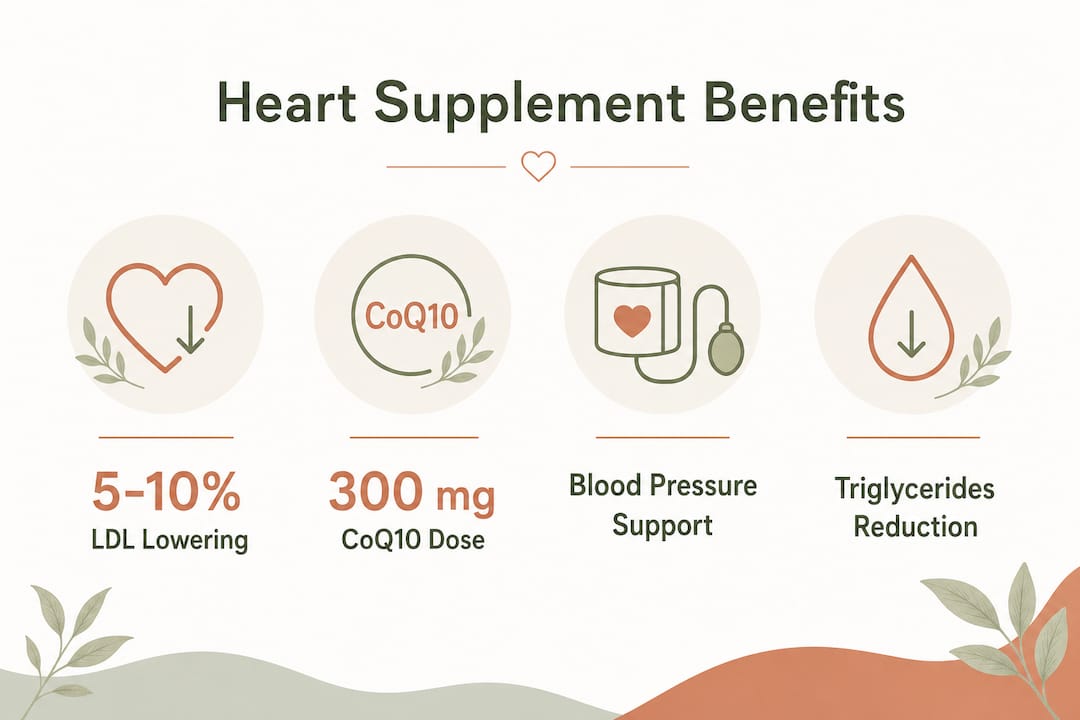
Psyllium fiber is one of the strongest over-the-counter options available. Psyllium lowers LDL cholesterol by 5–10% at practical doses of 7–10 grams daily with adequate water. That reduction is meaningful for people managing borderline cholesterol without medication.
Coenzyme Q10 (CoQ10) has the strongest evidence in heart failure patients. A meta-analysis found that 300 mg daily reduces mortality and hospitalizations in heart failure. CoQ10 does not, however, reliably relieve statin-related muscle pain, a claim still widely repeated on product labels.
Magnesium offers modest blood pressure support in specific populations. A meta-analysis of 38 randomized controlled trials found magnesium reduces systolic BP by roughly 2 mmHg in hypertensive or magnesium-deficient individuals. That effect is real but modest. You can read a thorough breakdown of the evidence in this magnesium supplementation guide.
Purified EPA (prescription-strength omega-3) is recommended only for high-risk patients with very high triglycerides at 2–4 grams per day. Standard over-the-counter fish oil is not recommended for general cardiovascular disease prevention. That distinction matters because most people buying fish oil capsules at a pharmacy are not the target population for this therapy.
| Supplement | Primary benefit | Evidence level |
|---|---|---|
| Psyllium fiber | Lowers LDL by 5–10% | Strong (multiple RCTs) |
| CoQ10 | Reduces heart failure mortality | Strong (meta-analysis) |
| Magnesium | Modest systolic BP reduction | Moderate (38 RCTs) |
| Purified EPA | Lowers very high triglycerides | Strong (prescription only) |
| Standard fish oil | General CVD prevention | Not supported |
Pro Tip: Red yeast rice can lower LDL similarly to prescription statins, but quality varies widely and some products contain harmful contaminants. Use it only under medical supervision.
How do you choose safe, high-quality heart supplements?
Supplement quality is not guaranteed by law. Under the Dietary Supplement Health and Education Act (DSHEA), manufacturers do not need to prove safety or efficacy before putting a product on store shelves. That regulatory gap places the responsibility on you.
Third-party certification is the most reliable quality signal available. Organizations like USP, NSF International, and ConsumerLab test supplements for potency, purity, and contaminant levels. A product carrying one of these seals has been independently verified to contain what the label claims. Nutribliss publishes a detailed breakdown of third-party testing standards worth reading before you buy.

Proprietary blends are a red flag. When a label groups multiple ingredients under a single total weight, you cannot know whether any single ingredient reaches a therapeutic dose. Proprietary blends obscure dosages and make it impossible to compare a product against clinical trial data. Stick to supplements that list each ingredient and its exact amount separately.
Key steps for evaluating a heart health supplement:
- Look for USP, NSF, or ConsumerLab verification seals on the label.
- Confirm each active ingredient has a listed dose that matches clinical evidence.
- Avoid products with long lists of botanical ingredients and vague “proprietary blend” disclosures.
- Check the supplement regulation overview to understand what FDA oversight actually covers.
- Tell your doctor or cardiologist about every supplement you take. Some interact with blood thinners and statins.
Pro Tip: Disclosing supplement use to your healthcare provider is not optional. Certain heart health dietary aids, including CoQ10 and red yeast rice, can interact with prescription medications and affect lab results.
How do supplements fit into a heart-healthy lifestyle?
Supplements are adjuncts to a healthy diet and lifestyle. The 2026 AHA guidelines state clearly that whole-food dietary patterns remain the gold standard for cardiovascular wellness. No supplement replaces that foundation.
The Mediterranean and DASH dietary patterns have the strongest evidence for cardiovascular protection. Both emphasize vegetables, legumes, whole grains, unsaturated fats, and limited processed foods. These patterns deliver fiber, potassium, magnesium, and antioxidants in forms the body absorbs and uses efficiently. A supplement can fill a specific gap. It cannot replicate the combined effect of a nutrient-dense diet.
Regular physical activity and weight management reduce cardiovascular risk independently of supplementation. Sleep quality and stress management also affect blood pressure, inflammation, and heart rhythm. Supplements that support stress reduction, such as those covered in this evidence-based stress supplement list, can play a supporting role in that broader picture.
“Supplements should be thought of as targeted tools, not shortcuts. A person eating a poor diet and skipping exercise will not offset that risk with a handful of capsules. The lifestyle has to come first, and supplements fill specific, documented gaps within that framework.”
This framing matters because the supplement market actively encourages the opposite belief. Products promising to “support” cardiovascular health often imply more than the evidence supports. Knowing that supplements work within a lifestyle, not instead of one, keeps expectations accurate and spending focused.
Practical steps for starting a cardiovascular supplement routine
A structured approach prevents both wasted money and real safety risks. Follow these steps before adding any new supplement to your routine.
- Assess your cardiovascular risk profile. Ask your doctor for a lipid panel, blood pressure reading, and basic metabolic panel. These numbers tell you which specific gaps, such as high LDL, elevated triglycerides, or low magnesium, a supplement might address.
- Identify nutrient deficiencies before buying. Vitamin D supplementation, for example, reduces cardiovascular events in individuals with baseline 25(OH)D levels at or above 50 nmol/L. That benefit does not apply to people who are not deficient.
- Consult your healthcare provider. Share your full supplement list. Supplement interactions with heart medications like blood thinners or statins are well documented and avoidable with proper disclosure.
- Select verified products. Use the third-party seal criteria above. Review the 2026 supplement safety checklist for a current, practical reference.
- Monitor your response over 8–12 weeks. Track blood pressure, energy levels, and any side effects. Bring updated lab results to your next appointment and adjust with clinical guidance.
| Step | What to do |
|---|---|
| Baseline assessment | Get a lipid panel and blood pressure check before starting |
| Provider consultation | Disclose all supplements to avoid drug interactions |
| Product verification | Choose supplements with USP, NSF, or ConsumerLab seals |
| Monitoring period | Track effects for 8–12 weeks, then review with your doctor |
| Regimen adjustment | Modify doses or products based on lab results and symptoms |
Key Takeaways
Effective cardiovascular supplement use requires evidence-based selection, verified product quality, and consistent integration with a heart-healthy diet and exercise routine.
| Point | Details |
|---|---|
| Evidence-based selection | Choose supplements like psyllium, CoQ10, and magnesium with clinical trial support. |
| Quality verification | Look for USP, NSF, or ConsumerLab seals to confirm potency and purity. |
| Lifestyle first | Supplements support but cannot replace the Mediterranean or DASH dietary patterns. |
| Provider disclosure | Always tell your doctor what you take to prevent dangerous drug interactions. |
| Ongoing monitoring | Reassess your supplement regimen every 8–12 weeks using lab results and symptoms. |
What I’ve learned after years of watching the supplement market
The supplement aisle is full of products that sound credible and deliver very little. I’ve watched people spend significant money on multi-ingredient “heart formulas” that contain no single ingredient at a therapeutic dose. The proprietary blend problem is real, and it is not accidental. Obscuring doses protects manufacturers from accountability while giving consumers the feeling of comprehensive coverage.
What actually works is boring by comparison. Psyllium fiber, CoQ10 for the right patient, magnesium if you are deficient, and a prescription EPA product if your triglycerides are dangerously high. That is a short list. The market does not profit from a short list, which is why it keeps expanding.
The phrase “natural heart health boosters” gets used to sell everything from beet root powder to garlic extract. Some of those ingredients have preliminary evidence. None of them have the clinical depth of the nutrients listed above. “Natural” does not mean safe at any dose, and it does not mean effective at the dose in the capsule you are holding.
My honest recommendation is to start with your bloodwork, not the supplement shelf. Know your numbers, identify a specific gap, find a verified product that addresses it, and tell your doctor. That sequence produces results. Browsing the supplement aisle looking for something that “supports heart health” does not. Follow #nutribliss for evidence-based content that cuts through the noise.
— GAURAV
Nutribliss and your cardiovascular wellness goals
Nutribliss builds its supplement line around published science, not marketing trends. Every product in the Nutribliss supplement collection is formulated with ingredient transparency, meaning no proprietary blends and no hidden doses.

The Science Behind Superfoods page explains the research principles behind each formulation, so you can evaluate the evidence before you buy. Nutribliss also publishes ongoing educational content on supplement quality, cardiovascular nutrients, and safe supplementation practices. If you are ready to add a clinically grounded supplement to your heart health routine, the Nutribliss catalog is a practical starting point built on the same standards this article describes.
FAQ
Do heart health supplements actually work?
Some do, for specific conditions. Psyllium fiber lowers LDL by 5–10%, CoQ10 reduces mortality in heart failure patients, and magnesium modestly lowers blood pressure in deficient individuals. Most multi-ingredient “heart formulas” lack clinical support.
What is the safest way to start taking heart supplements?
Get baseline bloodwork first, then consult your healthcare provider before adding any supplement. Disclose your full supplement list to avoid interactions with medications like statins or blood thinners.
Are over-the-counter fish oil supplements good for the heart?
Standard over-the-counter fish oil is not recommended for general cardiovascular disease prevention. Prescription-strength purified EPA is indicated only for high-risk patients with triglycerides at or above 500 mg/dL.
How do I know if a supplement is high quality?
Look for third-party verification seals from USP, NSF International, or ConsumerLab. Avoid products with proprietary blends, which hide individual ingredient doses and make quality assessment impossible.
Can supplements replace a heart-healthy diet?
No. The 2026 AHA guidelines confirm that whole-food dietary patterns like the Mediterranean and DASH diets remain the foundation of cardiovascular health. Supplements address specific nutrient gaps within that framework, not instead of it.