

To support fast-twitch muscle fibers most effectively, prioritize high-velocity power training and plyometrics, keep weekly volume in a range your body can actually recover from, and back it with daily protein adequacy plus creatine at established doses. Session order and rest matter almost as much as the exercises themselves. Skip any of these and the others lose most of their value.
TL;DR:
- Effective fast-twitch muscle training prioritizes high-velocity movements like plyometrics, Olympic lifts, and resisted sprints, performed when fully fresh.
- Training shifts muscle fibers from type IIx toward IIa, with the goal being improved sprint times, jumps, and rate of force development rather than changing fiber percentages.
- Nutritional support with 1.4 to 2.0 grams of protein per kilogram daily and creatine supplementation at 0.3 grams per kilogram enhances power adaptation.
- Power training volume should be low, with focused effort and proper recovery, avoiding excessive fatigue, especially when combining with other energy-demanding activities.
- Protect tissues by building tolerance gradually, avoiding static stretching before explosive work, and monitoring early neural fatigue signals like drops in jump height or sprint speed.
Table of Contents
- What Training Actually Recruits Fast-Twitch Fibers?
- What Does a Weekly Power Training Plan Look Like?
- How Should You Eat to Support Fast-Twitch Performance?
- How Do You Periodize Training Without Losing Explosiveness?
- Practitioner Notes From GAURAV
- How Do Plyometric Drills Build Motor Unit Recruitment?
- Why Does Central Nervous System Fatigue Matter for Power?
- Should You Stretch and Do Mobility Work for Explosive Performance?
- How Do Age and Genetics Affect Fast-Twitch Fiber Development?
- How Do You Prevent Injury During Explosive Training?
- Editorial Take: What the Evidence Actually Supports
- Where Nutribliss Fits Into Your Power Training Plan
- Sources
- FAQ
What Training Actually Recruits Fast-Twitch Fibers?
Fast-twitch fibers respond to one signal above all others: force produced quickly. Slow, grinding reps under fatigue mostly train the endurance side of the muscle. Explosive, high-velocity movement is what wakes up the motor units that generate power.
Here’s the part most gym-goers get wrong about fiber types: you’re not permanently converting one fiber into another. Muscle biopsy research on strength and sprint athletes shows fibers shift along a spectrum, mostly from type IIx toward the more fatigue-resistant IIa phenotype, not the reverse. One training intervention observed a significant increase in type IIa representation alongside a decrease in type I fibers, while pure IIx fibers remained uncommon. The takeaway from this fiber-transition review is blunt: stop chasing a biopsy percentage and start chasing better sprint times, higher jumps, and faster rate of force development (RFD). That’s the metric that actually reflects fast-twitch function.
Load selection depends on the goal. For power output, move loads around 30 to 70% of your one-rep max (1RM) as fast as possible. For raw force capacity, you still need heavy strength work above 80% 1RM. Both feed different pieces of the same engine.
- Plyometrics (box jumps, depth jumps, bounding) teach the stretch-shortening cycle to fire faster.
- Olympic-style lifts (cleans, snatches) train force production at speed under load.
- Resisted sprints (sleds, hills) build acceleration-specific power.
- Ballistic throws (medicine ball slams, rotational throws) transfer power to upper-body and rotational athletes.
Weekly volume depends on which quality you’re chasing. Hypertrophy work generally benefits from at least 10 sets per muscle group per week, while pure power work needs far fewer sets performed with much higher intent and full recovery between efforts. The ACSM position stand makes a point worth repeating: individualize the plan, hit major muscle groups at least twice-weekly, and resist the urge to stack endurance work on top without adjusting recovery. Consistency beats a clever program every time.
Pro Tip: Never program max-velocity work when you’re already fatigued from the day’s session. If your jump height or sprint time drops more than 10% from your first rep, the fast-twitch training effect is gone, and you’re just adding fatigue.
What Does a Weekly Power Training Plan Look Like?
Three templates cover most athletes, depending on whether the goal is raw power, sport speed, or general strength-power blend.
- Template A: Power-focused microcycle (3 to 4 days/week). Day 1: depth jumps (4x5), trap bar jump squats (5x3 at 40% 1RM, moved explosively), medicine ball slams (3x8), rest 2 to 3 minutes between sets. Day 2: lower-intensity technical work or full recovery. Day 3: repeat with slight load progression.
- Template B: Sprint/sport-specific microcycle. Day 1: technical sprint mechanics drills, then 4 to 6 resisted sprints of 20 to 30 meters at near-max effort, full recovery between reps. Day 2: bounding and single-leg plyometrics (3x6 per side). Day 3: supporting strength work (squats, hip thrusts) at moderate load, lower volume than a pure hypertrophy day.
- Template C: Mixed strength-power microcycle for gym-based athletes. Day 1: heavy squat or deadlift work (4x4 at 85% 1RM) followed by box jumps (3x5). Day 2: upper-body power (bench throws or plyo push-ups) paired with accessory hypertrophy work. Day 3: Olympic lift variations at moderate load with full rest.
Session order should never change: warm up thoroughly, do the highest-velocity work first while the nervous system is fresh, watch bar speed or jump height for signs of decline, then move into strength or hypertrophy work once the explosive quality has been trained. Progress load or complexity roughly every one to two weeks rather than every session, and you can add volume gradually using a safe progression method instead of jumping too fast.
How Should You Eat to Support Fast-Twitch Performance?
Training creates the stimulus, but nutrition determines whether fast-twitch fibers actually adapt or just accumulate fatigue. Two nutrients carry most of the weight: protein and creatine.
Protein needs for physically active people fall between 1.4 and 2.0 grams per kilogram of body weight daily, according to the ISSN position stand on protein and exercise. Total daily intake matters more than any single meal, but spacing 20 to 40 grams per feeding with adequate leucine content gives muscle protein synthesis (MPS) a repeated trigger throughout the day rather than one large spike.
Carbohydrates matter more than lifters often admit. Fast-twitch fibers rely heavily on stored muscle glycogen for repeated explosive efforts. Athletes training multiple times a day or doing back-to-back high-intensity sessions need carbs positioned around those sessions to keep glycogen from becoming the limiting factor before the muscle even fatigues.
Creatine monohydrate is widely regarded as the single most effective legal supplement for high-intensity exercise capacity, with performance benefits documented across decades of research.
Creatine dosing that’s actually backed by data:
- Loading protocol: roughly 0.3 grams per kilogram of body weight daily for 3 to 7 days, then a maintenance dose of 3 to 5 grams per day.
- Slow protocol alternative: skip loading and take 3 grams per day for about 28 days to reach similar saturation.
- Expect some water retention in the first week or two; this is normal and not fat gain.
- Athletes with existing kidney conditions should check with a physician before starting.
For supplement safety, choose products that carry independent certification such as NSF Certified for Sport, which screens for more than 290 banned substances. Certification lowers contamination risk but doesn’t eliminate it. Drug-tested athletes should verify the exact batch number against the certifier’s database before every purchase, a step covered in more detail in this guide to third-party tested supplements. Food-first is the right default for daily protein and carbohydrate needs. A supplement earns its place when timing, appetite, or travel make whole food impractical, and creatine is a supplement widely studied for supporting high-intensity exercise capacity.
How Do You Periodize Training Without Losing Explosiveness?
Periodization for fast-twitch development isn’t about complexity. It’s about protecting the nervous system’s ability to fire fast when it counts.
The ACSM’s guidance on individualized programming applies directly here: adherence beats elaborate block schemes almost every time. A short taper, sometimes as brief as five to ten days of reduced volume with maintained intensity, often restores lost speed qualities and can produce a temporary overshoot in explosiveness above baseline. This is why sprinters and jumpers taper hard before competition instead of training through fatigue.
Track the right numbers instead of guessing:
- Rate of force development (RFD) from force plate or jump testing.
- Sprint times over standard distances (10m, 20m, 40m).
- Vertical or broad jump height.
- Bar velocity on submaximal lifts.
- 1RM strength, tested periodically, not every week.
Trying to infer fast-twitch progress from a biopsy or a guess is pointless. These five metrics tell you everything that matters.
Pro Tip: If your sprint times or jump height plateau for more than three weeks despite consistent training, the issue is almost always recovery debt, not the exercises themselves. Add a deload before adding more volume.
Avoid piling endurance running or extra HIIT sessions onto a power block without cutting volume elsewhere. The nervous system and connective tissue recovering from max-velocity work need dedicated rest, not competing fatigue from a separate energy system.
Practitioner Notes From GAURAV
Layering training and nutrition works best when you think in phases, not a single static plan. Build the power base first with plyometrics and Olympic-style lifts, add creatine and protein consistency in week one rather than week four, and let recovery metrics (not motivation) decide when to progress load.
Nutribliss’s athletic supplements guide and sports nutrition breakdown go deeper on fueling strategy for athletes running this kind of program.
How Do Plyometric Drills Build Motor Unit Recruitment?
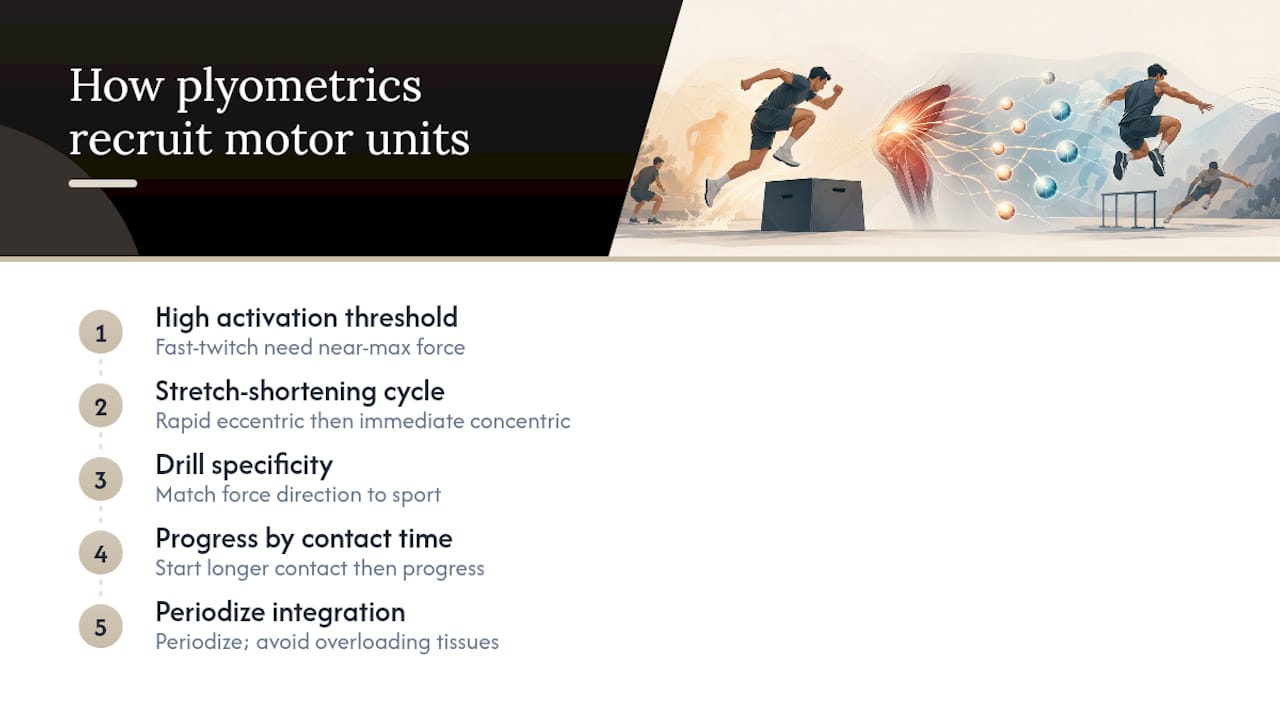
Motor units for fast-twitch fibers have a high activation threshold. Your nervous system doesn’t recruit them for casual movement. It saves them for moments demanding maximum force in minimum time, which means training has to specifically demand that intensity to reach them at all.
Plyometric drills work through the stretch-shortening cycle: a rapid eccentric (lengthening) phase immediately followed by a concentric (shortening) contraction. Depth jumps are the clearest example. Stepping off a box and immediately exploding upward on landing forces the nervous system to recruit fast-twitch motor units within milliseconds, since there’s no time for a slow, gradual buildup of tension.
Drill specificity matters more than variety. A basketball player working on vertical jump gets more transfer from depth jumps and squat jumps than from lateral bounds. A sprinter benefits more from horizontal bounding and resisted starts than from vertical box jumps. Match the drill’s force direction and contact time to the sport’s actual demands.
Progression should follow contact time, not just height or distance. Start with drills that allow longer ground contact (box jumps with a pause), then move toward true reactive plyometrics (depth jumps, repeated bounds) only once landing mechanics are solid. Research on HIIT’s effect on neuromuscular function confirms that this kind of high-intensity interval work improves motor unit recruitment, synchronization, and tendon stiffness when integrated properly alongside resistance training, though it requires deliberate periodization to avoid overloading the same tissues twice.
Why Does Central Nervous System Fatigue Matter for Power?
Early gains in strength and explosiveness come almost entirely from neural adaptations, not muscle growth. Your nervous system gets better at recruiting more motor units, firing them faster, and synchronizing their timing well before the muscle fibers themselves change size. That’s why a beginner can add 20% to their vertical jump within a few weeks of starting plyometric training, long before any meaningful hypertrophy could explain it.
The catch is that central nervous system (CNS) fatigue doesn’t feel like muscle soreness. You can perform a max-effort sprint session, feel fine the next day muscularly, and still underperform on jump testing because the nervous system hasn’t fully recovered its capacity to fire at full intensity. Research on the neural versus hypertrophic contributions to strength gains supports tracking performance output, RFD, sprint velocity, and bar speed, rather than assuming recovery based on how sore you feel.
Practical CNS management looks like this: cap true max-effort sessions at two to three per week, insert lower-intensity technical days between them, and treat a drop in bar velocity or jump height as your clearest fatigue signal. Sleep quality affects this more than almost any other recovery variable; poor sleep blunts motor unit recruitment the next day regardless of how fresh the muscles feel.
Should You Stretch and Do Mobility Work for Explosive Performance?
Static stretching held for long durations right before a power session can temporarily reduce force output and RFD. That’s a real effect, not just gym folklore, and it’s why sprinters and jumpers avoid long static holds in a warm-up.
Dynamic mobility work is the better fit before explosive training. Leg swings, walking lunges with rotation, and hip openers raise tissue temperature and improve range of motion without dampening the nervous system’s readiness to fire fast. The goal is to reach full range of motion at the joints you’ll be loading (hips, ankles, thoracic spine) so a jump or sprint isn’t limited by stiffness rather than strength.

Static stretching still has a place, just not immediately pre-power. Save longer holds for after training or on separate recovery days, when improving long-term range of motion matters more than immediate force output. Athletes with genuinely restricted ankle dorsiflexion or hip extension often see better jump mechanics after a few months of consistent post-session stretching, since limited range at those joints forces compensations elsewhere in the kinetic chain.
Mobility work targeted at the specific joint restrictions limiting your sprint or jump technique beats generic full-body stretching every time. A sprinter with tight hip flexors gets more benefit from targeted hip extension work than from a generic 10-minute stretch routine that ignores their actual limitation.
How Do Age and Genetics Affect Fast-Twitch Fiber Development?
Fast-twitch fibers are the first to decline with age, a process that typically accelerates after the mid-30s to 40s if power training isn’t part of the routine. Type II fibers atrophy faster than type I fibers in sedentary aging adults, which is part of why older adults lose the ability to catch themselves from a stumble years before they lose basic walking endurance.
The encouraging part: power training remains effective at essentially any age. Older adults who add plyometric-style and explosive resistance work to their routine show measurable improvements in RFD and functional power output, even into their 60s and 70s. The fiber-transition principle still applies. You’re not reversing decades of change overnight, but you are meaningfully improving how fast the fibers you have can fire.
Genetics set a ceiling, not a floor. Fiber-type distribution varies naturally between individuals, and elite sprinters tend to carry a genetically higher proportion of fast-twitch fibers than elite marathoners. But genetic predisposition explains why some people respond faster to power training, not whether power training works for them. Most people fall in a mixed-fiber range where training response matters far more day to day than baseline genetics.
How Do You Prevent Injury During Explosive Training?
High-velocity training carries real injury risk if progression is rushed, and the most common failure point is jumping straight into maximal plyometrics without building a tendon and landing-mechanics base first.
Build tolerance in this order: start with lower-intensity jumps and land mechanics drills, progress to moderate-height plyometrics once landing form is consistent, then introduce true reactive, high-intensity plyometrics like depth jumps. Skipping steps to chase faster results is the single most common cause of tendon and ligament injuries in athletes new to power training.
Volume caps matter as much as intensity caps. Total ground contacts in a plyometric session should stay within a range your connective tissue can handle, and that range shrinks when you’re also sprinting or lifting heavy the same week. Fatigue changes landing mechanics before it changes how you feel, so technique breakdown under fatigue is often invisible to the athlete doing the drill.
Warm-up quality is non-negotiable for this kind of training. Cold, stiff tissue asked to absorb high eccentric forces is a common setup for strains, particularly in the hamstrings and Achilles tendon. Give the nervous system and tissues a genuine ramp-up, not a token five-minute jog, before any max-velocity work.
Editorial Take: What the Evidence Actually Supports
The conventional advice on fast-twitch training spends too much time on exotic exercise selection and not nearly enough on the two things that actually move the needle: consistent high-velocity practice and unglamorous recovery management. Athletes chase novel plyometric variations while skipping the protein target or the sleep that would let their nervous system actually adapt.
Here’s what gets underweighted: the fiber-transition research means you’re not trying to “convert” muscle fiber types through some magic exercise combination. You’re training the function you already have to fire faster and recover quicker between efforts. That reframe changes what you prioritize. Consistency in load, protein, and creatine intake, plus disciplined session order, beats a clever program built around chasing a fiber-type myth.
If you take one thing from this article, prioritize recovery capacity before adding volume. Most lifters plateau in power output not because they’re undertrained, but because they never gave the nervous system room to actually express the adaptation they trained for.
— GAURAV
Where Nutribliss Fits Into Your Power Training Plan
Nutribliss gives athletes a direct path to the specific nutrients this article covers, without the subscription traps or vague label claims that make supplement shopping harder than it should be. The Athlete Recovery & Performance collection is built around the exact levers discussed above: protein support, creatine, and recovery-focused formulas designed for people training for speed and power, not general wellness. Pair that with Daily Foundations to cover baseline micronutrient gaps that quietly undercut recovery even when training and macros look solid.
If you’re a drug-tested athlete, run through this checklist before adding anything new: verify the product carries independent certification, confirm the specific batch number against the certifier’s database, and read the full label for allergens or interactions with any medications you’re taking. Nutribliss formulates with ingredient transparency and third-party lab testing as a baseline, not an upsell, which matters if you’re the one held liable for what shows up in your system. Follow #nutribliss for ongoing formulation notes and athlete-focused content.
Ready to build out your stack? Start with the Athlete Recovery & Performance collection and check current formulas and pricing directly on the product pages before your next training block begins.
Sources
- Muscle Fiber Type Transitions with Exercise Training: Shifting Perspectives
- Exercise and Athletic Performance (NIH ODS)
- Resistance training volume and hypertrophy umbrella review
FAQ
What Is the Fastest Way to Train Fast-Twitch Muscle Fibers?
Explosive movements performed at maximum intent, like plyometrics, resisted sprints, and Olympic-style lifts, recruit fast-twitch fibers fastest. Place them early in your session while your nervous system is fresh, since fatigue quickly shifts recruitment away from these high-threshold motor units.
How Much Protein Do I Need to Support Fast-Twitch Muscle Growth?
Physically active people generally need 1.4 to 2.0 grams of protein per kilogram of body weight daily, according to the ISSN position stand. Spreading 20 to 40 grams across four to five meals supports muscle protein synthesis more consistently than one large dose.
Does Creatine Actually Help Fast-Twitch Performance?
Yes. Creatine monohydrate is one of the most well-supported supplements for high-intensity, short-duration effort, with a common protocol of about 0.3 grams per kilogram daily for 3 to 7 days, followed by 3 to 5 grams per day for maintenance. Expect some early water retention, which is normal.
Can You Really Convert Slow-Twitch Fibers Into Fast-Twitch Fibers?
Not in the way most people assume. Training mostly shifts fibers within the fast-twitch category, from IIx toward IIa, rather than converting slow-twitch fibers into fast ones. The practical goal is improving how fast your existing fibers fire and recover, which shows up in sprint times, jump height, and RFD.
How Many Sets Per Week Should I Do for Power Training?
Power work needs far fewer sets than hypertrophy training, since quality and full recovery between efforts matter more than volume. Hypertrophy-focused resistance work benefits from at least 10 sets per muscle group weekly, but power sessions should stay lower in volume with longer rest periods to preserve movement velocity.