

Change only one variable at a time, whether that’s sets, reps, or load. Watch recovery markers weekly, and deload the moment two or more signs of fatigue stack up. Evidence-based guidelines put most lifters in a 10 to 20 weekly set range per muscle before returns flatten out. Templates, monitoring tools, and nutrition support follow below.
TL;DR:
- Most lifters should gradually increase weekly sets for each muscle by only one or two sets every week or two to avoid overtraining and injury.
- The optimal weekly volume for hypertrophy ranges from 10 to 20 sets per muscle, with beginners typically starting around 6 to 10 sets, and advanced lifters approaching 20 or more.
- Monitoring performance, soreness, sleep, and motivation helps identify when it’s time to deload by reducing volume and intensity for a week to recover effectively.
- Adding volume primarily through sets and reusing back-off or high-rep technique sets minimizes joint stress and promotes sustained progress.
- Supporting nutrition with adequate protein intake, hydration, and quality sleep amplifies training adaptations during volume increases.
Table of Contents
- How to Increase Workout Volume Safely: A Step-by-Step Progression
- What Do Research and ACSM Guidance Say About Weekly Volume Limits?
- Sample Mesocycle Templates for Building Volume Over 4 to 8 Weeks
- How Do You Know When to Deload or Pull Back Volume?
- Fueling Higher Volume: Nutrition, Sleep, and Hydration That Actually Matter
- Why Patience Beats Ambition When Scaling Training Volume
- Optional Recovery Supports for Higher Training Volume
- Sources
How to Increase Workout Volume Safely: A Step-by-Step Progression
Most progression plans fail for one reason: people change too many things at once. They add weight, swap rep ranges, and throw in extra sets in the same week, then can’t figure out why their shoulder hurts or their bench stalls. The fix isn’t complicated. It’s sequencing.
Start with sets, not weight. Adding working sets is the most dependable lever for driving muscle growth, and it’s the method most consistently backed by research. A UNM analysis on volume training for hypertrophy points to sets and reps as the primary levers coaches should adjust before touching intensity. A “working set” here means any set taken close to fatigue, typically within 1 to 3 reps of failure, not a warm-up or a technique-focused ramp-up set.
Here’s the sequence that keeps things safe and easy to track:
- Pick your starting baseline. Log your current weekly sets per muscle group for two weeks before changing anything. You need a real number, not a guess.
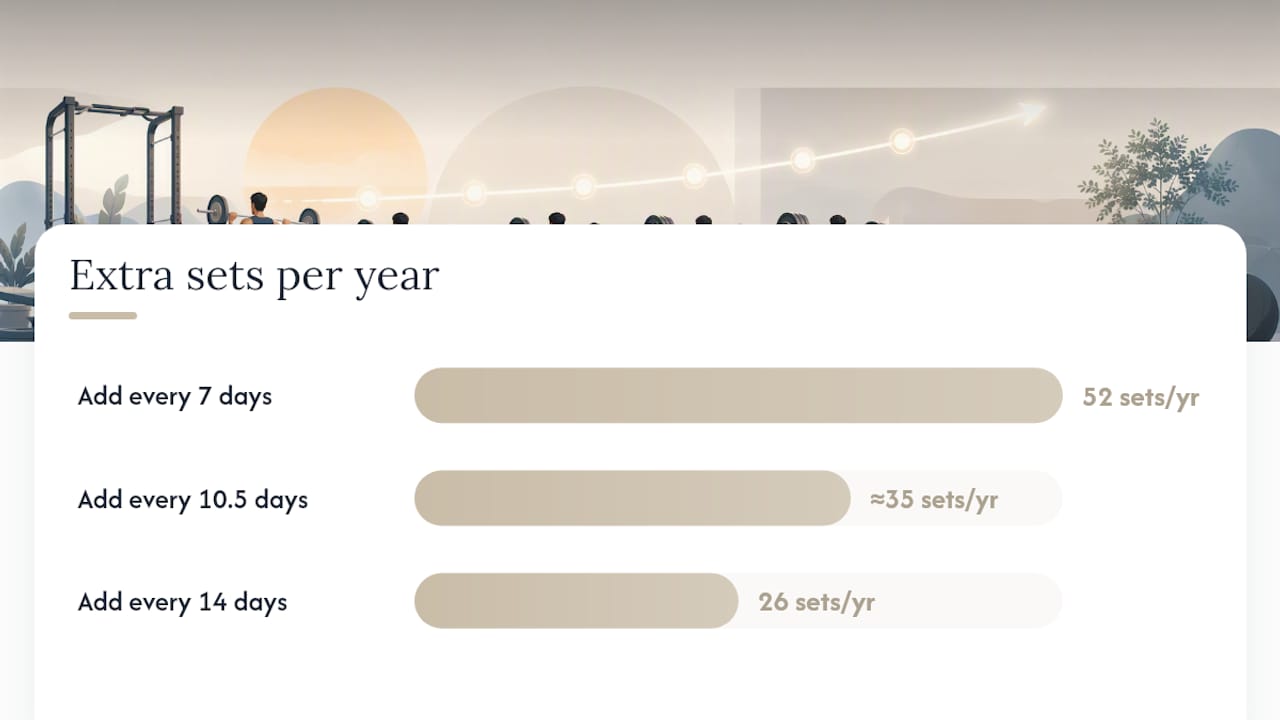
- Choose one progression rule. Either add one working set per muscle group every 7 to 14 days, or increase total weekly volume by 10 to 20%. Don’t mix both in the same week.
- Hold everything else constant. If you’re adding sets, keep your rep range and load the same for at least a week so you can actually see the effect.
- Reassess after 2 to 4 weeks. If your lifts are stable or improving and soreness resolves within 48 hours, repeat the cycle. If not, hold volume flat for a week before trying again.
- Use back-off sets for low-risk extra work. A back-off set, a lighter set added after your heaviest work for the day, lets you accumulate volume without pushing intensity higher. This is a good option for lifters who want more sets without more joint stress.
- Rotate in higher-rep technique sets sparingly. One set of 15 to 20 reps at a lighter load, done with strict form, adds volume with minimal wear and tear, especially useful for smaller muscle groups like arms or calves.
The one-variable-at-a-time rule matters more than any specific number. Practical coaches most reliably add sets over several weeks and then use short deloads. Piling on multiple variables muddies the recovery signal, so when your lift stalls, you won’t know if it was the extra reps, the heavier weight, or the added set that caused it.
How this plays out depends on your split. On a full-body program hitting each muscle 3 times a week, add your extra set to just one session first, not all three, so you can gauge the impact in isolation. On an upper/lower split, add sets to the lift you’re most motivated to improve, since adherence matters more than perfect symmetry across all exercises. On push/pull/legs, prioritize adding sets to compound movements (squats, rows, presses) before isolation work, since compounds recruit more muscle mass and give you more return per set added.
Pro Tip: Track total weekly sets per muscle group in a simple spreadsheet, not per workout. Muscles don’t know which day it is, they just accumulate stress across the week, so weekly totals are the number that actually predicts growth and fatigue.
Consistency beats cleverness here. ACSM-aligned guidance emphasizes that regular training repeated over time, without overcomplicating the plan, produces the bulk of long-term gains. Adding one set every two weeks feels almost too slow. Over a training year, that’s roughly 20 to 26 extra sets per muscle group, which is a substantial shift in stimulus without ever risking a spike your joints can’t handle.
What Do Research and ACSM Guidance Say About Weekly Volume Limits?
Somewhere between 10 and 20 working sets per muscle group per week is where most hypertrophy research lands for trained lifters, based on network meta-analyses synthesizing dozens of controlled trials. That range isn’t arbitrary. Multiple studies on resistance training prescription for muscle strength and hypertrophy rank multiset programs highest for hypertrophy outcomes, while strength gains track more closely with load than with sheer set count.
Strength and hypertrophy aren’t the same goal, and they don’t respond to volume the same way:
- Hypertrophy responds well to higher weekly set totals, generally in the 10 to 20 set range per muscle, spread across 2 or more sessions weekly.
- Strength depends more on intensity. Lifting at 80% of your one-rep max or higher for 2 to 3 sets is a primary driver of strength gains, separate from the volume needed for muscle growth.
- Frequency matters almost as much as total sets. Hitting a muscle group twice or more per week tends to outperform cramming the same volume into one session.
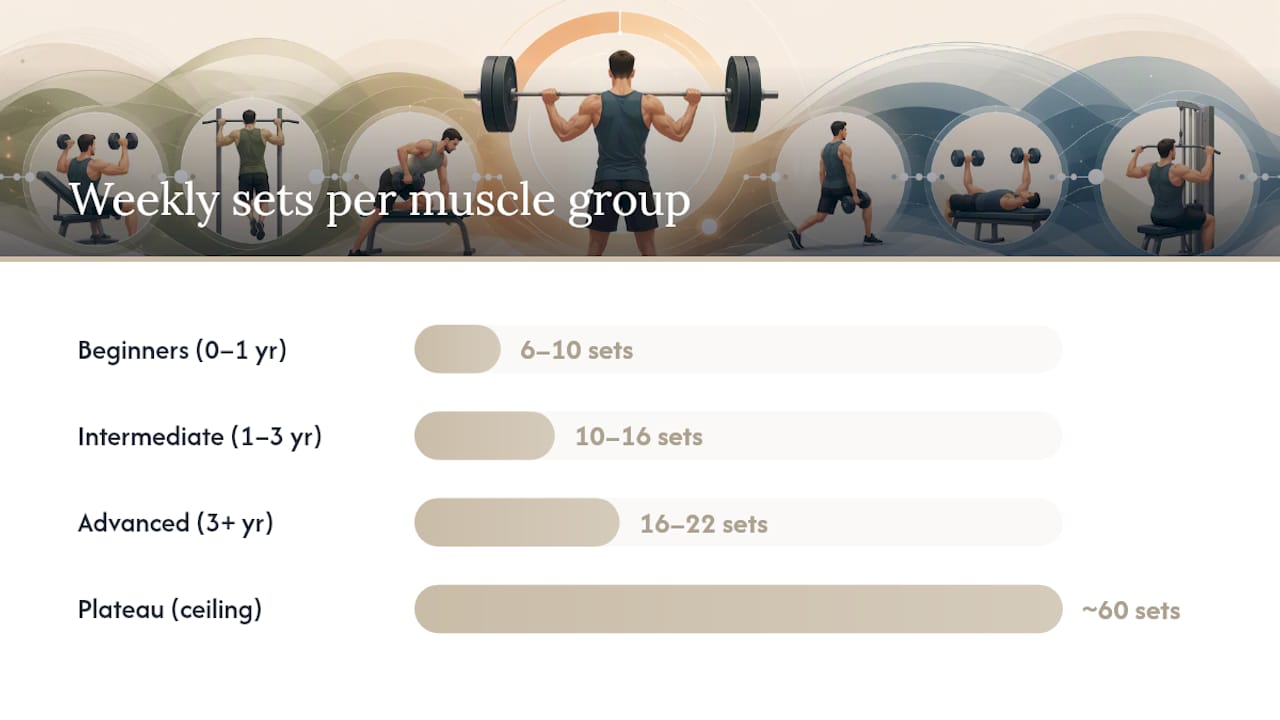
There’s a ceiling, though, and it’s worth naming directly. Pooled analyses have observed a plateau in extra gains beyond roughly 60 sets per week for a given muscle group in trained males. Past that point, additional sets mostly add fatigue without proportional additional growth. For the overwhelming majority of lifters, that ceiling is nowhere near reach, but it explains why elite bodybuilders training 6 days a week per muscle group aren’t actually outgrowing intermediate lifters doing half that.
Where you fall in that 10 to 20 set range depends on training age, recovery capacity, age, and sex. Untrained lifters often see meaningful growth from as few as 4 to 6 sets weekly, because any consistent stimulus is new. Advanced lifters need to push toward the higher end of the range, sometimes beyond it temporarily, to keep progressing, but they also need longer to recover between sessions.
Translating that into practical target bands:
- Beginners (0 to 1 year of consistent training): 6 to 10 sets per muscle group weekly, added slowly.
- Intermediate (1 to 3 years): 10 to 16 sets weekly, with room to cycle toward 20 during specialization blocks.
- Advanced (3+ years): 16 to 22 sets weekly, closer to the plateau zone, requiring tighter recovery monitoring.
Age and sex modify these numbers at the margins rather than changing the framework. Older lifters generally need more recovery time between volume increases, and women often tolerate slightly higher relative training frequencies due to differences in fatigue and recovery profiles, though individual variation swamps most group-level trends.
Sample Mesocycle Templates for Building Volume Over 4 to 8 Weeks
A mesocycle is just a planned block of training, typically 4 to 8 weeks, built around a specific progression goal before a deload resets fatigue. Programming literature on mesocycle progression in hypertrophy training supports this window as long enough to see real adaptation without letting fatigue accumulate past the point of diminishing returns.
Beginner template (4 weeks, 2 to 3 sessions per week):
- Week 1: Establish baseline, 6 to 8 sets per muscle group weekly.
- Week 2: Hold volume steady, focus on form and consistent RPE (rate of perceived exertion).
- Week 3: Add one set to your two main lifts per session.
- Week 4: Assess recovery. If solid, repeat the cycle; if not, hold flat another week.
Intermediate template (6 weeks, 4 sessions per week):
- Weeks 1 to 2: Baseline at 10 to 12 sets per muscle group weekly.
- Weeks 3 to 4: Add one set per muscle group every 1 to 2 weeks, reaching 12 to 14 sets.
- Week 5: Intentional deload, cut volume by roughly 40 to 50%.
- Week 6: Resume at week 4’s volume and reassess for another push.
Advanced template (8 weeks, 5 sessions per week):
- Weeks 1 to 3: Start near 16 to 18 sets weekly, smaller relative increases (5 to 10%) since baseline is already high.
- Weeks 4 to 5: Push toward 18 to 20 sets with a planned micro-deload (10 to 15% volume cut) mid-block rather than waiting until the end.
- Weeks 6 to 7: Return to peak volume, hold or nudge slightly higher if recovery markers are clean.
- Week 8: Full deload, 50% volume reduction, lower intensity, before starting the next block.
If you’re running a specialization phase, say, prioritizing squat strength for 6 weeks, shift intensity higher (closer to 80 to 90% 1RM) for that lift specifically while holding or slightly trimming volume on secondary lifts. Trying to specialize in strength and hypertrophy across every lift simultaneously is how most home-grown programs collapse under their own ambition.
How Do You Know When to Deload or Pull Back Volume?
Falling performance across two or more consecutive sessions on the same lift, even with equal or better sleep and nutrition, is the clearest objective signal that volume has outpaced recovery. Persistent high session RPE at loads that used to feel moderate is another. Elevated resting heart rate and disrupted sleep round out the physiological markers worth tracking.
Subjective signs matter just as much, even though they’re harder to quantify. Watch for:
- Motivation dropping specifically around training days, not life in general.
- Soreness that lingers past 72 hours or shows up in joints rather than muscle bellies.
- A creeping sense that sessions feel harder than the numbers on the bar suggest.
- Mood or irritability shifts that track with your training week rather than outside stress.
None of these tools need to be complicated. A weekly performance log tracking top-set weight and reps, a simple 1 to 10 session RPE rating jotted down after each workout, and a basic sleep tracker cover most of what matters. If two or more markers, one objective and one subjective, show up together for more than a few days, that’s your deload trigger.
A standard deload cuts volume by 40 to 60% for a week while keeping movement patterns familiar. Drop to 4 to 6 sets per muscle group, keep intensity moderate (around 60 to 70% of recent working loads), and treat the week as active recovery rather than a full break. A large controlled trial comparing abrupt volume increases found that even a 120% jump in weekly volume didn’t consistently impair hypertrophy outcomes compared to a modest 20% increase, but that same research included close monitoring throughout. Real-world training rarely has a research team watching your biomarkers, so building deloads into the plan proactively is the safer bet.
Pro Tip: Schedule your deload before you think you need it. Waiting until you’re clearly overreached means you’ve already lost a week of quality training to fatigue you could have avoided.
Fueling Higher Volume: Nutrition, Sleep, and Hydration That Actually Matter
Adding sets without adding fuel is how progress stalls even when the programming is perfect. Protein intake in the range of 1.6 to 2.2 grams per kilogram of body weight daily supports muscle repair during periods of higher training stress, and total calorie intake needs to stay high enough to cover the added energy demand, not just protein specifically. A 70 kilogram lifter targeting the upper end of that range needs roughly 112 to 154 grams of protein daily, split across 3 to 4 meals for practical absorption.
Energy balance deserves a direct callout: running a calorie deficit while simultaneously ramping up weekly sets is asking your body to build and recover on a shortfall, which blunts the very adaptation you’re chasing. If you’re increasing volume meaningfully, that’s not the week to also be cutting calories hard.
Hydration and electrolyte balance affect session performance more than most lifters credit, particularly once weekly volume climbs and total sweat loss adds up across more working sets. Sodium, potassium, and magnesium losses through sweat can leave you flat halfway through a session even when you’ve had “enough” water. Reviewing Nutribliss’s hydration guidance for athletes is a good starting point if your sessions run long or you train in heat.
Sleep is the recovery pillar most people shortchange first when life gets busy, and it’s the one that costs the most. Seven to nine hours nightly isn’t a luxury target, it’s closer to a baseline requirement once training volume rises. Stress management outside the gym (work load, sleep debt, life disruptions) directly competes with training stress for the same recovery resources, so a demanding month at work is a reasonable signal to hold volume flat rather than push it.
A few evidence-supported supplement categories are worth knowing about as you scale volume:
- Creatine monohydrate has one of the strongest research bases in sports nutrition for supporting strength and training capacity.
- Protein supplementation helps close the gap when whole-food intake falls short of daily targets, especially on high-volume training days.
- Electrolyte formulas support hydration status during longer or higher-volume sessions, particularly for anyone training in heat or sweating heavily.
These are supports, not substitutes for the training and recovery fundamentals above. If you’re building out a full recovery stack, Nutribliss’s guide to structuring a supplement routine walks through sequencing that alongside training, a useful reference as you scale weekly sets over #nutribliss’s core approach to evidence-aligned recovery support.
Why Patience Beats Ambition When Scaling Training Volume
The lifters who make the fastest long-term progress aren’t the ones who add the most sets the quickest. They’re the ones who add a little, hold steady, watch how their body responds, and repeat that loop for months without getting bored of it. Sporadic spikes, cramming three months of volume increases into three weeks because you’re motivated this week, tend to produce a strong session or two followed by a stall that takes longer to dig out of than the gains were worth.
Ambition isn’t the enemy here. The mistake is treating volume like a switch instead of a dial. Every marker in this article, falling performance, disrupted sleep, lingering soreness, exists because your body is telling you something specific about that week, not about your ceiling as a lifter. Listen to the data you’re already generating in your own training log before you decide you need more.
If you want to go deeper on how the recovery side of this equation works, our piece on muscle recovery strategies covers the practical side of what happens between sessions, which is arguably where most volume increases actually get won or lost.
— GAURAV
Optional Recovery Supports for Higher Training Volume
Once you start adding sets consistently, the two recovery gaps that show up fastest are hydration and sleep quality, and they’re also the two most fixable with a simple, evidence-aligned addition to your routine.

Nutribliss makes two products built specifically around this stage of training. The Nutribliss Electrolytes Supplement replaces sodium, potassium, and magnesium lost during longer or more frequent sessions, useful on days when weekly set totals climb and sweat loss adds up. It’s meant to be taken during or after training, not as a stimulant substitute. The Nutribliss Sleep Formula Supplement supports the 7 to 9 hour sleep window this article keeps circling back to, taken roughly 30 to 60 minutes before bed on higher-volume training days when winding down feels harder than usual.
Neither product replaces the fundamentals: adding sets gradually, tracking recovery, and eating enough. They’re built to support the plan once you’ve got it in place. If you’re scaling weekly volume this training cycle, check out the full Nutribliss product catalog and see which recovery support fits where your current routine has the biggest gap.
Sources
The BJSM network meta-analysis on resistance training prescription anchors the strength versus hypertrophy distinction used throughout this guide, pooling dozens of controlled trials. The PMC plateau study provides the ceiling data for very high weekly set counts. The UNM volume training article and mesocycle progression research shaped the practical progression rules and templates. Readers managing joint limitations or age-related recovery concerns may also find balance and safe exercise progression guidance useful for adapting these principles conservatively.
This article is general information, not a substitute for advice from a qualified doctor. Consult a qualified healthcare professional about your own circumstances before acting on anything here.
- PMC article reporting plateau effects for very high weekly set counts
- Resistance training prescription for muscle strength and hypertrophy (BJSportsMed)
- Volume training for hypertrophy (UNM article)
- Recent randomized study on large vs modest volume increases (2026 preprint/doi)