

The highest-impact way to support cellular energy production is consistent aerobic and resistance exercise, at least 7 hours of sleep, a protein-adequate whole-foods diet, and correcting any actual nutrient deficiencies before reaching for a bottle. Federal exercise guidelines call for 150 to 300 minutes of moderate activity weekly plus strength training twice a week, and no supplement carries FDA pre-market approval for effectiveness. #nutribliss fits here as a food-first adjunct, never a substitute.
TL;DR:
- Adequate sleep of at least 7 hours is essential for mitochondrial remodeling and recovery, supporting energy production.
- Combining consistent aerobic and resistance exercise increases mitochondrial biogenesis more effectively than supplements alone.
- Nutrients like magnesium, B vitamins, and CoQ10 support energy metabolism but are most beneficial when addressing deficiencies rather than as general boosters.
- Test and track individual energy responses over six weeks by changing one variable at a time to identify what truly improves fatigue.
- Persistent fatigue warrants medical evaluation for underlying conditions, as supplements cannot replace treatment for issues like anemia or thyroid dysfunction.
Table of Contents
- How Do Mitochondria Produce Cellular Energy?
- What Lifestyle Habits Increase Mitochondrial Capacity?
- Which Nutrients and Supplements Actually Support Energy Metabolism?
- How Do You Test What Actually Works for Your Energy?
- Realistic Expectations and Common Pitfalls
- Where Nutribliss Fits Into a Food-First Energy Plan
- Sources
- FAQ
How Do Mitochondria Produce Cellular Energy?
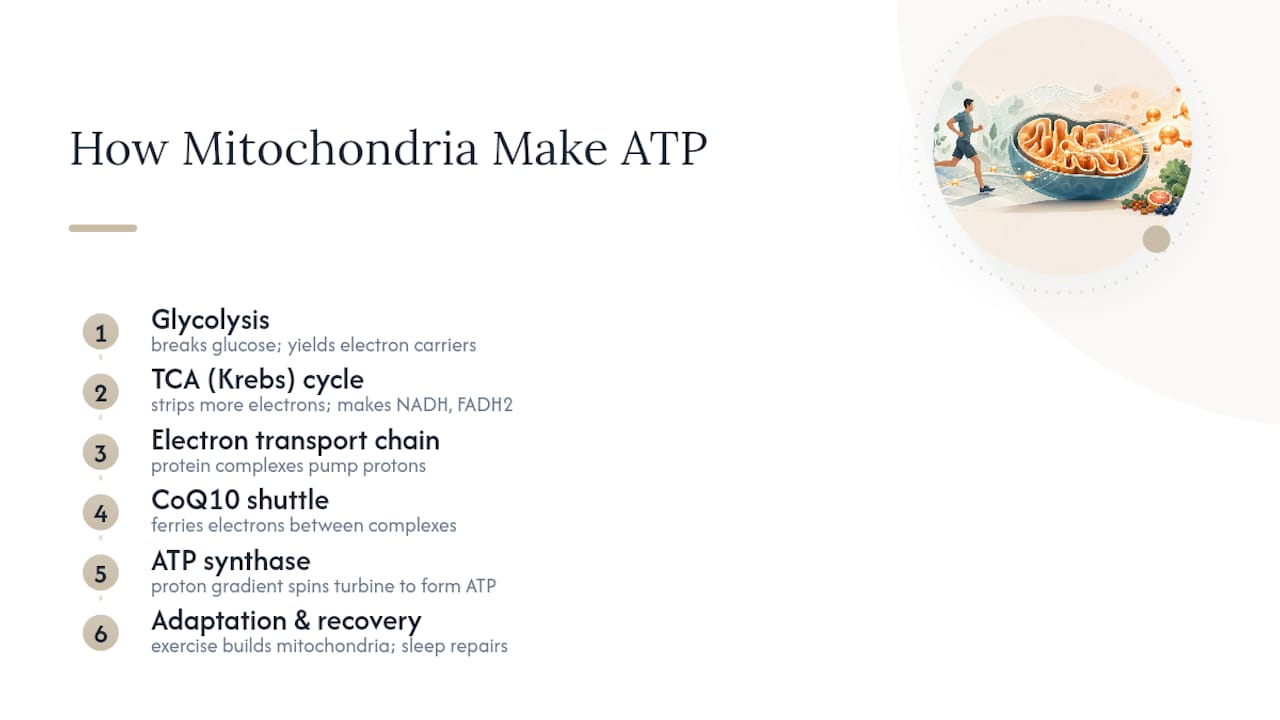
Every cell converts food into usable energy through a chain of reactions that ends in a molecule called ATP, the currency your muscles, brain, and organs spend constantly. It starts with glycolysis, which breaks glucose down in the cell’s main compartment and hands off electron carriers to the mitochondria, the small structures inside cells often called the “powerhouse” for good reason. Inside the mitochondria, the TCA cycle (also called the Krebs cycle) strips more electrons from nutrient fragments and loads them onto two shuttle molecules: NAD+ becomes NADH, and FAD becomes FADH2.
Those shuttles carry electrons to the electron transport chain, a series of protein complexes embedded in the mitochondrial membrane. Coenzyme Q10 sits in the middle of that chain, ferrying electrons between complexes. The chain’s activity pumps protons across the membrane, and that gradient drives ATP synthase, a molecular turbine that literally spins to attach phosphate groups and produce ATP. Without adequate B vitamins, magnesium, and CoQ10 as cofactors, this entire relay slows down regardless of how much food you eat.
Here’s the part most people miss: mitochondria aren’t fixed in number. Exercise, particularly aerobic training, triggers mitochondrial biogenesis, the process of building new mitochondria and expanding existing networks. Recovery periods, especially sleep, are when much of that remodeling and repair actually happens. Skip the recovery, and you cap the adaptation no matter how hard you train.
What Lifestyle Habits Increase Mitochondrial Capacity?
Exercise remains the single most reliable lever for improving mitochondrial function, and the evidence for that claim is deep. A review of exercise and mitochondrial health treats training as the primary intervention for preserving mitochondrial density and efficiency, with supplements positioned as secondary support at best. The federal physical activity guidelines recommend 150 to 300 minutes of moderate aerobic activity per week, or 75 to 150 minutes of vigorous activity, plus muscle-strengthening work on at least 2 days per week. Aerobic training builds the oxidative machinery; resistance training adds muscle mass that houses more mitochondria and demands more of them. You need both, not one or the other.
Sleep is the recovery half of the equation, and most adults shortchange it. Most adults slept fewer than 7 hours a night on average](https://www.cdc.gov/nchs/products/databriefs/db559.htm), below the American Academy of Sleep Medicine’s minimum recommendation. Research on sleep and mitochondrial remodeling shows that chronic short sleep interferes with the redox balance mitochondria need to repair and reorganize. No amount of supplementation compensates for that deficit.
Stress management matters more than most energy guides admit. Chronic cortisol elevation and heavy reliance on stimulants both push the nervous system into a state that interferes with steady mitochondrial output. Three habits help here: schedule actual recovery days instead of “listening to your body” after the fact, practice slow paced breathing for a few minutes daily, and taper stimulant intake rather than layering more caffeine on top of fatigue.
Food timing and composition round out the picture. Spread protein across meals rather than loading it all at dinner, and keep whole grains in the rotation. One 2021 study on whole-grain intake found that pairing whole grains with adequate protein and resistance training modestly supported protein turnover and muscle function, an effect isolated micronutrients don’t replicate on their own.
Practical steps to try this week:
- Book two strength sessions and three cardio sessions on your calendar before the week starts, not after.
- Set a fixed bedtime and wake time, even on weekends, to stabilize your sleep window above 7 hours.
- Add a palm-sized protein source to breakfast, since most people concentrate protein too late in the day.
- Swap one refined-grain meal for a whole-grain option.
- Cut your last caffeine dose to before 2 p.m.
Pro Tip: Track your resting morning energy on a simple 1 to 10 scale for a week before changing anything. It gives you a baseline number to compare against once you start adjusting sleep or training, instead of relying on vague impressions of feeling “more tired” or “less tired.”
Which Nutrients and Supplements Actually Support Energy Metabolism?
Food covers most of what your mitochondria need, and the nutrients with the clearest evidence base are worth naming specifically rather than lumping into a vague “eat healthy” instruction.
B vitamins. Thiamin and riboflavin work as direct cofactors in the pathways that generate ATP. The NIH fact sheet on thiamin notes that whole or fortified grains, legumes, dairy, eggs, nuts, and seeds cover typical needs, and high-dose supplementation only helps when someone is actually deficient. Piling on extra B vitamins when you’re already replete does not translate to more energy.
Magnesium. This mineral is required for both glycolysis and oxidative phosphorylation and functions as a cofactor in more than 300 enzyme systems. Leafy greens, legumes, nuts, seeds, and whole grains are the reliable sources; low intake here is common enough in Western diets that it’s worth a genuine look at your plate before assuming you need a pill.
CoQ10. This is where the supplement evidence gets more interesting, and more nuanced than marketing copy suggests.
A 2022 meta-analysis of 13 randomized trials found CoQ10 supplementation reduced fatigue scores with a moderate effect size (Hedges’ g of negative 0.398). That’s symptom-level relief, not proof that CoQ10 increases ATP output in someone who isn’t deficient.
Creatine and carnitine. These support the energy systems in muscle tissue more directly, particularly around exercise performance, though their benefit is most pronounced in athletes and people with higher training loads rather than as general fatigue fixes.
NAD+ precursors. Nicotinamide riboside and similar compounds have a compelling mechanism on paper. In practice, the trial data on NR is underwhelming: studies changed blood metabolite levels without improving muscle mitochondrial respiration or exercise capacity, and a more recent pilot combining NR with walking found no advantage for blood pressure over walking alone.
The NIH’s material on primary mitochondrial disorders is blunt on this point: there is no single supplement that reliably boosts cellular energy across the board, and most of the strongest results come from people with diagnosed deficiencies or mitochondrial disease, not healthy adults. That’s a meaningfully different population than most readers browsing an energy-supplement aisle.
Before trying any supplement:
- Confirm you’re not simply undereating protein, sleeping poorly, or sedentary, since those three fix more fatigue than any capsule.
- Ask a clinician to check for iron, vitamin D, thyroid, or B12 deficiency if fatigue is persistent.
- Choose products with third-party testing and check for ingredient overlap across everything else you already take.
- Remember dietary supplements are not FDA pre-approved for safety or effectiveness, so read the Supplement Facts panel rather than the front-of-bottle claims.
For a deeper breakdown of which products have real human evidence behind them, Nutribliss’s guide to energy supplements and overview of supplement safety and regulation both go further into interaction risks and dosing context.
How Do You Test What Actually Works for Your Energy?
A single-variable, multi-week test beats guessing, and it beats stacking five changes at once and having no idea which one helped.
Week 0: baseline. Track sleep hours, morning energy on a 1 to 10 scale, training performance (weights lifted, pace, or reps), and any medications or supplements you’re already taking. Write it down daily; memory alone rounds numbers in flattering directions.
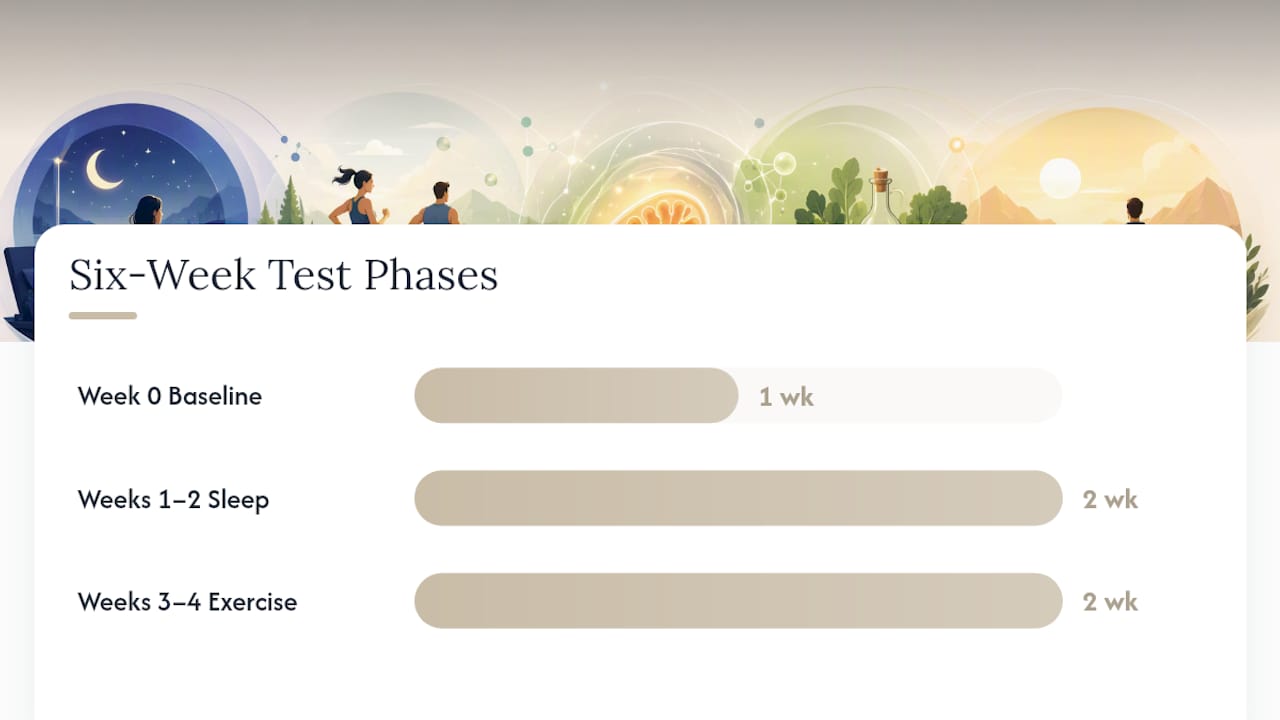
Weeks 1 to 2: sleep consistency. Fix your bedtime and wake time. Change nothing else.
Weeks 3 to 4: exercise volume. Add the strength and cardio minutes from the physical activity guidelines if you’re not already there. Keep sleep steady.
Weeks 5 to 6: diet and, if warranted, one supplement. Adjust protein distribution and whole-grain intake first. Only then, if a real gap remains and a clinician has ruled out deficiency, introduce a single supplement, one at a time, never a stack.
Practical guidance for running this well:
- Use a notes app or a simple spreadsheet, not memory, to log your daily numbers.
- Change exactly one variable per phase; simultaneous changes make it impossible to know what worked.
- Stop a supplement trial immediately if you notice any adverse effect, and stop it at the end of the trial window regardless if you notice no benefit.
- Reassess against your Week 0 baseline, not against how you feel compared to yesterday.
Pro Tip: Multi-week windows matter more than people expect. Two or three weeks is roughly the minimum to separate a real trend from normal day-to-day noise in energy and sleep, which is why single-variable changes need to run that long before you draw any conclusion.
Realistic Expectations and Common Pitfalls
Fatigue rarely has one cause, and that’s the piece most energy content skips past. A tired, sluggish feeling can trace back to poor sleep, undiagnosed anemia, thyroid dysfunction, chronic stress, medication side effects, or a mitochondrial issue that genuinely needs medical attention, not a supplement. If fatigue is disproportionate to your sleep and training load, or it’s persistent despite fixing the basics, that’s a signal to get evaluated rather than to keep experimenting on yourself indefinitely.
The pitfall I see most often is supplement stacking: someone takes a multivitamin, a CoQ10 capsule, a B-complex, and an energy gummy simultaneously, then can’t tell what’s helping, what’s doing nothing, or what’s interacting badly with something else. Heavy stimulant use compounds this, masking fatigue instead of resolving it and often disrupting the sleep that would have fixed the problem in the first place.
None of this is complicated once you strip the marketing away. Incremental, evidence-based changes, tested one at a time, beat any single pill. That’s not a compromise position. It’s what the actual research supports.
— GAURAV
Where Nutribliss Fits Into a Food-First Energy Plan
Once your sleep, training, and meals are dialed in, the remaining gap is usually small, and that’s exactly where a targeted supplement earns its place instead of masking a problem you haven’t actually fixed. Some supplement companies build their formulas around third-party lab testing and transparent ingredient sourcing, so consumers can know what’s actually in the capsule and at what dose, not just what the label promises.

If your diet is inconsistent on protein or whole grains, Daily Foundations is built to cover the everyday micronutrient gaps this article walks through, including magnesium and B-vitamin support. Training hard and want recovery support that respects the same food-first logic, Athlete Recovery & Performance is formulated for people layering supplements onto real training volume rather than in place of it. For readers leaning into whole-food density over isolated pills, the Superfood Collection offers a nutrient-dense middle ground.
Whatever you choose, treat it as one variable in the six-week plan above, not a shortcut around it. Check with a clinician before adding anything if you take medication, and avoid stacking overlapping formulas. Browse the collections, check the ingredient panels against what your diet is actually missing, and add one product at a time.
Sources
This article is general information, not a substitute for advice from a qualified doctor. Consult a qualified healthcare professional about your own circumstances before acting on anything here.
FAQ
How Can I Boost Cellular Energy Production Naturally?
Consistent aerobic and resistance exercise, 7 or more hours of sleep, and a protein-adequate diet with magnesium and B vitamins are the most reliable levers. The federal guidelines recommend 150 to 300 minutes of moderate cardio weekly plus strength training twice a week as the baseline.
What Is the Best Supplement for Cellular Energy?
There isn’t one universal best option; evidence varies by nutrient and by whether you actually have a deficiency. CoQ10 has the strongest symptom-level support, with a 2022 meta-analysis linking it to reduced fatigue scores, though that’s not the same as proving higher ATP output in healthy people. Products like those in Nutribliss’s Daily Foundations line are designed as adjuncts to a food-first diet, not replacements for it.
How Do I Repair My Mitochondria Naturally?
Exercise is the primary driver of mitochondrial repair and biogenesis, according to research on exercise and mitochondrial health, with sleep providing the recovery window where much of that remodeling happens. Sufficient magnesium, B vitamins, and protein support the biochemical machinery involved, but none of them substitute for the training and sleep that trigger the adaptation itself.
What Foods Boost Cellular Repair?
Leafy greens, legumes, nuts, and seeds supply magnesium; whole grains, dairy, eggs, and fortified cereals supply thiamin and riboflavin, all direct cofactors in energy metabolism. Adequate protein spread across meals, paired with whole grains, has also been linked to better protein turnover and muscle function in a 2021 study when combined with resistance training.
When Should I See a Doctor About Low Energy?
See a clinician if fatigue is persistent, disproportionate to your sleep and activity levels, or unresponsive to a few weeks of consistent sleep and exercise changes. Chronic fatigue can signal thyroid dysfunction, anemia, or other conditions that NIH research on mitochondria and health notes deserve proper medical evaluation rather than prolonged self-experimentation with supplements.