

TL;DR:
- Poor sleep quality affects millions and contributes to serious health conditions despite efforts to rest better.
- Consistent wake times, a cool dark environment, and proper timing of daily habits can dramatically improve sleep quality.
You already know that sleep matters. But knowing it and actually achieving it are two different things. If you’ve tried going to bed earlier and still wake up feeling wrecked, you’re not alone. Poor sleep quality, what sleep specialists call sleep insufficiency or insomnia, affects millions of adults and contributes to obesity, heart disease, and depression. The good news is that concrete, science-backed lifestyle changes can dramatically improve how you sleep. This guide walks you through every stage, from setting up your environment to adjusting your daily habits and choosing the right natural remedies.
Table of Contents
- Key Takeaways
- How to improve sleep quality: the foundation
- Timing your daily habits for better nights
- Behavioral techniques to fall asleep and stay asleep
- Natural remedies and supplements for sleep support
- Tracking progress and troubleshooting setbacks
- My honest take on what actually works
- Sleep better with Nutribliss
- FAQ
Key Takeaways
| Point | Details |
|---|---|
| Consistency beats perfection | A fixed wake-up time does more for your sleep than trying to go to bed at the exact same time every night. |
| Your environment sends signals | A cool (60–67°F), dark, quiet room tells your brain it’s time to sleep before you even close your eyes. |
| Timing your habits matters | When you eat, drink caffeine, exercise, and nap directly shapes how well you sleep that night. |
| The 20-minute rule works | If you can’t fall asleep after 20 minutes, leaving the bed breaks the frustration cycle that makes insomnia worse. |
| Supplements support, not replace | Melatonin and magnesium can help, but they work best on top of solid sleep hygiene, not instead of it. |
How to improve sleep quality: the foundation
Before any technique or supplement can work, you need to understand what your body actually needs. Adults require roughly 7 to 8 hours of sleep per night. Going below that consistently causes measurable cognitive and health deficits, no matter how adapted you think you’ve become to running on six hours.
Why your schedule matters more than your bedtime
Your body runs on a circadian rhythm, a roughly 24-hour internal clock that regulates when you feel alert and when you feel tired. The most reliable way to support that clock is consistent sleep-wake schedules. That means waking up at the same time every day, including weekends. Sleeping in on Saturday to “catch up” actually shifts your rhythm and makes Sunday night harder to fall asleep.
Setting up a bedroom that promotes rest
Your bedroom should function as a dedicated sleep space, and these physical elements make a measurable difference:
- Temperature: Keep it between 60 and 67°F to support your body’s natural temperature drop during sleep onset.
- Light: Total darkness is ideal. Blackout curtains or a sleep mask block street lights and early morning sun that can fragment sleep.
- Noise: A white noise machine or earplugs reduce the chance that background sound pulls you out of lighter sleep stages.
- Electronics: Screens in the bedroom, even powered-down TVs and phones, function as arousal cues that interfere with your brain’s association between bed and sleep.
These factors work together. Think of them as a collective signal your environment sends to your brain. A cool, dark, quiet, screen-free room trains your nervous system to associate that space with rest.
| Bedroom factor | Recommended setting | Why it helps |
|---|---|---|
| Temperature | 60–67°F | Supports natural body temp drop during sleep |
| Lighting | Total darkness | Prevents melatonin suppression |
| Noise | Quiet or white noise | Reduces sleep fragmentation |
| Electronics | Out of the bedroom | Eliminates blue light and arousal cues |
Pro Tip: If you read before bed, use warm-toned lighting or an amber bulb. Blue-spectrum light from standard LEDs suppresses melatonin even at low intensities.
Good sleep hygiene, which you can read more about in this sleep hygiene guide, is largely about training your environment to do the work of preparing your brain for sleep.
Timing your daily habits for better nights
What you do during the day sets the stage for what happens at night. The specific timing of meals, drinks, exercise, and naps is just as significant as what you do.

Eating within three hours of bedtime increases the risk of acid reflux, discomfort, and fragmented sleep. Your digestive system stays active after a large meal, which competes directly with the rest-and-repair processes your body needs during sleep. Similarly, limiting fluids in the two hours before bed reduces the chance of waking up for bathroom trips, which interrupts your sleep cycles at the worst moments.
Caffeine and alcohol deserve special attention. Caffeine after noon can still be active in your system at midnight since its half-life runs six to eight hours. Many people who swear they “sleep fine” after an afternoon coffee are actually spending less time in deep, restorative sleep without realizing it. Alcohol is even more deceptive. It helps you fall asleep faster, but it fragments REM sleep and worsens snoring, leaving you groggy regardless of how many hours you logged.
Exercise is one of the most effective tools for improving nightly rest, but timing matters. Regular physical activity improves sleep depth and duration over time. The caveat is that vigorous workouts within two to three hours of bedtime elevate core temperature and cortisol levels, both of which delay sleep onset. Morning or afternoon workouts deliver the benefits without the drawback.
- Finish your last full meal at least three hours before bed.
- Cut off caffeine consumption by noon.
- Stop alcohol at least three to four hours before your target bedtime.
- Schedule intense exercise for the morning or early afternoon.
- Keep naps to 20 minutes or less and take them before 3:00 PM.
Pro Tip: If you need an afternoon pick-me-up, try a short walk outdoors. Natural light exposure in the afternoon reinforces your circadian rhythm and gives you energy without the sleep cost of caffeine.
Behavioral techniques to fall asleep and stay asleep
Struggling to fall asleep and then lying there frustrated is one of the most counterproductive patterns in sleep medicine. The harder you try to force sleep, the more alert your brain becomes. Cognitive Behavioral Therapy for Insomnia, known as CBT-I, addresses this directly through structured behavioral changes.
Here is a practical sequence you can start tonight:
- Set a consistent wake time first. Pick the same time every morning and protect it ruthlessly, even on days when you slept poorly. This is the single most powerful lever you have over your circadian rhythm.
- Build a 30 to 60-minute wind-down routine. Use the same sequence each night: dim lights, light reading or gentle stretching, maybe a warm shower. The routine itself becomes a sleep trigger.
- Apply the 20-minute rule. If you’re still awake after roughly 15 to 20 minutes, get out of bed and move to another room. Do something calm until you feel genuinely sleepy, then return. This breaks the negative association between your bed and wakefulness.
- Avoid screens for at least 45 minutes before bed. Replace scrolling with something analog. Reading a physical book, journaling, or light stretching signals the shift from stimulation to rest.
- Stop clock-watching. Turn your clock away from view. Watching time pass creates anxiety, which spikes cortisol and delays sleep further.
The stimulus control component of CBT-I is one of the most well-supported treatments in sleep research. It works by rebuilding the mental link between bed and sleepiness rather than bed and frustration. For people with chronic insomnia, sleep hygiene alone may not be sufficient, which is why the structured behavioral approach matters.
Pro Tip: Write a brief “worry dump” before bed. Spend three to five minutes writing down tomorrow’s tasks and any lingering anxieties. Research on this technique shows it reduces the mental chatter that delays sleep onset.
Natural remedies and supplements for sleep support
Natural supplements are useful tools when used correctly. They are not shortcuts. Their value depends entirely on using them alongside solid sleep habits, not as a replacement for them.
Melatonin is the most popular sleep supplement and also the most misunderstood. It works best for circadian rhythm disorders, such as jet lag or shift work, not for standard insomnia. Timing matters more than dose. Taking 0.5 to 1 mg about 30 minutes before your target bedtime is more effective than taking 10 mg right before you lie down.
Magnesium, particularly magnesium glycinate, supports muscle relaxation and nervous system calm. Learn more about how magnesium supports sleep and muscle health and why the form you take makes a difference.
Other natural options worth considering:
- L-theanine: An amino acid from green tea that promotes calm without sedation.
- Ashwagandha: An adaptogen shown to reduce cortisol levels and improve sleep onset time in several studies.
- CBD oral sprays: Some people find a CBD pre-bedtime routine helpful for winding down before sleep.
One comparison worth understanding:
| Supplement | Best use case | Timing |
|---|---|---|
| Melatonin | Jet lag, shift work, circadian reset | 30 min before target bedtime |
| Magnesium glycinate | Relaxation, muscle tension, anxiety | 30 to 60 min before bed |
| L-theanine | Reducing mental overactivity | 30 to 45 min before bed |
Avoid long-term reliance on over-the-counter sleep aids. Extended OTC sleep aid use carries real risks, including daytime drowsiness, fall risk in older adults, and dependency. Talk to your doctor before starting any supplement, especially if you take medications.
Tracking progress and troubleshooting setbacks
Improving your sleep is a process, and tracking it makes the difference between guessing and knowing what’s working.
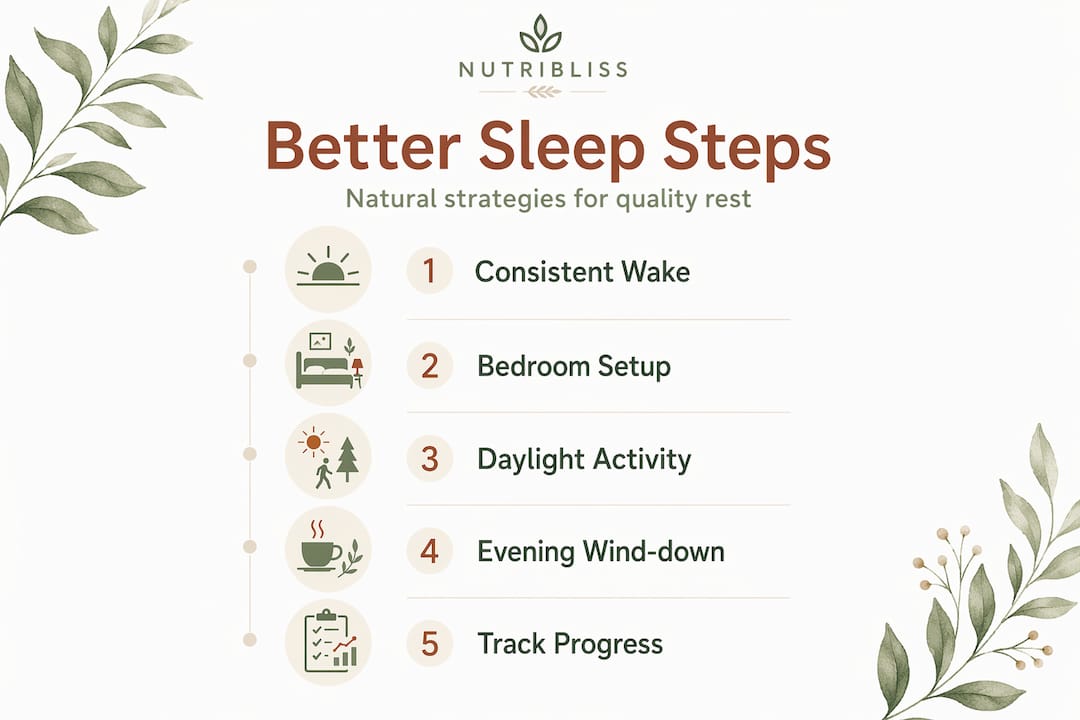
A sleep diary is the simplest tool available. Each morning, note your bedtime, wake time, how long it took to fall asleep, any nighttime awakenings, and your energy rating. After two weeks, patterns will emerge. You might notice that nights after alcohol, late dinners, or irregular schedules consistently score lower, which gives you something concrete to change.
Here’s what to watch for as you build better habits:
- Signs of progress: Falling asleep faster, fewer nighttime awakenings, waking feeling rested.
- Common pitfalls: Skipping your wake time on weekends, adding caffeine “just this once” in the afternoon, going to bed while stressed or still on screens.
- Red flags for professional help: Chronic difficulty falling or staying asleep lasting more than three months, excessive daytime sleepiness despite adequate hours, or signs of sleep apnea like gasping or loud snoring.
Expect changes to take two to four weeks of consistency before they feel natural. Sleep improvements don’t happen in three days.
Pro Tip: Rate your sleep quality on a simple 1 to 5 scale each morning and average it weekly. One number is easier to track than a paragraph of notes, and weekly averages reveal trends that single nights hide.
My honest take on what actually works
I’ve watched a lot of people chase perfect sleep with the wrong tools. They buy expensive mattresses, try every supplement on the market, and obsess over their sleep tracker numbers. What I’ve seen consistently is that none of it matters much without addressing the basics first.
The most underestimated factor in my experience is the fixed wake-up time. Not bedtime. Wake time. When you protect your morning alarm even after a rough night, you build sleep pressure throughout the day that makes the following night much easier. Most people do the opposite. They sleep in to compensate, and then wonder why they can’t fall asleep the next night.
I’ve also noticed that people underestimate how much the hour before bed shapes their sleep. What happens in those final hours before bedtime matters enormously. A stimulating argument, a stressful email, or even an intense TV episode can delay sleep by 30 to 60 minutes. The wind-down routine isn’t a luxury. It’s a physiological requirement.
My honest advice: start with one change. Pick your wake time, stick to it for two weeks, and watch what happens. Add other strategies from there. Trying to overhaul everything at once creates stress, and stress is the enemy of sleep.
— GAURAV
Sleep better with Nutribliss

If you’ve put the lifestyle strategies in place and want added support, Nutribliss has products built specifically for this. The Nutribliss Sleep Formula combines clinically studied ingredients designed to support healthy sleep cycles without next-day grogginess. Pair it with Magnesium Glycinate for muscle relaxation and nervous system calm before bed.
Every Nutribliss product is grounded in the science you’d expect from a brand serious about results. Explore the science behind our formulas to understand what goes into each capsule and why. For people building a complete wellness routine, browse the full Nutribliss supplement catalog to find what fits your goals.
Use #nutribliss to share your sleep progress and join a community of people taking their rest seriously.
FAQ
How many hours of sleep do adults actually need?
Most adults need 7 to 8 hours per night according to the American Academy of Sleep Medicine. Consistently sleeping less leads to cognitive deficits, weakened immunity, and increased disease risk.
What is the fastest way to improve sleep quality naturally?
The most immediate change you can make is setting a fixed daily wake time and sticking to it, including weekends. Consistent scheduling resets your circadian rhythm faster than any other single adjustment.
Does melatonin actually help with insomnia?
Melatonin is most effective for circadian rhythm disruptions like jet lag or shift work rather than standard insomnia. Low doses (0.5 to 1 mg) timed 30 minutes before your target bedtime produce better results than high doses taken right before bed.
When should I see a doctor about poor sleep?
If you’ve struggled with falling or staying asleep for more than three months, experience excessive daytime sleepiness, or a partner reports that you gasp or snore loudly, consult a sleep specialist. These signs may point to an underlying disorder like sleep apnea that lifestyle changes alone won’t fix.
Can exercise help you sleep better?
Regular physical activity significantly improves sleep depth and duration over time. Schedule vigorous workouts in the morning or early afternoon to avoid the cortisol and body temperature spike that late evening exercise causes.