

TL;DR:
- Most successful meal planning focuses on simple, repeatable meals and a well-organized grocery list to minimize decision fatigue.
- Starting with small goals like two dinners and one lunch weekly helps build consistency and reduces overwhelm.
- Regular weekly reviews and adjustments ensure your plan remains realistic, flexible, and aligned with your evolving goals.
Most people spend more mental energy deciding what to eat each day than they realize. That daily scramble, staring at the fridge at 6 PM with no plan, leads to takeout, skipped meals, and nutrition goals that never quite stick. Learning how to build a meal plan is one of the highest-return habits you can develop. Done right, it saves you time, cuts food waste, reduces stress, and makes eating for your health or fitness goals something that actually happens, not something you keep meaning to do. This guide walks you through everything from setup to weekly refinement.
Table of Contents
- Key Takeaways
- How to build a meal plan: what you need before you start
- Step-by-step: building your weekly meal plan
- Troubleshooting common meal planning challenges
- Reviewing and refining your plan each week
- My honest take on what actually makes meal planning work
- Support your meal plan with the right nutrition foundation
- FAQ
Key Takeaways
| Point | Details |
|---|---|
| Start smaller than you think | Plan only 2 dinners and 1 lunch your first week to reduce overwhelm and build momentum. |
| Use the 3-2-1 meal method | Plan 3 core dinners, 2 leftover nights, and 1 open night for a sustainable weekly rhythm. |
| Make your grocery list the priority | A well-built grocery list prevents execution drift and keeps your plan from falling apart mid-week. |
| Repeat meals on purpose | Default, repeatable meals reduce decision fatigue far better than planning something new every night. |
| Treat it as a living system | Small weekly adjustments outperform trying to build a perfect plan from scratch every time. |
How to build a meal plan: what you need before you start
Before you open a recipe app or write a single meal down, two things need to be clear: what you are working toward, and what your week actually looks like. Skipping this step is why most meal plans get abandoned by Wednesday.
Start by defining your goal in specific terms. Using the SMART goal framework gives your plan a concrete target, whether that is eating more vegetables, hitting a protein target, losing body fat, or simply cooking at home four nights a week. A goal like “eat healthier” gives you nothing to plan around. A goal like “eat 100 grams of protein per day and cook dinner five nights a week” tells you exactly what your plan needs to do.
Next, take stock of your real schedule. Not your ideal week. Your actual week. If you have three evenings with back-to-back commitments, plan for those nights to be leftover nights or something you can reheat in ten minutes. Repeatable default meals that fit your true schedule are what separate a plan you follow from one you abandon.
Here is the basic toolkit that makes meal planning and prep genuinely easier:
- Weekly planner or planning app: A simple notebook works. So do dedicated apps. What matters is having one place where your meals live.
- Quality meal prep containers: Glass or BPA-free plastic in multiple sizes. Prepped meals stay fresh in the refrigerator for 4 to 5 days max, so containers that seal well matter.
- A slow cooker or sheet pan: These two tools make batch cooking low-effort and hands-off.
- Sharp chef’s knife: Nothing slows down veggie prep like a dull blade. Dietitians consistently rank quality kitchen tools as a major factor in whether people actually follow through on meal prep.
- Pantry inventory list: A running list of what you already have at home, so your grocery trips fill gaps rather than duplicate items.
Pro Tip: Before your first planning session, spend five minutes photographing your pantry and fridge. This one habit alone can reduce food waste significantly by keeping you from buying what you already own.
| Tool | Why it matters |
|---|---|
| Meal prep containers | Keeps prepped food fresh and portion-ready throughout the week |
| Weekly planner or app | Centralizes your plan so meals are never forgotten |
| Slow cooker | Enables hands-off batch cooking on busy evenings |
| Sharp chef’s knife | Speeds up vegetable and protein prep considerably |
| Pantry inventory list | Prevents duplicate purchases and reduces food waste |
Step-by-step: building your weekly meal plan
This is where most guides get too abstract. Here is a concrete process you can run in about 30 minutes each week.
Step 1: Set your weekly goal. Use your broader nutrition goal to anchor this specific week. If muscle gain is the target, you need a plan hitting at least 1,500 to 2,000 calories with 66 or more grams of protein daily. If your goal is weight management, focus on filling half your plate with vegetables, a quarter with lean protein, and a quarter with complex carbs. Your goal shapes every choice that follows.
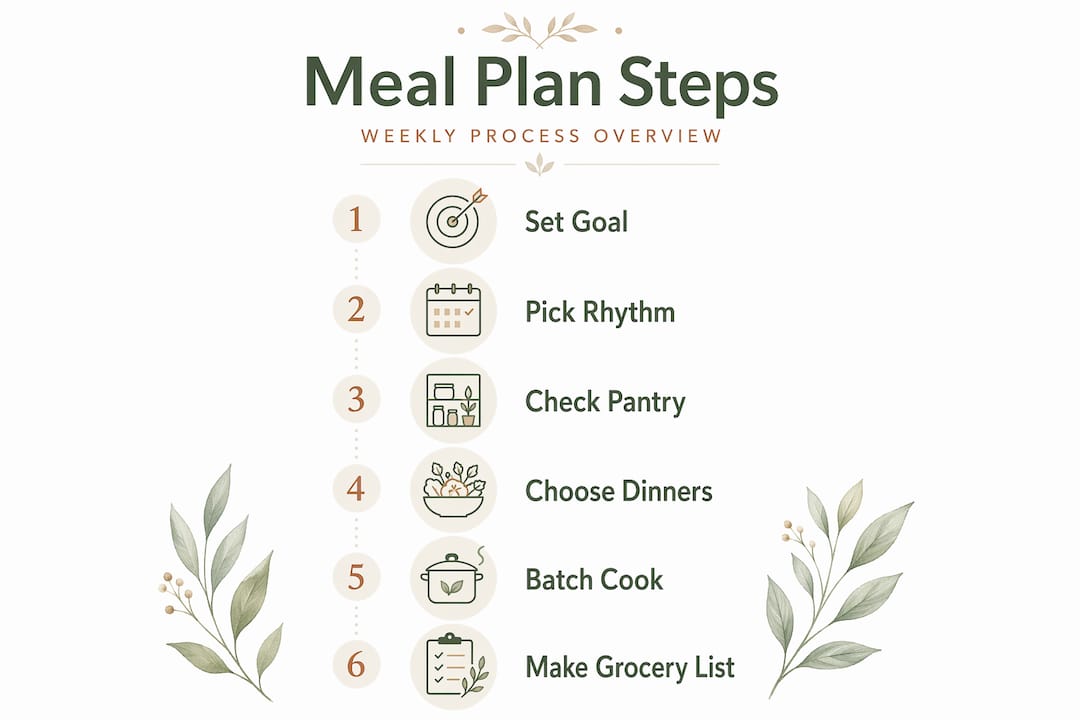
Step 2: Pick your meal rhythm. Do not try to plan 21 unique meals. That is a recipe for burnout. Instead, plan 3 core dinners, designate 2 nights for leftovers from those dinners, and leave 1 night open for flexibility or whatever is in the fridge. For lunches, plan 2 to 3 options maximum and rotate them. Breakfast can stay the same all week if that simplifies your mornings.
Step 3: Check your pantry before you plan. This is called reverse meal planning, and it is one of the most underused strategies out there. Start with what you already have. Build meals around expiring proteins, grains already open, and vegetables that need to be used. Inventory-first planning can reduce food waste by 20 to 30 percent compared to starting from scratch every week.

Step 4: Choose your 3 core dinners. Pick meals that share ingredients where possible. For example: roasted chicken thighs, brown rice, and roasted broccoli on Monday; chicken rice bowls with avocado and salsa on Wednesday using leftovers; sheet pan salmon with sweet potatoes and green beans on Thursday. One prep session handles much of the work for multiple meals.
Step 5: Batch cook your base components. Rather than assembling complete meals in advance, batch cooking base ingredients like roasted vegetables, grilled protein, and cooked grains gives you mix-and-match flexibility throughout the week. Fully assembled meals tend to get soggy or repetitive fast. Components stay fresh longer and combine into different dishes each day.
Step 6: Build your grocery list from the plan, not from memory. Write down exactly what each meal needs, subtract what you already have, and build a consolidated list by store section. Focusing on your grocery list as the primary output of your planning session is what prevents execution drift during the week. The list is where your plan either survives or collapses.
Pro Tip: Assign theme nights to remove the decision entirely. Monday is protein and veggies, Tuesday is pasta or grains, Thursday is fish. You only choose the specific recipe, not the category. This alone cuts planning time in half.
Experts recommend setting aside 20 to 30 minutes weekly for this process, and starting with just 2 dinners and 1 lunch if you are new to it. Fewer meals planned consistently beats a full week planned once and abandoned. For deeper reading on how balanced nutrition shapes your meal choices, the foundation is worth understanding before you commit to a specific structure.
Troubleshooting common meal planning challenges
Even well-built plans run into friction. Here is how to handle the most common problems without scrapping the whole system.
Overplanning kills follow-through. The biggest mistake is planning for your aspirational self rather than your real self. If you are exhausted on Thursdays, do not plan a recipe with 12 ingredients for Thursday night. Small, intentional steps build habits far more reliably than elaborate systems that only work when everything goes right.
Leftovers getting ignored. The fix is to plan for leftovers explicitly, not hope they get eaten. If you cook a large batch of ground turkey on Sunday, put “turkey bowls” on Tuesday’s plan. Named leftovers get eaten. Unnamed leftovers sit in the fridge and get thrown out.
Grocery list discipline slipping. Buying items that were not on your list is how food waste creeps back in. Stick to the list you built from your actual plan. If you are using an app, the best meal planning apps like those with built-in pantry tracking help you stay on track by syncing your plan directly to your shopping list.
- Build in at least one “fallback meal” each week, something simple like eggs and toast or canned soup, for nights when nothing goes as planned.
- Avoid buying ingredients for aspirational recipes you have never cooked. Stick to meals you know you will actually make.
- If a meal gets skipped three weeks in a row, remove it from your rotation. It is not the right fit for your life right now.
- Review your plan midweek. A quick two-minute check on Wednesday prevents forgotten meals from going to waste by the weekend.
Pro Tip: If cooking feels like too much on a given night, give yourself permission to use that open night slot. The goal is adherence over time, not perfection every single evening.
For guidance on setting health goals that connect naturally to your meal planning process, having a clear framework makes your plan feel purposeful rather than arbitrary.
Reviewing and refining your plan each week
A meal plan is not a document you write once. It is a system you tune over time. The weekly review takes five minutes and makes everything work better going forward.
- Note what got eaten versus skipped. If a meal sat untouched, ask yourself why. Was it too complicated? Did something come up? Did you not feel like that food by the time the day arrived? The answer tells you what to change.
- Track food waste and grocery budget surprises. If you threw out half a bunch of kale or a bag of spinach, that ingredient may not belong in your plan this time of year, or you bought too much. Adjust portions and quantities accordingly.
- Assess effort ceiling honestly. Some weeks you have time and energy to cook. Other weeks you need four meals that take under 20 minutes. Build your review around what your upcoming week actually looks like, not last week.
- Adjust for changing goals. If you started meal planning to lose weight and your goal shifts toward building muscle, your calorie and protein targets change. Your plan should reflect that shift. Weekly review and minor adjustments sustain effectiveness far better than rebuilding the plan from scratch every month.
- Add one new recipe per month, not per week. Novelty is fine in small doses. Trying to cook something new every week is exhausting. One new recipe every few weeks keeps things interesting without adding stress.
Pro Tip: Keep a short “meal wins” list on your phone. When a meal goes well and you loved eating it, write it down. Over time, this list becomes your default rotation and makes planning significantly faster.
A personalized nutrition approach means your plan reflects your actual body, preferences, and schedule. No template does that for you. Only iteration does.
My honest take on what actually makes meal planning work
I have worked with a lot of people on nutrition habits, and the pattern I keep seeing is this: the ones who succeed are not the ones with the most elaborate plans. They are the ones with the shortest, most repeatable grocery lists.
Most guides celebrate recipe variety. I think that is mostly wrong, at least at the start. The real deliverable of any good meal planning session is a grocery list that fits your week and a rotation of meals you already know how to make. Complexity is the enemy of consistency.
The other thing I have seen derail people is planning for a version of their life that does not exist yet. If you have never meal prepped before, planning five unique dinners, three different lunches, and daily snacks in week one is setting yourself up to quit. Start with two dinners. Nail those. Then add.
What changed things for many people I have supported is shifting the frame entirely. Meal planning is not about eating perfectly. It is about removing barriers so that eating well becomes the path of least resistance, not the harder choice. That reframe makes the whole process feel less like discipline and more like design.
— GAURAV
Support your meal plan with the right nutrition foundation

Building a solid meal plan covers the food side of your nutrition strategy. But even the most thoughtfully planned meals can leave gaps in micronutrients, protein intake, or recovery support, especially if you are training hard or managing a demanding schedule. That is where Nutribliss comes in. The Nutribliss superfoods collection is built around science-backed ingredients designed to complement, not replace, real food. From protein powders and electrolytes to vitamins and specialty capsules, every product is formulated to fill the gaps your meals might miss. Visit Nutribliss supplements to browse the full range and find what fits your goals. Follow along at #nutribliss for tips, product highlights, and nutrition content worth your time.
FAQ
How long does it take to build a meal plan each week?
Most people can complete a solid weekly meal plan in 20 to 30 minutes. Beginners who start with just 2 dinners and 1 lunch often find the process takes under 15 minutes once they have a basic rotation established.
What is the best meal planning method for beginners?
The 3-2-1 method works well for most beginners: plan 3 core dinners, use leftovers for 2 nights, and leave 1 night open. This structure reduces decision fatigue and makes the plan realistic enough to actually follow.
How do I know if my meal plan is nutritionally balanced?
Use the balanced plate model as a starting point: fill half your plate with vegetables, one quarter with lean protein, and one quarter with complex carbs, plus a source of healthy fat. For fitness-specific goals like muscle gain, aim for at least 66 grams of protein per day.
What are the most common reasons meal plans fail?
The two biggest culprits are overplanning unique meals and building a plan around an idealized schedule rather than your real week. A misaligned grocery list that does not match the actual plan is also a frequent source of execution drift.
Do I need a special app to create a meal plan?
No. A notebook and a grocery list work fine. That said, the best meal planning apps can speed up the process by linking your meal choices directly to a shopping list and tracking pantry inventory, which helps reduce waste and shopping time.