

Most adults should build meals around nutrient-dense whole foods first, and treat supplements as a patch for documented gaps rather than a daily insurance policy. A basic multivitamin makes sense if your diet is inconsistent or a blood test flags a shortfall. Beyond that, the supplements worth discussing with a clinician are narrower than the vitamin aisle suggests.
- Vitamin D: worth considering for most adults, especially with limited sun exposure.
- Vitamin B12: relevant for older adults, vegans, and vegetarians.
- Vitamin C: only if your diet runs low in fruits and vegetables.
- Zinc: for documented deficiency, not routine use.
- Iron and high-dose fat-soluble vitamins (A, D, E, K): test first, then supplement under clinician guidance, since excess accumulates in the body rather than flushing out.
The Dietary Guidelines for Americans (2025–2030) back this order of operations: food first, supplements second, and only to fill a gap you can actually name.
Key Takeaways
Diet-first nutrition covers most needs, and daily supplementation only pays off when it targets a documented gap confirmed by diet review or lab testing.
| Point | Details |
|---|---|
| Food comes first | Build meals around nutrient-dense whole foods before adding any daily supplement. |
| Test before you supplement | Request 25-OH vitamin D, serum B12, and ferritin tests to confirm a real gap. |
| Watch the fat-soluble vitamins | Vitamins A, D, E, and K accumulate in the body, so high doses carry real toxicity risk. |
| Read the label, not the marketing | Choose products with exact ingredient amounts and third-party testing seals, and skip vague “proprietary blends.” |
| Choose transparent, tested formulas | Nutribliss offers life-stage multivitamins with third-party testing and full-dose labeling for readers who’ve confirmed a documented gap. |
Table of Contents
- Good Daily Vitamins to Check Against Your Diet
- Who Should Get Tested Before Adding Daily Supplements
- The Real Risks of Taking Too Many Vitamins
- How to Choose a Quality Multivitamin or Supplement
- Building a Daily Supplement Routine That Actually Sticks
- Why “Test First” Beats “Take Everything”
- Where to Find Transparent, Third-Party Tested Vitamins
- Frequently Asked Questions
- Sources
Good Daily Vitamins to Check Against Your Diet
Here’s a working checklist for daily vitamins to take, organized by who actually benefits and what to watch.
- Multivitamin/mineral (MVM). Fills small, scattered gaps across a diet that’s inconsistent rather than deficient in one nutrient. A Consumer fact sheet from the NIH Office of Dietary Supplements notes that MVM use raised nutrient adequacy from about three quarters to over four fifths across 17 nutrients in one study, but the same users showed higher odds of excess intake for vitamin A, iron, and zinc. More isn’t automatically better.
- Vitamin D. Supports bone health and immune regulation. People with limited sun exposure, darker skin, or northern latitudes are common candidates. D3 (cholecalciferol) is the form most clinicians discuss, typically in the 600 to 2,000 IU daily range depending on baseline levels.
- Vitamin C. Matters for immune maintenance and collagen synthesis, primarily useful when produce intake is genuinely low. Most people get enough from citrus, peppers, and broccoli without a pill.
- B-complex, especially B12. Vegans, vegetarians, and adults over 50 lose stomach acid and absorption efficiency, which limits B12 uptake from food. Methylcobalamin is the form most often recommended.
- Zinc. Supports immune function and wound healing but only merits daily supplementation with a confirmed deficiency, since it’s easy to overshoot the upper limit.
- Iron. Needed for menstruating women, pregnant women, and some vegetarians, but never a default. Iron overload carries real risk to the liver and heart.
Statistic to remember: the ODS immune function fact sheet lists vitamin C, vitamin D, and zinc among the nutrients most tied to immune performance, each with its own RDA and upper limit. Pregnant women, older adults, and smokers show up repeatedly as the groups most likely to fall short on one or more of these.
Who Should Get Tested Before Adding Daily Supplements
Testing beats guessing, and it’s cheaper than a cabinet full of bottles you don’t need.
- Pregnant women need folate and iron tracked closely; deficiency risk here is well documented and the stakes are higher than for most other groups.
- Vegans and vegetarians are the classic B12 risk group, since the vitamin occurs almost exclusively in animal products.
- Older adults often absorb B12 and vitamin D less efficiently, even with a reasonable diet.
- Anyone with malabsorption conditions (Crohn’s, celiac, prior bariatric surgery) needs individualized monitoring, not a general multivitamin.
- People on certain medications, including metformin and long-term acid reducers, are at higher risk for B12 depletion.
Ask your clinician about a 25-OH vitamin D test, serum B12 (or methylmalonic acid when B12 is borderline), ferritin and iron studies, and a TSH if fatigue is the symptom driving the conversation. A pragmatic prescribing review in adult medicine frames this as the difference between treating a real deficiency and layering supplements onto a body that doesn’t need them.
Pro Tip: Book the blood panel before you buy the bottle. A $30 to $80 lab test is cheaper than a year of guessing, and it tells you exactly which nutrient, if any, needs attention.
The Real Risks of Taking Too Many Vitamins

Fat-soluble vitamins, A, D, E, and K, store in your liver and fat tissue instead of leaving through urine like B and C vitamins do. That storage is exactly why routine high-dose supplementation of vitamin E or beta-carotene isn’t recommended for disease prevention. The evidence doesn’t support it, and in a few large trials, high-dose beta-carotene actually raised lung cancer risk among smokers.
Interactions matter too:
- High-dose zinc can interfere with copper absorption over time.
- Vitamin K can blunt the effect of blood thinners like warfarin.
- High-dose vitamin C can skew certain iron and glucose test results.
The NIH’s Dietary Reference Intake framework sets Tolerable Upper Intake Levels for exactly this reason, and label %DV numbers exist so you can compare a product against those limits instead of guessing. Broader evidence reviews, including systematic analyses of vitamin and mineral trials, consistently find little to no effect of most supplements on mortality, heart disease, or cancer risk in the general population. If you’re taking something long-term or at a high dose, a clinician should know about it.
How to Choose a Quality Multivitamin or Supplement
Not every bottle on the shelf earns a place in your routine, and the label is where you find out which ones do.
- Look for third-party testing seals (USP, NSF) that confirm the bottle contains what the label says.
- Read the full ingredient list with exact amounts, not a vague “proprietary blend” that hides dosing.
- Choose a life-stage-appropriate formula, prenatal, 50+, or gender-specific, so you’re not taking extra iron you don’t need.
- Check for a batch certificate or lot testing where the brand makes one available.
Ingredient transparency isn’t a marketing checkbox. It’s the only way to know whether you’re getting 400 IU of vitamin D or a rounding error. Nutribliss builds its formulas around exactly this principle, with clear label dosing and third-party tested products instead of unverified botanical claims stacked into a single capsule.
A supplement label that hides its doses behind a “proprietary blend” is asking for trust it hasn’t earned. Real transparency means every ingredient carries a number next to it.
For a deeper walk-through of what separates a well-formulated product from filler, the guide to daily vitamins breaks down what to check before you buy.
Building a Daily Supplement Routine That Actually Sticks
Timing isn’t trivial. Fat-soluble vitamins (D, A, E, K) absorb better with a meal that contains some fat. Water-soluble vitamins (B and C) can go down any time of day. Vitamin C paired with a plant-based iron source improves absorption, while iron and calcium compete for the same absorption pathway, so it’s worth spacing them apart.
- Use a pillbox or a phone reminder tied to an existing habit, like brushing your teeth.
- Review your supplement list once a year, or whenever your diet or health status changes.
- If money’s tight, prioritize the one or two nutrients your testing actually flagged instead of a shelf full of extras.
- Stop and call your clinician if you notice unusual fatigue, GI upset, or symptoms that started after adding something new.
Pro Tip: Keep it to one multivitamin and, at most, one or two targeted nutrients. A cabinet with eight bottles usually means nobody’s tracking the totals anymore.
Why “Test First” Beats “Take Everything”
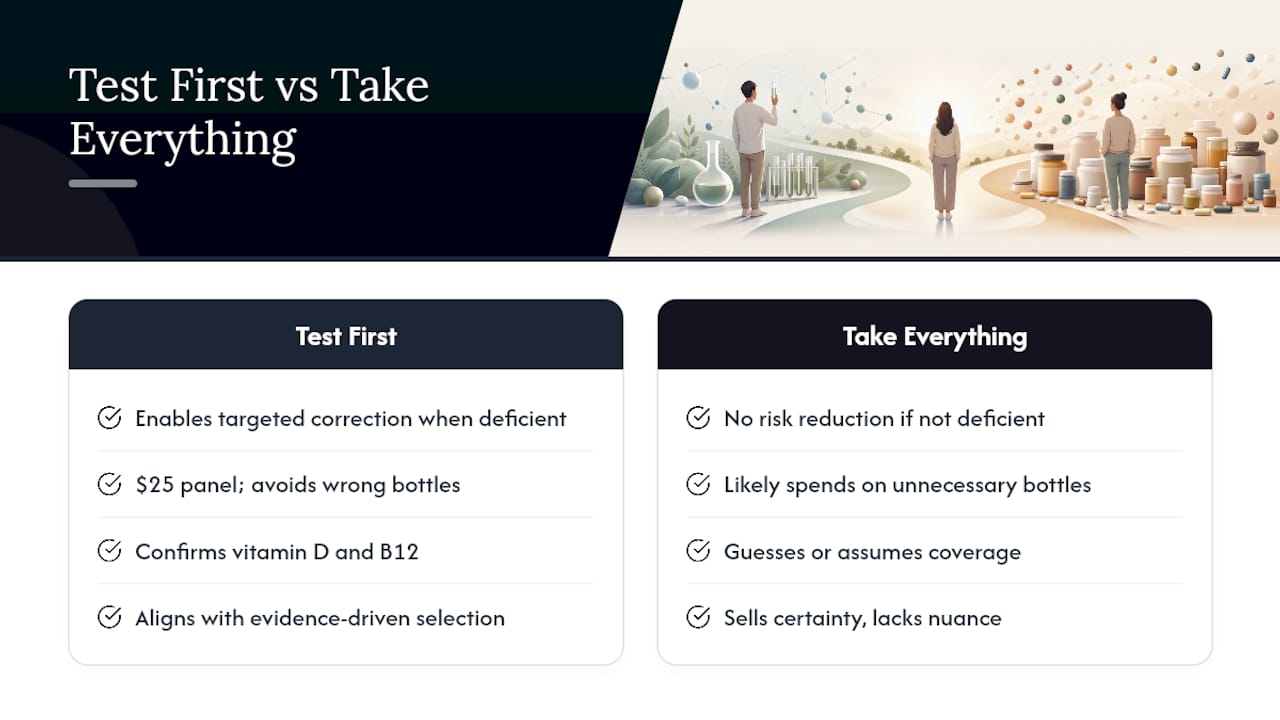
The supplement aisle sells certainty. The evidence sells nuance, and that gap is where most people get it wrong. A well-nourished adult popping a multivitamin every morning isn’t doing much harm, but they’re also not doing what they think they’re doing. The Johns Hopkins review on multivitamin evidence is blunt about it: multivitamins don’t move the needle on heart disease, cancer, or cognitive decline for people who aren’t deficient in anything.
What’s underrated is how much a $25 blood panel changes the entire conversation. Instead of guessing whether you need more vitamin D, you know your number. Instead of assuming B12 is covered, you confirm it. That’s not caution for caution’s sake, it’s just better information before spending money on the wrong bottle. Nutribliss’s own approach, tagged #nutribliss across its formulation notes, leans the same direction: test, confirm, then choose a formula that matches what your body actually needs.
Where to Find Transparent, Third-Party Tested Vitamins
If you’ve confirmed a gap through diet review or a lab test, Nutribliss builds its multivitamins around exactly the criteria this article just walked through: full-dose transparency, no vague “proprietary blends,” and life-stage formulas instead of one-size-fits-all capsules.

The Nutribliss science page lays out the formulation reasoning behind each product, and the multivitamin for men and multivitamin for women are built for exactly the life-stage differences covered above, without the extra iron or unnecessary fillers that trip people up on generic formulas. If zinc or magnesium came up as gaps in your own review, the zinc and magnesium breakdown is worth a read before you buy. Visit the Nutribliss store to compare formulas against your own test results, and talk to your clinician about which one, if any, actually fits.
Frequently Asked Questions
What are the good vitamins to take daily for most healthy adults? Vitamin D is the one most adults should discuss with a clinician, given how common low levels are. Beyond that, daily supplementation should follow a documented gap, not a blanket routine.
Is a daily multivitamin necessary if I eat a balanced diet? Not usually. Evidence reviewed by Johns Hopkins shows multivitamins don’t reduce disease risk in people who are already well-nourished.
Which vitamins support immune function specifically? Vitamin C, vitamin D, and zinc show up most consistently in immune function research, though correcting an actual deficiency matters more than loading up when levels are already normal.
How do I know if I need iron supplements? Only through blood work, specifically ferritin and iron studies. Iron overload carries real risks, so this is not one to guess on.
Are there risks to taking too many vitamins? Yes, particularly with fat-soluble vitamins A, D, E, and K, which build up in the body over time. Tolerable Upper Intake Levels exist for exactly this reason.
This article is general information, not a substitute for advice from a qualified doctor. Consult a qualified healthcare professional about your own circumstances before acting on anything here.
Sources
- Dietary Guidelines for Americans (2025–2030)
- Multivitamin/mineral Supplements - Consumer
- Is There Really Any Benefit to Multivitamins? - Johns Hopkins Medicine
- The immune system as a guardian of health: micronutrient support and lifelong protection - Frontiers (2026)
- Evidence review / meta-analytic summaries on vitamins and health outcomes (NCBI Bookshelf)