

TL;DR:
- Nutribliss’s probiotic offers clinically supported strains, guaranteed CFU at shelf life, and third-party testing for quality. It is recommended for healthy adults seeking targeted gut health support with proven strain-specific benefits. Proper selection involves verifying strain evidence, label transparency, and adherence to storage and testing standards.
For most healthy adults, Nutribliss’s daily probiotic formulation is the clearest starting point for gut health support. It combines clinically studied strains, a CFU count verified at end of shelf life, shelf-stable packaging, and independent third-party testing. That combination is rarer than most supplement labels suggest.
Start with one capsule taken alongside your largest meal. Give it several weeks before judging results. In the initial period, mild gas or bloating is normal as your gut microbiome adjusts.
- Strain identity listed to the subspecies level (e.g., Lactobacillus rhamnosus GG, not just “Lactobacillus”)
- CFU count guaranteed at end of shelf life, not just at manufacture
- Third-party testing by an independent lab (NSF, USP, or equivalent)
- Structure-function claims only, consistent with FDA DSHEA rules
The International Scientific Association for Probiotics and Prebiotics (ISAPP) and the American Gastroenterological Association (AGA) both emphasize that no single probiotic works for every person or condition. Nutribliss’s formulation is built around that reality.
Pro Tip: Write down your primary symptom before you start. Bloating? Irregular transit? Antibiotic recovery? Naming it helps you pick the right strain and judge whether the product is actually working after four weeks.
Table of Contents
- How do probiotics actually work in your gut?
- Which probiotic strains have real evidence for gut outcomes?
- How do you choose the right probiotic product?
- Who should be cautious with probiotics?
- How long does it take for a probiotic to work?
- Nutribliss’s recommended daily probiotic for gut health
- Key Takeaways
- A note on what the evidence actually demands
- Nutribliss: gut health supplements built on evidence, not marketing claims
- Useful sources and further reading
How do probiotics actually work in your gut?
Probiotics are live microorganisms that, when consumed in adequate amounts, confer a health benefit on the host. That definition, established by ISAPP and adopted by the FDA and World Health Organization, is the standard the supplement industry is held to, even if labels rarely quote it directly.
The mechanisms behind that benefit are more specific than most marketing copy admits:
- Competitive exclusion: beneficial strains crowd out pathogens by occupying receptor sites and consuming available nutrients
- Short-chain fatty acid (SCFA) production: fermentation of fiber produces butyrate and other SCFAs that fuel colon cells and reduce inflammation
- Immune modulation: certain strains stimulate cytokine production and regulate mucosal immune responses in strain-specific ways
- Gut barrier reinforcement: some species strengthen tight junctions between intestinal cells, reducing permeability
A 2026 ISAPP-led consensus redefined “gut health” in a way that matters for supplement shoppers:
“A state of normal gastrointestinal function without active gastrointestinal disease and gut-related symptoms that affect quality of life.” The goal of probiotic use, under this framing, is symptom improvement and functional normality, not microbiome “optimization” — a term with no agreed clinical definition.
Under DSHEA, U.S. supplement manufacturers cannot claim their products treat or prevent disease. Labels use structure-function language: “supports digestive health,” not “treats IBS.” That regulatory ceiling is why third-party testing and strain-level transparency matter so much. The FDA acts post-market on supplements, which means the burden of verification falls on the buyer. For a deeper look at how to evaluate what you’re reading on a label, Nutribliss’s 2026 probiotic guide walks through the basics clearly.
Dietary fiber remains the primary lever for microbiome health in most healthy people. Probiotics are targeted tools, not universal daily cures, and the NCCIH makes that distinction explicit in its reviews.
Which probiotic strains have real evidence for gut outcomes?
Evidence is strain-specific and indication-specific. A strain proven effective for antibiotic-associated diarrhea (AAD) cannot be assumed to help with IBS or constipation. That’s the single most important thing to understand before buying any probiotic. The ISAPP clinical guide puts it plainly: clinicians should consult strain-level human trial evidence, not species-level generalizations.

Meta-analyses that pool different strains often obscure this. A review showing “probiotics reduce IBS symptoms” may combine ten different organisms with ten different mechanisms. The signal gets diluted.
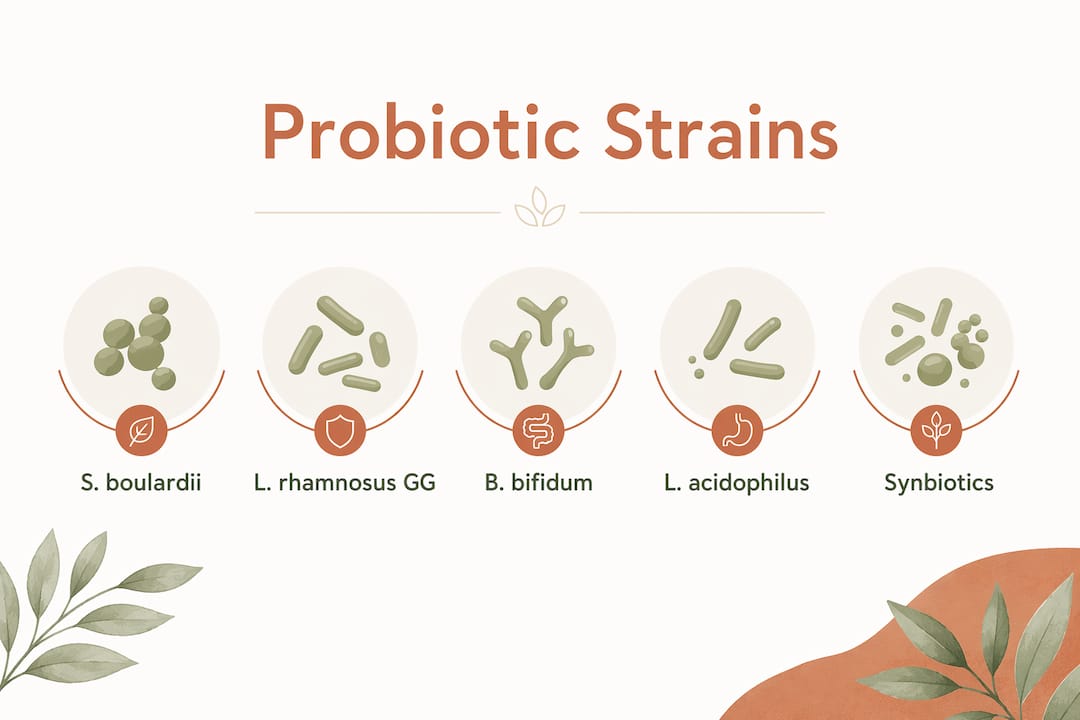
| Strain / Formulation | Primary Indication | Evidence Level | Typical Effective Dose |
|---|---|---|---|
| Saccharomyces boulardii I-745 | Antibiotic-associated diarrhea (AAD) | Strong (multiple RCTs) | — |
| Lactobacillus rhamnosus GG | AAD, pediatric acute diarrhea | Strong (multiple RCTs) | 10–20 billion CFU/day |
| Bifidobacterium lactis (various strains) | Constipation, transit time | Moderate (RCTs) | 1–10 billion CFU/day |
| Lactobacillus plantarum | IBS bloating, flatulence | Moderate (RCTs) | 10–20 billion CFU/day |
| Bifidobacterium infantis | IBS abdominal pain, bloating | Moderate (RCTs) | 1 billion CFU/day |
| Bifidobacterium breve / B. longum | IBS pain scores | Moderate (meta-analysis) | Varies by product |
| Multi-strain synbiotic blends | General gut function, IBD (ulcerative colitis) | Variable; condition-specific | Product-dependent |
A PLOS ONE practical guide on choosing probiotics confirms that S. boulardii I-745 and specific Lactobacillus/Bifidobacterium formulations have the most consistent evidence for AAD prevention. For IBS, a meta-analysis of 23 RCTs in 2,575 patients found probiotics reduced the risk of persistent IBS symptoms by 21%, though the quality of individual studies was low and no single combination outperformed others.
The World Gastroenterology Organisation (WGO) recommends synbiotics (combined probiotic and prebiotic) in select cases, particularly where prebiotic substrates can amplify probiotic colonization.
Pro Tip: When reading a label, look for the full strain designation: genus, species, and strain code (e.g., “GG” in L. rhamnosus GG). A label that says only “Lactobacillus acidophilus” with no strain code cannot be matched to any specific clinical trial. That’s a red flag.
How do you choose the right probiotic product?
The answer is a six-point checklist, applied in order of importance. Skip any item and you’re buying on marketing, not evidence.
- Strain evidence match: Confirm the exact strain(s) on the label appear in human clinical trials for your specific goal. Use the ISAPP clinical guide or the NIH Office of Dietary Supplements fact sheet to cross-reference.
- CFU at end of shelf life (EoSL): The FDA’s draft guidance on live microbial labeling makes clear that CFU declared at manufacture can be meaningless by the time you open the bottle. Look for “CFU guaranteed through expiration” or equivalent language.
- Formulation and delivery: Capsules with enteric coating or moisture-barrier packaging protect strains through stomach acid. Powders are convenient but often degrade faster. Synbiotics (probiotic + prebiotic in one product) may offer added benefit for specific conditions per the WGO.
- Third-party testing: Under DSHEA, manufacturers bear responsibility for safety and label accuracy, but the FDA rarely inspects pre-market. NSF International, USP, or independent lab certification confirms that what’s on the label is in the bottle. This is non-optional for a quality purchase. Nutribliss’s guide to third-party tested supplements explains exactly what to look for on a certificate.
- Storage requirements: Some strains require refrigeration; others are shelf-stable. A shelf-stable product that doesn’t need cold-chain shipping is more practical for most people and less likely to arrive degraded.
- Price per effective serving: Divide the monthly cost by the number of servings. A 60-count bottle at $40 is $0.67/serving. Compare that to the trial dose in the relevant study. If the label CFU is half the trial dose, the effective cost doubles.
For AAD prevention, prioritize S. boulardii I-745 or L. rhamnosus GG, started the same day as the antibiotic course. For general gut maintenance in a healthy adult, a shelf-stable multi-strain product with documented EoSL CFU and third-party testing is the practical default. The Frontiers regulatory review notes that probiotic foods, dietary supplements, and live biotherapeutics face different regulatory pathways, which explains why clinical-grade products cost more and why label transparency varies so widely across categories.

Who should be cautious with probiotics?
Most healthy adults tolerate probiotics without issue. The typical early side effects are mild gas and bloating in the first one to two weeks, as the gut microbiome adjusts to new microbial input. These usually resolve on their own. Taking the supplement with food rather than on an empty stomach tends to reduce them.
The risk picture changes for specific populations. The AGA and clinical literature consistently flag three groups where caution is warranted:
The American Gastroenterological Association advises that probiotics should be used cautiously in high-risk populations, including premature infants, people who are severely immunocompromised, and individuals with central venous catheters. In these groups, rare but serious infections — including bacteremia and fungemia — have been reported in association with probiotic use.
If you’re in any of those categories, or if you’re managing an active gastrointestinal disease like Crohn’s, consult a gastroenterologist before starting any probiotic. The AGA’s guidance is explicit that broad probiotic recommendations are not supported by current evidence for most clinical GI conditions.
On the product side, third-party testing and sterile manufacturing practices are the clearest safety signals available to consumers. Look for lot-specific testing records, not just a generic “tested” badge. A product that can’t provide a certificate of analysis on request is one to skip.
This article is general information, not medical advice. Confirm current guidelines with a qualified clinician for your specific situation.
How long does it take for a probiotic to work?
The honest answer: it depends on what you’re trying to achieve. For AAD prevention, the relevant window is the duration of the antibiotic course plus a few days after. For IBS symptom relief, most trials run 8–10 weeks before measuring outcomes. For general gut comfort, many people notice changes in bloating or transit within two to four weeks, but individual responses vary considerably.
A practical timeline:
- Days 1–14: Mild adjustment symptoms (gas, bloating) are common and expected. No meaningful efficacy signal yet for chronic conditions.
- Weeks 4–8: The window most clinical trials use to measure IBS and constipation outcomes. If you see no change by week eight, the strain may not match your indication, or the dose may be below the trial threshold.
- 3+ months: Relevant for sustained microbiome shifts and longer-term outcomes. Some probiotic benefits for fitness and gut health accumulate over this timeframe when combined with a fiber-rich diet.
The NCCIH confirms that evidence for probiotics reducing AAD risk is among the most consistent in the field, with benefit relevant within the antibiotic treatment window itself. Evidence for longer-term microbiome “optimization” in healthy adults is much thinner.
On cost: quality probiotic supplements in the U.S. vary widely in price depending on formulation and testing assurances. If the label CFU matches the trial dose and third-party testing is confirmed, the cost may represent fair value. If the CFU falls short of the trial dose, the product may not replicate study results.
When to stop or switch: if you’ve completed a full eight-week trial with no symptom improvement and no side effects, the strain is likely not the right match. Switch to a product with a different strain profile targeting your specific indication, or consult a clinician before continuing.
Nutribliss’s recommended daily probiotic for gut health
Nutribliss recommends its daily probiotic formulation for healthy adults seeking evidence-aligned gut support: a multi-strain capsule with CFU guaranteed at end of shelf life, shelf-stable packaging, and independent third-party testing.
| Spec | Details |
|---|---|
| Strains included | Multi-strain blend including Lactobacillus and Bifidobacterium species with full strain ID on label |
| CFU (end of shelf life) | Guaranteed through expiration date |
| Formulation | Capsule, enteric-coated for acid protection |
| Storage | Shelf-stable; no refrigeration required |
| Third-party testing | Independent lab verified; certificate of analysis available |
| Regulatory compliance | DSHEA-compliant structure-function claims only |
Usage instructions:
- Take one capsule daily with your largest meal to reduce early GI adjustment symptoms
- Consistency matters more than timing: same time each day builds habit and maintains steady microbial input
- Pair with a fiber-rich diet; fiber is the primary substrate that supports beneficial gut bacteria between doses
- Allow 4–8 weeks for a fair assessment of gut symptom changes
Trust signals:
- Strain identities listed to subspecies level on the label
- CFU declared at end of shelf life, not manufacture date
- Third-party lot testing confirms label accuracy and absence of contaminants
- Formulated in line with Nutribliss’s science approach, which prioritizes evidence-based ingredient selection
The advantages of probiotics for digestive health are real, but only when the product delivers what the label promises. That’s the standard Nutribliss holds its formulations to.
Browse the full Nutribliss supplement collection to find the right fit for your gut health goals.
Key Takeaways
Strain identity, CFU at end of shelf life, and third-party testing are the three non-negotiable criteria for any probiotic worth buying.
| Point | Details |
|---|---|
| Match strain to indication | No single strain treats every condition; use ISAPP or NIH resources to confirm trial evidence for your goal. |
| Demand EoSL CFU disclosure | CFU at manufacture is unreliable; only end-of-shelf-life guarantees reflect what you actually consume. |
| Verify third-party testing | DSHEA puts label accuracy on manufacturers; independent lab certification is the consumer’s primary safety check. |
| Trial for 4–8 weeks minimum | Most gut symptom outcomes in clinical trials are measured in a timeframe of roughly two months or more; shorter trials may not provide a clear indication of effectiveness. |
| Nutribliss daily probiotic | Multi-strain, shelf-stable, EoSL-guaranteed, third-party tested — built to the criteria this article outlines. |
High-risk individuals (severely immunocompromised, premature infants, those with central venous catheters) should consult a clinician before using any probiotic.
#nutribliss
A note on what the evidence actually demands
There’s a version of probiotic advice that sounds responsible but quietly misleads: the “just take a probiotic for gut health” recommendation with no strain name, no CFU figure, and no mention of what the clinical trials actually tested. It’s everywhere. It sells products. It doesn’t serve the person buying them.
What the evidence actually demands is specificity. The ISAPP clinical guide, the AGA guidelines, and the NIH fact sheet all converge on the same point: strain identity and dose matching are what separate a product with a plausible mechanism from one with a documented outcome. A label that lists “Lactobacillus acidophilus” with no strain code and a CFU count measured at manufacture is not a clinical product. It’s a marketing product dressed in scientific language.
The other thing most probiotic articles understate is the diet-first reality. Fiber intake shapes the microbiome more reliably than any supplement for most healthy people. Probiotics are genuinely useful for specific, evidence-backed needs: AAD prevention, targeted IBS symptom relief, post-antibiotic recovery. For a healthy adult with no specific GI complaint, a fiber-rich diet does more than a daily capsule. That doesn’t make probiotics useless. It makes them a targeted tool, which is exactly how Nutribliss frames its recommendations.
The readers who get the most from a probiotic are the ones who start with a specific symptom, match it to a strain with trial evidence, choose a product that guarantees EoSL CFU, and give it a full eight weeks. That’s not complicated. But it requires ignoring a lot of label copy designed to make the decision feel simpler than it is.
Nutribliss: gut health supplements built on evidence, not marketing claims
If you’ve read this far, you know what separates a probiotic worth buying from one that just looks good on a shelf. Nutribliss supplements are formulated to meet exactly those criteria: strain-specific selection, CFU guaranteed at end of shelf life, shelf-stable packaging, and independent third-party testing.

The Nutribliss daily probiotic is the practical choice for health-conscious adults who want gut support grounded in clinical evidence rather than label hype. Every formulation is built against the same standard this article outlines, and the science behind the approach is published on the site for anyone who wants to verify it.
Ready to start? Browse the full Nutribliss supplement range, pick the formulation that matches your gut health goal, and give it a fair eight-week trial. That’s the evidence-based way to do it.
Useful sources and further reading
These are the primary references behind the recommendations in this article. Each is worth reading at the strain-level detail if you’re making a clinical or purchasing decision.
- ISAPP Clinical Guide to Probiotic Products Available in the USA: The most practical clinician-facing resource for matching specific products to indications. Updated regularly; lists exact strain codes and trial evidence by condition.
- NIH Office of Dietary Supplements — Probiotics Health Professional Fact Sheet: Comprehensive review of mechanisms, strain-specific outcomes, and safety data. The IBS meta-analysis data cited in this article comes from this source.
- NCCIH — Probiotics: Usefulness and Safety: Plain-language summary of what the evidence supports and where it falls short; useful for setting realistic expectations.
- World Gastroenterology Organisation Practice Guideline (2023): Covers synbiotics, prebiotics, and strain-specific recommendations for GI conditions. Includes a summary table of evidence by indication.
- ISAPP Consensus Statement on Gut Health (2026): The definition of “gut health” used in this article comes from this expert panel consensus, published in Nature Reviews Gastroenterology & Hepatology.
- PLOS ONE — Choosing an Appropriate Probiotic Product (Evidence-Based Practical Guide): Practical framework for matching products to patients; the source for S. boulardii I-745 and L. rhamnosus GG AAD evidence cited here.
- Frontiers in Microbiology — Regulatory Landscape of Probiotics (2023): Explains why regulatory category (food vs. supplement vs. live biotherapeutic) affects evidence expectations, label claims, and pricing.
Check publication dates on each source and verify strain-level details directly in the original studies before making clinical decisions.