

TL;DR:
- Vitamin supplementation should target individual nutritional gaps based on diet, life stage, and lab-confirmed deficiencies. The most essential supplements include vitamin D, folic acid, and B12, with safety and quality verified through third-party certification. Regular testing and personalized assessment are crucial for safe, effective, and tailored vitamin use.
Vitamin supplementation is most effective when matched to your individual nutritional gaps, not taken as a universal fix. Knowing what vitamin supplements should I take starts with three factors: your diet quality, your life stage, and any confirmed deficiencies from lab work. Dietary guidelines confirm that most people eating a varied, nutritious diet do not need supplements at all. The exceptions are real and significant. Pregnancy, older age, veganism, and limited sun exposure all create specific needs that food alone often cannot meet.
What vitamin supplements should i take based on my needs?
The answer depends entirely on who you are. A 28-year-old woman planning a pregnancy has completely different needs than a 65-year-old man with low sun exposure. Below are the most commonly recommended supplements, organized by the groups most likely to benefit.
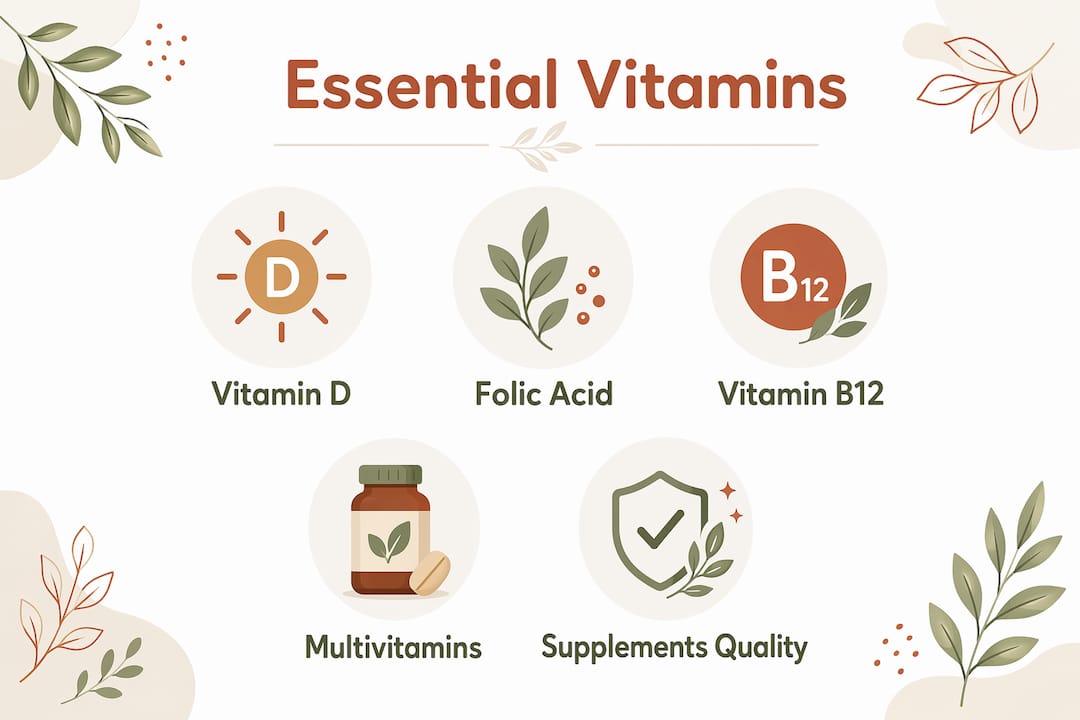
Vitamin d: the most widely needed supplement
Vitamin D deficiency is one of the most common nutrient gaps in the developed world. 400 IU daily is the standard recommendation when dietary intake falls short, with greater urgency after age 50. The NHS also advises that everyone over age 1 consider a daily vitamin D supplement during winter months to maintain healthy levels. This matters because very few foods contain meaningful amounts of vitamin D naturally. Fatty fish, egg yolks, and fortified dairy are the main sources, and most people do not eat enough of them consistently.

Folic acid: non-negotiable before and during pregnancy
Folic acid is the supplement with the clearest, most evidence-backed recommendation for a specific group. 400 mcg daily is advised for all adults and adolescents who could become pregnant, specifically to prevent neural tube defects. Higher-risk individuals may need more, as confirmed by Health Canada’s 2026 guidelines. Timing is critical here. Folic acid must be taken before conception, not just after a positive pregnancy test, because neural tube development begins in the first weeks of pregnancy.
Vitamin b12: a must for vegetarians and vegans
B12 is found almost exclusively in animal products. Vegetarians and vegans face a genuine risk of deficiency over time, and B12 supplementation is one of the clearest cases where lab-confirmed gaps make supplementation directly beneficial. Older adults are also at risk because stomach acid production declines with age, reducing B12 absorption from food. A sublingual or methylcobalamin form is often better absorbed than standard cyanocobalamin tablets.
Other commonly recommended supplements
The following groups and nutrients round out a practical health supplements checklist:
- Calcium: Adults over 50, especially women, often fall short of the 1,200 mg daily target from food alone.
- Iron: Recommended for pregnant individuals and those with confirmed iron-deficiency anemia. Do not supplement iron without a blood test.
- Omega-3 fatty acids: Beneficial for those who rarely eat fatty fish. Look for EPA and DHA forms, not just ALA.
- Iodine: Relevant for pregnant women and those avoiding iodized salt or dairy.
| Supplement | Who Benefits Most | Standard Guidance |
|---|---|---|
| Vitamin D | Adults over 50, low sun exposure | 400 IU daily; test levels first |
| Folic Acid | Anyone who could become pregnant | 400 mcg daily before conception |
| Vitamin B12 | Vegans, vegetarians, older adults | Sublingual or methylcobalamin form |
| Iron | Pregnant individuals, confirmed deficiency | Blood test required before use |
| Omega-3 | Low fish intake | EPA + DHA combined form |
How do you know if you actually need supplements?
The most reliable way to identify a deficiency is a blood test ordered by your doctor or a registered dietitian. Self-diagnosing based on symptoms alone is unreliable because fatigue, brain fog, and muscle weakness overlap with dozens of conditions. Confirmed deficiencies are where supplements deliver the greatest benefit. Taking supplements without that confirmation is often unnecessary and occasionally harmful.
Start your self-assessment with these steps:
- Audit your diet honestly. Track what you eat for one week using an app like Cronometer or MyFitnessPal. Look for consistent gaps in food groups.
- Identify your life stage. Pregnancy, breastfeeding, menopause, and older age all shift nutrient requirements significantly.
- Note any medical conditions. Celiac disease, Crohn’s disease, and bariatric surgery all impair nutrient absorption and create specific supplement needs.
- Request lab work. Ask your doctor for a panel that includes vitamin D (25-OH), B12, ferritin, and folate at minimum.
- Reassess annually. Needs change as your diet, health, and age change. A supplement that made sense at 35 may be unnecessary at 45.
Pro Tip: If you are planning a pregnancy, start folic acid at least three months before you try to conceive. Neural tube formation happens before most people know they are pregnant, making preconception timing the single most important factor in folic acid effectiveness.
Are there real risks to taking vitamin supplements?
Yes, and they are more common than most people realize. High doses of vitamins A and E may be harmful, and the evidence that multivitamins prevent heart disease or cancer remains limited. Fat-soluble vitamins, specifically A, D, E, and K, accumulate in body tissue and can reach toxic levels. Water-soluble vitamins like C and B-complex are generally safer in excess, but they are not risk-free at very high doses.
Vitamin D is the most misunderstood case. Many people assume more is better, but over-supplementation causes toxicity and increases fall risk in older adults. The safe upper limit is 4,000 IU per day for most adults. Exceeding that without medical supervision is not a wellness strategy. It is a risk.
“Testing vitamin D status and adjusting doses carefully is safer than arbitrarily increasing supplementation doses.” — Harvard Health, 2026
Additional safety considerations worth knowing:
- Iron and calcium compete for absorption. Take them at different times of day if you need both.
- Vitamin K interacts with warfarin. Anyone on blood thinners must consult a doctor before supplementing K.
- Zinc in high doses suppresses copper absorption. Long-term zinc supplementation without copper monitoring causes deficiency.
- Proprietary blends hide individual doses. If a label lists a “blend” without specific amounts, you cannot verify safety.
For a structured approach to avoiding these pitfalls, the supplement safety checklist from Nutribliss covers the key steps for 2026.
How to choose quality vitamin supplements
The FDA does not evaluate supplements for safety or effectiveness before they reach store shelves. That regulatory gap is the most important thing to understand when learning how to pick vitamins. Third-party certifications from organizations like USP (United States Pharmacopeia), NSF International, and ConsumerLab are your primary protection. These certifications confirm that a product contains what the label claims, at the stated dose, without harmful contaminants.
Pro Tip: Look for the USP Verified or NSF Certified for Sport seal on the bottle. These are not marketing badges. They represent independent lab testing that the manufacturer paid for voluntarily, which signals a higher standard of accountability.
When reading a supplement label, check these elements:
- Serving size and dose: Confirm the dose per serving matches clinical recommendations, not just a percentage of daily value.
- Form of the nutrient: Magnesium glycinate absorbs better than magnesium oxide. Methylfolate is more bioavailable than folic acid for some people. Form matters.
- Inactive ingredients: Fillers, binders, and artificial colors are worth avoiding if you have sensitivities.
- Expiration date: Potency degrades over time. A supplement past its date is not necessarily dangerous, but it may be less effective.
| Label Feature | What to Look For | Red Flag |
|---|---|---|
| Third-party seal | USP, NSF, or ConsumerLab | No certification at all |
| Nutrient form | Methylcobalamin, glycinate forms | Oxide or cyanocobalamin only |
| Dose clarity | Exact mg or mcg per serving | “Proprietary blend” with no amounts |
| Manufacturer info | Full address and contact | Vague or missing company details |
For deeper guidance on evaluating supplement quality, Nutribliss has a detailed breakdown of what to look for before you buy.
Practical supplement strategies by life stage
Your supplement needs are not static. They shift with age, diet changes, and health events. Here is a practical framework for the most common life stages:
- Children and teens: Most healthy children eating a varied diet do not need supplements. Vitamin D is the exception, particularly in northern climates or for children with limited outdoor time.
- Adults aged 18–49: Focus on confirmed gaps. A basic panel checking vitamin D, B12, and ferritin is a reasonable starting point. Folic acid is mandatory for anyone who could become pregnant.
- Pregnant and breastfeeding individuals: A prenatal vitamin covering folate, iron, iodine, and DHA is the standard recommendation. Start before conception, not after.
- Adults aged 50 and older: Vitamin D needs increase. B12 absorption declines. Calcium becomes more relevant, especially for women post-menopause. The role of supplements in aging shifts toward maintenance rather than correction.
- Vegans and vegetarians: B12 is non-negotiable. Vitamin D, omega-3 (algae-based DHA), iron, zinc, and iodine all warrant monitoring through annual blood work.
- Seasonal adjustments: Vitamin D needs increase in winter for most people living above 35 degrees latitude, where sun exposure is insufficient for skin synthesis from october through march.
The guide to daily vitamin intake is not one-size-fits-all. Revisit your supplement plan whenever your diet changes significantly, you move to a different climate, or you enter a new life stage.
Key takeaways
The most effective approach to vitamin supplementation is targeted, lab-confirmed, and adjusted by life stage rather than based on general wellness trends.
| Point | Details |
|---|---|
| Personalization over universal use | Base supplement choices on your diet, life stage, and confirmed deficiencies, not general advice. |
| Core supplements with clear evidence | Vitamin D, folic acid, and B12 have the strongest evidence for specific groups. |
| Safety requires dose awareness | Fat-soluble vitamins accumulate in tissue; never exceed upper intake limits without medical guidance. |
| Quality certification matters | Look for USP, NSF, or ConsumerLab seals to verify label accuracy and purity. |
| Reassess regularly | Supplement needs change with age, diet shifts, and health conditions. Annual lab work keeps your plan current. |
Why i think most people are supplementing backwards
Most people I see approach supplementation the wrong way. They start with a product and work backward to justify it, rather than starting with a confirmed need and finding the right product to fill it. That backwards approach is how someone ends up taking a high-dose multivitamin that delivers 300% of the daily value for vitamin A while doing nothing for their actual B12 deficiency.
The research backs this up. Multivitamins often lack sufficient levels of individual vitamins needed for specific deficiencies. A one-a-day pill feels reassuring, but it rarely solves a real problem. What actually works is getting a blood panel, identifying the gap, and taking a targeted single-nutrient supplement at a clinically relevant dose.
I have also seen the other extreme: people who research supplements obsessively and end up taking 12 different products daily without any professional oversight. That is not wellness. That is a recipe for interactions, toxicity, and wasted money. The vitamin D safety data from Harvard Health is a perfect example of how a genuinely useful nutrient becomes a liability when people assume more is always better.
My honest recommendation: get tested first, supplement second. Use food as your primary source of nutrients. Add supplements only where food consistently falls short. And buy products with third-party certification so you know what you are actually taking.
— GAURAV
Build your supplement plan with Nutribliss
Knowing what you need is only half the equation. Finding products that actually deliver what the label promises is the other half.

Nutribliss is built around that second half. Every product in the Nutribliss lineup is developed with a science-first approach, and the science behind each formula is documented and accessible. Whether you are looking for vitamin D, B12, prenatal support, or omega-3s, Nutribliss offers targeted options designed for specific needs rather than generic wellness claims. Browse the full Nutribliss supplement collection to find products matched to your life stage, dietary needs, and health goals. Use #nutribliss to share your supplement journey and connect with others making evidence-based choices.
FAQ
What vitamins do most adults actually need?
Most adults benefit from vitamin D if sun exposure is limited, and B12 if they follow a plant-based diet. Beyond those, needs depend on diet quality and confirmed deficiencies from lab work.
Is it safe to take a multivitamin every day?
A standard multivitamin is generally safe, but limited evidence supports its ability to prevent major diseases. High-dose formulas containing vitamins A and E carry real risks and should be avoided without medical guidance.
When should i start taking folic acid?
Start folic acid at least three months before trying to conceive. Neural tube defects develop in the first weeks of pregnancy, often before a positive test result.
How do i know if a supplement brand is trustworthy?
Look for third-party certifications from USP, NSF International, or ConsumerLab. These organizations independently verify that a product contains what its label claims at the stated dose.
Can i take too much vitamin d?
Yes. The safe upper limit is 4,000 IU per day for most adults. Exceeding that level causes toxicity and, in older adults, increases fall risk. Always test blood levels before increasing your dose.