

Choose your omega-3 supplement by its combined EPA+DHA per serving, verified purity from a named third-party certifier, and a serving size you’ll realistically take every day. Those three filters cut through most of the label noise before you even open the bottle.
Before you read further, run these checks:
- EPA+DHA per serving: Find the Supplement Facts panel, add the EPA and DHA lines. Ignore the front-label “fish oil” milligrams entirely.
- Chemical form: Triglyceride or re-esterified triglyceride (rTG) forms generally absorb better than ethyl esters.
- Third-party certification: Look for a named badge: IFOS, NSF, USP, or ConsumerLab. “Third-party tested” with no logo is a weaker claim.
- Expiration date and storage guidance: A product with no expiry printed or no refrigeration note after opening is a freshness red flag.
- Serving burden: Count how many capsules deliver the stated dose. Four capsules per day is a compliance problem waiting to happen.
- Price per effective dose: Divide the bottle price by the number of servings, then by the EPA+DHA per serving. The cheapest bottle is rarely the best value.
Prioritizing EPA+DHA content over the headline fish-oil weight is the single move that most reliably prevents you from buying a weak or already-oxidized product.
Key Takeaways
The single most important rule when choosing an omega-3 supplement: calculate EPA+DHA per serving from the Supplement Facts panel, verify purity with a named third-party certification, and confirm the product is fresh before you buy.
| Point | Details |
|---|---|
| EPA+DHA per serving is the only number that matters | Add EPA and DHA from the Supplement Facts panel; ignore the front-label fish oil weight. |
| Chemical form affects absorption | Triglyceride and re-esterified triglyceride forms absorb better than ethyl ester, especially at higher doses. |
| Named certifications beat generic claims | IFOS, NSF, USP, or ConsumerLab badges are verifiable; “third-party tested” with no logo is not. |
| Freshness is a safety and potency issue | A sharp or sour fishy smell means oxidation; check expiry and store in a cool, dark place after opening. |
| Nutribliss supplements | Formulations with disclosed EPA+DHA, third-party verification, and COA access available at nutribliss.us. |
Table of Contents
- What are EPA, DHA, and ALA, and why do EPA and DHA matter most?
- Which supplement source is right for you: fish oil, krill, algal, or plant-based?
- Does the chemical form of omega-3 affect how well you absorb it?
- How to read the supplement label and calculate actual EPA+DHA per serving
- Purity, contaminants, and freshness: what actually matters
- Which third-party certifications actually mean something?
- How diet, allergies, and ethics should guide your source choice
- Who should talk to a clinician before starting omega-3 supplements?
- A practical buying checklist for in-store or online shopping
- What does the clinical evidence actually say about dosing?
- An editorial perspective on what most buyers get wrong
- Nutribliss omega-3 supplements: what to look for and where to start
- Sources
What are EPA, DHA, and ALA, and why do EPA and DHA matter most?
Omega-3 fatty acids are a family of polyunsaturated fats, but not all of them behave the same way in your body. EPA and DHA are the long-chain omega-3s most commonly found in seafood and the ones most studied in clinical trials. ALA, or alpha-linolenic acid, is a shorter-chain omega-3 found in flaxseed, chia, and walnuts.
EPA (eicosapentaenoic acid) is a 20-carbon fatty acid. Most of the research on inflammation, mood, and cardiovascular markers targets EPA specifically. DHA (docosahexaenoic acid) is a 22-carbon fatty acid concentrated in the brain, retina, and sperm cells. It’s the structural fat your nervous system depends on throughout life, and it’s especially critical during fetal development and infancy. ALA is the plant-world entry point: your body can technically convert it to EPA and DHA, but the conversion rate is low enough that ALA-only supplements rarely move the needle on blood EPA or DHA levels.
That conversion gap is why label math focuses on EPA+DHA, not total omega-3s. Salmon and mackerel deliver EPA and DHA directly. Flaxseed oil delivers ALA. Both are omega-3s; only one reliably raises your blood EPA and DHA. The U.S. Dietary Guidelines recommend about 8 ounces of seafood per week for adults partly because of this direct-delivery advantage. When diet falls short, that’s where a well-chosen supplement fills the gap.
Which supplement source is right for you: fish oil, krill, algal, or plant-based?
No single source wins for everyone. The right category depends on your diet, allergies, sustainability values, and how your stomach handles fish-derived products.
Fish oil is the most studied and cost-effective option for hitting meaningful EPA+DHA doses. It’s derived from oily fish like anchovies, sardines, and mackerel, and it comes in a wide range of concentrations. The main downsides: fishy burps, sustainability concerns with some fisheries, and the fact that it’s off the table for vegans and people with fish allergies.

Krill oil delivers EPA and DHA in phospholipid form, which some research suggests may improve absorption at lower doses. Krill are also lower on the food chain, which means less bioaccumulation of contaminants. The tradeoff is cost: krill oil typically costs more per milligram of EPA+DHA than fish oil, and the absolute dose per capsule is usually lower. For a deeper look at the phospholipid advantage and tolerability data, the Nutribliss guide on krill oil benefits covers the science in detail.
Algal oil is the vegan option and the only plant-derived source that delivers preformed DHA and sometimes EPA. It’s derived from the same microalgae that fish eat, so it bypasses the fish entirely. Algal oil is a reliable vegetarian source of DHA, and some algal products also provide EPA, making it the go-to for vegans, vegetarians, and anyone with a fish or shellfish allergy.
Plant-based ALA sources (flaxseed oil, chia oil, hemp oil) are not equivalent substitutes for EPA+DHA supplements. They’re useful for general dietary fat balance but shouldn’t be your primary omega-3 strategy if you’re targeting specific EPA+DHA outcomes.
- Choose fish oil when cost-effectiveness and dose flexibility matter most and you have no fish allergy.
- Choose krill oil when you want phospholipid-form EPA+DHA and can tolerate the higher price per dose.
- Choose algal oil when you’re vegan, vegetarian, pregnant and avoiding fish, or allergic to shellfish.
- Skip ALA-only supplements if your goal is raising blood EPA+DHA levels.
Pro Tip: If you’re comparing krill to fish oil on price, calculate cost per 500 mg of combined EPA+DHA, not cost per capsule. Krill capsules often contain far less EPA+DHA per capsule than fish oil capsules at the same price point.
Does the chemical form of omega-3 affect how well you absorb it?
Yes, and it’s one of the most overlooked factors when people ask what to look for in an omega-3 supplement. The form determines how efficiently your gut absorbs the fatty acids, and it explains why two products with identical EPA+DHA numbers on the label can perform differently.
Triglyceride (TG) form is the natural form found in fish. It’s well-absorbed, especially with a fatty meal. Re-esterified triglyceride (rTG) is a concentrated, processed version that starts as ethyl ester and is converted back to triglyceride form. Ethyl ester (EE) is the most common form in standard fish oil supplements because it’s cheaper to produce. Absorption is lower than TG forms, particularly in a fasted state. Phospholipid form is what krill oil provides. It’s water-dispersible and may absorb efficiently at lower doses. Free fatty acids (FFA) are another well-absorbed form, though less common in consumer products.
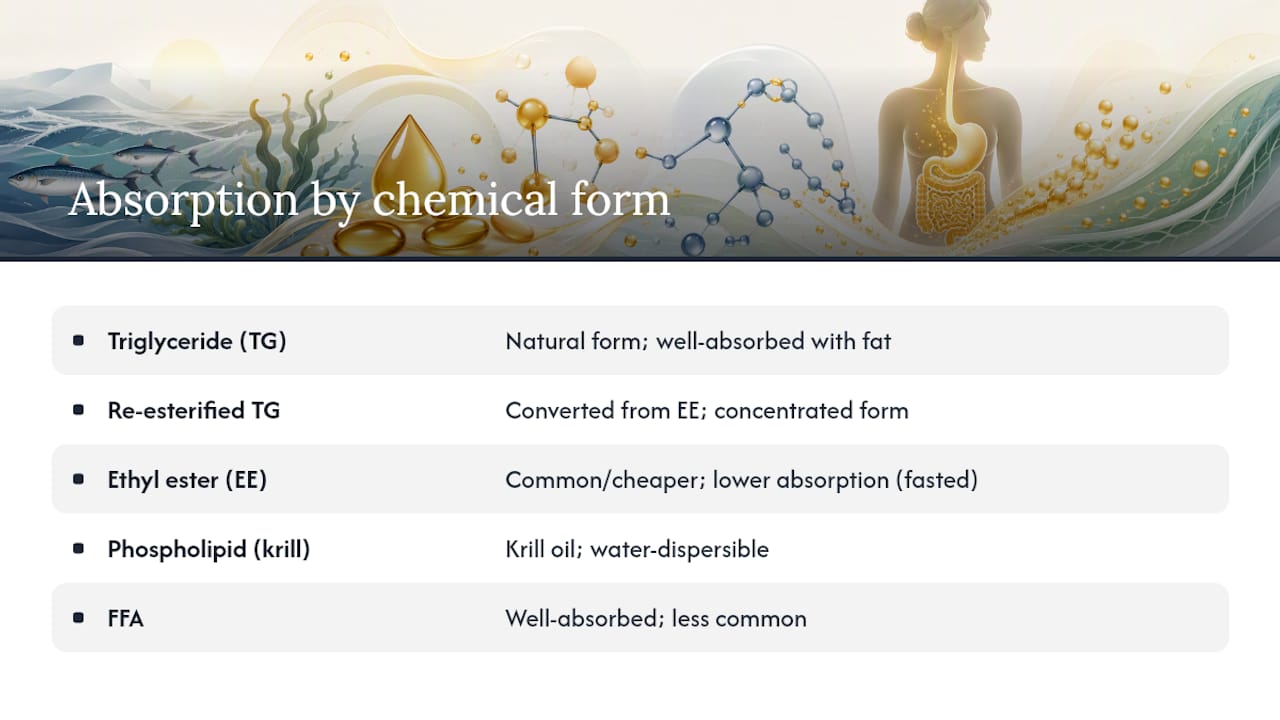
For most healthy adults taking a standard maintenance dose with food, the form difference is modest in practice. Where it matters more: therapeutic doses (2 g or more of EPA+DHA daily), older adults with reduced fat absorption, and anyone taking supplements on an empty stomach. In those cases, paying the premium for rTG or natural TG form is worth it.
Pro Tip: Check the label for “re-esterified triglyceride,” “natural triglyceride,” or “phospholipid” form. If the label just says “fish oil concentrate” with no form specified, it’s almost certainly ethyl ester.
How to read the supplement label and calculate actual EPA+DHA per serving
This is the skill that separates a smart omega-3 buyer from everyone else. Front-of-bottle fish oil milligrams often do not equal EPA+DHA milligrams; the only reliable number is what you calculate from the Supplement Facts panel.
The four-step label math:
- Find the serving size. Note how many capsules or milliliters constitute one serving.
- Locate the EPA and DHA lines. They’re listed separately in milligrams under the Supplement Facts panel.
- Add EPA + DHA. That sum is your functional dose per serving.
- Divide the bottle price by the number of servings, then by the EPA+DHA per serving. That gives you cost per milligram of EPA+DHA, the only apples-to-apples comparison.
Example calculation:
A bottle labeled “1,000 mg Fish Oil” per capsule. You open the Supplement Facts panel and find 180 mg EPA and 120 mg DHA per capsule. Your functional dose per capsule is 300 mg EPA+DHA, not 1,000 mg. To reach 1,000 mg of EPA+DHA, you’d need roughly three to four capsules per day. A bottle of 60 capsules at $20 gives you about 20 servings at that dose, or $1.00 per 1,000 mg EPA+DHA.
The third row shows what a genuinely concentrated product looks like. The first row is a standard-potency product that requires multiple capsules to reach a therapeutic dose.
- Never compare products by the front-label fish oil weight.
- Always check whether the stated dose requires one capsule or four.
- A high capsule burden per day is a real compliance barrier, especially long-term.
Purity, contaminants, and freshness: what actually matters
Fish accumulate environmental contaminants, and omega-3 supplements made from fish carry that risk into the bottle. The main concerns are heavy metals (mercury, lead, arsenic), polychlorinated biphenyls (PCBs), and dioxins. Reputable manufacturers use molecular distillation or other purification processes to reduce these to levels well below regulatory limits. The problem is that “purified” on a label is a marketing claim, not a verified fact, unless a third-party test backs it up.
Oxidation is the other major quality issue. Omega-3 fatty acids are highly unsaturated, which makes them prone to going rancid when exposed to heat, light, or air. Oxidized fish oil loses potency and may cause more GI side effects. Signs of oxidation include a strong or sour fishy smell, discoloration, or a persistent bad aftertaste. A fresh, high-quality fish oil should smell mild and oceanic, not sharp or rotten.
The technical measure of oxidation is the TOTOX value (total oxidation), which combines peroxide value (primary oxidation) and anisidine value (secondary oxidation). IFOS, the International Fish Oil Standards program, uses TOTOX thresholds as part of its certification criteria. A product with a low TOTOX score is meaningfully fresher than one without that data.
Storage recommendations: Keep fish oil in a cool, dark place. Refrigerate after opening if the label recommends it. Never leave a bottle on a sunny windowsill or in a hot car. Check the expiration date before buying, and don’t buy a bottle that expires within three months.
Pro Tip: Open a capsule and smell the oil before committing to a new brand. A mild, slightly oceanic smell is normal. A sharp, sour, or paint-like odor means the oil is already oxidized, regardless of the expiration date.
Which third-party certifications actually mean something?
“Third-party tested” printed on a label means almost nothing without a named organization behind it. Named certifications from recognized testing bodies are a stronger signal than an unnamed claim. Here’s what each major program actually verifies:
- IFOS (International Fish Oil Standards): Tests for EPA+DHA potency, heavy metals, PCBs, dioxins, and TOTOX oxidation scores. One of the most rigorous programs specifically for fish oil. Results are publicly searchable.
- NSF International: Certifies that the product contains what the label claims, screens for contaminants, and verifies manufacturing practices. The NSF Certified for Sport mark also screens for banned athletic substances.
- USP (U.S. Pharmacopeia): Verifies potency, purity, and dissolution (whether the capsule actually breaks down properly). A USP Verified mark is meaningful for both fish oil and other supplements.
- ConsumerLab: An independent subscription-based testing service that purchases products off store shelves and publishes results. Not a certification program, but its reports have caught label mismatches that manufacturers didn’t disclose.
- Clean Label Project: Focuses on contaminant screening, particularly heavy metals and pesticide residues. Useful as a secondary check.
Past independent tests have found mismatches between label claims and measured EPA+DHA in some supplements, which is exactly why a named certification matters. A brand that has paid for IFOS or USP verification has put its product through scrutiny it can’t control.
Verification questions to ask before buying:
- Is there a certificate of analysis (COA) available on the brand’s website or by request?
- Does the COA show EPA+DHA content, heavy metal levels, and oxidation (TOTOX) values?
- Is the certification badge from a named, searchable organization, or is it a generic “tested” claim?
How diet, allergies, and ethics should guide your source choice
Your personal constraints narrow the field faster than any potency comparison. A shellfish-allergic reader and a vegan reader both land on algal oil as the answer, but for different reasons.
For vegans and vegetarians: Algal oil is the only supplement source that delivers preformed EPA and DHA without animal products. Fish oil and krill oil are both off the table. Look for algal oil products that list both EPA and DHA on the label, since some algal products provide only DHA.
For shellfish-allergic individuals: Krill is a crustacean, so krill oil carries a shellfish allergen risk. Fish oil from finfish (anchovy, sardine, mackerel) is generally tolerated by shellfish-allergic people, but confirm with your allergist. Algal oil is the safest option when any doubt exists.
Sustainability: Not all fish oil is sourced equally. Look for certifications from the Marine Stewardship Council (MSC) or Friend of the Sea, which verify that the fish were caught using sustainable practices. Anchovies and sardines are generally lower-impact choices than larger fish species. Krill fisheries are also certified by MSC in some cases, though krill’s role in the Antarctic food web makes some environmental groups cautious.
Capsule shell ingredients: Gelatin capsules are derived from animal collagen (usually pork or beef). Vegan capsules use hydroxypropyl methylcellulose (HPMC) or pullulan. Some vegan softgels use carrageenan as a gelling agent, which some people prefer to avoid. Check the “Other Ingredients” section of the label.
Pro Tip: If you’re buying for someone with multiple allergies, request the full allergen statement from the manufacturer, not just the label. Manufacturing cross-contamination is rarely disclosed on the front label.
Who should talk to a clinician before starting omega-3 supplements?
Most healthy adults can take standard omega-3 doses without concern. But several groups face real risks that make a clinician conversation non-negotiable before starting.
Populations who should consult a clinician first:
- People taking warfarin, heparin, or other anticoagulants: omega-3s may extend bleeding time, which can amplify the drug’s effect.
- People taking NSAIDs (ibuprofen, naproxen) regularly: a similar additive bleeding-time concern applies.
- Anyone scheduled for surgery within two weeks: most surgeons ask patients to stop omega-3 supplements pre-operatively.
- Pregnant and breastfeeding individuals: DHA is critical for fetal brain development, but dose and source matter. Algal oil is often recommended over high-mercury fish sources during pregnancy.
- Children: dosing is weight-dependent and should be guided by a pediatrician.
- People with fish or shellfish allergies: source selection needs medical input.
Common side effects at standard doses include mild GI upset, loose stools, and fishy burps. Taking capsules with food and choosing enteric-coated products reduces these. A persistent fishy aftertaste after swallowing is also a sign the oil may be oxidized.
When discussing omega-3s with your clinician, bring the Supplement Facts label, note the EPA+DHA per serving, and mention any current medications. If you’re targeting a specific therapeutic goal (triglyceride reduction, for example), ask about lab monitoring to track progress.
This article provides general information and is not a substitute for professional medical advice. Confirm dosing and interactions with a qualified healthcare provider.
A practical buying checklist for in-store or online shopping
Use this sequence every time you evaluate a new omega-3 product, whether you’re standing in a pharmacy aisle or scrolling a product page.
- Find the Supplement Facts panel. If it’s not visible on the product page, that alone is a reason to pause.
- Add EPA + DHA per serving. This is your functional dose. Ignore the front-label fish oil weight.
- Check the serving burden. How many capsules or teaspoons deliver that dose? More than two capsules per day is worth noting.
- Identify the chemical form. Look for “triglyceride,” “re-esterified triglyceride,” or “phospholipid.” No form listed usually means ethyl ester.
- Look for a named third-party certification. IFOS, NSF, USP, or ConsumerLab. A COA should be available on request or on the brand’s website.
- Check the expiration date. At least six months of shelf life remaining. Avoid products expiring within three months.
- Calculate cost per effective dose. Price divided by servings, divided by EPA+DHA per serving in grams.
- Check capsule tolerability notes. Enteric coating, gelatin vs. vegan shell, added flavorings.
Quick example: A product labeled “Omega-3 Fish Oil 2,000 mg” at $30 for 60 softgels. The Supplement Facts panel shows 400 mg EPA and 300 mg DHA per 2-capsule serving. That’s 700 mg EPA+DHA per serving, 30 servings per bottle, and $1.00 per 700 mg EPA+DHA. The label says “third-party tested” but shows no logo. That missing certification badge is a reason to look for a COA or choose a certified alternative.
If the label is missing EPA and DHA breakdowns, contact the manufacturer directly. A reputable brand will provide a COA. If they can’t or won’t, choose a different product.
What does the clinical evidence actually say about dosing?
The evidence for omega-3 supplementation is strongest in two areas: triglyceride reduction and certain secondary cardiovascular prevention contexts. For most other conditions, the picture is more mixed.
Authoritative guidance emphasizes seafood first, with supplements as an option under specific clinical circumstances. For readers who want broader context on dietary omega-3 sources, the Nutribliss guide on foods that contain omega-3s covers practical food-first strategies.
Commonly used dose ranges:
- 250–500 mg EPA+DHA per day: General maintenance for adults without specific cardiovascular risk. This is the range most often cited for population-level benefit and aligns with roughly two servings of oily fish per week.
- ~1 g EPA+DHA per day: The range referenced in some cardiovascular guidance for people with existing heart disease or elevated risk.
- 2–4 g EPA+DHA per day: Prescription-level doses used under clinician supervision for significant triglyceride reduction. At these doses, pharmaceutical-grade omega-3 products (icosapentaenoic acid concentrates or EPA+DHA combinations) are typically used rather than standard consumer supplements.
| Goal | Typical EPA+DHA Dose | Evidence Strength |
|---|---|---|
| General maintenance | 250–500 mg/day | Moderate; consistent with dietary guidelines |
| Cardiovascular secondary prevention | ~1 g/day | Moderate; varies by trial and population |
| Triglyceride reduction | 2–4 g/day (clinician supervised) | Strong; FDA-approved prescription products exist |
| Cognitive/mood support | Varies; often 1–2 g/day EPA-dominant | Mixed; promising but not conclusive |
| Pregnancy/fetal development | 200–300 mg DHA/day minimum | Moderate to strong for DHA specifically |
The evidence for triglyceride lowering is the most consistent. For general cardiovascular prevention, results across large trials have been mixed, and the benefit appears most pronounced in people with very low baseline dietary omega-3 intake. For cognitive and mood applications, EPA-dominant formulations have shown more consistent signals than DHA-dominant ones in some studies, but the evidence base is still developing.
An editorial perspective on what most buyers get wrong
Most people shopping for omega-3 supplements spend their time comparing front-label claims and price per bottle. That’s the wrong unit of analysis entirely. The number that matters is EPA+DHA per dollar, calculated from the Supplement Facts panel, not the marketing copy.
There’s also a widespread assumption that a more expensive product is automatically purer or more potent. That’s not reliably true. A $15 bottle with an IFOS certification and 700 mg EPA+DHA per capsule beats a $40 bottle with a vague “third-party tested” claim and 300 mg EPA+DHA per capsule on every metric that actually matters.
The freshness question is underappreciated in most buying guides. An oxidized fish oil supplement isn’t just unpleasant; it may be counterproductive. Rancid lipids can generate compounds that work against the anti-inflammatory effects you’re trying to get. The smell test costs nothing and takes three seconds. Do it.
At Nutribliss, the approach is straightforward: transparent label math, named third-party verification, and honest dosing guidance. That’s what #nutribliss stands for, and it’s the standard we’d apply to any product we’d recommend. For readers who want to go deeper on the science behind supplement formulations, the Nutribliss science page lays out the methodology and evidence standards we use.
Nutribliss omega-3 supplements: what to look for and where to start

If you’ve done the label math and want a product that’s already cleared the checklist, Nutribliss offers omega-3 formulations built around the criteria this article covers: disclosed EPA+DHA per serving, named third-party verification, and clear storage guidance. The Superfoods Collection science page details the formulation rationale and links to product-level testing documentation, so you can review the COA before you buy.
For general maintenance, look for a product delivering at least 500 mg combined EPA+DHA per serving in triglyceride or re-esterified triglyceride form. For higher-dose goals (cardiovascular support or triglyceride management), consult your clinician before selecting a dose above 1 g EPA+DHA per day. Pregnancy, breastfeeding, and pediatric use all require a healthcare provider’s input on dose and source.
Visit Nutribliss to browse current omega-3 offerings, check serving details, and access product documentation directly.